What is a service based business?
Also called: Service business, service company, professional services business, skills-based business

A service based business earns money by doing work for customers, using skills, time or expertise, rather than by making or selling physical products. Examples include consultants, designers, cleaners, coaches, plumbers and agencies.
A service based business earns money by doing something for its customers rather than selling them a physical product. The customer pays for a skill, a result or someone’s time: a haircut, a tax return, a new website, a repaired boiler or an hour of coaching.
A bakery that sells bread is a product business. A wedding planner who organises the day is a service business. Many businesses mix the two, but if most of your income comes from work you or your team do, you run a service business.
Why the service model matters for a small business
Service businesses are often the easiest way to start. You usually need little stock or equipment, so start-up costs are lower, and you can begin with one client and your own skills. That is why so many freelancers, consultants and trades start this way.
The catch is that your time is the product. When you are fully booked, you can’t sell more without raising prices, hiring or changing how you work. Understanding this early helps you price properly and build systems before you burn out.
Types of service based business, with examples
Business-to-business (B2B) services
Work for other businesses: marketing and design agencies, IT support, bookkeeping, recruitment, cleaning contracts for offices. Deals tend to be larger and relationships longer.
Business-to-consumer (B2C) services
Work for individuals: hair and beauty salons, personal trainers, tutors, photographers, event planners. Bookings, reminders and reviews matter a lot here.
Professional services
Work that needs a qualification or licence: accountants, lawyers, architects, therapists. Trust, accuracy and record keeping are central.
Creative and freelance services
Writers, developers, video editors, illustrators and consultants who sell projects or retainers, often to clients in other cities or countries.
Home and field services
Plumbers, electricians, cleaners, solar installers and gardeners who go to the customer. Scheduling, quotes and getting paid on the day are the daily challenges.
How a service based business works: an example
Amara is a freelance brand designer in Nairobi. A typical client journey looks like this:
- A café owner finds her on Instagram and fills in an enquiry form.
- She books a 30-minute discovery call through her booking link.
- She sends a proposal for a logo and brand kit at a fixed price, with 50% upfront.
- The client pays the deposit from the invoice link, and Amara starts a project with three milestones.
- She delivers, collects the final payment and asks for a review and a referral.
Nothing physical changes hands until the files are delivered. Every step depends on clear communication, a record of what was agreed, and getting paid on time.
How service businesses charge
- Hourly or daily rates: simple and fair for open-ended work, but income is capped by your hours. Tracking billable hours becomes essential.
- Fixed-price projects: one price for a defined result. Clients like certainty; you need a clear scope.
- Packages: a named bundle, such as “starter brand kit”, that is easy to explain and repeat.
- Retainers and subscriptions: a monthly fee for ongoing work, which smooths out cash flow.
- Deposits: part-payment at booking, which protects your time and reduces no-shows.
Characteristics of a service business
- You can’t see it before you buy it. Customers rely on reviews, examples and how professional you seem.
- Time is perishable. An empty appointment slot can never be sold again, which is why no-shows hurt.
- Quality depends on people. Two team members may deliver the same service differently, so checklists and standards matter.
- Delivery and the customer overlap. The customer is often present or involved while the work happens.
Best practices and common mistakes
- Charging too little. Price for the result and your expertise, not just the hours. Include time for admin, travel and revisions.
- Working without a written scope. Agree what is and isn’t included before you start, so extra requests become paid extras.
- Running everything from chats. Enquiries, bookings and payment promises get lost in WhatsApp and email. Keep one list of clients and what you owe each other.
- Chasing payment by memory. Send invoices promptly and follow up on a schedule.
- Staying the bottleneck. Write down how you deliver your core service so someone else can help as you grow.
Related terms
A client management system keeps your clients, conversations and work in one place. Appointment booking lets clients book time without back-and-forth messages. An invoice is how most service businesses get paid, and a CRM tracks leads and clients from first enquiry to repeat business. For more ideas on running the numbers, see our profit and loss tracker guide.
Running a service based business in startbuddi
Service businesses are who startbuddi is built for. In Bookings you set up each service with its own length and price, and can require a deposit or full payment before a booking is confirmed. Clients book from your own link, and reminder emails go out before each appointment.
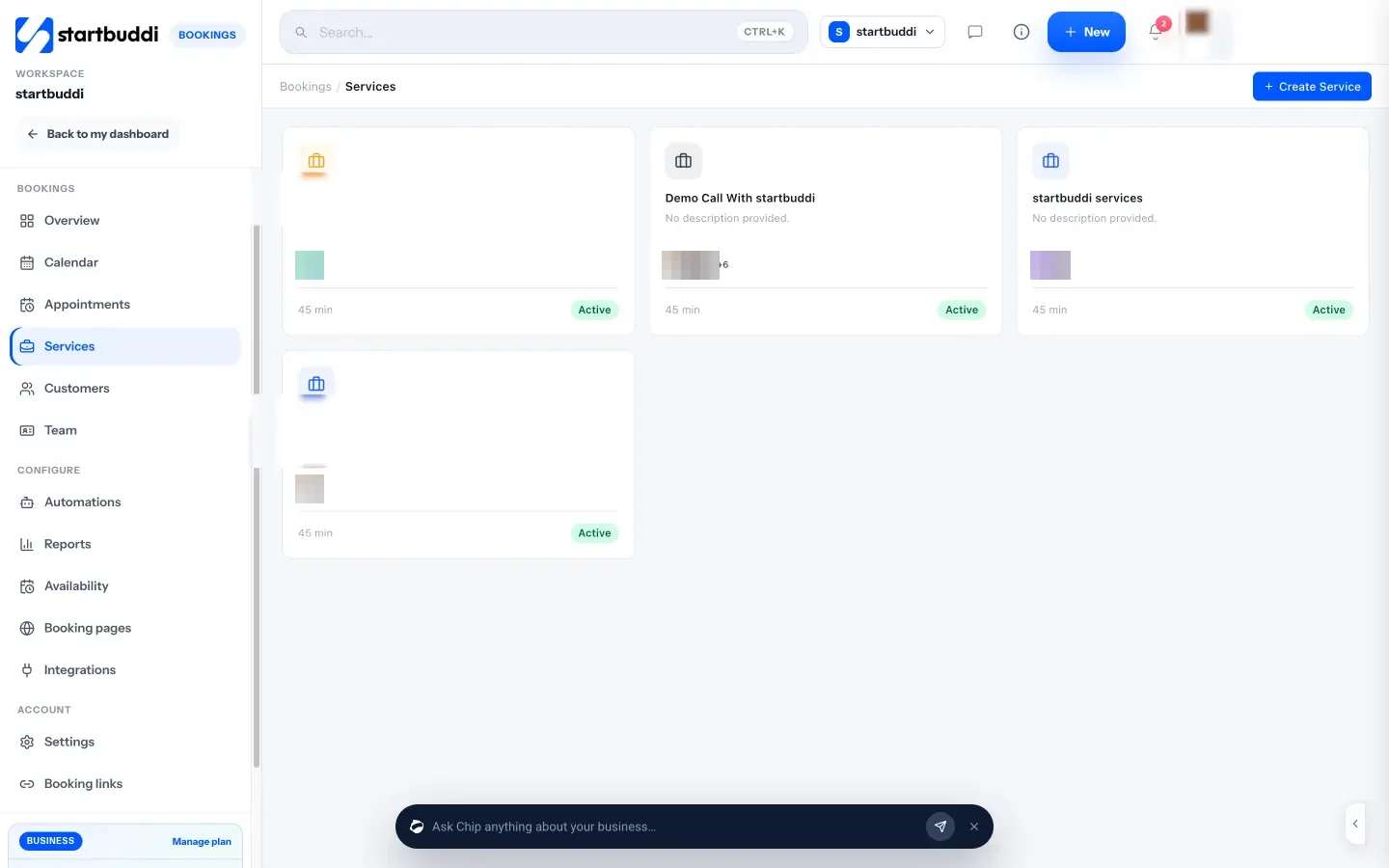
New enquiries and bookings land in Customers as contacts, with deals, notes and conversations on one page. Invoices can be paid online by card or bank transfer, projects and time tracking live in Work, and client portals give each client one place to see updates and invoices. Chip, the built-in assistant, can draft follow-ups and answer questions about your numbers.
Your next step: write down your three most common services with a fixed price for each, then set them up as bookable services. See what each plan includes on the pricing page.
Related terms
FAQ
What are examples of a service based business?
Consultants, accountants, designers, marketing agencies, hair salons, personal trainers, tutors, cleaners, plumbers and photographers are all service based businesses.
Can a service business also sell products?
Yes. A salon may sell hair products and a mechanic may sell parts. It is still mainly a service business if most income comes from the work itself.
Is a service business easier to start than a product business?
Usually, because you need little stock or equipment. The harder part is growing beyond your own hours, which needs good pricing and simple systems.
How do service businesses make more money without working more hours?
By packaging services at fixed prices, raising rates as demand grows, selling retainers, and training others to deliver part of the work.
Omolola Akiyode is the operations and project manager at startbuddi, leading cross-functional projects and the content that helps founders get set up. Omolola writes about projects, websites and getting found online, and turns complex ideas into clear, practical steps.
Runs operations and projects at startbuddi