
Pricing strategy for small business: set, present and raise your prices
A four-part guide to pricing: know your real costs, choose a pricing model, charge for the value you deliver, and raise prices without losing good customers.


This guide helps you build a pricing strategy for your small business from the ground up. It is written for freelancers, service businesses, makers and small shops who set their prices by guesswork or by copying competitors, and suspect they are charging too little.
The four chapters follow the order you should think in. First you work out your real costs and break-even point, so you know the lowest price you can charge. Then you choose a pricing model that fits your work, learn value-based pricing and how to present a price with confidence, and finally learn how to raise prices without losing the customers you want to keep. Each chapter ends with how to do it in startbuddi. By the end you will have a one-page pricing worksheet, a pricing model, three-option quotes and ready-to-send price rise messages.
Know your numbers before you choose a price
- Why pricing matters more than almost anything else you do
- Step 1: list every cost, then split them into two groups
- Step 2: work out the direct cost of one sale
- Step 3: find your break-even point
- Step 4: for a service business, price your hours honestly
- Step 5: decide the margin you need
- What if your break-even number is impossible?
- Common mistakes at this stage
- A one-page pricing worksheet you can copy
- Seeing your real costs and margins in startbuddi
A pricing strategy for a small business is simply a clear, written answer to three questions: what does each sale cost you, what is it worth to the customer, and where between those two numbers do you want to sit? Most owners skip the first question and jump straight to "what are other people charging?". That is how you end up busy, well reviewed and still short of money at the end of the month.
This chapter gives you the floor under every price you will ever set: your real costs, your break-even point and the margin you need to stay in business. It takes an hour with a spreadsheet or a notebook. Everything else in this guide builds on it.
Why pricing matters more than almost anything else you do
Price is the one number that changes your profit without changing your workload. If you win ten more clients, you also do ten more jobs. If you charge each existing client a little more for the same job, all of the extra money is profit.
The effect is bigger than most people expect. In a well-known Harvard Business Review study of the average economics of 2,463 companies, McKinsey consultants Michael Marn and Robert Rosiello found that a 1% improvement in price lifted operating profit by 11.1%, compared with 3.3% for a 1% rise in sales volume (Harvard Business Review, Managing Price, Gaining Profit). Those were large companies, and your numbers will differ, but the direction holds for a two-person agency or a bakery: small changes in price move profit a lot.
The flip side is just as true. A small discount you give "to be nice" comes straight out of profit. If your profit on a job is 20% of the price, a 10% discount halves it. Knowing your numbers is what stops you from giving money away without noticing.
Step 1: list every cost, then split them into two groups
Start with a list of everything the business spends money on in a normal month. Use your bank statements from the last three months so you do not forget the small, regular things. Then put each cost into one of two groups.
- Direct costs (also called variable costs). Costs that only happen when you make a sale, and grow with each one. Ingredients for a cake, fabric for a dress, a subcontractor you hire for a specific job, fuel to reach a customer, packaging, delivery and payment processing fees.
- Overheads (also called fixed costs). Costs you pay whether you sell anything or not. Rent, software subscriptions, phone and internet, insurance, accountant fees, your website, equipment repayments, and the salary you pay yourself.
The salary you pay yourself belongs in overheads. Many new owners leave it out, set prices that cover everything else, and then wonder why there is nothing left for them. If you would need to earn $3,000 a month in a job to live comfortably, that $3,000 is a real cost of running your business.
Payment fees are easy to forget, and they are a direct cost of every sale. Stripe's standard fee for domestic card payments in the US, for example, is 2.9% plus 30 cents per successful transaction (Stripe pricing). On a $100 sale that is $3.20. It sounds small, but on a product with a thin margin it can be a quarter of your profit.
Step 2: work out the direct cost of one sale
For each thing you sell, add up the direct costs of one unit or one job. Here are three examples from different kinds of business.
| Business | What they sell | Direct costs per sale | Total |
|---|---|---|---|
| Home bakery in Toronto | One celebration cake | Ingredients $14, box and board $4, card fee $1.60 | $19.60 |
| Cleaning company in Manchester | One end-of-tenancy clean | Two cleaners for 5 hours at £13 an hour £130, products £12, travel £8 | £150 |
| Freelance web designer in Nairobi | One small business website | Theme licence $60, stock photos $40, copywriter subcontract $150 | $250 |
Notice that the web designer's own time is not in the direct costs. For a solo service business, your time is covered by the salary you put in overheads. The question for a service business is not "what does one job cost?" but "how many jobs can I do in a month, and what must each one earn?". We come to that in a moment.
Step 3: find your break-even point
Your break-even point is the amount you need to sell each month to cover every cost, including your own pay, with nothing left over. Anything above it is profit. Anything below it is a loss you fund from savings or debt.
The formula is short. First work out your contribution per sale: the price minus the direct costs. Then divide your monthly overheads by that contribution.
Break-even sales per month = monthly overheads ÷ (price − direct cost per sale)
Take the Toronto bakery. Its monthly overheads are $2,400: $1,600 for the owner's pay, $300 for a shared commercial kitchen, $200 for insurance and licences, $150 for software and phone, and $150 for marketing. If a cake sells for $65 and the direct cost is $19.60, each cake contributes $45.40 towards overheads.
$2,400 ÷ $45.40 = 52.9. The bakery has to sell 53 cakes a month just to break even. That is almost two a day, every day. If the owner can realistically bake and deliver 40 cakes a month, a $65 price cannot work, however popular the cakes are. The price has to change, or the costs have to change, or both.
Now try $85. The contribution becomes $65.40, and break-even drops to 37 cakes a month. At 40 cakes, the business makes a small profit. This is the moment many owners realise their "competitive" price was quietly guaranteeing a loss.
Step 4: for a service business, price your hours honestly
If you sell your time, the maths starts from how many hours you can actually bill, not how many hours you work. Admin, travel, quoting, marketing, learning and chasing invoices all take time that no client pays for.
A realistic starting point for a solo service business is to assume that half to two thirds of your working time is billable. Here is the calculation for the Nairobi web designer, worked in US dollars because she bills international clients.
- Target yearly pay: $30,000.
- Yearly overheads: $6,000 (laptop replacement fund, software, co-working desk, internet, accountant).
- Profit to keep in the business: 15% on top, $5,400.
- Total the business must earn: $41,400.
- Working weeks: 46 (after holidays, public holidays and a few sick days).
- Billable hours per week: 22 out of about 40 worked.
- Billable hours per year: 46 × 22 = 1,012.
- Minimum hourly rate: $41,400 ÷ 1,012 = $40.90, so round up to $45.
That $45 is a floor, not a target. It tells her that a $600 website which takes 20 hours ($30 an hour) loses money, even before direct costs. If you want to run your own figures, the hourly rate calculator does the same steps for you. For a deeper look at setting service fees specifically, read how to price your services.
Step 5: decide the margin you need
Break-even keeps the lights on. Margin is what lets you save for a slow month, replace equipment, take a holiday or hire help. There are two numbers people mix up, and it is worth being clear about them.
- Markup is profit as a percentage of cost. A cake that costs $20 and sells for $30 has a 50% markup.
- Margin is profit as a percentage of price. The same cake has a 33% margin ($10 of a $30 price).
When someone says "aim for a 50% margin", they mean the price should be double the cost, not cost plus half. Mixing the two up is one of the most common reasons small businesses underprice. The profit margin calculator converts between them if you want to check your own products.
There is no single right margin. Businesses that sell low-cost products in large volumes can live on thin margins. Small service businesses and makers who can only produce a limited amount usually need much fatter ones, because they cannot make it up on volume. Look at your break-even number: if it is uncomfortably close to your maximum capacity, your margin is too thin.
What if your break-even number is impossible?
Sometimes the worksheet delivers bad news: the number of sales you need each month is more than you could ever make or deliver. That is uncomfortable, but it is far better to find out now than after a year of working flat out. You have four levers, and most businesses pull more than one.
- Raise the price. Usually the fastest fix, and the subject of the rest of this guide.
- Cut direct costs. Buy materials in bulk, change supplier, reduce waste, or charge delivery separately rather than absorbing it.
- Cut or share overheads. Cancel software you rarely use, share premises, or move a fixed cost to a pay-as-you-go one.
- Change the mix. Sell more of your higher-margin products or services and less of the ones that barely pay. A café that makes most of its margin on drinks might promote coffee with every pastry, rather than discounting pastries.
Rerun the worksheet after each change. You are looking for a break-even point that sits comfortably below what you can realistically sell in an ordinary month.
Common mistakes at this stage
- Leaving out your own pay. If the business only breaks even because you work for free, it has not broken even.
- Forgetting small, regular costs. Five subscriptions at $15 each is $900 a year. Go through three months of statements line by line.
- Using your best month as normal. Base capacity on an ordinary month, including slow weeks and admin days.
- Ignoring payment and platform fees. Card fees, marketplace commissions and delivery apps come out of every sale.
- Treating a busy diary as proof the price is right. A full calendar at a loss-making price just means you lose money faster.
- Converting currencies once and forgetting. If you buy in one currency and sell in another, recheck your costs whenever the exchange rate moves sharply.
A one-page pricing worksheet you can copy
Before moving on, write these numbers down for your business. You will use them in every chapter that follows.
- Monthly overheads, including your own pay: ______
- Your main product or service: ______
- Direct cost of one sale (materials, subcontractors, travel, fees): ______
- Current price: ______
- Contribution per sale (price minus direct cost): ______
- Break-even sales per month (line 1 ÷ line 5): ______
- Realistic maximum sales per month: ______
- Current margin (line 5 ÷ line 4 × 100): ______%
If line 6 is more than about 70% of line 7, you have very little room for a slow month. That is a strong sign your prices need to go up, which chapter 4 covers in detail.
Seeing your real costs and margins in startbuddi
The worksheet above is a snapshot. The risk is that costs creep up over the following months and your prices stay where they were. If you record your sales and spending in one place, the margin calculation keeps itself up to date.
In startbuddi, Money Manager brings together what came in (paid invoices, payment links, bookings and sales) and what went out (expenses, bills and reimbursements). Three parts of it matter for pricing.
Expenses with categories. Every cost you log under Expenses gets a category such as Software and tools, Marketing, Contractor/freelancer or Bank fees, and you can link it to a project or a customer. That link is what lets startbuddi work out the direct cost of a specific job, rather than only your total spending. Recurring costs like rent and subscriptions go in once under Add recurring, so your overheads are never forgotten.
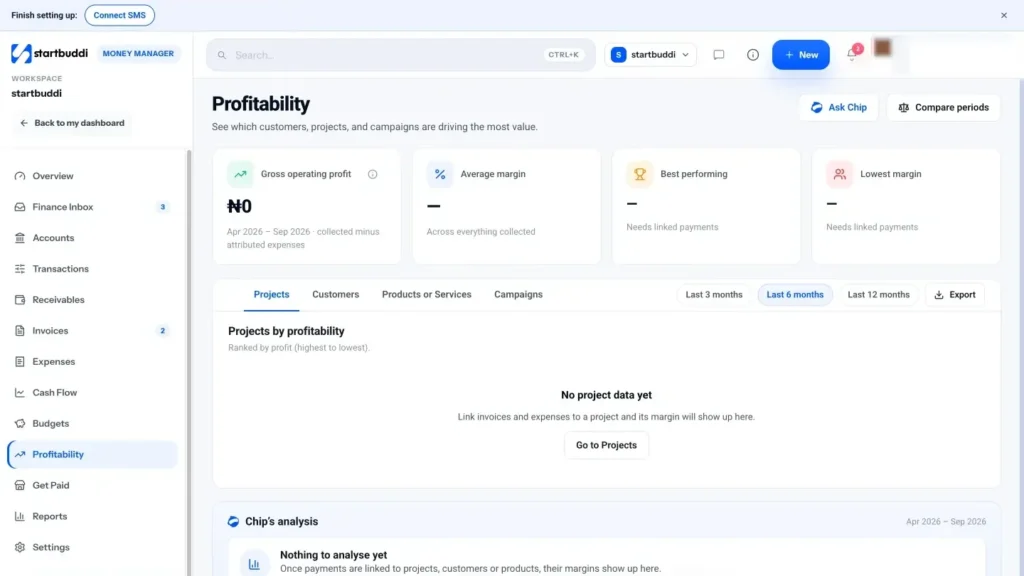
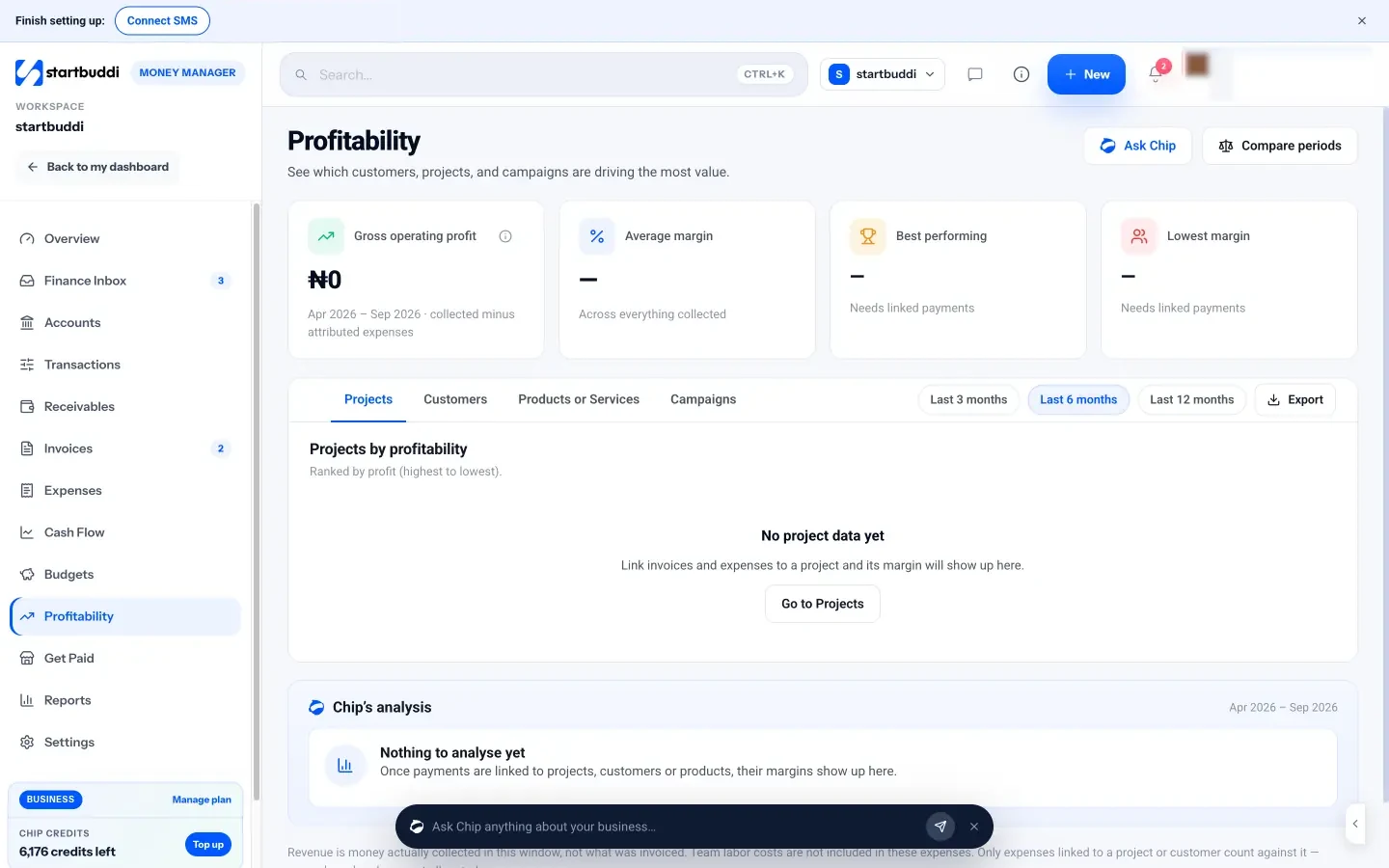
Profitability. The Profitability page shows revenue collected minus attributed expenses for each project, customer, product or service and marketing campaign, ranked by profit, with the margin next to each one. If one type of job consistently shows a lower margin than the rest, that is the first price to look at. Note that it counts expenses you have linked; it does not include the cost of your team's time.
Reports. Under Reports, the Profit & loss tab shows revenue, expenses and net profit for this month, quarter or year, built from your real invoices, payments and expenses. It is a cash-basis view, not statutory accounts, but it is exactly what you need to check whether your prices are covering your costs.
You can also ask Chip, the assistant built into startbuddi, questions such as "which customers had the lowest margin this quarter?" from the Profitability page, and it answers from your own figures.
With your floor in place, the next chapter looks at the different ways you can charge: cost-plus, competitor-based, value-based, hourly, per project, packages and subscriptions, and which suits which kind of business.
Pricing models: choose how you charge
- The three ways to set the level of a price
- Cost-plus pricing
- Competitor-based pricing
- Value-based pricing
- How to package your price: the common pricing models
- Hourly or daily rates
- Fixed project pricing
- Per-unit or per-item pricing
- Packages and tiers
- Retainers and subscriptions
- Deposits and staged payments
- Other pricing tactics you will come across
- Choosing your model: a quick decision table
- How to test a new pricing model safely
- Common mistakes when choosing a pricing model
- Putting your pricing models to work in startbuddi
Once you know your floor, the next decision is the shape of your price. Do you charge by the hour, by the job, by the month, or by the item? Do you add a fixed percentage to your costs, match the market, or charge for the result you deliver? These are pricing models, and the one you choose affects your profit, your cash flow and how customers feel about paying you.
There is no single best model. The right one depends on what you sell, who buys it and how predictable the work is. Many small businesses use two or three models side by side. This chapter walks through the main options with examples, so you can pick deliberately rather than by habit.
The three ways to set the level of a price
Before looking at how you package a price (hourly, per project, monthly and so on), it helps to see the three basic ways of deciding how high it should be. Every pricing strategy for a small business leans on one of them, or a mix.
Cost-plus pricing
Cost-plus pricing means adding a fixed markup to your costs. If a candle costs you $6 to make and you use a 150% markup, you sell it for $15. It is simple, it guarantees that every sale covers its direct cost, and it is easy to explain.
Where it works: products where customers compare like with like, such as printed items, made-to-order food, parts and materials, and work you resell with little change. It also works as a quick check on any other method: whatever price you land on, it should clear cost plus your minimum margin.
Where it fails: it ignores what the customer would happily pay. A logo that takes you three hours might be worth thousands to a business launching a new brand. Cost-plus would price it at a few hundred. It also punishes you for getting faster: as your skills improve and your costs fall, your price falls with them.
Competitor-based pricing
Competitor-based pricing means looking at what similar businesses charge and positioning yourself relative to them: slightly below, in line, or above. Most new businesses start here, often without realising it.
Where it works: markets where customers shop around and the offers look alike, such as a car wash, a standard haircut, a basic bookkeeping package or a delivery service. If every salon on your street charges between £35 and £45 for a cut and blow-dry, pricing at £90 needs a very good reason.
Where it fails: you have no idea whether your competitors are profitable. They may be underpricing, subsidising the business from savings, or have far lower costs than you. Copying their price copies their problems. Use competitor prices as a map of what customers expect, not as your answer. Chapter 3 of our market research guide shows how to collect competitor prices properly.
Value-based pricing
Value-based pricing means setting the price according to what the result is worth to the customer. A bookkeeper who saves a café owner ten hours a month, or a consultant who helps a company win a $200,000 contract, can charge a share of that value rather than a rate for their time.
Where it works: services with a clear, measurable outcome, specialist skills, and work where the customer's alternative is expensive. It suits consultants, agencies, specialist trades and B2B services best.
Where it fails: when you cannot explain or measure the value, or when the customer sees you as interchangeable with cheaper options. Value-based pricing needs a conversation about outcomes before you quote. We cover how to have that conversation in chapter 3.
How to package your price: the common pricing models
Now the practical part: how the customer sees the price. Here are the models small businesses use most, with the pros and cons of each.
Hourly or daily rates
You charge for time spent. Plumbers, tutors, lawyers, freelance developers and many consultants work this way.
- Good for: work where the scope is genuinely unknown, such as repairs, open-ended support and advice.
- Watch out for: the better and faster you get, the less you earn per job. Clients also watch the clock and question every hour. You need a way to track time accurately and explain it on the invoice.
- Example: an IT support freelancer in Johannesburg charges R650 an hour, billed in 15-minute blocks, with a one-hour minimum for call-outs.
Fixed project pricing
You quote one price for a defined piece of work. A website for $2,500, a kitchen fitting for £4,800, a wedding cake for $400.
- Good for: work you have done before and can scope well. Customers like knowing the total up front, and you keep the benefit if you work efficiently.
- Watch out for: scope creep. If the client keeps adding "just one more thing", a fixed price turns into an hourly rate that falls with every request. Write down exactly what is included and how extras are charged. Our post on how to prevent scope creep has wording you can reuse.
- Example: a Nairobi web designer quotes $1,800 for a five-page site with two rounds of changes, and $150 for each extra page.
Per-unit or per-item pricing
Each item has a price: a meal, a T-shirt, a class pass, a printed banner. This is how most shops, food businesses and makers sell.
- Good for: anything the customer buys one at a time or in quantities.
- Watch out for: small margins that disappear with discounts, delivery costs and platform fees. Check each item against the cost worksheet from chapter 1, not just the average.
Packages and tiers
You bundle services or products into a small number of named options, often three: a basic, a standard and a premium. A well-designed middle option gives you a way to guide customers towards the package that suits both of you best.
- Good for: service businesses where clients want different levels of help, such as photography (1 hour, half day, full day), social media management (8, 12 or 20 posts a month) or cleaning (standard, deep, end of tenancy).
- Watch out for: too many options. Three is usually enough. More than five and customers freeze.
| Package | What is included | Price |
|---|---|---|
| Starter shoot | 1 hour, 1 location, 15 edited photos | $250 |
| Brand shoot | 3 hours, 2 locations, 50 edited photos, usage licence for web and social | $650 |
| Full day | 7 hours, up to 4 locations, 120 edited photos, licence, express delivery | $1,400 |
The middle package in this example is the one the photographer actually wants to sell. The top package makes it look reasonable, and the starter package gives price-sensitive customers a way in.
Retainers and subscriptions
The customer pays a fixed amount every month (or quarter, or year) for ongoing access or a set amount of work. Agencies, accountants, IT support firms, gyms, coaches and software companies use this model.
- Good for: steady, repeat work. Recurring income makes cash flow predictable, which makes every other part of running the business easier.
- Watch out for: retainers that quietly grow in scope while the fee stays the same. Review each one at least twice a year against the hours or costs it actually takes.
- Example: a bookkeeper in Birmingham charges £300 a month for up to 80 transactions, monthly reports and a quarterly call, with extra transactions at £2 each.
If you want to move clients onto monthly fees, our guide on how to sell and bill retainers covers the agreement and the billing in detail.
Deposits and staged payments
Strictly speaking this is a payment structure rather than a pricing model, but it belongs in your pricing strategy because it changes your risk. Asking for part of the price up front protects you from cancellations and no-shows and funds the materials for the job. Read how much deposit to charge clients for typical percentages by industry.
Other pricing tactics you will come across
You will hear about several more pricing approaches. Here is a plain summary of each, and when a small business might use it.
- Penetration pricing: launching at a low price to win customers quickly, then raising it. Risky for small businesses because customers anchor on the launch price. If you do it, call it a launch offer with an end date.
- Premium pricing: deliberately pricing above the market to signal quality. It works when everything else matches: branding, service, speed and results.
- Charm pricing: ending prices in 9 or 99 ($49 rather than $50). Common in retail. For professional services, round numbers often look more confident.
- Minimum charges: a floor for small jobs, such as a call-out fee. Essential for trades and anyone who travels to customers.
- Rush fees: a surcharge for faster delivery, usually 25% to 50%. It protects your schedule and rewards clients who plan ahead.
Choosing your model: a quick decision table
| If your work is... | Consider... |
|---|---|
| Unpredictable in scope (repairs, advice) | Hourly or daily rate with a minimum charge |
| Well defined and repeatable | Fixed project price or packages |
| Ongoing every month | Retainer or subscription |
| Physical products | Per-item price, checked against cost-plus |
| High value to the customer and hard to copy | Value-based project price |
| Similar to many competitors nearby | Competitor-based, with a clear reason if you charge more |
How to test a new pricing model safely
Changing how you charge can feel risky, so test before you switch everything. Offer the new model to new customers only for a month or two, and keep existing customers on the old one. For example, a tutor who charges by the hour could offer a ten-lesson package at a small saving to new students, and see how many choose it. A web designer could quote three packages alongside her usual hourly estimate and note which the client picks.
Keep a simple tally of how many quotes you sent under each model, how many were accepted, and the margin on each job. After twenty or thirty quotes you will have real evidence, not a hunch, about which model works better for your business.
Common mistakes when choosing a pricing model
- Using hourly rates for work you could price as a project. Once you have done a type of job ten times, you know roughly how long it takes. Price the outcome.
- Offering too many options. Ten packages with small differences confuse customers and slow down every sale.
- Different prices for the same thing without a reason. Customers talk. If you charge differently, have a clear rule, such as a rush fee or a location charge.
- No written price list. If prices live in your head, every quote is a fresh negotiation. A simple price list template fixes this in an afternoon.
Putting your pricing models to work in startbuddi
No software can decide your prices for you, but startbuddi gives each pricing model a place to live, so the price you chose is the price your customer actually sees.
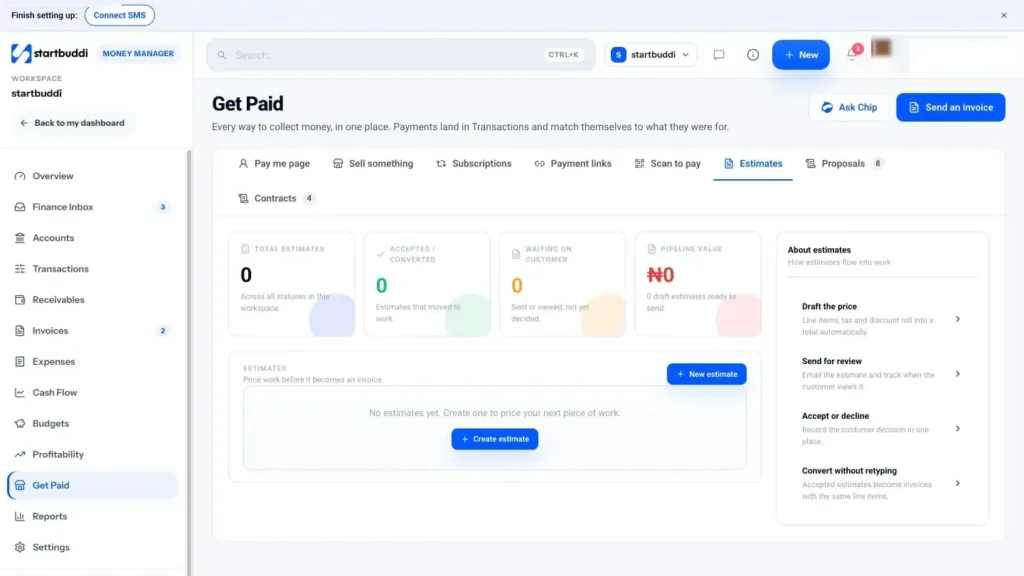
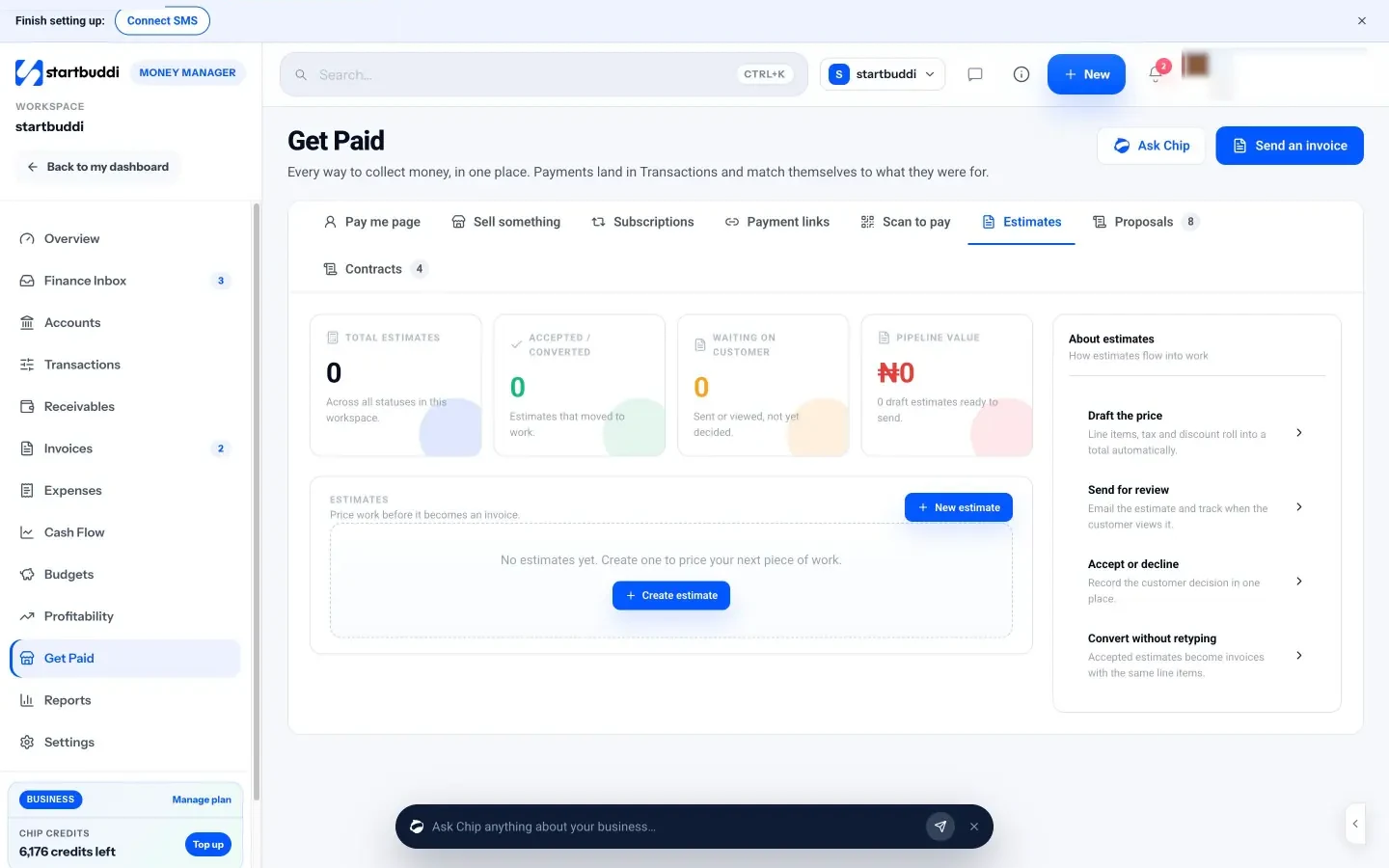
Fixed prices and packages as estimates. Under Money Manager, Get Paid has an Estimates tab. An estimate has line items, tax, discount and a notes field (the placeholder suggests wording like "Valid for 30 days. 50% deposit to begin."). You send it by email, and the customer replies to accept, decline or ask for changes. When they agree, you click Mark accepted and then Convert to invoice, and the invoice is created with the same line items, so the agreed price is never retyped or changed by accident. See estimates, proposals and contracts.
Per-item prices as products. If you sell items, you can add them as products in your Store (under Publish) or in the products catalogue, with a name and price. The Sell something tab in Get Paid lets you pick a product, set a quantity and get a payment link instantly, so the price comes from your list rather than your memory.
Retainers as recurring invoices. On the Invoices page, the Recurring billing card lets you create a schedule once: client, Monthly or Quarterly, issue day, line item and amount. A new draft invoice is created when each one is due.
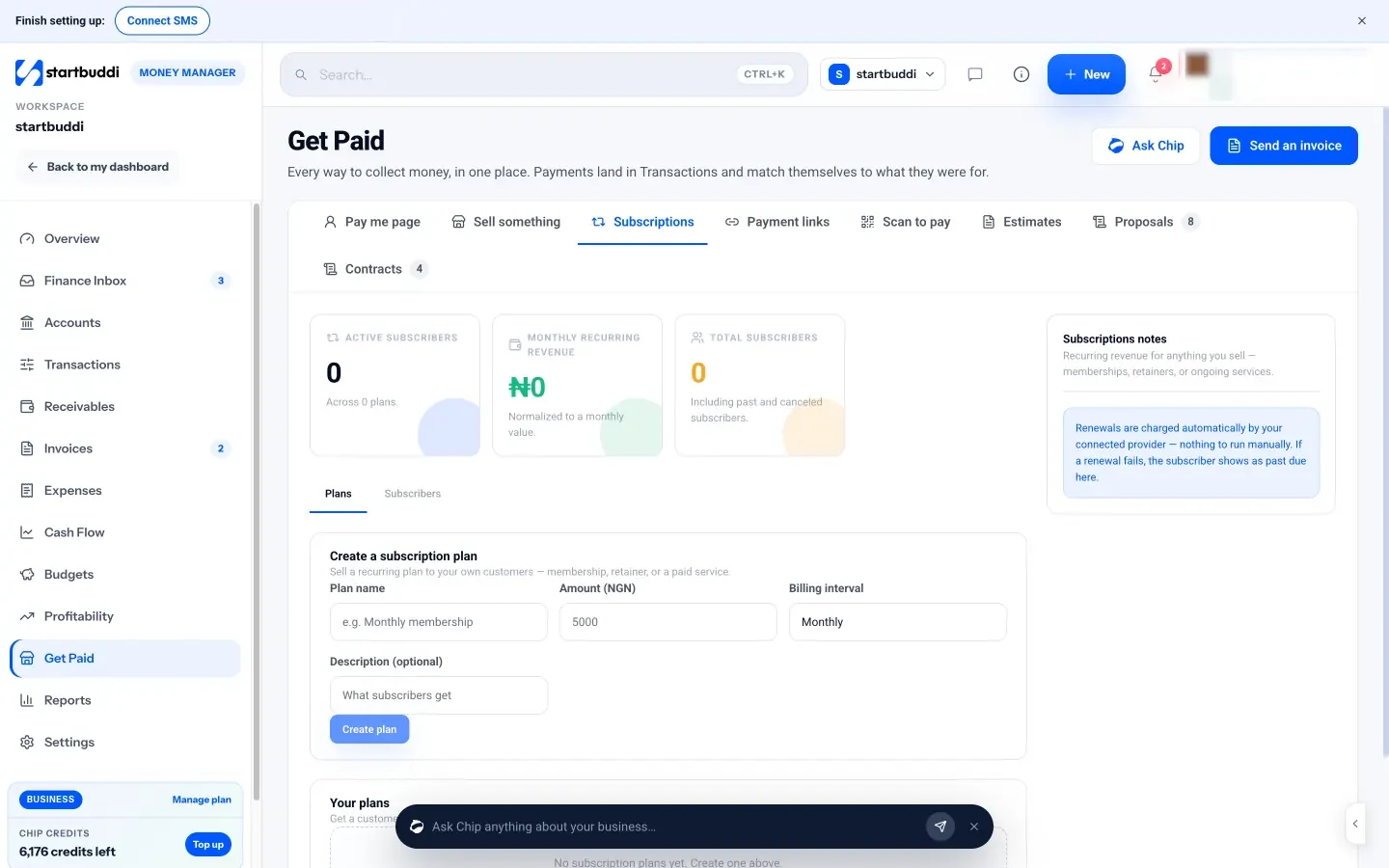
Memberships and subscriptions. The Subscriptions tab in Get Paid lets you create a plan (name, amount, Monthly or Annually), then share a subscribe link. Renewals are charged automatically by your connected payment provider, Paystack or Stripe, and the tab shows active subscribers and monthly recurring revenue. See subscriptions.
Hourly work with time tracking. If you bill by the hour, Work includes time tracking, so the hours on your invoice match the hours you logged.
Choosing a model is half the job. The other half is getting the customer to say yes to the number. Chapter 3 covers value-based pricing in practice and how to present your prices with confidence.
Value-based pricing and how to present your price
- What value-based pricing really means
- Step 1: ask about outcomes before you quote
- Step 2: put a rough number on the value
- Step 3: offer options, not a single take-it-or-leave-it price
- Step 4: present the price with confidence
- Step 5: handle "that's too expensive" without panicking
- A simple discount policy
- Value-based pricing for products, not just services
- Common mistakes with value-based pricing
- Presenting prices professionally with startbuddi
The same piece of work can be worth $300 to one customer and $3,000 to another. A new website means little to a hobbyist and a great deal to a clinic that loses bookings every week because nobody can find it online. Value-based pricing is the practice of pricing according to that difference, and it is the single biggest lever most service businesses never pull.
This chapter shows how to find out what your work is worth to a customer, how to turn that into a number, and how to present the price so it gets a yes. Even if you sell products, the second half of the chapter on presenting prices and handling objections applies to you.
What value-based pricing really means
Value-based pricing does not mean charging whatever you can get away with. It means understanding the result your customer is buying and setting a price that is clearly worth it to them while leaving you a healthy margin.
Think of three numbers side by side:
- Your cost (from chapter 1): the least you can charge.
- The market price: what similar offers usually sell for.
- The value to the customer: what the result is worth in money, time saved, risk avoided or opportunity gained.
When the value is far above the market price, you have room to charge more than the market, as long as the customer can see the value too. If they cannot see it, the price just looks high. That is why value-based pricing starts with questions, not a rate card.
Step 1: ask about outcomes before you quote
Most owners quote too early. A customer asks "how much for a logo?" and gets a number before anyone has discussed why they want one. Instead, have a short conversation first. These questions work for almost any service.
- What made you look for help with this now?
- What happens if you do nothing for another six months?
- If this goes well, what changes for your business? How would you measure it?
- What have you tried already, and what did it cost you?
- Who else is involved in the decision, and what matters most to them?
- Is there a date this needs to be done by, and why that date?
Write the answers down. They are the raw material for your price and for your proposal. They also show the customer that you care about their result, not only about the job.
Step 2: put a rough number on the value
You do not need a perfect figure. You need a reasonable range that you and the customer both believe. Here are worked examples from different businesses.
A booking system set-up for a physiotherapy clinic in Melbourne. The clinic says it misses about eight calls a week because reception is busy, and roughly half of those would have become appointments at A$95 each. That is around A$380 a week, or nearly A$20,000 a year, in lost bookings. A set-up and training package priced at A$2,500 pays for itself within two months. At an hourly rate the job might have been quoted at A$1,200. The value makes A$2,500 an easy decision.
A bookkeeper for a busy café in Leeds. The owner spends about six hours a month on receipts and spreadsheets, time she could spend on the floor or with her family. She values her time at £30 an hour, so the bookkeeping saves her about £180 a month, plus the stress of a late tax return. A £220 monthly fee that includes tidy reports and year-end preparation is clearly worth it to her.
A sales training day for a solar installer in Abuja. The company's average installation is worth ₦4,500,000 in revenue. If better follow-up helps the sales team close two extra jobs a quarter, the training is worth millions of naira a year. A ₦1,200,000 training day with a follow-up session is small next to that.
As a rule of thumb, a price that is a small fraction of the value, say 10% to 25%, tends to feel like a good deal to the customer. There is no law behind that range: it is a starting point you adjust for your market.
Step 3: offer options, not a single take-it-or-leave-it price
A single price invites a yes or a no. Three options invite the question "which one?". Build them from the conversation:
- Option 1: the core result. The minimum that solves the main problem.
- Option 2: the recommended result. The core plus the things that make it work better or faster. Price this for your ideal margin.
- Option 3: the full result. Everything, including support, extra speed or ongoing help. Price it high enough that it is worth your while if someone picks it.
Put the recommended option in the middle and say why you recommend it. The top option acts as an anchor: next to it, the middle looks reasonable. The bottom option gives cautious customers a way to start working with you.
| Essentials | Recommended | Complete | |
|---|---|---|---|
| Booking system set-up | Yes | Yes | Yes |
| Staff training session | 1 hour | Half day | Half day plus refresher |
| Reminder messages written for you | No | Yes | Yes |
| Support after launch | 2 weeks | 2 months | 6 months |
| Price | A$1,500 | A$2,500 | A$4,200 |
Step 4: present the price with confidence
How you present a price changes how it is received. A few habits make a real difference.
- Lead with the outcome, then the price. Restate what the customer told you they want, show how each option gets them there, then give the numbers.
- Put it in writing. A clear estimate or proposal looks more professional than a number in a chat message, and it avoids arguments later.
- Say the number and stop talking. Nervous owners often justify, apologise or offer a discount before the customer has even reacted. Let them respond.
- Show what is included and what is not. Most disputes about price are really disputes about scope.
- Set an expiry date. "This estimate is valid for 30 days" protects you from costs rising and gives the customer a reason to decide.
- State payment terms. Include the deposit, when the rest is due and how to pay.
Our guide on how to write a business proposal covers the full structure of a proposal.
Step 5: handle "that's too expensive" without panicking
Some customers will push back. That is normal, and it does not mean your price is wrong. It usually means one of four things, and each needs a different answer.
| What they really mean | What to do |
|---|---|
| "I don't see why it costs that much." | Go back to the value. Walk through what they told you and what the work achieves. |
| "I can't afford it right now." | Offer the smaller option, or split the payment into stages. Reduce scope, not your rate. |
| "Someone else quoted less." | Ask what the other quote includes. Compare like with like. If it really is the same, you may not be the right fit, and that is fine. |
| "I always ask for a discount." | A polite "our prices are fixed, but here is what I can do" works. Offer something that costs you little, such as a faster start date. |
Here is a short reply you can adapt when a client asks for money off:
Thanks for being straight with me. I keep my prices the same for every client, so I can't reduce the fee for the same work. What I can do is start with the Essentials option at A$1,500 and add the training later if you want it. Would that work better for you?
A simple discount policy
Discounts are not always wrong. The problem is discounts given on the spot, under pressure, with no rule behind them. Decide in advance when you will discount, and write it down.
- Paying up front for a year: for example, 12 months for the price of 10. You get cash now and a committed client.
- Volume: a lower unit price above a set quantity, based on your real cost savings.
- Launch or seasonal offers: with a clear end date, announced publicly, not negotiated one by one.
- Charities or community groups: if it fits your values, set a fixed percentage and apply it to everyone who qualifies.
Before offering any discount, check its effect with the numbers from chapter 1. A 15% discount on a job with a 30% margin removes half your profit.
Value-based pricing for products, not just services
Value-based pricing is easiest to see in services, but it works for products too. The value of a product is not only what it does, but what it means to the buyer: the occasion, the convenience, the confidence it gives them.
- Occasion. A celebration cake for a wedding is worth more to the buyer than the same sponge on a Tuesday. Many bakers price occasion cakes separately for exactly this reason.
- Convenience. Same-day delivery, pre-assembled furniture or ready-to-cook meal kits save the customer time. Price the saving, not only the item.
- Personalisation. Engraving, custom colours or a name on the packaging turn a product into a gift. The extra work is small; the extra value to the customer can be large.
- Guarantee and aftercare. A longer warranty, free adjustments or easy returns reduce the buyer's risk, and customers pay for lower risk.
Ask your best customers why they chose you, and what they would have done otherwise. Their answers show you which kind of value they are really paying for, and where you could charge more for it.
Common mistakes with value-based pricing
- Quoting before asking questions. Without the conversation, you have nothing to base the value on.
- Talking about your process, not their result. Customers care about what changes for them, not how many hours you spent.
- Inventing big numbers. If the customer does not recognise the value you describe, the price just looks inflated.
- Using value pricing for commodity work. If a customer can get the same thing easily elsewhere, value pricing will not stick. Differentiate first.
- Forgetting to deliver the value. Value-based pricing raises expectations. Make sure you track and report the result you promised.
Presenting prices professionally with startbuddi
The tools you use to send prices shape how customers see them. A clear, branded document with options, terms and a way to accept or pay feels more trustworthy than a figure in a WhatsApp chat. Here is how startbuddi supports each step.
Proposals for value-based offers. In Money Manager, Get Paid has a Proposals tab. You create a proposal from the built-in Project Proposal template or a blank page, write up the customer's goals and your options, add pricing, and send it for approval. From there you can continue into a contract and an invoice without retyping.
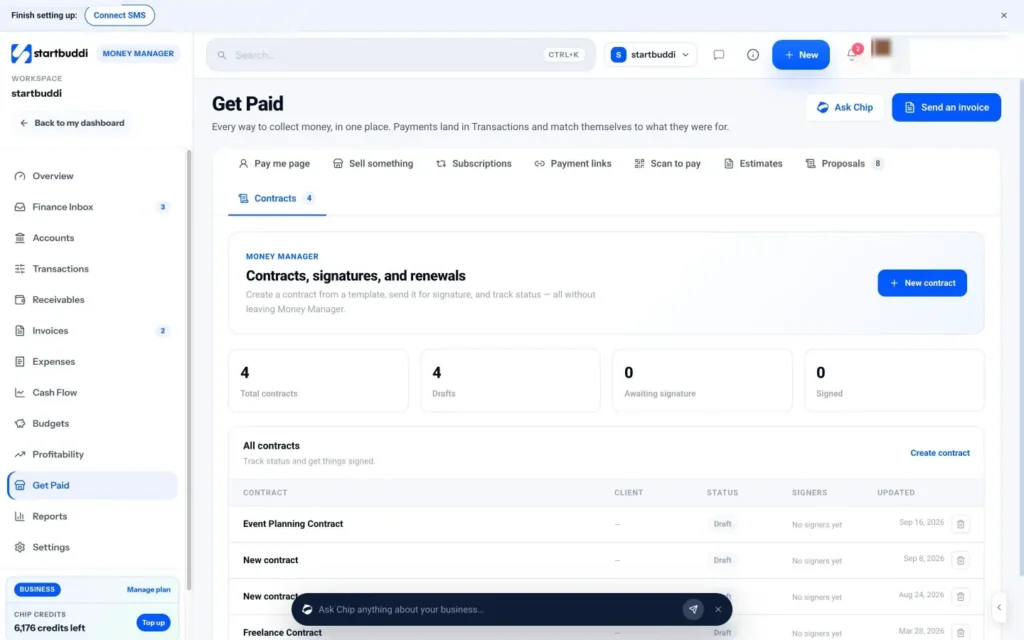
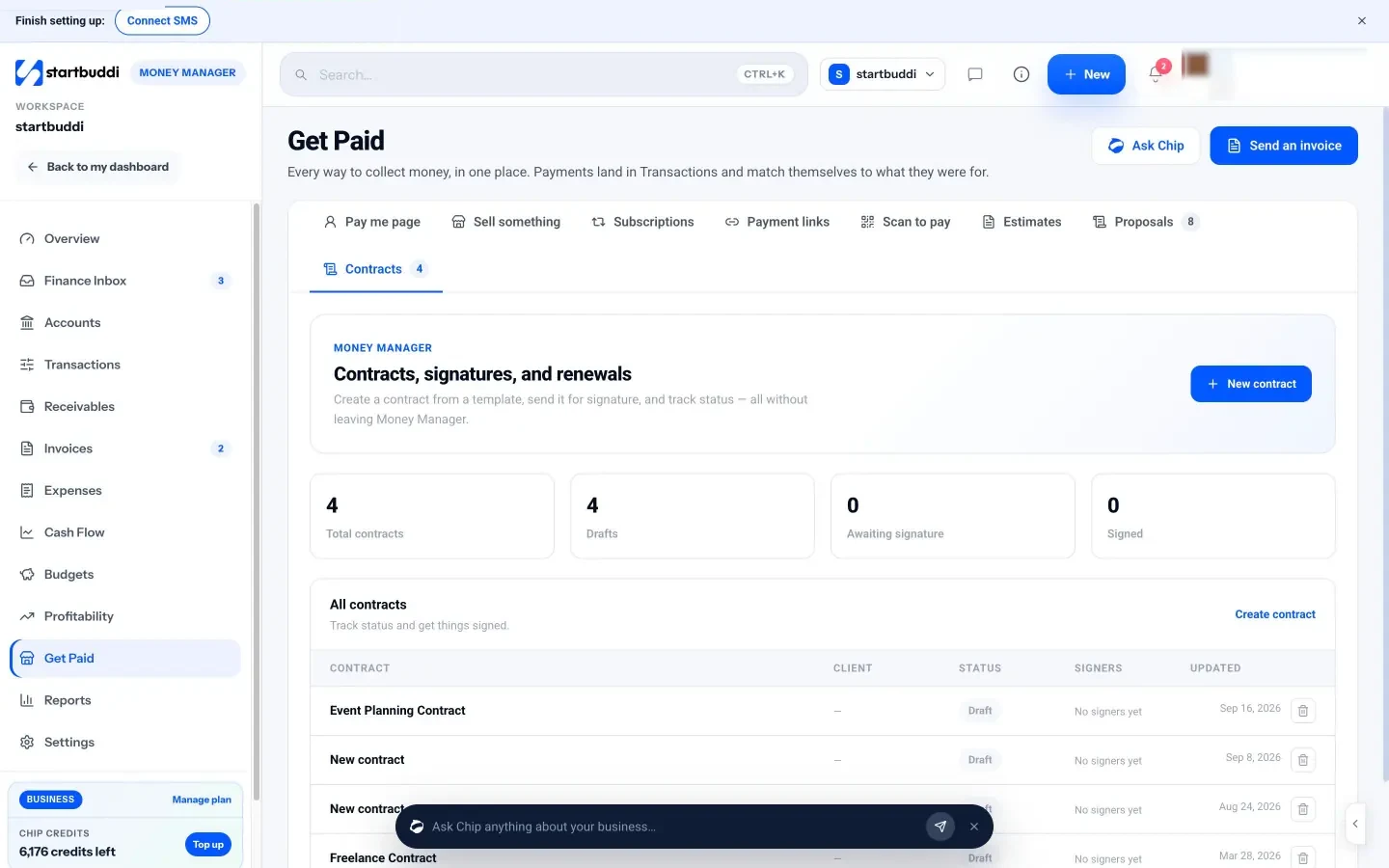
Contracts with e-signature. The Contracts tab has templates including Freelance Contract, Photography Contract, Brand Design Contract, Website Development Contract and Event Planning Contract. You edit the wording, add signers and send it for signature. Status moves from draft to awaiting signature to signed, so you know exactly where each deal stands. See estimates, proposals and contracts.
Estimates with terms and expiry. For simpler quotes, the estimate's notes and terms field holds your validity period and deposit terms. Accepted estimates become invoices with the same line items.
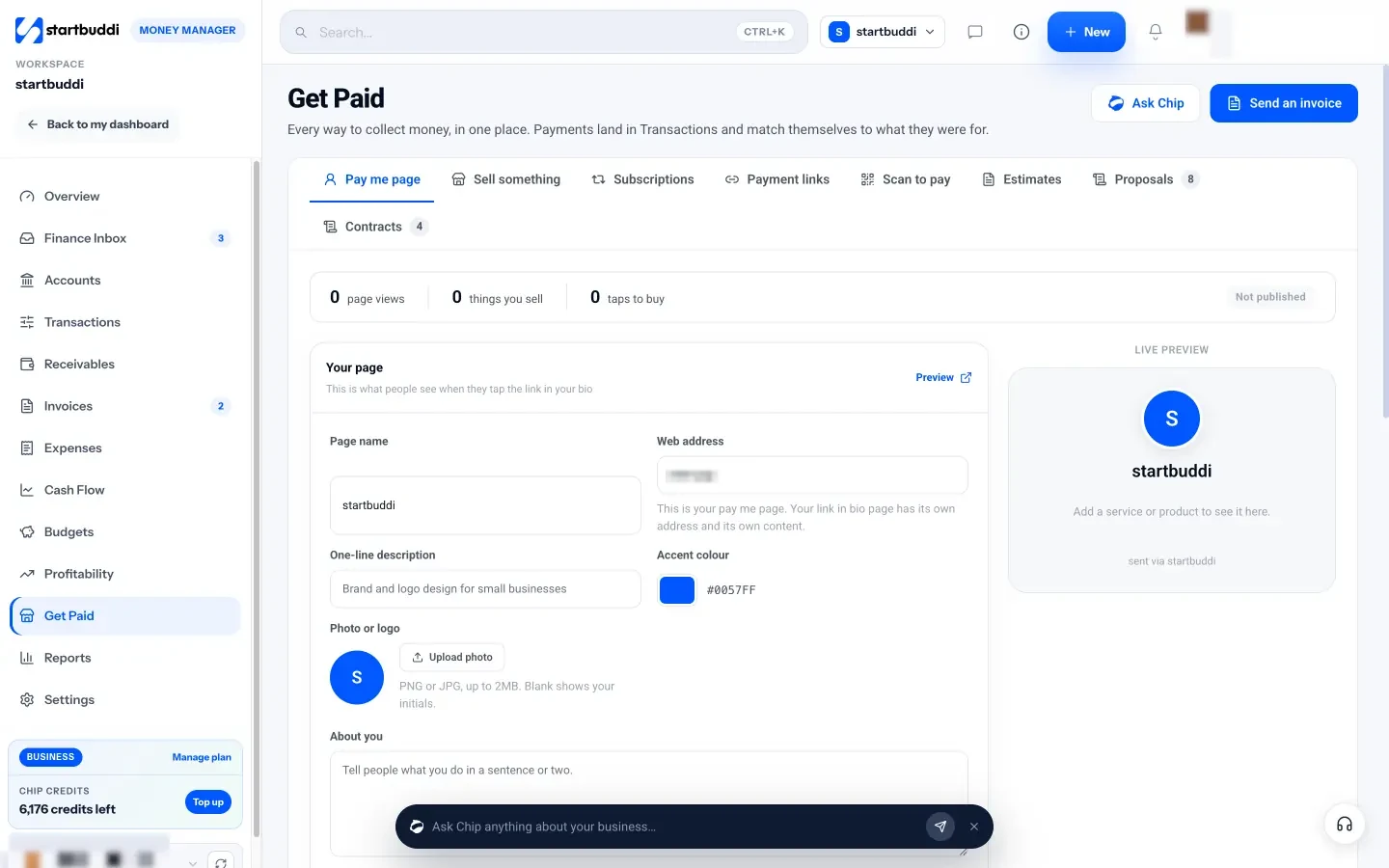
A public price list you can share. The Pay me page in Get Paid is a one-link page where you list services or products with a name, price and short description, and customers can pay you straight from it once Paystack or Stripe is connected. It works well for fixed-price packages.
Notes from the discovery conversation. Keep the answers to your outcome questions on the customer's record in Contacts, and track the quote as a deal in your pipeline. When a deal is lost, you can record a reason such as budget or "went with competitor". Over a few months, those reasons tell you whether price really is the problem.
You now have a price that covers your costs and reflects your value. The final chapter covers what happens next year, when costs rise and your prices need to rise too.
How to raise prices and keep your customers
- Signs it is time to raise your prices
- How much can you afford to lose? The maths that removes the fear
- How much should you raise prices by?
- New customers first, existing customers with notice
- Nervous? Test the new price first
- How to tell customers: templates you can copy
- Handling the replies
- Add value at the same time (optional, but helpful)
- After the rise: measure what actually happened
- Make it a yearly habit
- Running your price rise in startbuddi
- Your next step
- Sources
Every business eventually needs to raise its prices. Your costs go up, your skills improve, demand grows, or you simply realise you started too low. Yet raising prices is the pricing task owners put off longest, because it feels risky and a little awkward. This chapter shows you how to know when it is time, how much to raise by, and exactly how to tell your customers, with templates you can copy.
The short answer: raise prices regularly and in modest steps, give existing customers clear notice and a reason, apply new prices to new customers straight away, and measure what happens afterwards.
Signs it is time to raise your prices
You do not need all of these. Two or three together are a strong signal.
- Your costs have gone up and your margin (from chapter 1) has shrunk.
- You are fully booked or turning work away. Demand is higher than your capacity, which is exactly when price should rise.
- Almost nobody pushes back. If every quote gets an instant yes, you are probably below what customers expect to pay.
- You have not changed prices in over a year. Inflation alone means your real price has fallen since then.
- Your skills, results or reputation have grown. You have more reviews, better work to show and faster delivery.
- You feel resentful about certain jobs. That feeling is often a pricing problem, not a customer problem.
To see how much costs have risen in general where you are, check your national statistics office. The US Bureau of Labor Statistics consumer price index, the UK Office for National Statistics inflation pages and Nigeria's National Bureau of Statistics all publish regular inflation figures. Your own costs matter more than the national average, but the official figure is a useful reference when you explain an increase to customers.
How much can you afford to lose? The maths that removes the fear
The biggest fear is losing customers. So work out, before you do anything, how many you could lose and still be better off. The answer is usually reassuring.
Suppose your margin is 30% and you raise prices by 10%. On a $100 sale you used to keep $30. Now you charge $110 and keep $40. To earn the same total profit as before, you only need 30 ÷ 40 = 75% of your previous sales. In other words, you could lose a quarter of your customers and still make the same profit, with less work.
| Your current margin | Price rise | Sales you could lose and still earn the same profit |
|---|---|---|
| 20% | 5% | 20% |
| 20% | 10% | 33% |
| 30% | 10% | 25% |
| 40% | 10% | 20% |
| 50% | 15% | 23% |
This is the worst case you can afford, not a prediction. A modest, well-explained increase often loses far fewer customers than that. The customers who do leave are often the ones who were most price-sensitive and hardest to serve.
How much should you raise prices by?
There is no universal figure, but these guidelines help.
- Regular annual rises in line with your costs are the least disruptive. Customers get used to a small review each year.
- If you are clearly underpriced (fully booked, no pushback, well below competitors), a bigger step of 15% to 30% may be justified. Consider doing it in two stages six months apart for existing customers.
- Round to clean numbers. A move from $95 to $110 looks more deliberate than $95 to $103.
- Check the new price against your market. Being the most expensive option is fine if your service justifies it, but know where you stand.
New customers first, existing customers with notice
The easiest price rise is the one nobody has to be told about. Put new prices on your website, price list and quotes for new customers straight away. They never knew the old price, so there is nothing to explain.
Existing customers deserve notice. How much depends on your relationship and any contracts in place:
- One-off customers: the new price applies to their next order. A short note is enough.
- Regular clients and retainers: 30 to 60 days' notice is courteous and common. Check your agreement for any notice period you promised.
- Annual contracts: the new price applies at renewal. Tell them before the renewal date, not after.
- Subscriptions: follow your payment provider's rules for changing a plan price, and tell subscribers clearly before any higher charge is taken. Consumer protection rules in many countries expect this.
Some businesses choose to keep long-standing customers on their old price for a while ("grandfathering"). It rewards loyalty, but do not let it last forever, or you will end up with clients who pay far less than new ones for the same work. Set an end date, such as the next renewal.
Nervous? Test the new price first
If a price rise still feels like a leap, test it on a small scale before you tell everyone.
- Quote the new price to the next five new enquiries and see how many accept. If most do, you have your answer.
- Raise the price of one service or product rather than everything at once, ideally the one with the thinnest margin or the longest waiting list.
- Add a premium option above your current top price. If some customers choose it, you have learned that part of your market will pay more.
- Remove an automatic discount, such as free delivery on small orders, before you touch the headline price.
Each of these gives you evidence with very little risk. Once you see customers accepting the new numbers, rolling the change out to everyone feels far less daunting.
How to tell customers: templates you can copy
Keep the message short, clear and confident. Say what is changing, when, why in one or two sentences, and what stays the same. Do not over-apologise: a price rise is a normal business decision.
Email to a regular client or retainer:
Hi Amara,
I wanted to let you know in good time that my monthly fee will change from $800 to $880 from 1 March. My own costs for software, travel and subcontractors have risen over the past year, and this keeps the service at the standard you are used to.
Nothing else changes: the same monthly report, the same response times, and I'm still here whenever you need me. If you'd like to talk it through, just reply and we can find a time.
Thank you for your continued trust. I really enjoy working with you.
Short message for one-off or occasional customers:
Hi Tom, a quick heads-up: from 1 April our end-of-tenancy clean will be £320 (currently £290). Any booking made before then stays at the current price. Thanks for choosing us.
Notice on your website or price list:
Our prices will change on 1 May. Bookings and orders placed before then are honoured at current prices. Thank you for supporting a small local business.
Giving customers a chance to book at the old price before the change often brings in a small wave of orders, which helps your cash flow in the month of the change.
Handling the replies
Most customers will reply "thanks for letting me know", or not reply at all. A few will push back. When they do:
- Listen first. Ask what worries them. Sometimes it is timing, not the price.
- Offer choices, not discounts. A smaller package, a longer commitment at a better rate, or a later start date for the new price.
- Accept that some will leave. Thank them sincerely and keep the door open. Some come back when they find the cheaper option does not deliver.
- Do not back down on the spot. If you reverse the rise for anyone who complains, you teach every customer to complain.
If a valued client leaves over price, keep in touch. A friendly check-in a few months later costs nothing.
Add value at the same time (optional, but helpful)
You do not need to add anything to justify a price rise. But if you have been meaning to improve something, the price change is a good moment to announce it: faster turnaround, a new monthly summary, online payment, extended opening hours. Customers remember the improvement as much as the price.
After the rise: measure what actually happened
Set a reminder for three months after the change and compare these numbers with the three months before.
- Revenue: total money collected.
- Number of sales or active clients: did volume drop, and by how much?
- Margin: profit as a share of revenue.
- Quote acceptance rate: the share of quotes that turned into work.
- Time spent: are you working fewer hours for the same money?
If revenue and margin went up and volume barely moved, your prices were too low, and you may have room for another step next year. If you lost more customers than the table above allowed for, look at how the change was communicated, and whether the new price is out of line with your market.
Make it a yearly habit
The best pricing strategy for a small business is not one big decision but a regular review. Once a year, ideally at the same time, go back through this guide:
- Update your cost worksheet from chapter 1.
- Check your pricing models from chapter 2. Is anything you charge hourly now predictable enough to package?
- Look at which clients and services are most and least profitable.
- Decide on new prices, and write the customer messages.
- Update your price list, estimate templates, recurring invoices and subscription plans.
Running your price rise in startbuddi
In startbuddi, you can handle all three parts of a price rise: deciding, telling customers and updating your billing.
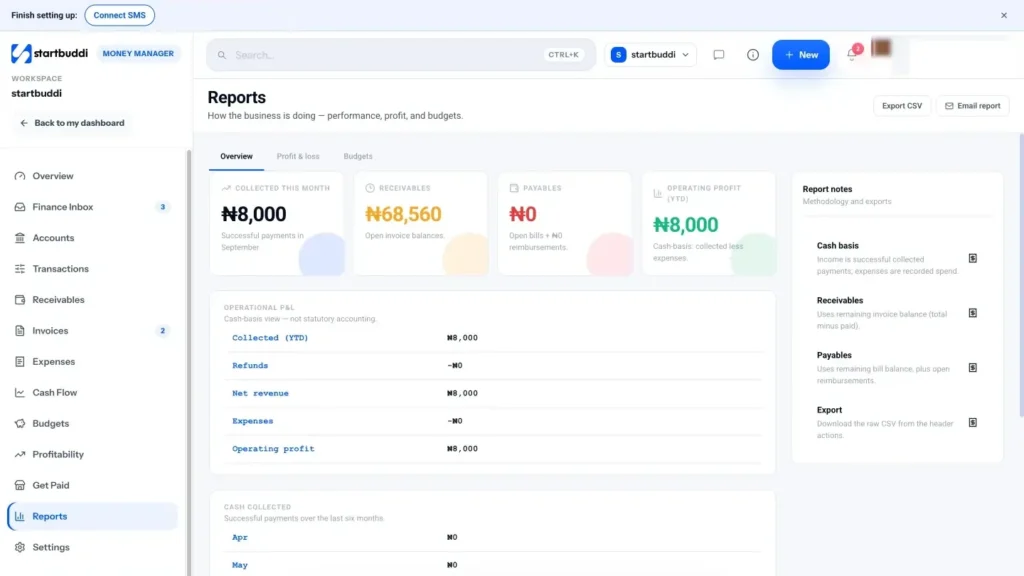
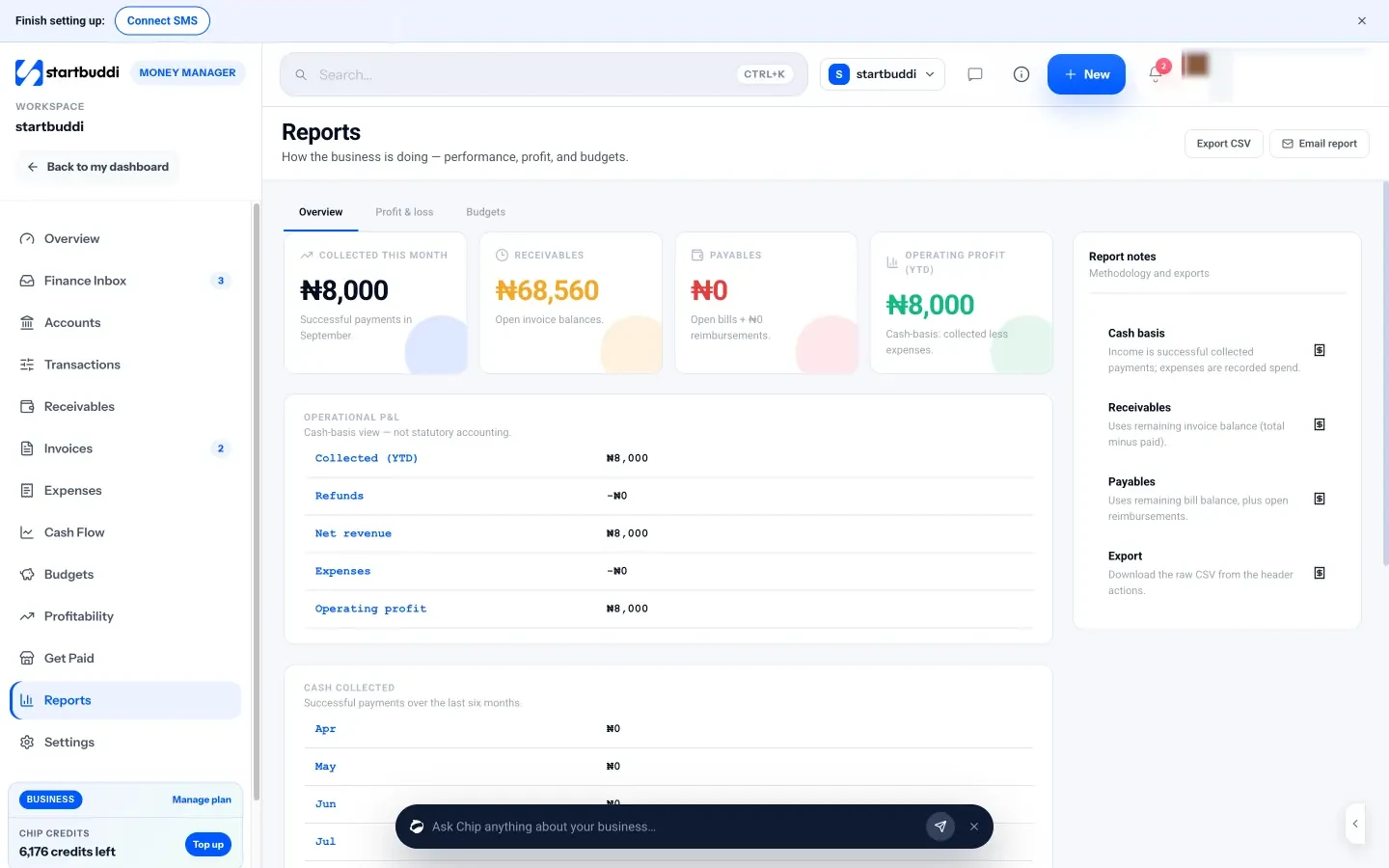
Decide with real numbers. Money Manager Reports shows money collected, receivables, payables and operating profit, with a Profit & loss tab by month, quarter or year. Run it for the last 12 months to see whether your margin has been squeezed. The Profitability page shows which customers, projects and services earn the least, which tells you where a price change matters most. You can export the figures to CSV for your accountant. See money reports.
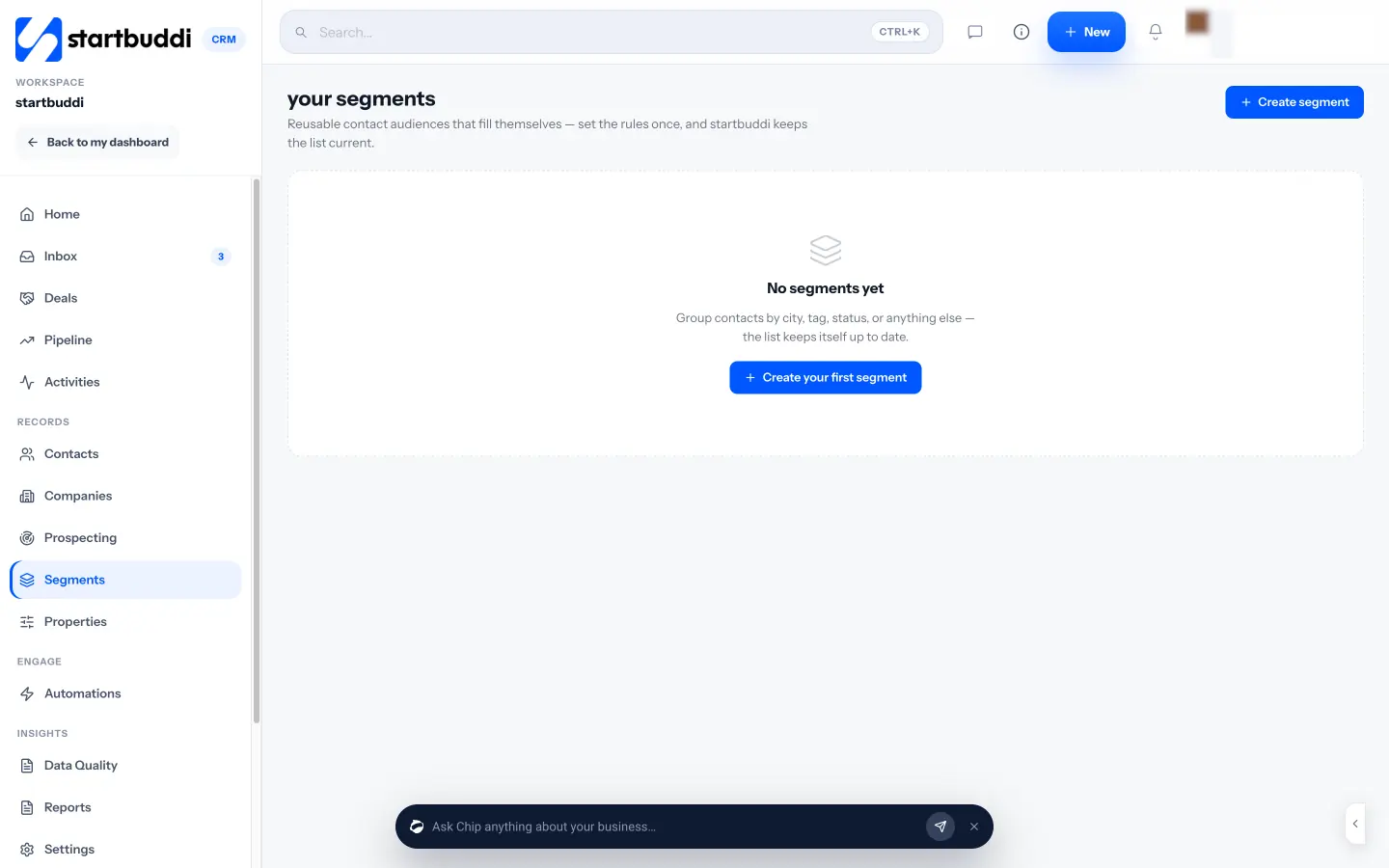
Tell the right customers. In Customers, a segment is a contact list that keeps itself up to date from rules you set, such as a tag like "retainer client" or a status. You can send your price-change email to that segment through Email marketing, with Chip helping you draft it ("Write with Chip" in the email composer). Email campaigns are part of the Marketing module, which needs the Starter plan or above. On the Free plan, you can still use the segment as your list and send the message to each client yourself. See audiences, lists and segments.
Update your billing. After the change date:
- Check each recurring billing schedule on the Invoices page, and set up the schedule at the new amount so the next draft is right. Recurring invoices arrive as drafts, so you can also check the amount before each one is sent.
- Update your estimate line items and any products in your Store or product catalogue.
- For subscription plans in Get Paid, create a new plan at the new price for new subscribers, and tell existing subscribers how and when their price changes.
- Update the prices on your Pay me page so the public list matches.
Keep an eye on the effect. In three months, run the same report again and compare. The Receivables page also shows average days to pay, a useful check that the new prices are not causing payment delays.
Your next step
Fill in the worksheet from chapter 1 this week, even roughly. It will tell you whether your prices are covering your costs. If you want your costs, invoices and margins in one place so the numbers stay current, you can start on startbuddi's Free plan and set up Money Manager in an afternoon. When you need unlimited invoices and email campaigns, see the plans and prices.
Sources
- Harvard Business Review: Managing Price, Gaining Profit (Marn and Rosiello)
- Stripe: pricing
- US Bureau of Labor Statistics: consumer price index
- UK Office for National Statistics: inflation and price indices
- Nigeria National Bureau of Statistics
Tiwalade Joanna Okedara-Kalu is the founder, CEO and CTO of startbuddi, the business system that brings clients, bookings, invoices, projects, marketing and the Chip AI assistant into one place. Tiwalade builds software around how service businesses really work day to day, and writes about client management, getting paid on time and why small businesses outgrow the tools they start with.
Founded startbuddi and leads its product and engineering