Recurring revenue for service businesses: retainers, plans and memberships
How service businesses build recurring revenue: design a retainer, service plan or membership, price it, sell it to existing clients, bill it reliably and keep customers.


This guide shows service businesses how to build recurring revenue: income that arrives every month from the same customers, through retainers, service plans, subscriptions and memberships. It is for freelancers, agencies, consultants, coaches, salons, cleaners, trades and anyone whose income today depends on winning new one-off jobs every month.
The short answer: recurring revenue comes from turning work you already do into an ongoing offer with a fixed monthly (or yearly) price, a clear scope and automatic or scheduled billing. Start with your best existing clients, design one simple plan, bill it the same way every month, and put as much effort into keeping recurring customers as you once put into finding new ones.
Each chapter covers the business side first (why it works, examples, pricing maths, templates and mistakes), then how to set it up in startbuddi. By the end you will have a recurring offer, a way to bill it and a monthly routine for keeping customers.
What recurring revenue is and why it matters
- What recurring revenue is
- Why recurring revenue matters for a service business
- The five main forms for service businesses
- How to measure recurring revenue: MRR and ARR
- Recurring revenue and customer lifetime value
- Where recurring revenue hides in different industries
- How much of your income should be recurring?
- A quick self-audit
- Worked example: two agencies, same revenue
- Worked example: a salon adds memberships
- Is recurring revenue right for your business?
- Recurring revenue in your first year
- What recurring revenue does not fix
- Common mistakes when starting out
- Seeing your recurring revenue in startbuddi
Most service businesses start with one-off work: a website, a deep clean, a consultation, a haircut. Each month begins at zero, and the owner spends a large share of their time finding the next job. Recurring revenue changes that. This chapter explains what recurring revenue is, why it matters so much for a small service business, the main forms it takes, and how to measure it.
What recurring revenue is
Recurring revenue is income you can expect to receive again and again, on a regular schedule, from customers who have agreed to keep paying until they choose to stop. The key word is agreed. A client who happens to book you every few months gives you repeat revenue; a client on a monthly plan gives you recurring revenue.
| Type of income | Example | How predictable? |
|---|---|---|
| One-off | A single logo design project | Not at all: you must win it each time |
| Repeat | A client who books a deep clean "every so often" | Somewhat: likely, but not agreed |
| Recurring | A client on a fortnightly cleaning plan, billed monthly | Very: agreed in advance, paid on a schedule |
All three are valuable. The aim is not to replace one-off work, but to build a base of recurring income underneath it, so that one-off projects become extra rather than survival.
Why recurring revenue matters for a service business
It makes income predictable. If you know $6,000 will arrive next month before you win any new work, you can plan, hire and invest with far less stress. Our guide to creating a business budget shows how much easier budgeting becomes when part of your income is already agreed.
It smooths cash flow. Small businesses run on thin cushions. The JPMorgan Chase Institute found that the median small business holds 27 cash buffer days. Regular payments on known dates make that thin cushion far less risky.
It lowers the cost of selling. Winning a new client takes time: calls, proposals, follow-ups. A recurring client is won once and then pays every month. Your sales effort goes further.
It deepens relationships. Working with a client every month, you learn their business, spot new needs and become harder to replace. Recurring clients often buy extra projects too.
It makes the business more valuable. If you ever want a loan, an investor or a buyer, predictable income is one of the first things they look for.
The five main forms for service businesses
1. Retainers. A client pays a fixed monthly fee for a set amount of work or access. Common for agencies, consultants, lawyers, bookkeepers, designers and developers. A retainer might be "20 hours of design a month" or "social media management for two platforms". Our post on retainer agreements covers retainers in depth.
2. Service plans and maintenance contracts. Regular scheduled work for a fixed price: fortnightly cleaning, quarterly HVAC servicing, monthly website maintenance, weekly lawn care. The customer buys peace of mind; you get a predictable schedule.
3. Memberships. Customers pay a monthly fee for access or perks: a salon membership with one blow-dry a month and discounts on other services, a fitness studio membership, a community for clients. The value is partly the service and partly the feeling of belonging.
4. Subscriptions. A regular product or service delivered on a schedule: a monthly box of supplies, a meal plan, a monthly report, access to a template library.
5. Prepaid packages. Customers pay upfront for a bundle, such as ten coaching sessions or six massages, used over a few months. These are not strictly recurring, but they bring cash in advance and often lead to renewals.
How to measure recurring revenue: MRR and ARR
Two numbers describe recurring revenue.
Monthly recurring revenue (MRR) is the total you expect to receive each month from all active recurring customers. If you have eight clients on a $500 monthly plan and three on $1,200 a month, your MRR is 8 × $500 + 3 × $1,200 = $7,600. Yearly plans count as one twelfth of their price each month: a $2,400 annual plan adds $200 to MRR.
Annual recurring revenue (ARR) is MRR times 12, so $91,200 in this example. Small businesses usually find MRR more useful, because they plan month to month.
Only count agreed, ongoing income. One-off projects, setup fees and occasional extras are not recurring, even from recurring clients.
Recurring revenue and customer lifetime value
Customer lifetime value is the total a customer pays you over the whole relationship. With one-off work it is hard to predict. With recurring plans it becomes simple arithmetic: monthly price multiplied by how many months customers typically stay. A $300 monthly plan with customers who stay two years on average is worth $7,200 per customer.
That number changes how you think about marketing and service. If a new plan customer is worth $7,200, spending $300 to win one is easy to justify, and so is an extra hour a month to make sure they stay. Without recurring revenue, the same $300 marketing cost has to be recovered from a single job.
Where recurring revenue hides in different industries
If you are not sure what a plan could look like for you, this table gives starting points.
| Business | One-off service today | Possible recurring version |
|---|---|---|
| Web designer | New website | Monthly care plan: updates, backups, small changes |
| Accountant or bookkeeper | Year-end tax return | Monthly bookkeeping and quarterly check-ins |
| Cleaner | One-off deep clean | Weekly or fortnightly clean on a fixed day |
| Photographer | Single shoot | Monthly content shoot for a brand's social media |
| Personal trainer or coach | Pay-per-session | Monthly plan with a set number of sessions |
| Plumber, electrician, HVAC | Emergency call-out | Annual maintenance plan with priority booking |
| Marketing consultant | One-off strategy | Monthly advisory retainer |
| Salon or barber | Walk-in appointments | Monthly membership with included services |
How much of your income should be recurring?
There is no magic percentage, but a useful first target is simple: enough monthly recurring revenue to cover your fixed costs and your own basic pay. Once your MRR does that, every one-off job is profit rather than survival, and a quiet month is an inconvenience instead of a crisis.
From there, many service businesses aim for a healthy mix: a solid recurring base, with project work on top for growth and variety. Going fully recurring is not always the goal. Project work keeps things interesting, brings in new clients and often leads to new plans.
A quick self-audit
Answer these five questions about the last 12 months to see where you stand.
- What share of revenue came from agreed, ongoing plans or retainers?
- How many clients bought from you three or more times?
- How much time did you spend each month finding new work?
- How many months started with less than half your costs already covered?
- Which service did clients ask for most often between projects?
If the answer to question 1 is low and question 2 is high, you have clients ready for a plan. Question 5 tells you what the plan should be.
Worked example: two agencies, same revenue
Two small marketing agencies in Manchester each bring in £180,000 a year.
- Agency A earns it all from one-off campaigns and websites. Some months bring £25,000; others £6,000. The owner spends two days a week on proposals and cannot plan hires more than a month ahead.
- Agency B has ten clients on £1,000 monthly retainers (£120,000 a year) and earns £60,000 from projects, most of them from retainer clients. Every month starts with £10,000 already agreed.
Same revenue, very different businesses. Agency B can hire with confidence, survives a quiet month without panic, spends less time selling and would be easier to sell or borrow against. Agency A's owner is always one bad month from trouble.
Worked example: a salon adds memberships
A hair salon in Lagos has about 300 regular clients who visit every four to six weeks, paying per visit. Takings swing between busy festive months and quiet ones. The owner launches a membership at ₦30,000 a month that includes two wash-and-styles and 10% off treatments.
After six months, 45 clients have joined. That is ₦1,350,000 of MRR, arriving on known dates whether or not it rains or the roads are blocked. Members visit more often, because the visits are already paid for, and they buy more treatments with their discount. The salon still takes walk-ins and per-visit bookings; the membership simply puts a floor under the month. The owner now knows, on the first of each month, that rent and staff wages are covered before a single walk-in arrives.
The numbers here are an illustration, not a forecast. Your own uptake will depend on your clients, your prices and how well the membership is explained.
Is recurring revenue right for your business?
Almost every service business can offer some kind of plan, but some fit more naturally than others. Recurring revenue works best when:
- customers need the service regularly (cleaning, maintenance, bookkeeping, marketing, grooming, coaching),
- the value builds up over time (content, SEO, fitness, skills),
- customers would rather not think about re-booking each time, or
- regular contact prevents bigger, more expensive problems later (servicing, check-ups, monitoring).
It is harder when the need is genuinely once-in-a-lifetime, like a wedding or a one-off legal matter. Even then, related services (anniversary shoots, annual legal check-ups) can sometimes become recurring.
Recurring revenue in your first year
If you are just starting your business, you may wonder whether to offer plans straight away. Often you should, at least as an option. A new cleaner, bookkeeper or web designer who signs even three clients onto plans in the first few months has a small, reliable base to build on. The risk is committing too much of your time to low-priced plans before you know what the work really takes. Price carefully, cap the number of plan clients until you have tested the workload, and review everything after three months.
What recurring revenue does not fix
Recurring revenue helps a great deal, but it is not magic. A plan priced too low locks in a loss every month. A plan that promises more than you can deliver creates twelve disappointed customers instead of one. And recurring customers still need looking after: they can leave, and when they do, the gap is felt every month. Treat plans as a way to build on a sound business, not as a fix for unclear pricing or patchy delivery. Get those right first, and recurring revenue will multiply the benefit.
Common mistakes when starting out
- Calling a vague arrangement a retainer. "Pay me monthly and I'll help when you need it" leads to disputes. Define the scope.
- Pricing it like a discount. A plan should be priced for the value of reliability, not just as the one-off price divided by twelve and cut.
- No minimum term or notice period. Without one, clients can leave the day after a busy month. Agree a notice period that is fair to both sides.
- Billing by hand every month. Manual billing gets forgotten and makes a recurring customer feel like a new sale each time.
- Counting it before it is agreed. A client who "will probably continue" is not recurring revenue until they have signed up.
Seeing your recurring revenue in startbuddi
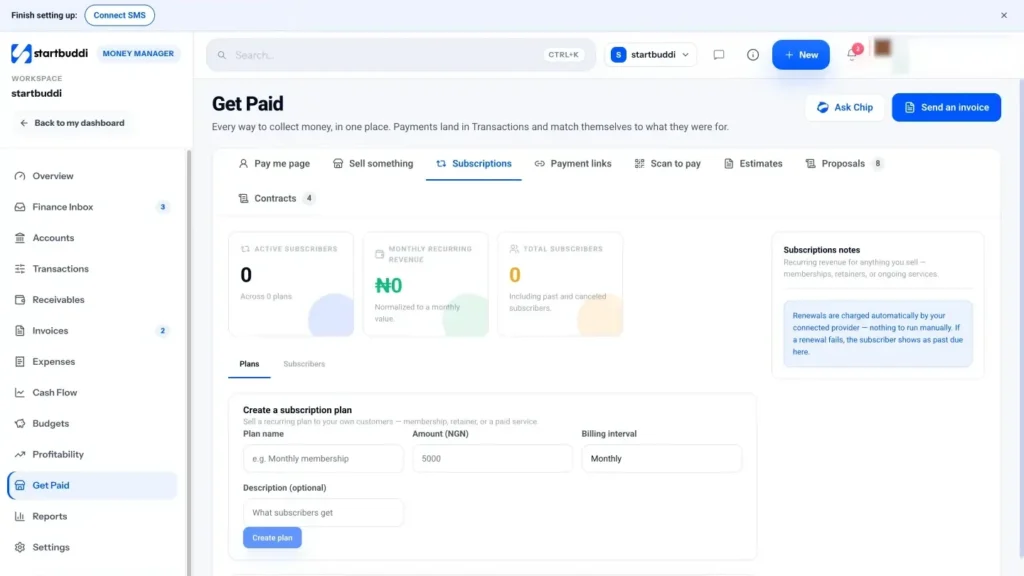
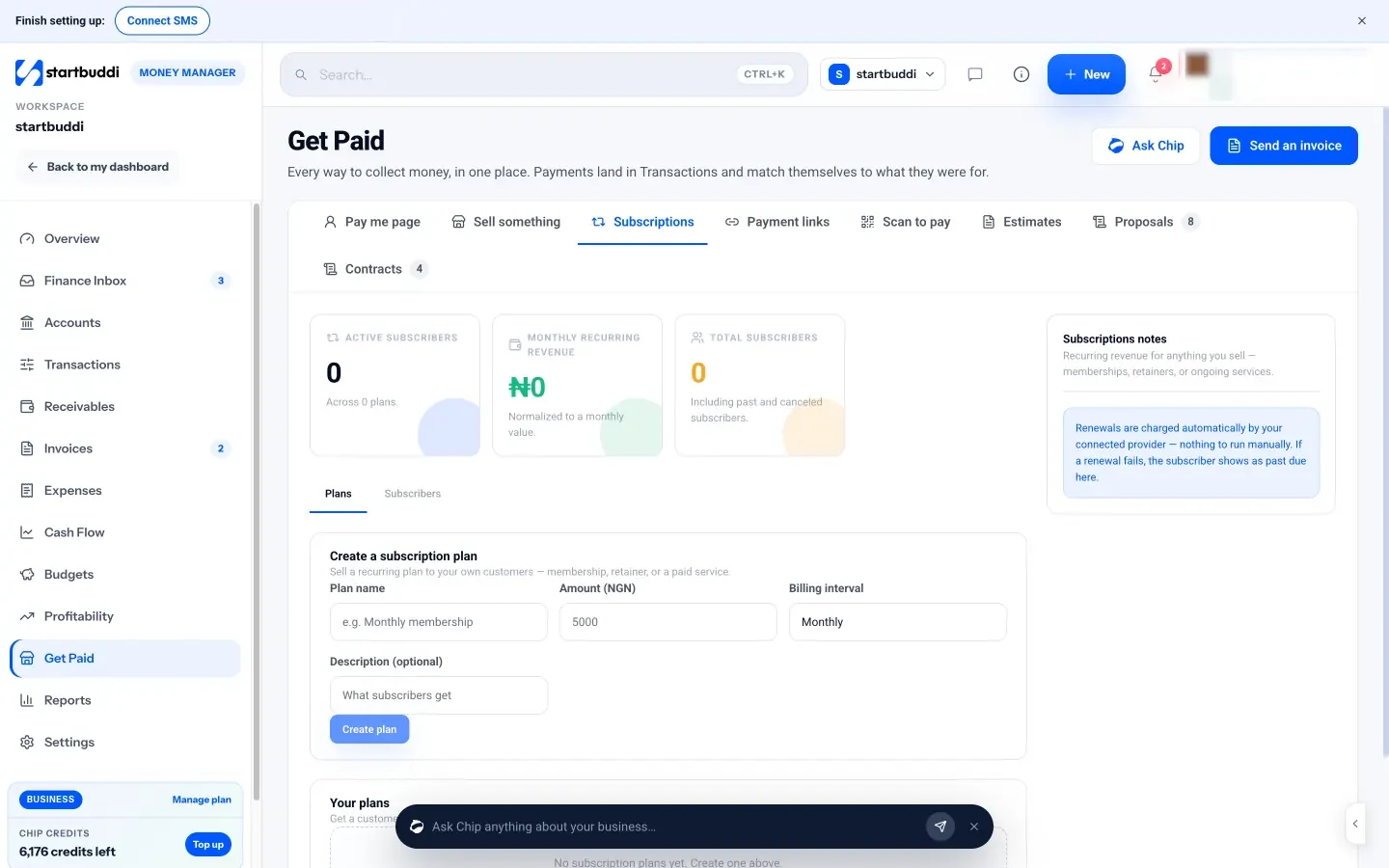
In Money Manager, the Get Paid page has a Subscriptions tab for selling recurring plans to your own customers, described in the app as a membership, retainer or paid service. It shows three numbers at the top: active subscribers, monthly recurring revenue and total subscribers.
If some recurring clients pay by invoice instead, the Reports page's Profit & loss tab breaks income down by source, including invoices, subscriptions and payment links, so you can see how much of your revenue now comes from plans. The Subscriptions product page has the details, and chapter 2 covers designing the plan itself.
A practical first step in the app: open your Customers list and look at the clients you have invoiced most often this year. Each contact record shows their invoices, payments and notes together, which makes it quick to spot the repeat clients from the self-audit above.
Design and price a recurring offer
- Start from what your best clients already buy
- Define the scope: what is in, what is out
- How to price a recurring offer
- Tiers: the good, better, best approach
- Examples across service businesses
- A recurring offer template
- Monthly or annual billing?
- Unused hours: three models
- Worked example: turning a one-off service into a plan
- Check the plan still pays if clients use all of it
- Naming and presenting the plan
- Test before you launch widely
- How big a discount for committing?
- Setup fees and onboarding
- Mistakes when designing the offer
- Creating a plan in startbuddi
A good recurring offer is simple to understand, clearly worth the price, and easy for you to deliver every month without it taking over your week. This chapter covers how to design the offer, how to price it, how to structure tiers, and gives examples and a template you can adapt for your own business.
Start from what your best clients already buy
The easiest recurring offer is one you already deliver. Look through your last year of work and ask:
- Which clients came back more than twice? What did they buy each time?
- Which services do clients need regularly but book irregularly?
- Which problems keep coming back for your clients (a messy website, overflowing inbox, untidy books, dirty office)?
- What do clients ask for between projects ("can you just quickly…")?
The answers point to a plan. A web designer whose clients keep asking for small updates has a maintenance plan waiting to be written. A cleaner whose customers rebook every fortnight has a fortnightly plan. A consultant whose clients call "just to run something past you" has an advisory retainer.
Define the scope: what is in, what is out
The biggest risk with recurring offers is scope creep: the plan slowly grows until you are doing twice the work for the same price. Prevent it by writing the scope down in plain words.
- What is included, in measurable terms: hours, visits, posts, sessions, reports, response times.
- What is not included, with examples, and how extra work is charged.
- Unused time: does it roll over, expire, or roll over up to a limit?
- How to request work, and how quickly you respond.
- The term and notice period: for example, month to month with 30 days' notice, or a three-month minimum.
How to price a recurring offer
There are three common ways to set the price. Use more than one to check each other.
Cost-plus. Work out what the plan costs you to deliver each month (your time at your target hourly rate, plus any direct costs) and add your margin. If a website maintenance plan takes about 4 hours a month and your target rate is $75 an hour, plus $20 of software per client, the cost is $320. With a healthy margin, a price around $400 to $450 makes sense. Our hourly rate calculator helps you set that target rate.
Value-based. Ask what the service is worth to the client. If regular bookkeeping saves a business owner eight hours a month and avoids penalties, the value may be well above your cost-plus price.
Market. Look at what others in your area charge for similar plans, but do not simply copy the cheapest. Clients who choose a plan are buying reliability.
A common mistake is pricing the plan below your one-off rate to "sweeten the deal". A small saving for committing can make sense, but remember that the plan also gives the client priority, reliability and less hassle. Those are worth paying for. For a deeper look at pricing models, see our guide to pricing strategy for small business.
Tiers: the good, better, best approach
Offering two or three levels helps clients choose and often lifts the average price. Keep the differences clear and meaningful.
| Essential | Growth | Premium | |
|---|---|---|---|
| Example: social media management | 2 platforms, 8 posts a month | 3 platforms, 16 posts, monthly report | 3 platforms, 24 posts, report, monthly strategy call |
| Price (USD) | $450 / month | $850 / month | $1,400 / month |
| Price (NGN) | ₦180,000 / month | ₦340,000 / month | ₦560,000 / month |
Most clients pick the middle option, so design it as the one you most want to sell. The top tier makes the middle look reasonable, and the bottom tier gives price-sensitive clients a way in. The prices above are illustrations; set yours from your own costs and market.
Examples across service businesses
- Cleaning business (Toronto): fortnightly home clean, 3 hours per visit, C$260 a month billed monthly, one free deep clean after 12 months.
- Bookkeeper (Nairobi): monthly bookkeeping for up to 100 transactions, a monthly report and a quarterly call, KES 25,000 a month.
- Hair salon (Lagos): membership with two wash-and-styles a month and 10% off treatments, ₦35,000 a month.
- Web developer (Cape Town): website care plan with updates, backups, security checks and one hour of changes a month, R1,200 a month.
- Business coach (London): two 60-minute sessions a month plus message support on weekdays, £450 a month, three-month minimum.
- HVAC company (Texas): maintenance plan with two services a year and priority booking, $20 a month or $220 a year.
A recurring offer template
Fill this in for your first plan. If you cannot fill in every line in a sentence or two, the offer is not clear enough yet.
- Name: short and descriptive ("Website Care Plan", "Fortnightly Home Clean").
- Who it is for: the kind of customer who benefits most.
- What they get each month: in measurable terms.
- What is not included: and the rate for extra work.
- Price and billing: monthly price, billing frequency, any yearly option.
- Term and notice: minimum term (if any) and how to cancel.
- Unused time: rolls over, expires or has a cap.
- How to start: the link, form or call that signs them up.
Monthly or annual billing?
Monthly billing is easier for customers to say yes to, because the amount is smaller. Annual billing brings cash in upfront and tends to keep customers longer, because they have committed for a year. Many businesses offer both, with the annual price slightly lower than twelve monthly payments as a reward for paying ahead.
Think about your own cash flow when you decide. Annual payments are wonderful in the month they arrive, but that money has to fund twelve months of work. Put part of it aside, and do not treat the whole amount as spare cash.
Unused hours: three models
For time-based retainers, decide upfront what happens when a client does not use all their hours.
- Use it or lose it. Unused hours expire at the end of the month. Simple for you, but clients may feel short-changed in quiet months.
- Rollover with a cap. Unused hours roll over for one month, or up to a maximum. A common, fair middle ground.
- Outcome-based. Price the plan on deliverables (posts, reports, visits) instead of hours. This avoids the question entirely and suits many clients better.
Whichever you choose, write it in the agreement and remind clients in your monthly summary of how much they have used.
Worked example: turning a one-off service into a plan
Kemi is a freelance social media manager in Accra who has been setting up Instagram accounts for small businesses at a one-off fee of GHS 3,000. Most clients ask her to "keep an eye on it" afterwards, and she ends up doing small jobs for free.
She designs a plan: 12 posts a month, replies to comments on weekdays, and a short monthly report, for GHS 2,200 a month with a two-month minimum. She works out that the plan takes about 10 hours a month per client. At her target rate, that is fair, and it replaces unpaid favours with paid work. She offers it to her last eight setup clients; four sign up. Her MRR goes from zero to GHS 8,800 in a month, and her next setup clients are offered the plan from the first conversation.
Check the plan still pays if clients use all of it
Some clients will use every hour, every visit and every request their plan allows. Price for them, not for the average. Work out the cost of delivering the full plan every month and make sure the price still leaves a healthy margin. If it does not, reduce what is included, add a usage cap or raise the price. A plan that only works if clients under-use it will fail as soon as your best clients sign up.
Naming and presenting the plan
Plans sell better with clear names and simple presentation. Name each plan after the outcome or the customer, not the internal details: "Website Care", "Fortnightly Home Clean" or "Growth Retainer" are easier to understand than "Package B". Show the price per month, list three to five things included, say who it is for, and make the sign-up step obvious. If you offer tiers, highlight the one most customers choose. Keep the small print (notice period, rollover rules, extra work rates) one click away, not hidden.
Test before you launch widely
Before you put a plan on your website, try it with two or three friendly clients for a couple of months. Track the time it really takes, what clients ask for that is not in the scope, and whether they feel it is worth the price. Adjust the scope and price, then launch it more widely. A plan you have tested is far easier to sell with confidence.
How big a discount for committing?
Customers often expect a lower price in return for committing to a plan or paying yearly. A modest reward is reasonable; a large one gives away the margin that makes plans worth offering.
Work it through with numbers. A one-off website update service at $120 per request might become a plan at $400 a month for up to four requests. If clients use all four, they pay $100 per request, about 17% less than one-off. If they use three, they pay about $133, more than one-off, but they gain priority, a fixed budget and no admin. For an annual plan, a common approach is to charge ten or eleven times the monthly price for twelve months, so the customer saves one or two months' fees in exchange for paying upfront.
Keep discounts simple and tied to something that helps you: a longer commitment, payment upfront, or automatic billing. Avoid discounting just to close a hesitant customer; that sets the expectation for every renewal.
Setup fees and onboarding
The first month of a plan often takes more work than later months: auditing a website, setting up social accounts, organising a year of receipts. You can cover this with a one-off setup fee, a higher first month or a minimum term that lets you recover the effort over time. Be upfront about it. Clients accept a setup fee more easily when you explain what it pays for.
Mistakes when designing the offer
- Too many options. One to three plans are plenty. Ten confuse people.
- Unlimited anything. "Unlimited revisions" or "unlimited support" invites the most demanding clients to take over your time.
- Vague deliverables. "Ongoing marketing support" is impossible to deliver consistently. "Eight posts and one report a month" is not.
- No room for price rises. Say in your terms how and when prices may change, with notice.
- Designing it around what you like doing rather than what clients value.
Creating a plan in startbuddi
In startbuddi, the Subscriptions tab lets you sell a recurring plan to your own customers, with renewals charged automatically by your connected payment provider.
1. Connect a payment provider. Subscriptions work through Paystack or Stripe, so connect and verify one first in Money Manager settings under How you get paid. Paystack covers cards, bank transfer, USSD and mobile money in Nigeria, Ghana, Kenya and South Africa; Stripe covers cards worldwide. Money goes to your own account, and startbuddi takes no cut.
2. Create the plan. Open Money Manager, go to Get Paid and choose the Subscriptions tab. Under "Create a subscription plan", enter a name (for example "Website Care Plan"), the amount, whether it is billed monthly or annually, and a short description of what is included. Click Create plan. The plan is created at your payment provider.
3. Check it in Your plans. Each plan shows how it is billed, how many active subscribers it has and whether it is active or paused. For tiers, create one plan per tier.
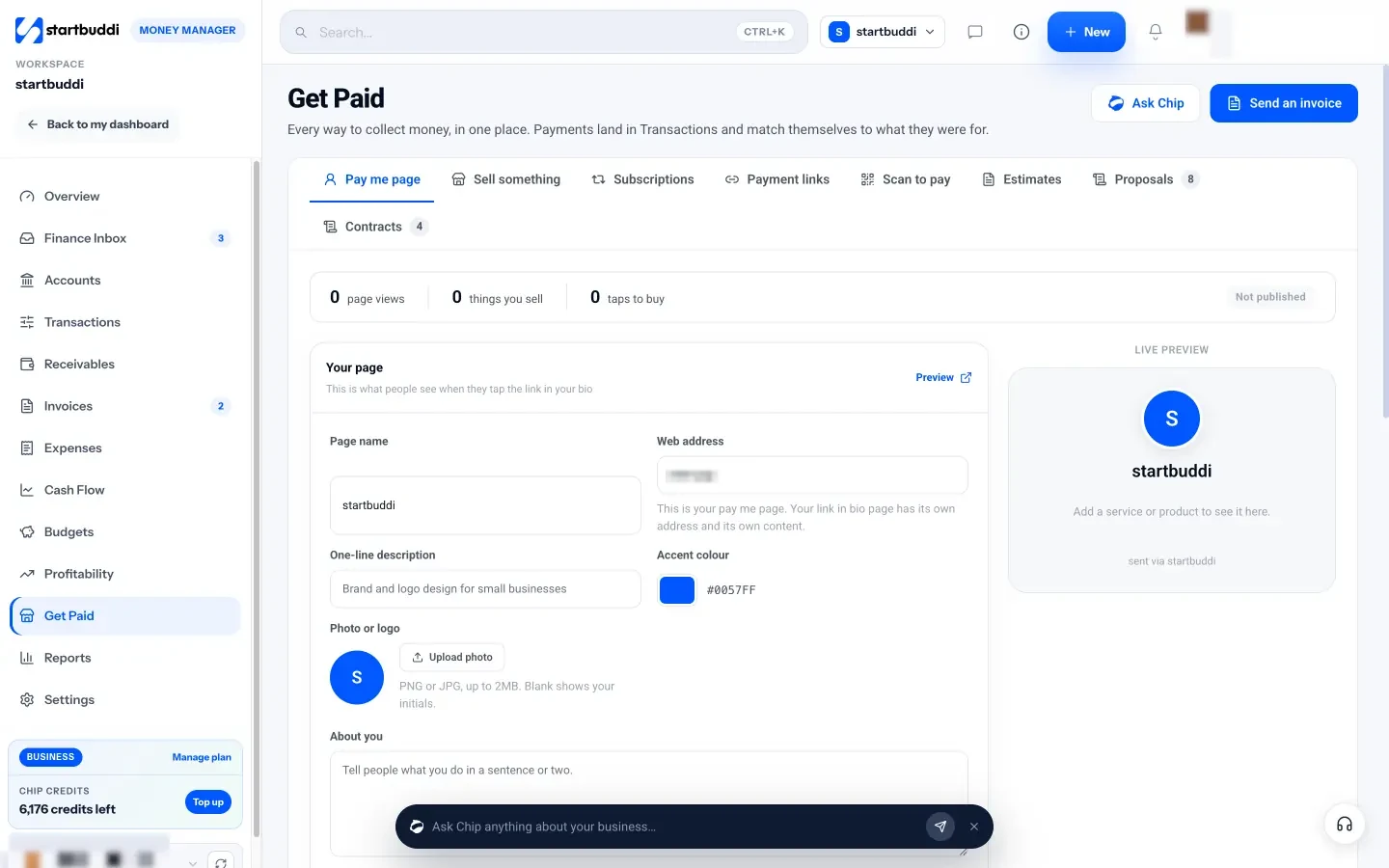
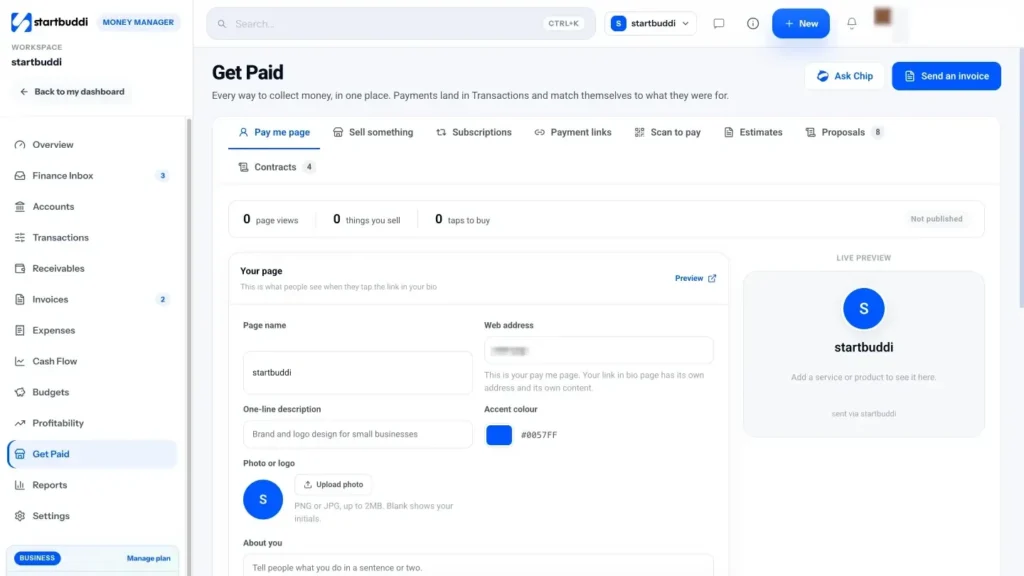
4. Show your plans where customers look. The Pay me page in Get Paid is a one-link page where you can list services and products with prices, ready to share in your bio or messages. For a fuller sales page, a landing page in Publish can describe each tier. Chapter 3 covers signing customers up and getting paid.
Sell, sign and bill recurring payments
- Your first recurring customers are already your clients
- Selling plans to new customers
- Answering common objections
- Onboarding a new recurring customer
- Put the agreement in writing
- Automatic payments or recurring invoices?
- Choose a billing date and stick to it
- Tax on recurring payments
- Payment methods that suit recurring billing
- Moving a retainer client from invoices to automatic payments
- Handling failed payments
- Consumer rules for subscriptions
- Keep plan income and one-off income apart in your records
- Mistakes when selling and billing plans
- Signing up and billing customers in startbuddi
Once your offer is designed, you need to sell it, put the agreement in writing and bill it reliably. This chapter covers moving existing clients onto plans, what to put in the agreement, choosing between automatic card payments and recurring invoices, handling failed payments, and the consumer rules that apply to subscriptions in some countries.
Your first recurring customers are already your clients
The fastest way to start is with people who already trust you. Make a list of clients who have bought from you more than once, or who you know will need the service again. Then offer the plan directly, in a message or a short call.
A simple script:
"Hi Ada, you've booked a deep clean with us three times this year. We've started a fortnightly plan for regular customers: same team each time, a fixed day that suits you, and you never have to remember to book. It's ₦45,000 a month, billed automatically, and you can cancel with 30 days' notice. Would you like to try it from next month?"
Notice what the message does: it reminds the client of their own pattern, names the benefits that matter to them (same team, fixed day, no remembering), gives the price and the exit clearly, and asks a simple yes or no question.
Selling plans to new customers
For new customers, lead with the problem the plan solves, not the plan itself. Someone searching for a one-off clean wants a clean home; offer the one-off, then the plan as the easier way to keep it that way. Useful approaches:
- Offer the plan at the end of a one-off job, when the customer has just seen the result.
- Make the plan the default on your pricing page, with one-off prices shown beside it.
- Use a trial month or a first-month discount to lower the barrier.
- Show the saving, in time and money, compared with booking separately.
Answering common objections
Customers hesitate before committing to a monthly payment. Most objections fall into a few groups, and each has an honest answer.
- "I don't want to be locked in." Offer month-to-month with a short notice period, or a short minimum term followed by month-to-month. Make leaving easy and people are more willing to join.
- "I don't need it every month." Offer a lighter tier or a quarterly option. Or show them the months they did need you last year.
- "It's cheaper to pay as I go." Compare honestly. Include what the plan adds: priority booking, a fixed price, no admin, the same person each time.
- "What if I'm not happy?" Explain how they can raise issues and how to cancel. A clear exit builds trust.
Onboarding a new recurring customer
The first few weeks set the tone for the whole relationship. A simple checklist:
- Send a welcome message the day they sign up, with what happens next.
- Confirm the billing date, the payment method and how to reach you.
- Book the first session, visit or delivery date.
- Collect whatever information or access you need in one go, ideally with a form.
- Deliver something visible in the first week.
- Check in at the end of the first month: is this what they expected?
Put the agreement in writing
Every recurring arrangement needs a written agreement, even a short one. It protects both sides and prevents most disputes. Include:
- the scope from chapter 2 (included, not included, extra work rate),
- the price, billing frequency, payment method and billing date,
- the term, notice period and how to cancel,
- what happens if a payment fails or is late,
- how and when prices can change, and how much notice you give,
- how unused time is handled, and
- any confidentiality or data terms relevant to your work.
Our free agency retainer agreement template is a good starting point for retainers, and our post on the client service agreement covers the general structure.
Automatic payments or recurring invoices?
There are two main ways to bill a recurring plan. Each suits different customers.
| Automatic card or account payments | Recurring invoices | |
|---|---|---|
| How it works | The customer signs up once; the payment provider charges them on each renewal date | You send an invoice on a schedule; the customer pays it each time |
| Best for | Consumers and small businesses paying modest amounts | Larger business clients who need invoices for their finance team, purchase orders or bank transfers |
| Effort for you | Very low once set up | Low to medium: invoices must be sent and chased |
| Risk | Failed payments when cards expire or accounts are short | Late payment, like any invoice |
Many businesses use both: automatic payments for smaller customers and invoices for larger ones. Our glossary entry on recurring invoicing explains the invoice route in more detail.
Choose a billing date and stick to it
Decide when each plan is billed: on the day the customer signs up, or on a fixed day each month for everyone (the 1st, for example). Signup-date billing is simplest with automatic payments. A fixed day is tidier for invoiced clients and makes your own cash flow easier to predict. If you use a fixed day, agree how you will charge for the first part-month, either a proportion of the monthly fee or starting the plan on the next billing date. Write it in the agreement, so the first invoice is never a surprise.
Tax on recurring payments
If you are registered for VAT, GST or sales tax, it usually applies to each recurring payment just as it would to a one-off sale. Make sure your plan price says whether tax is included, and that each renewal is recorded as income in the month it is received. Our guide to small business taxes for beginners covers the basics; check the rules where you are with your tax authority or accountant.
Payment methods that suit recurring billing
The right payment method depends on where your customers are and how they like to pay.
- Cards work almost everywhere and are the easiest for automatic renewals. They expire, so expect some failures.
- Bank debits (such as direct debits or debit orders in some countries) are common for regular household and business payments where available.
- Bank transfer suits business clients who pay invoices through their finance team.
- Mobile money is how many customers across Africa prefer to pay, especially for smaller amounts.
Paystack supports subscriptions for customers across several African countries, and Stripe supports them worldwide. Check each provider's current documentation, such as Paystack's subscriptions guide, for which payment methods can renew automatically in your country.
Moving a retainer client from invoices to automatic payments
Many service businesses have long-standing clients who pay a monthly invoice by bank transfer. Moving them to automatic payments saves both sides time and removes late payments. Do it gently:
- Explain the benefit to them: no more invoices to process, no risk of missing a payment, receipts sent automatically.
- Keep the price and date the same, so nothing else changes at the same moment.
- Send the sign-up link with a clear deadline, for example before next month's billing date.
- Offer the invoice route as a fallback for clients whose finance teams require invoices and purchase orders. Some will, and that is fine.
- Cancel the old schedule once the automatic payment is set up, so nobody is billed twice.
Even moving half your retainer clients to automatic payments can take hours of chasing out of every month.
Handling failed payments
With automatic payments, some charges will fail: cards expire, get replaced or hit their limit. This is often called involuntary churn, because the customer did not mean to leave. Stripe's documentation describes tools to reduce and recover failed subscription payments, including automatic retries and emails asking customers to update their payment method. Whatever provider you use, have a simple process:
- Check for failed payments every week.
- Contact the customer personally within a day or two: a friendly message, not a threat.
- Send them a fresh link to pay or update their details.
- Agree in your terms how long you continue the service while payment is sorted out.
Consumer rules for subscriptions
If you sell plans to consumers (individuals rather than businesses), many countries have specific rules about automatic renewals and cancellations. The details differ, but the principles are similar almost everywhere: tell customers clearly what they will be charged and how often, get their clear agreement to recurring charges, remind them before renewals where required, and make cancelling as easy as signing up.
- United Kingdom: the Digital Markets, Competition and Consumers Act 2024 introduces a new subscription contracts regime, including reminder notices and easy exit. Law firm updates in 2026 put its start in 2027; see Taylor Wessing's summary and check the current date.
- United States: a federal appeals court struck down the FTC's "click to cancel" rule in July 2025, but existing federal law (the Restore Online Shoppers' Confidence Act) and several state automatic renewal laws still apply, as WilmerHale explains.
- Elsewhere: check your national consumer protection authority's guidance on automatic renewals.
This is general information, not legal advice. The simplest way to stay on the right side of the rules, and to keep customers' trust, is to be clear, remind people before big renewals and let them leave easily.
Keep plan income and one-off income apart in your records
When recurring and one-off payments are mixed together, it becomes hard to see whether your recurring base is growing. Label plan payments clearly, invoice extra work separately and keep your MRR table up to date each month. It takes a minute per payment and gives you the most important number in a recurring business.
Mistakes when selling and billing plans
- Starting work before the agreement is signed. Get the signature, then start.
- Hiding the cancellation terms. It damages trust and, for consumers, may break the law.
- Billing on random dates. Pick one billing date and stick to it, so both of you know when money moves.
- Ignoring failed payments. A failed payment left for a month is often a lost customer.
- Forgetting to raise prices on old plans. Review prices once a year and give notice as your terms say.
Signing up and billing customers in startbuddi
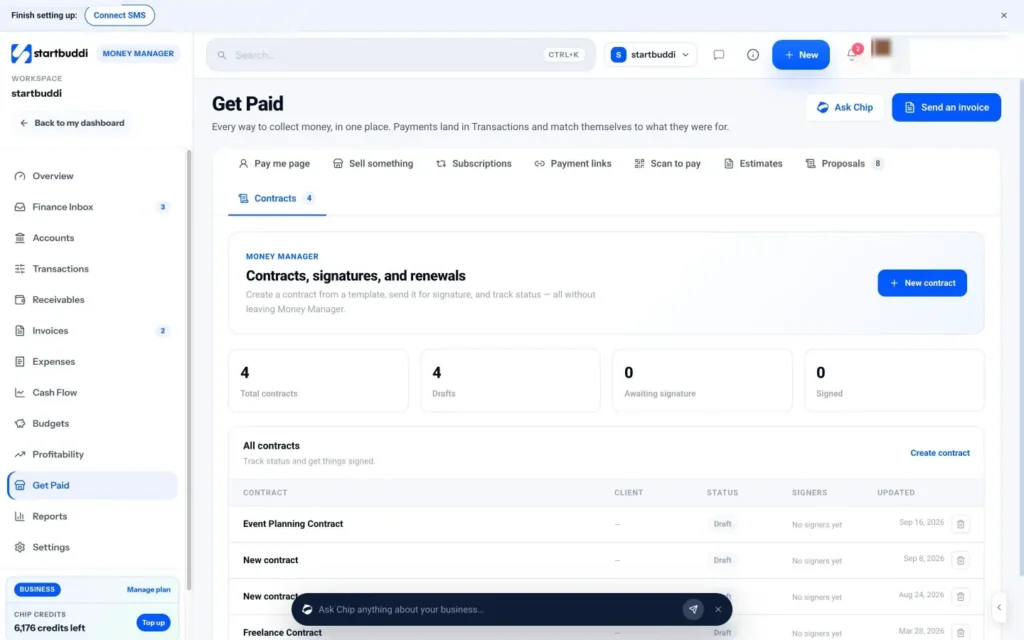
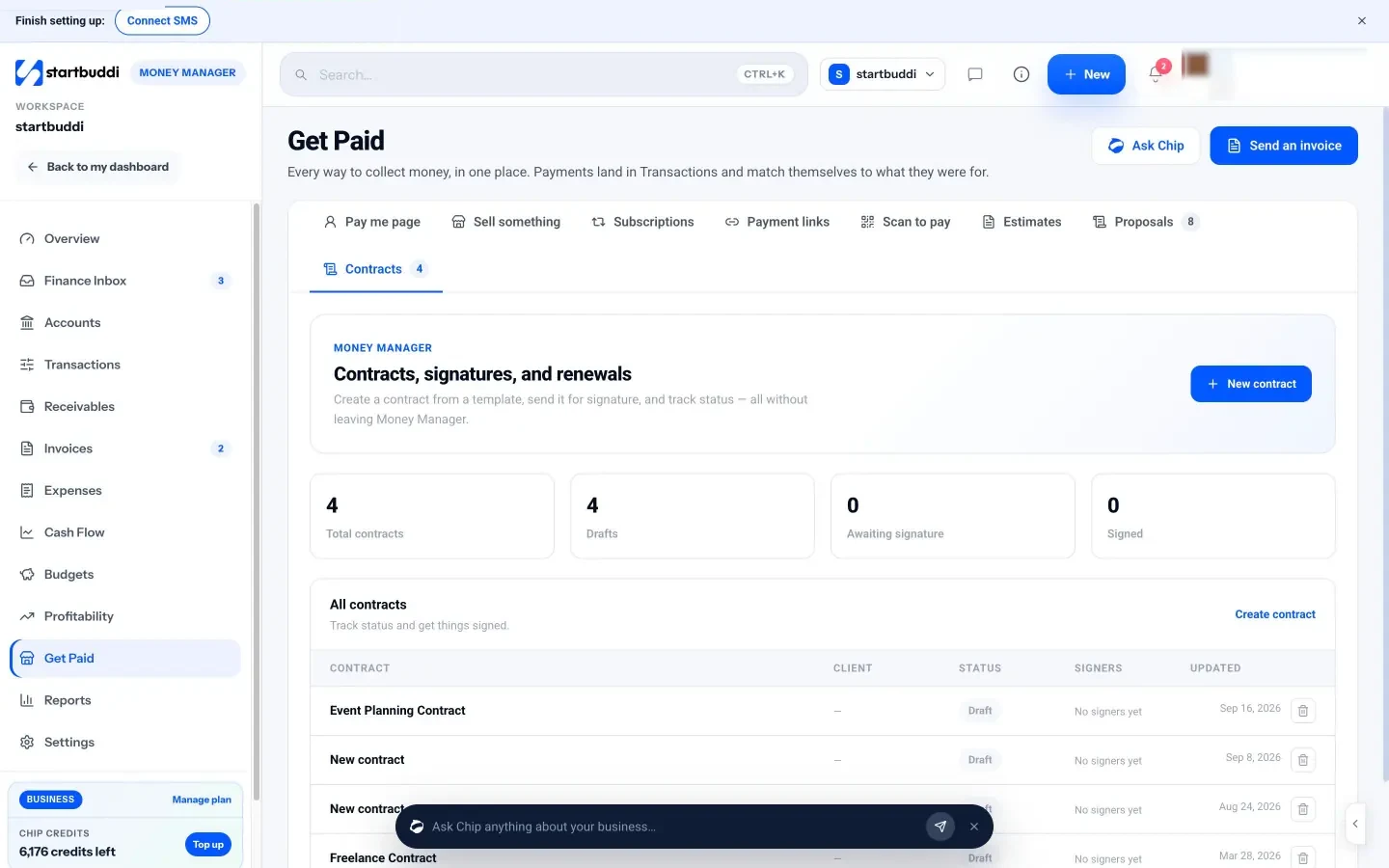
Get the agreement signed. In Money Manager, Get Paid has a Contracts tab. Click New contract, pick a template (the built-in ones include Freelance, Photography, Brand Design, Website Development and Event Planning contracts), use Edit wording to add your plan's scope and terms, add each signer's name and email, and click Send for signature. Signers sign on a public page, and the status moves to Signed when everyone has signed. The app notes that templates are a starting point, not legal advice.
Sign up automatic-payment customers. On the Subscriptions tab, open the plan and click Add subscriber. Enter the customer's email and name, then Create subscribe link and share it by email or message. When the customer subscribes, renewals are charged automatically by your connected provider (Paystack or Stripe) with nothing to run manually. The Subscribers list shows each customer's status and next renewal date, and you can cancel a subscription there when a customer stops.
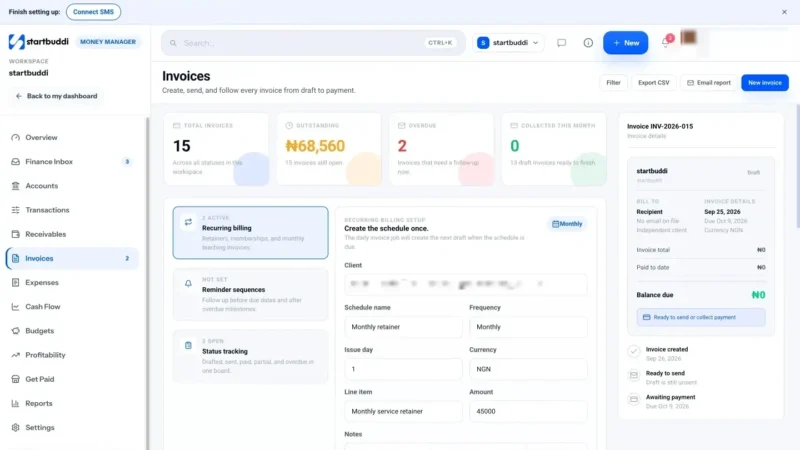
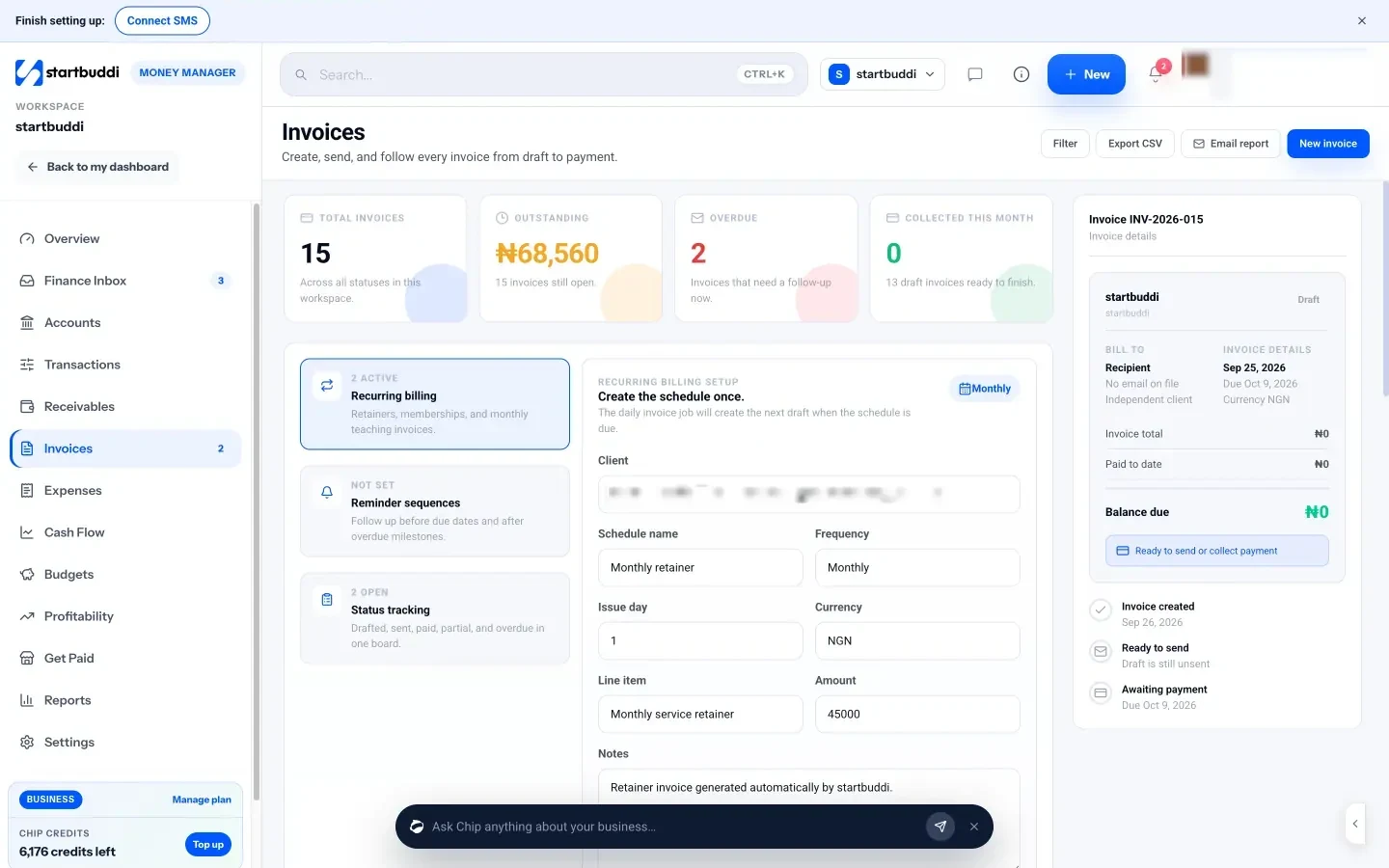
Bill invoice-paying clients. For clients who need invoices, Invoices has a Recurring billing card where you set the client, schedule name (for example "Monthly retainer"), frequency (monthly or quarterly), issue day, currency, line item and amount, and can generate the first draft straight away. Our help article on setting up recurring invoices walks through it. Invoices can include a pay button for Paystack or Stripe as well as your bank details.
Take one-off extras separately. For work outside the plan, a payment link from the Payment links tab collects a one-off payment without drafting a full invoice. Keep plan income and extras apart so your MRR stays accurate.
Keep recurring customers and grow your recurring revenue
- The numbers that matter: churn and retention
- Worked example: what churn does to MRR
- Why customers cancel
- Seven ways to keep recurring customers
- Raising prices on existing plans
- Bigger plans and extras: growing revenue from current customers
- A monthly summary template
- Handling cancellations gracefully
- Tracking MRR month by month
- A monthly recurring revenue routine
- Loyalty rewards that actually work
- Plan your capacity as MRR grows
- When a plan is not working
- Net revenue retention in plain words
- Ask for referrals from happy plan customers
- Mistakes that quietly kill recurring revenue
- Looking after recurring revenue in startbuddi
- Your next step
Winning a recurring customer is only half the job. The value of a plan comes from how long the customer stays. A client who pays $500 a month for three months is worth $1,500; one who stays three years is worth $18,000. This chapter covers how to measure retention, why customers leave, how to keep them, how to raise prices fairly, and a monthly routine for looking after recurring revenue.
The numbers that matter: churn and retention
Churn rate is the share of recurring customers who leave in a period. If you start the month with 40 subscribers and 2 cancel, your monthly churn is 2 ÷ 40 = 5%.
Retention rate is the opposite: the share who stay, here 95%.
Revenue churn looks at money rather than customers. If the two who left were on your cheapest plan, revenue churn may be much lower than 5%. If they were your biggest clients, it may be much higher.
Average customer lifetime is roughly 1 ÷ monthly churn. At 5% churn a month, customers stay about 20 months on average. At 2%, about 50 months. Small improvements in churn make a big difference to lifetime value.
Worked example: what churn does to MRR
A cleaning company in Johannesburg has 60 customers on a R900 monthly plan (MRR of R54,000) and signs up 5 new customers a month.
| Monthly churn | Customers lost a month | Net change a month | Where MRR heads over time |
|---|---|---|---|
| 10% | 6 | −1 | Slowly shrinking despite new sales |
| 5% | 3 | +2 | Growing, levelling off around 100 customers |
| 2% | about 1 | +4 | Growing strongly, levelling off around 250 customers |
With the same sales effort, halving churn changes a business that is quietly shrinking into one that grows. The level-off point is new customers per month divided by the monthly churn rate: 5 ÷ 0.05 = 100 customers. Keeping customers is often cheaper and faster than finding more.
Why customers cancel
When recurring customers leave, the reasons usually fall into a few groups:
- They stopped seeing the value. The work happens, but they no longer notice it.
- Their needs changed. They grew, shrank, moved or changed direction.
- Service slipped. Missed visits, slow replies, a new team member who did not know them.
- Price. Their budget tightened, or a competitor offered less for less.
- Payment failed and nobody followed up.
Ask everyone who cancels one short question: "What is the main reason you are leaving?" After a few answers, patterns appear, and most of them can be fixed.
Seven ways to keep recurring customers
- Make a strong start. The first month decides whether a customer stays. Welcome them, set expectations and deliver a visible early win. Our post on onboarding a new client has a checklist.
- Show the value. Send a short monthly summary: what you did, what changed, what is next. Customers who can see results rarely cancel.
- Check in before problems grow. A quick call every quarter to ask how things are going catches most issues early.
- Keep the same people. In services like cleaning, coaching and grooming, customers bond with a person. Keep continuity where you can.
- Offer a pause, not just a cancel. A customer going away for two months may pause instead of leaving for good.
- Reward loyalty. A free extra service after a year, early access to new services, or a locked price for long-term customers.
- Chase failed payments quickly. Most involuntary churn is avoidable with a friendly message and a fresh link.
Our post on how to retain clients goes deeper on the relationship side.
Raising prices on existing plans
Costs rise, and so should prices. Handled well, most recurring customers accept a fair price rise.
- Review once a year, at the same time each year, so customers know to expect it.
- Give plenty of notice, at least as much as your agreement requires, and more for consumers where local rules ask for it.
- Explain the reason briefly (rising costs, extra value added) without over-apologising.
- Keep the rise moderate. A modest yearly increase is easier to accept than a big jump after several years of nothing.
- Consider protecting your longest customers for a few months as a thank-you.
Bigger plans and extras: growing revenue from current customers
Recurring revenue also grows when existing customers move to a higher tier or add services. The monthly summary is the natural place to suggest it: "You've used your full hours for three months running. The Growth plan would give you 50% more for an extra $400." Keep suggestions relevant and occasional, and only when they genuinely help the customer.
A monthly summary template
A short summary each month is one of the most effective ways to keep customers, because it makes invisible work visible. Keep it to five lines:
- What we did this month: three to five bullet points.
- What changed: a result, number or improvement the customer cares about.
- What is coming next month.
- Plan usage: hours or items used and remaining, if relevant.
- One question or suggestion for them.
It takes ten minutes per customer and often prevents a cancellation you would never have seen coming.
Handling cancellations gracefully
Some customers will leave, however good your service. How you handle it matters, because many will come back, refer others or leave a review. When someone cancels:
- Confirm the cancellation quickly and clearly, with the date the last payment will be taken.
- Ask for the main reason, in one short question.
- Offer a pause or a lighter plan if it fits, once, without pressure.
- Deliver everything they have paid for until the end of the notice period.
- Thank them, and tell them how to restart if they ever want to.
Never make cancelling harder than signing up. Beyond any legal rules, it is the fastest way to turn a former customer into a critic.
Tracking MRR month by month
Keep a simple table, updated at the start of each month. It shows not just whether MRR grew, but why.
| Month | Starting MRR | New | Moved up | Moved down | Cancelled | Ending MRR |
|---|---|---|---|---|---|---|
| July | $7,600 | +$1,000 | +$400 | −$200 | −$500 | $8,300 |
| August | $8,300 | +$500 | $0 | $0 | −$1,200 | $7,600 |
In August, new sales were fine but one large client cancelled. Without the table, the owner might think sales had slowed. With it, the lesson is clear: find out why that client left, and whether others like them are at risk.
A monthly recurring revenue routine
- Update MRR: start of month, new plans added, moves to bigger or smaller plans, cancellations, end of month.
- Check churn: who left, and why.
- Chase failed and late payments.
- Review delivery: did every customer get what their plan promised?
- Pick three customers to contact this month for a check-in or a thank-you.
- Look at the pipeline: which one-off clients could be offered a plan?
Loyalty rewards that actually work
Rewards keep customers when they feel personal and useful. Small, well-timed gestures often work better than big discounts: a free extra session on a client's one-year anniversary, a handwritten thank-you, priority booking in your busiest season, or keeping their price unchanged for a year when you raise prices for new customers. Avoid rewards that train customers to wait for deals, such as frequent price cuts.
Plan your capacity as MRR grows
Recurring work fills your calendar in advance. That is the point, but it can also crowd out new projects and leave you with no time for your own business. Keep an eye on how many hours a month your plans commit you to. A simple rule: when committed plan work passes about three quarters of your available hours, it is time to raise prices, stop selling the plan for a while, or hire help. Our guide on creating a business budget covers how to budget for a new hire, and recurring revenue is exactly what makes that hire affordable.
When a plan is not working
Sometimes a plan does not sell, or it sells but loses money. Look at three things. If nobody signs up, the offer may be unclear or priced for the wrong customer; talk to five people who said no. If people sign up but leave within three months, delivery or onboarding is falling short of the promise. If customers stay but you are exhausted, the scope is too generous for the price. Change one thing at a time and give it two or three months before judging the result.
Net revenue retention in plain words
One more number is worth knowing once you have a few dozen recurring customers. Net revenue retention asks: of the recurring revenue you had from existing customers a year ago, how much do those same customers pay you now? Moves to bigger plans and price rises push it up; cancellations and moves to smaller plans push it down. New customers are left out.
Say your existing customers paid $8,000 a month a year ago. Since then, some moved to bigger plans (+$900), some to smaller ones (−$300) and some cancelled (−$1,100). Those same customers now pay $7,500, so net revenue retention is $7,500 ÷ $8,000 = about 94%. Above 100% means your existing customers alone are growing your revenue, even before you sign anyone new. That is the strongest sign that your plans deliver real value, and a good target to work towards over time.
Ask for referrals from happy plan customers
Your most loyal recurring customers are also your best source of new ones. Once a customer has been with you for three months and is clearly happy, ask whether they know anyone who would benefit from the same plan. Make it easy: a short message they can forward, or a link to your sign-up page. A thank-you for each referral that signs up, such as a free month or an extra service, rewards the behaviour you want most.
Mistakes that quietly kill recurring revenue
- Chasing new customers and neglecting current ones.
- Letting delivery slip on older accounts while new ones get attention.
- Never asking why people leave.
- Not tracking MRR at all, so a slow decline goes unnoticed for months.
- Relying on one or two big plans for most of your recurring income.
Looking after recurring revenue in startbuddi
Watch MRR and subscribers. The Subscriptions tab in Get Paid shows active subscribers, monthly recurring revenue and total subscribers, and the Subscribers list shows each customer's status and next renewal date. Check it at the start of each month as part of the routine above.
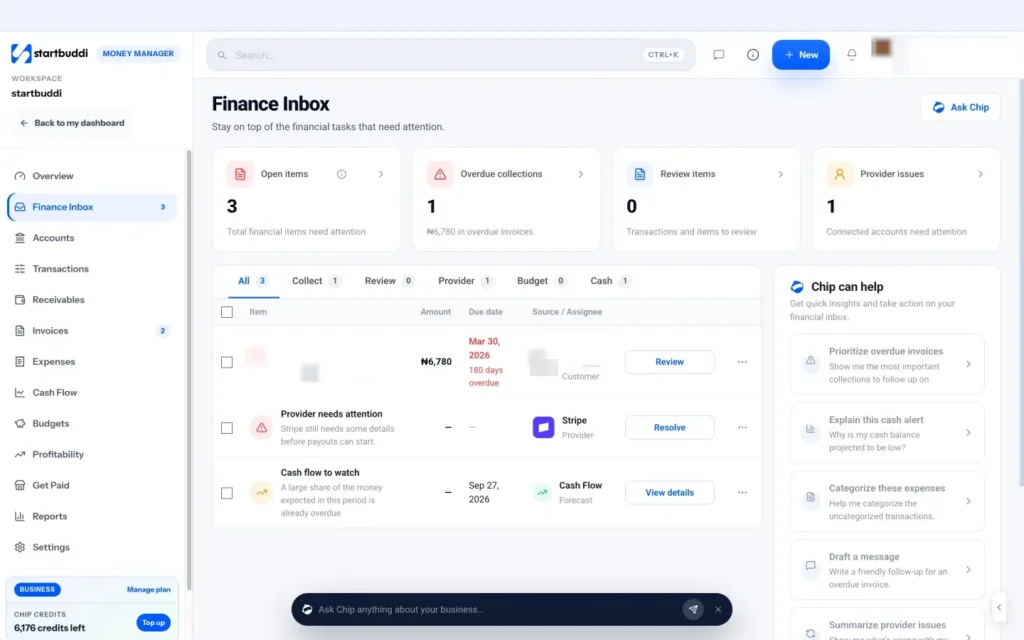
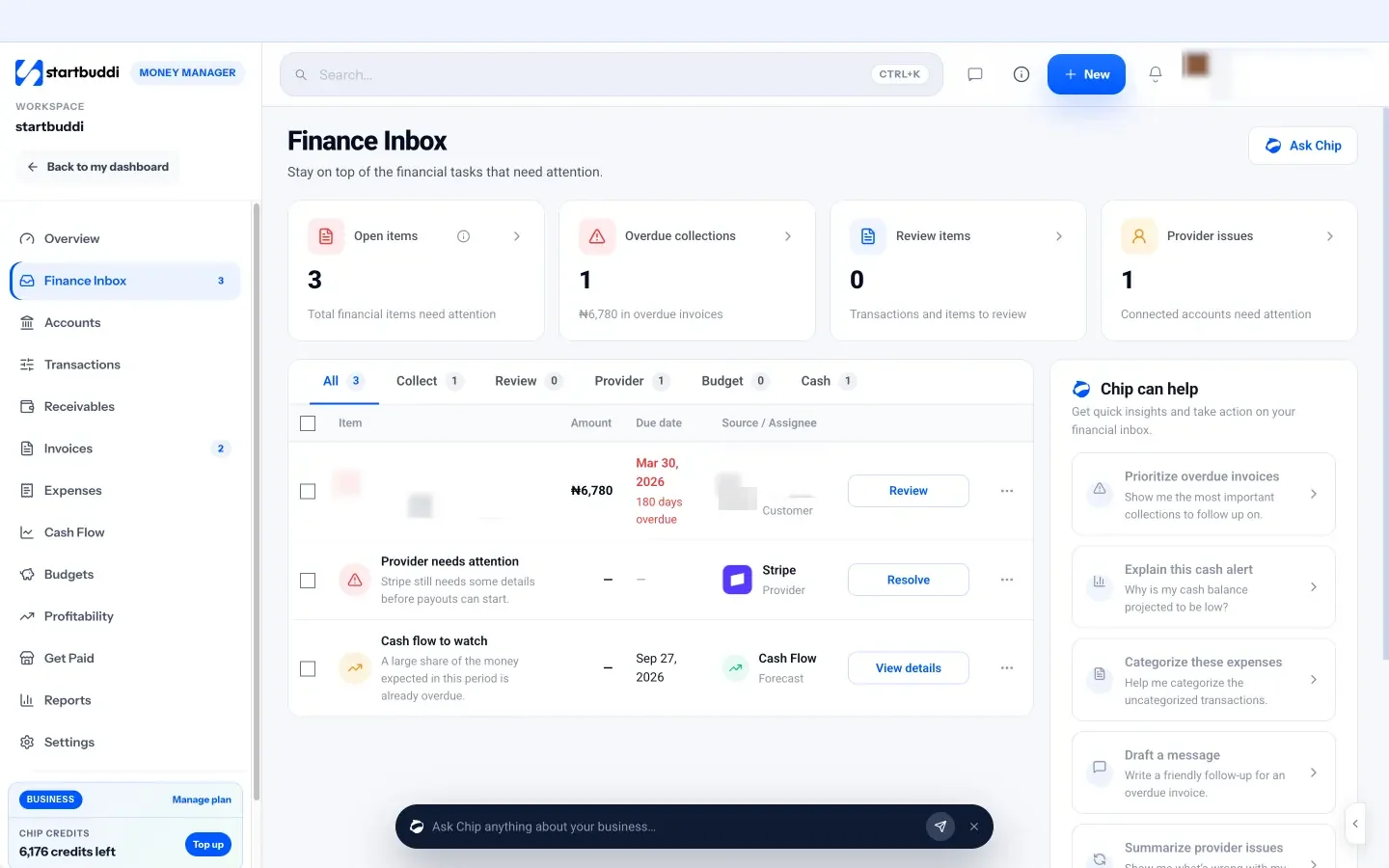
Catch failed payments early. The Finance Inbox flags a failed subscription payment as it happens, alongside overdue invoices and other items that need attention. Each item has an action and an Ask Chip button, and Chip can draft a friendly message to the customer.
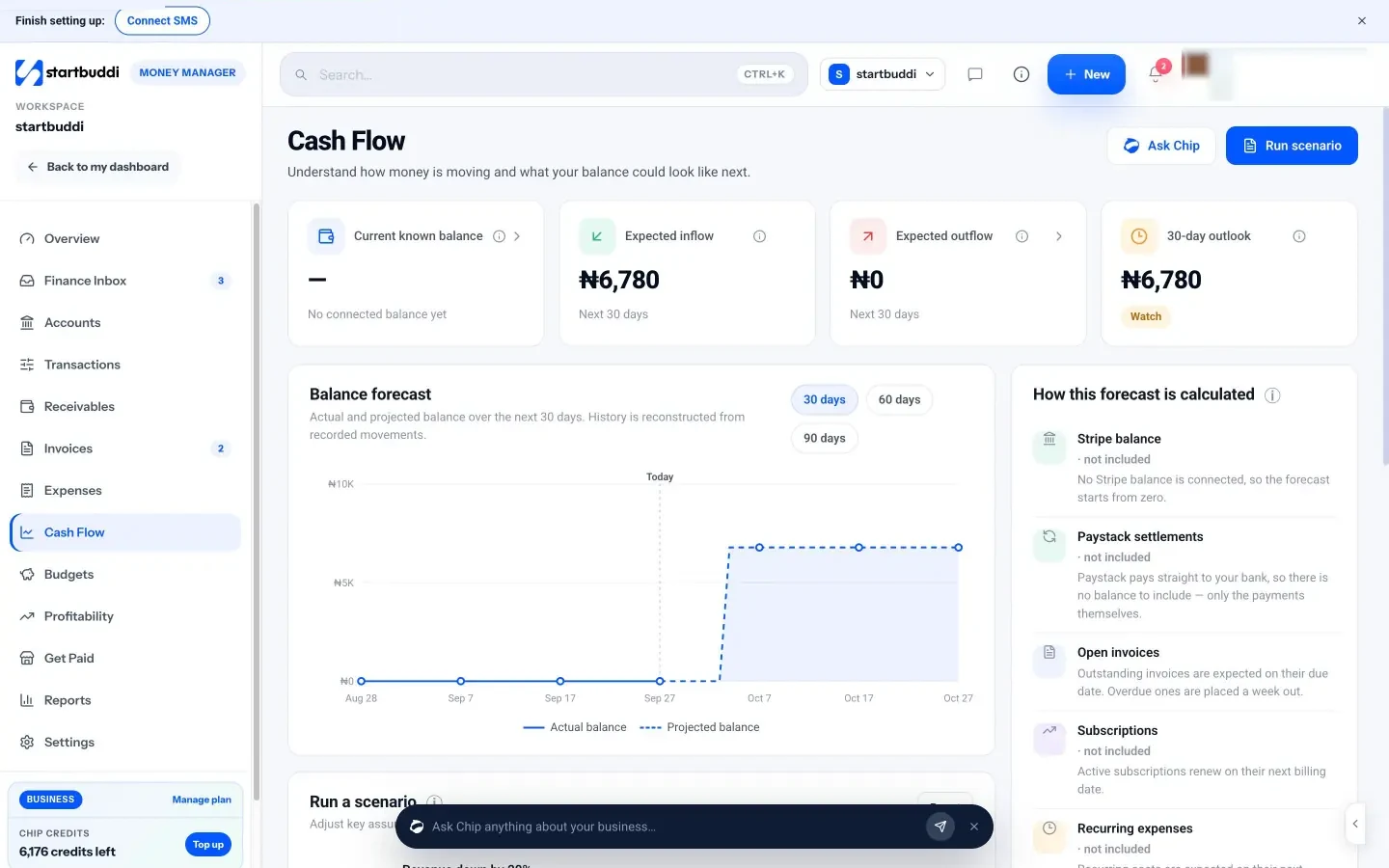
See renewals in your cash forecast. The Cash Flow page includes subscription renewals in its balance forecast, along with open invoices, recurring expenses and bills, so you can see how much of next month is already covered. In Transactions, the Subscriptions filter lists every subscription payment.
Ask Chip for help with the routine. From the Finance Inbox or any subscription payment, Ask Chip can help you prioritise follow-ups or draft a message to a customer whose payment failed. You can also ask Chip in the Chip drawer to draft a monthly summary for a client from your notes, then edit it before you send it. Chip shows you a preview; nothing is sent without you.
Know which clients are worth the most. The Profitability page ranks customers and projects by revenue, attributed expenses, profit and margin, which helps you decide where to focus retention effort and whether a plan is priced right.
Keep the relationship in one place. Because your clients live in startbuddi's Customers area, the same record holds their invoices, payments, notes and conversations, so check-ins and monthly summaries are easy to prepare. If your plans include delivery work, Work projects keep each client's tasks visible so nothing slips.
Subscriptions and payment links need a connected and verified Paystack or Stripe account. Money Manager is available on every plan, including Free, and every paid plan has a 30-day trial.
Your next step
This week, list your five best repeat clients, fill in the offer template from chapter 2 for one simple plan, and send each of them a short message offering it. Then set up the plan so they can sign up in one click. You can start free, or see what each plan includes on the pricing page.
Tiwalade Joanna Okedara-Kalu is the founder, CEO and CTO of startbuddi, the business system that brings clients, bookings, invoices, projects, marketing and the Chip AI assistant into one place. Tiwalade builds software around how service businesses really work day to day, and writes about client management, getting paid on time and why small businesses outgrow the tools they start with.
Founded startbuddi and leads its product and engineering