Talent Acquisition and Retention: A Practical Guide for Small Business Owners
Talent acquisition and retention for small teams: how hiring and keeping people connect, what turnover really costs, and a checklist to start this month.



Talent acquisition and retention is the joined-up work of finding the right people and then keeping them. Acquisition covers planning roles, attracting candidates, selecting and making offers; retention covers onboarding, pay, growth, feedback and how people are managed. For a small business they are one process, because who you hire and how you treat them decide who stays.
Key takeaways
- Treat hiring and keeping people as one loop. Most early resignations trace back to a mismatch at hiring or a poor first few months.
- Replacing someone is expensive. Gallup estimates the cost at between half and twice their annual salary.
- Small teams can’t win on salary alone, but they can win on clarity, flexibility, growth and a manager who listens.
- Simple habits work: honest job adverts, structured onboarding, monthly one-to-ones, regular pay reviews and asking people how they feel before they leave.
- Measure two numbers: how long new hires stay, and why people leave.
What talent acquisition and retention means for a small business
Talent acquisition is the planned way you bring people into the business. It is wider than filling a vacancy: it starts with deciding what work needs doing, then describing the role honestly, finding candidates, selecting fairly and making a clear offer.
Retention is everything that makes good people choose to stay: a proper start, fair pay, clear goals, feedback, chances to grow and flexibility where the work allows it.
In practice, acquisition sets the ceiling on retention. If you hire someone whose skills, expectations or values don’t fit the job, no amount of perks will keep them happy. And retention feeds acquisition: a team where people stay and speak well of you makes the next hire easier, because candidates hear about you from people who work there.
In a large company these sit in separate teams. In a business of five or fifteen, the founder usually does both, and that is an advantage. You can see in a single person how a promise made at interview plays out six months later.
Why the two belong together
Think of the employee lifecycle as one line: plan the role, attract, select, offer, onboard, develop, review, and either keep or say goodbye. A weak link anywhere costs you later.
| Stage | What can go wrong | What it does to retention |
|---|---|---|
| Plan the role | The job isn’t defined, so it changes weekly | New hire feels misled and leaves |
| Job advert | Overselling the role or hiding the pay | Expectations clash with reality |
| Selection | Hiring on gut feel or likeability | Skills or values don’t fit the work |
| Offer | Vague terms, verbal promises | Disputes about pay, hours or title |
| Onboarding | No plan for the first weeks | Early regret, quick resignations |
| Development | No feedback, no growth path | Good people get bored and look elsewhere |
Gallup’s research on onboarding found that only 12% of employees (checked on 1 October 2026) strongly agree their organisation does a great job of onboarding new people. The handover from “hired” to “settled in” is where many small businesses lose the people they worked hard to find.
What employee turnover really costs
When someone leaves, you pay for the gap, the search, the interviews, the new person’s learning time and the work that slips in between. Gallup puts the cost of replacing an employee (checked on 1 October 2026) at between one-half and two times their annual salary. The same research found that 52% of people who left voluntarily said their manager or organisation could have done something to keep them.
A worked example
These figures are illustrative.
Zainab runs a 10-person digital agency in Abuja. Last year three people left: two designers and an account manager, each earning about ₦6,000,000 a year.
| Figure | |
|---|---|
| Average headcount | 10 |
| People who left | 3 |
| Turnover rate (3 ÷ 10 × 100) | 30% |
| Replacement cost per person (half to two times ₦6,000,000) | ₦3,000,000 to ₦12,000,000 |
| Total cost of three departures | ₦9,000,000 to ₦36,000,000 |
Even at the low end, that is more than the salary of one extra designer. If better onboarding and regular one-to-ones kept just one of those three people, the time spent would pay for itself many times over.
Talent acquisition and retention strategies that work in small teams
1. Hire for the job as it really is
Write down what the person will do in a normal week before you write the advert. A clear role description, with the pay range, attracts people who want that job and puts off people who don’t. Our job description template walks through it, and the talent acquisition process covers the steps from advert to offer.
2. Be honest about the trade-offs
A small business can’t match a bank’s salary or a multinational’s training budget. Say so, and say what you offer instead: more responsibility sooner, direct access to the founder, flexible hours, or a share of profits. People who choose you knowing the trade-offs are far more likely to stay.
3. Run a structured first 90 days
Plan the first day, the first week and the first three months before the person starts. Equipment ready, logins working, a named buddy, and goals for 30, 60 and 90 days. Our guide on how to onboard a new employee gives a full plan, and employee onboarding explains the stages.
4. Talk every month, review twice a year
A 30-minute one-to-one each month catches problems while they’re small: workload, a difficult client, a personal issue, a sense of standing still. Twice a year, hold a proper performance review that looks at what went well, what’s next and whether pay still matches the job.
5. Show people where they can grow
In a team of eight there may be no promotion ladder, but there is always new responsibility: a client to lead, a process to own, a junior to train, a course to take. Agree one development goal per person and check it at each review.
6. Pay fairly and review it on schedule
Pay isn’t everything, but feeling underpaid is one of the fastest ways to lose someone. Check what similar roles pay in your city at least once a year, and review salaries on a fixed date so nobody has to ask. In high-inflation economies such as Nigeria, an annual review matters even more, because a salary that was fair in January can feel thin by December.
7. Offer flexibility where the work allows
Flexible hours or some remote days cost a small business little and are valued highly, especially by people who face long commutes in cities like Lagos or Nairobi. In the UK, all employees have the legal right to request flexible working (checked on 1 October 2026) from their first day in a job, so it is worth having a clear answer ready.
8. Ask before they leave, and learn when they do
Run a short anonymous pulse survey every quarter. When someone does resign, hold an exit conversation and look for patterns. Our guide to employee engagement surveys has question sets you can use.
How to get started this month
You don’t need an HR department. Start with this short plan:
Common mistakes to avoid
- Hiring in a panic. A rushed hire to plug a gap often leaves within months, and you start again.
- Selling a job that doesn’t exist. Promises of “lots of growth” with no plan behind them come back as resignations.
- Treating retention as perks. Free lunches don’t fix an unclear role or a manager who never gives feedback.
- Waiting for the resignation letter. By then the decision is made. Regular conversations are your early warning.
- Not tracking anything. Without a list of who left and why, you can’t see patterns.
How startbuddi helps you hire well and keep people
startbuddi doesn’t include an applicant tracking system, so you’ll still advertise and shortlist candidates elsewhere. Where it helps is from the offer onwards, in the People module:
- Onboarding checklists. Start onboarding for a new hire, pick a template, and every step is assigned to the new hire, their manager, HR or IT, with reminders for overdue steps.
- Performance reviews and feedback. Start a review for a team member: they add a self review, their manager adds theirs and a rating, and anyone can send feedback in between.
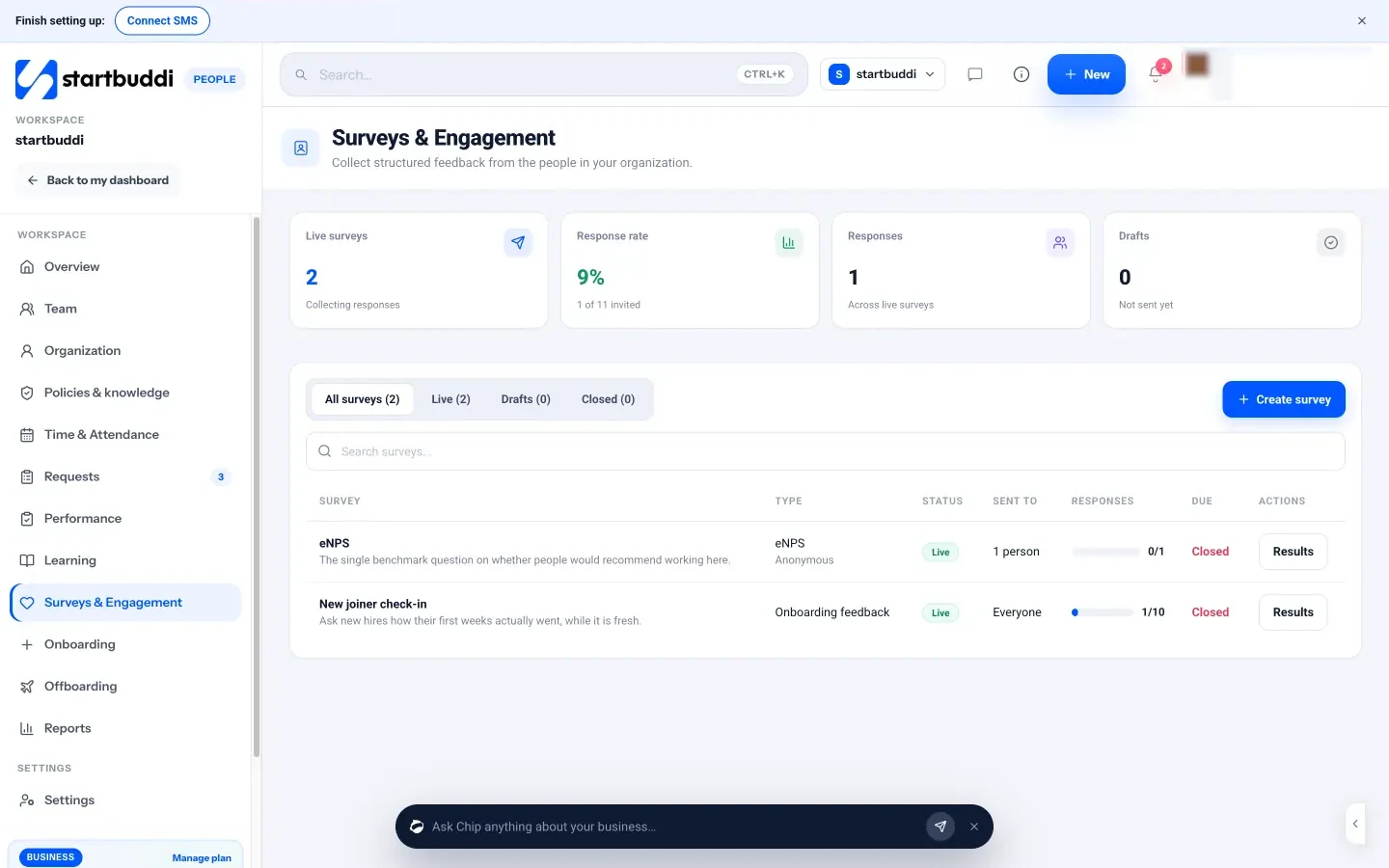
- Surveys and engagement. Send a weekly pulse check, eNPS, a new joiner check-in or an exit interview, anonymous by default, with results that stay hidden until at least three people respond.
- Learning, leave and policies in the same place, so a growing team has one home for its people work.
See how it fits together on the People and surveys pages, or read how startbuddi supports startups building their first team. For the bigger picture of hiring your first people, our guide to building your first team is the place to start.
Keep the people you worked hard to hire
Start each new hire with a proper onboarding checklist, hold reviews on time and ask your team how they’re doing. Start free with startbuddi and set up People for your team.
Frequently asked questions
What is talent acquisition and retention?
Talent acquisition and retention is the combined work of attracting and hiring the right people and then keeping them in the business. Acquisition covers role planning, adverts, selection and offers. Retention covers onboarding, pay, feedback, growth and management.
Why is employee retention important for a small business?
Each departure in a small team removes a large share of its capacity and knowledge. Gallup estimates replacing an employee costs between half and twice their annual salary. Keeping good people protects client relationships, quality and the founder's time.
How do you retain employees in a small business without big salaries?
Offer what larger firms often can't: clear responsibility, direct access to the founder, flexible hours and visible growth. Pay fairly for the local market and review it on a set date. Hold monthly one-to-ones so problems surface before people start looking elsewhere.
What is a good employee retention rate?
It depends on your industry and country, so compare yourself with your own past years rather than a single benchmark. Track how many people leave each year and how long new hires stay. If people regularly leave in their first six months, look at your hiring and onboarding first.
How do you calculate employee turnover?
Divide the number of people who left in a period by your average headcount in that period, then multiply by 100. For example, three leavers in a team averaging 10 people gives a 30% annual turnover rate. Track voluntary and involuntary departures separately.
What is the difference between talent acquisition and recruitment?
Recruitment is filling a specific vacancy now. Talent acquisition is the longer-term approach: planning the roles you'll need, building a reputation as a good employer and keeping a pool of people you'd like to hire. Small businesses benefit from thinking that way before they need to hire urgently. Our post on talent acquisition vs recruitment explains the difference in more detail.
Omolola Akiyode is the operations and project manager at startbuddi, leading cross-functional projects and the content that helps founders get set up. Omolola writes about projects, websites and getting found online, and turns complex ideas into clear, practical steps.
Runs operations and projects at startbuddi