Employee Onboarding and Offboarding Checklist: Step-by-Step List + Free Template
An employee onboarding and offboarding checklist for small teams: offer to day 90, then notice to last day, with access, equipment, pay and handover steps.


Photo: Jakub Żerdzicki / Unsplash
An employee onboarding and offboarding checklist is one list that covers both ends of a job: getting a new hire paperwork, access, equipment and a clear first 90 days, then, when someone leaves, handing over their work, getting equipment back, settling final pay and closing their access. Keeping both in one place stops the same gaps opening twice.
Key takeaways
- Onboarding and offboarding are mirror images. Every account, device and document you give on day one should appear again on the exit list.
- Start onboarding before day one. Contracts, right-to-work checks and laptops take longer than founders expect.
- On the way out, hand over work first and remove access last, on the final day, never before.
- Give every step an owner (new hire, manager, HR or whoever handles IT) and a due date.
- This is general information, not legal advice. Employment rules differ in Nigeria, the UK, the US and elsewhere, so check your own.
Why use one employee onboarding and offboarding checklist
Most small teams write an onboarding list once and never write the leaving one. Then the first resignation arrives and nobody knows which accounts the person has, who owns their client files, or whether the laptop was ever logged.
A combined checklist fixes that. The employee onboarding half records everything you hand over. The employee offboarding half takes the same items back in a safe order. If you only ever do one thing from this page, keep a simple access and equipment log from day one. It turns a stressful exit into a 20-minute job.
The employee onboarding checklist
Copy the boxes into a doc, a spreadsheet or your HR tool. Delete what doesn’t apply to your country or role.
1. After the offer is accepted (preboarding)
2. Before day one
3. Day one
4. First week
5. First 90 days
If your hire works remotely, add the steps in our remote employee onboarding checklist, such as shipping equipment and setting overlap hours. For the IT side in detail, see the IT onboarding checklist.
The employee offboarding checklist
Offboarding starts the day someone gives notice or you agree an end date. The order matters: knowledge first, things second, access last.
1. When notice is given
2. Handover (the notice period)
3. Last day
4. After they leave
Country notes: the legal bits founders miss
These are the checks that most often catch small employers out. They are general information, not legal advice; ask an adviser where you hire.
| Country | Joining | Leaving |
|---|---|---|
| UK | Check right to work before employment starts (GOV.UK). Give the written statement of employment particulars on the first day (GOV.UK). | Give a P45 and process final pay through payroll (GOV.UK). |
| US | Complete Form I-9 for every hire, with the employee and employer sections (USCIS). Check state rules on new-hire reporting. | Final pay timing is set by state law, so check your state labour department. |
| Nigeria | Put the terms of employment in writing, register the employee for pension with their chosen pension fund administrator, and register PAYE with your state tax authority. | Pay final entitlements under the contract, update pension and tax records, and keep a signed handover. |
GOV.UK and USCIS pages checked on 1 October 2026.
Worked example: one hire and one leaver in a six-person agency
This is an illustrative example. A six-person design agency in Lagos hires a project manager, Ifeoma, starting on Monday 30 November, while a designer, Tunde, has given four weeks’ notice with a last day of Friday 27 November.
| Date | Ifeoma (joining) | Tunde (leaving) |
|---|---|---|
| Fri 30 Oct | Offer signed; laptop ordered | Gives notice; last day agreed in writing |
| Mon 2 Nov | Accounts list drafted | Handover list started: 4 clients, 2 open projects |
| Mon 16 Nov | Handbook and 30/60/90 plan ready | Introduces new owners to 4 clients |
| Mon 23 Nov | Accounts created, day-one meetings booked | Files moved to shared folders; ownership transferred |
| Fri 27 Nov | Welcome message sent | Exit interview; laptop and access card returned; access closed at 6pm |
| Mon 30 Nov | Day one: equipment handed over, sign-ins tested | Final pay and owed leave on the November payroll |
Two things make this work. Tunde’s handover finishes on the Monday of his last week, so Ifeoma’s start doesn’t depend on him. And the laptop Tunde returns is logged and wiped, ready for the next hire rather than sitting in a drawer.
Common mistakes
- Removing access too early. Closing someone’s email on the day they resign can lock you out of client threads. Remove access on the last day, after handover.
- Forgetting shared logins. The social media password, the supplier portal, the office Wi-Fi. If they knew it, change it.
- No equipment log. Without one, you can’t ask for what you can’t name.
- Handover by memory. A written note per client or project survives the person leaving.
- Treating onboarding as day one only. Most new hires decide whether they’ll stay in the first few months, not the first morning.
For the people side of running a small team, from contracts to reviews, see our guide to HR for small business. For a deeper look at the first weeks, read how to onboard a new employee.
How to run this checklist in startbuddi
startbuddi’s People module has onboarding and offboarding built in, so the lists above become tracked checklists with owners and reminders.
- Start onboarding. Go to People → Onboarding → Start onboarding. Choose who, add the job title, department, manager and start date (due dates count from it), then pick a checklist.
- Use or adapt the template. The built-in “Company onboarding” template covers equipment and access before day one, introductions on day one, and training and goals in the first fortnight. Save your own version under Templates, with steps grouped by Day 1, Week 1 and so on.
- Give each step an owner. Steps can belong to the new hire, the manager, HR or IT / Admin, and each owner is notified. Equipment and access requests go to an owner or admin to approve; nothing is granted automatically.
- Ask Chip for the plan. Chip HR can draft a 30/60/90-day plan for the new hire and save it in Documents, showing you a preview first.
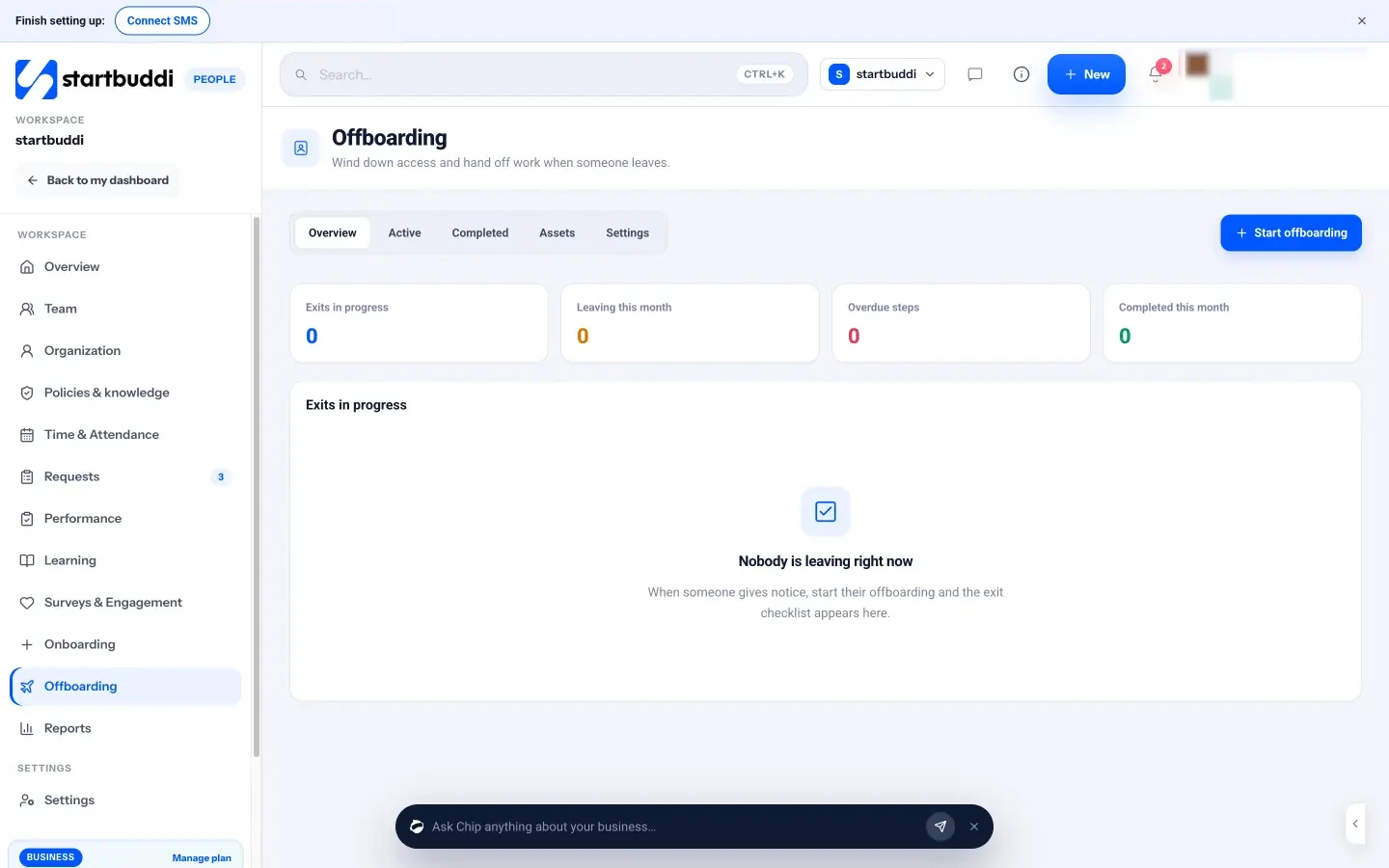
- Start offboarding when notice comes. People → Offboarding → Start offboarding, then add the last working day and reason. The default exit checklist covers confirming the last day, telling the team and clients, the handover note, transferring files, the exit interview, returning equipment, settling final pay and expenses, and removing access.
- Hand over and close out. Reassign their projects with “Hand everything to…”, log returned equipment under Assets, then Complete offboarding. Access stays until you complete the checklist.
startbuddi doesn’t run payroll, so final pay is a checklist step you complete in your payroll system. Inviting a new hire as a teammate needs a paid plan with seats; see pricing. Read more about People onboarding, or see how startups use People for their first hires.
Make joining and leaving routine
Copy both checklists, add your own accounts and equipment, and use them for every hire and every leaver. To run them with owners and reminders, start free with startbuddi and set up People.
Frequently asked questions
What should an onboarding and offboarding checklist include?
It should cover paperwork, access, equipment, introductions and goals for joiners, and handover, equipment return, final pay, access removal and records for leavers. Each step needs an owner and a due date. The most useful part is a log of every account and device you give out, so you can take them back.
When should offboarding start?
Offboarding should start the day someone gives notice or an end date is agreed, not on their last day. That gives time for a written handover, client introductions and moving files. Access removal comes last, at the end of the final working day.
When should I remove a leaving employee's access?
Remove access at the end of their last working day, after the handover is done and files have moved to shared folders. Change any shared passwords they knew at the same time. Removing access early can lock you out of client conversations and files.
How long should employee onboarding take?
Plan for about 90 days, not just the first day. Paperwork and equipment come before day one, introductions and a first task on day one, and regular check-ins and goals over the first three months, ending in a written review. Many small teams tie this to a probation period.
What is the difference between onboarding and offboarding?
Onboarding brings a new employee into the business: contract, access, equipment, training and goals. Offboarding takes them out safely: handover, equipment return, final pay and closing access. A good offboarding list mirrors the onboarding one item by item.
Do small businesses need an exit interview?
It isn't usually a legal requirement, but it's worth 20 minutes. Leavers often say what current staff won't, about workload, pay or management. Write the answers down and review them with the next hire's onboarding in mind.
Chinedu Kalu is the co-founder and chief operating officer of startbuddi, responsible for how the company runs day to day. Chinedu writes about the operational side of a small business: registering and running the company, money, hiring and the routines that keep a team on track.
Co-founded startbuddi and runs its operations