Sales Onboarding Checklist: Step-by-Step List + Free Template
A sales onboarding checklist for small businesses: what to prepare before day one, the first week, then the 30, 60 and 90 days, with a copy-ready template.


Photo: KOBU Agency / Unsplash
A sales onboarding checklist is the list of everything a new salesperson needs to learn, set up and practise before they can sell on their own: your offer and prices, your ideal client, your sales process and tools, the rules on contacting people, and supervised practice. For a small business, plan it in five phases: before day one, week one, then 30, 60 and 90 days.
Key takeaways
- A new rep should know your offer, your prices and who you sell to before they speak to a single lead.
- Shadowing and role-play in week one save months of lost deals later.
- Give them real targets by day 30, but activity targets (calls, meetings, proposals) before revenue targets.
- Teach the rules on contacting people: consent for marketing messages and do-not-call lists are not optional.
- Write the checklist once, then reuse it for every sales hire. It becomes your sales playbook.
Why small businesses need a sales onboarding checklist
In a 5 or 10 person service business, the first salesperson usually joins a founder who has been selling from memory. Everything that works (the pitch, the price objections, the follow-up timing) lives in the founder’s head. Without a checklist, the new rep learns by guessing, the founder answers the same questions every day, and the first three months produce very little.
A checklist turns that knowledge into steps. It also makes the first 90 days measurable: you can see whether the rep is behind because of skill, knowledge or simply a missing login.
General onboarding still applies. Acas, the UK’s workplace advice service, recommends planning an induction programme that covers the role, policies, people and a review of how things are going (checked on 1 October 2026). Our employee onboarding and offboarding checklist covers the HR side. This page covers what’s specific to sales.
The sales onboarding checklist
Copy this into a document or your onboarding tool and adapt it.
Phase 1: Before day one
Phase 2: Week one
Phase 3: Days 8 to 30
Phase 4: Days 31 to 60
Phase 5: Days 61 to 90
What goes in the sales pack
The sales pack is the folder a new rep will open every day. Keep it short enough to read in an afternoon:
- a one-line description of each service, with what’s included, what isn’t and the price;
- your ideal client and the three problems they most often bring;
- two or three short case studies with real outcomes (with the client’s permission);
- the questions you ask on a first call;
- answers to the five objections you hear most, in your own words;
- quote, proposal and follow-up templates;
- who to hand a won deal to, and what the client should receive next.
A 30-60-90 day plan: worked example
These figures are an illustration, not benchmarks. Use your own numbers.
Emeka joins a Lagos digital agency as its first salesperson. The agency’s average project is ₦1,200,000, and about one in four proposals turns into a deal.
| Period | Activity targets | Revenue target | What the manager checks |
|---|---|---|---|
| Days 1 to 30 | 40 new conversations, 8 meetings, 4 proposals | None | Call notes, pipeline hygiene, product knowledge |
| Days 31 to 60 | 60 conversations, 12 meetings, 8 proposals | 1 signed project (₦1,200,000) | Meeting-to-proposal rate, follow-up speed |
| Days 61 to 90 | 60 conversations, 12 meetings, 8 proposals | 2 signed projects (₦2,400,000) | Win rate, deal size, forecast accuracy |
Arithmetic check: 8 proposals × 1 in 4 = 2 deals, and 2 × ₦1,200,000 = ₦2,400,000. The day-60 target is lower because proposals sent in the first month take time to close.
For a recruiter in Toronto or an IT support firm in London, the shape is the same: activity first, then revenue, measured against your own conversion rates.
Compliance: what every new salesperson must know
Breaking the rules on contacting people can bring fines and damage your name. Cover these in week one:
- Consent for marketing messages. In the UK, electronic marketing by email and text generally needs consent or a clear exception; the Information Commissioner’s Office explains the rules in its direct marketing guidance. In Nigeria, the Nigeria Data Protection Act sets the rules for using personal data.
- Calling rules. In the US, the Federal Trade Commission’s guide to the Telemarketing Sales Rule covers do-not-call lists and calling hours. Other countries have their own registers.
- Honest claims. No promises the delivery team can’t keep, and no invented discounts or deadlines.
- Records. Every conversation logged, every opt-out respected.
Checked on 1 October 2026. This is general information, not legal advice.
Common mistakes in sales onboarding
- Handing over a phone and a lead list on day one. The rep burns good leads while learning the offer.
- No written prices or packages. If the founder quotes differently each time, the rep can’t sell consistently.
- Revenue targets in month one. They push reps to discount or over-promise.
- Skipping shadowing. Listening to real calls teaches more than any slide deck.
- No time with the delivery team. Reps who don’t understand delivery sell things that can’t be delivered on time.
- No reviews. Without check-ins at 30, 60 and 90 days, problems surface at month six.
How to do this in startbuddi
startbuddi’s People module runs onboarding as a checklist with owners and due dates, and Customers holds the pipeline the new rep will work in.
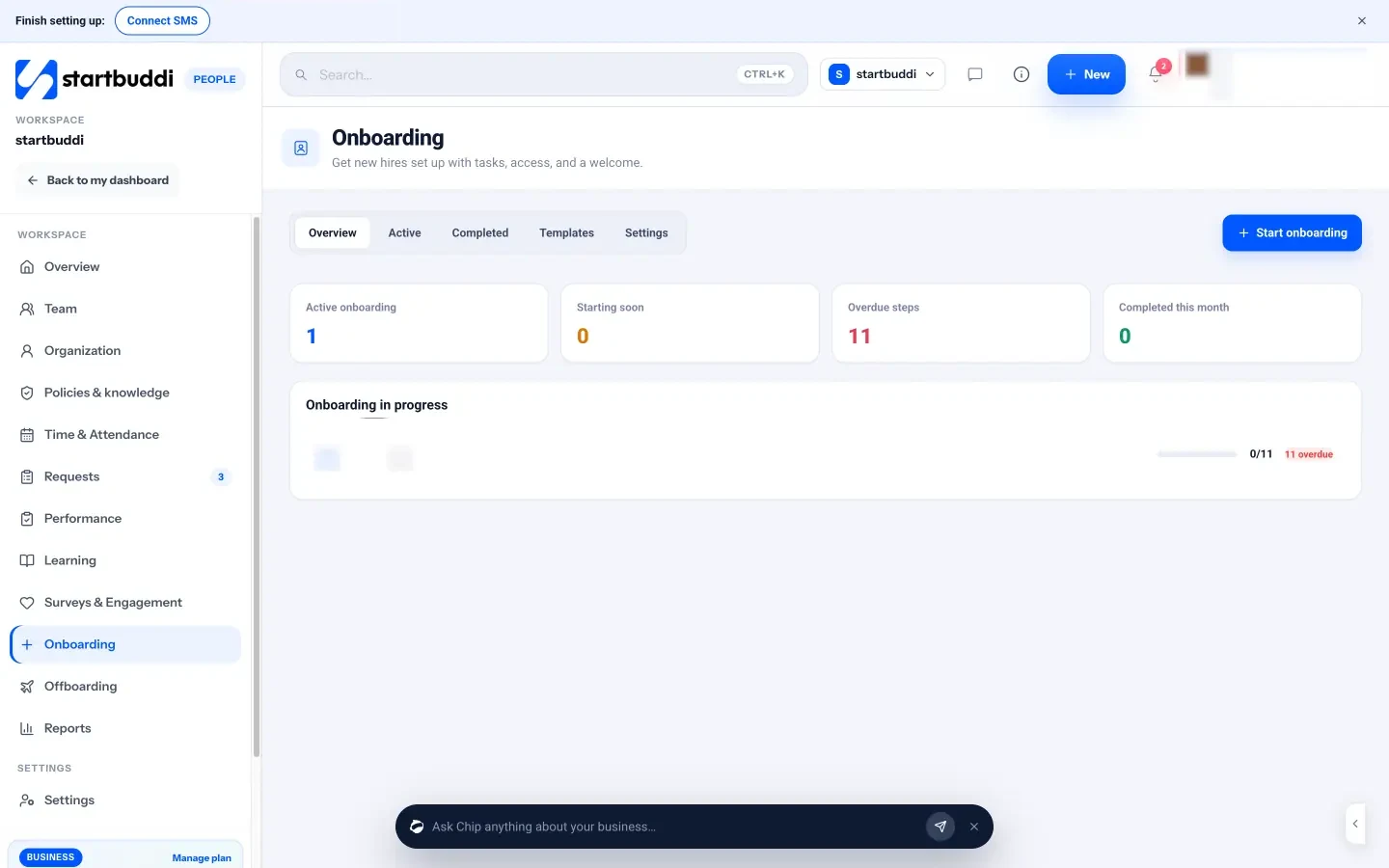
- Create a sales onboarding template. In People, open Onboarding, then Templates. Add the steps from the checklist above, grouped by phase (Before day one, Week one, Days 8 to 30 and so on), and give each step an owner: the new hire, their manager, HR or IT and admin.
- Start onboarding for the new rep. Choose Start onboarding, add them as a new hire or pick someone already in the team, enter their job title, manager and start date, and select your sales template. Due dates count from the start date, and everyone who owns a step is notified.
- Draft a 30/60/90 plan with Chip. Ask Chip, startbuddi’s AI assistant, to draft a 30/60/90 plan for the new rep. It creates a draft document you can edit before sharing.
- Give them their pipeline. In Customers, the rep works leads and deals through your pipeline stages, logging calls and notes on each contact.
- Track progress. The onboarding detail page shows each step, what’s overdue, and a Send reminder button. Complete onboarding once every step is done.
Inviting a new team member needs a paid plan with a seat for them; see pricing. Learn more about onboarding in startbuddi or how startbuddi works as a CRM for service businesses.
Related guides
- The sales process for a small business: the stages your new rep will follow.
- How to train employees: building practice and feedback into the first months.
- Remote employee onboarding checklist: extra steps when your rep works from home.
- Employee onboarding: the term explained.
Turn this checklist into a repeatable onboarding
Save the checklist as a template, assign each step and track your new rep’s first 90 days in one place. Start startbuddi free, then see what each plan includes on our pricing page.
Frequently asked questions
What should a sales onboarding checklist include?
It should cover setup before day one (accounts, CRM access, the sales pack), learning the offer, prices, ideal client and sales process in week one, supervised calls and activity targets in the first 30 days, and independent selling with revenue targets by days 60 and 90. Include compliance rules on contacting people.
How long should sales onboarding take?
Plan for 90 days to full productivity in a small business, with the first week focused on learning and shadowing. Simple, low-priced services can be faster; complex or high-value services with long sales cycles often take longer.
What is a 30-60-90 day plan for sales?
It's a plan that sets what a new salesperson should learn and achieve in their first 30, 60 and 90 days. Usually the first 30 days focus on learning and activity, the next 30 on running deals independently, and the last 30 on hitting a revenue target.
When should a new sales rep get a revenue target?
Usually from the second month, once they know the offer and have built a pipeline. Set activity targets in the first month instead, such as conversations, meetings and proposals, so the rep builds good habits without pressure to discount.
Who should run sales onboarding in a small business?
The founder or whoever has been selling until now, with a named buddy for daily questions. The founder holds the knowledge of what works, so they should run the week-one walkthroughs and the 30, 60 and 90-day reviews.
Tiwalade Joanna Okedara-Kalu is the founder, CEO and CTO of startbuddi, the business system that brings clients, bookings, invoices, projects, marketing and the Chip AI assistant into one place. Tiwalade builds software around how service businesses really work day to day, and writes about client management, getting paid on time and why small businesses outgrow the tools they start with.
Founded startbuddi and leads its product and engineering