Talent Acquisition Process: A Practical Guide for Small Business Owners
The talent acquisition process in eight stages for small firms: plan, define, source, screen, interview, check, offer and onboard, with a free scorecard.



The talent acquisition process is the set of steps a business follows to find, assess, hire and settle in new people: plan the hire, define the role, source candidates, screen them, interview and assess, check references and right to work, make the offer, then onboard. For a small business, writing them down once makes every later hire faster and fairer.
Key takeaways
- Treat hiring as a repeatable process, not a scramble each time someone leaves or work piles up.
- Decide what “good” looks like before you advertise. A one-page scorecard does more than a long job description.
- Ask every candidate the same core questions and score them the same way. It is fairer, and it is easier to defend.
- Checks come before the start date, not after. In the UK, right to work checks are a legal duty.
- The process ends when the new person is productive, not when they sign. Onboarding is part of it.
What is the talent acquisition process?
Talent acquisition is the ongoing work of attracting and hiring the people a business needs. The process is the order you do it in. Recruitment fills one vacancy; talent acquisition also covers the planning before it and the onboarding after it, so the next hire starts from a better place than the last.
Most small businesses don’t have a recruiter or an HR team. The founder does it between client work, which is why hiring often stalls at the same two points: nobody agreed what the job actually is, and nobody followed up with candidates after the interview. A written process fixes both.
There is no single legal procedure you must follow. ACAS, the UK’s workplace advisory service, says in its recruitment guidance (checked on 1 October 2026) that no set process is required by law, but you must still follow discrimination and data protection law throughout. That is a good rule anywhere.
The talent acquisition process in 8 stages
This table is the whole process on one screen. The times are typical for a business of under 20 people hiring one person, not a rule.
| Stage | What you do | What you end up with | Typical time |
|---|---|---|---|
| 1. Plan | Decide whether you need a hire, a contractor or a better process | A yes or no, and a budget | 1 to 2 days |
| 2. Define | Write the outcomes the person must deliver in their first 6 to 12 months | A scorecard and a short job advert | 1 day |
| 3. Source | Share the advert, ask for referrals, approach people directly | A list of applicants | 1 to 2 weeks |
| 4. Screen | Read applications against the scorecard, short phone or video call | A shortlist of 3 to 6 | 3 to 5 days |
| 5. Interview and assess | Structured interview plus a paid or short work sample | Scores for each finalist | 1 to 2 weeks |
| 6. Check | References, right to work, any licences or qualifications | A cleared preferred candidate | 2 to 5 days |
| 7. Offer | Verbal offer, then a written offer and contract | A signed offer and start date | 2 to 7 days |
| 8. Onboard | Set up access, introductions, training and first goals | A new hire who is working well | 30 to 90 days |
1. Plan the hire
Start with the work, not the job title. List what isn’t getting done, how many hours a week it takes and whether it needs a permanent person. A bookkeeper for four hours a week is usually a contractor. A customer support lead answering messages all day is a hire.
Set the pay range now, before you meet anyone you like. It stops you over-promising in an interview and it lets you put the range in the advert, which saves everyone’s time.
2. Define the role with a scorecard
A scorecard lists three to five outcomes the person must achieve, the skills needed to get there, and how you will test each one. It is more useful than a list of duties because it tells you what to ask in the interview.
Copy this and fill it in before you advertise:
| Outcome in the first 6 months | Skill or trait it needs | How we will test it | Score (1 to 4) |
|---|---|---|---|
| Reply to every customer message within 2 working hours | Organised, calm under pressure | Work sample: sort 15 sample messages by urgency | |
| Write a help article for each common question | Clear written English | Work sample: write one short help article | |
| Spot repeat problems and report them weekly | Notices patterns, speaks up | Interview: “Tell me about a problem you noticed before anyone asked” | |
| Hand over cleanly when off sick or on leave | Reliable, documents work | Reference question on handovers |
Then write the advert from the scorecard: what the person will do, what success looks like, the pay range, location or remote, and how to apply. Keep it short.
3. Source candidates
Small businesses usually get their best hires from people they already know. Ask your team, clients and suppliers for referrals, and say plainly who you are looking for. Post the advert on the job boards your candidates actually use: LinkedIn for many office roles, local boards in each country, and community groups for trades and creative work. Direct messages to people whose work you have seen are fine if they’re polite and specific.
Watch your wording. The US Equal Employment Opportunity Commission’s guidance on prohibited practices (checked on 1 October 2026) gives the example that an advert asking for “recent college graduates” may put off people over 40 and break the law. Describe the work and the skills, not the kind of person.
4. Screen applications
Read every application against the scorecard, not against your gut. Sort them into yes, maybe and no in one sitting so your standard doesn’t drift. A 15-minute call with each “yes” checks the basics: pay expectations, start date, location and whether they understood the role.
Reply to everyone, including the people you turn down. A two-line message takes a minute and protects your reputation in a small market.
5. Interview and assess
Use a structured interview: the same core questions for every candidate, in the same order, scored against the scorecard. Add follow-up questions freely, but score only what you planned to score. Two interviewers scoring separately, then comparing, cuts out a lot of bias.
For most roles, a short work sample tells you more than any question. Keep it under two hours, base it on real but made-up work, and pay for anything longer. Video interviews are normal now, and they make it easy to include a teammate in another city.
6. Check before you commit
Ask for two references and ask them specific questions from your scorecard, such as “How did they handle a handover?” Check any licences or qualifications the job needs.
In the UK, GOV.UK’s guidance on checking a job applicant’s right to work (checked on 1 October 2026) says you must check that someone is allowed to work for you before you employ them, and that you could face a civil penalty if you don’t. Other countries have their own rules, so check yours before the start date.
7. Make the offer
Call the candidate first, then send a written offer with the job title, start date, pay, hours, place of work, probation period and the conditions that still apply, such as references. Our free offer letter template covers these. Agree a date to reply by, and keep your second choice warm until the offer is signed.
8. Onboard
Hiring isn’t done on the first day. Plan access, equipment, introductions, training and the person’s first goals before they arrive, and check in at 30, 60 and 90 days. Our employee onboarding glossary entry explains what to include.
A worked example: hiring a support lead in Lagos
These numbers are illustrative. A six-person design agency in Lagos needs someone to answer client messages and run the support inbox. The founder follows the eight stages:
| Item | Detail | Cost |
|---|---|---|
| Referral bonus (paid if hired) | One payment to the team member who referred the hire | ₦100,000 |
| Paid work sample | 3 finalists × ₦25,000 for a two-hour task | ₦75,000 |
| Founder’s time | 14 hours across screening, interviews and references, valued at ₦10,000 an hour | ₦140,000 |
| Job advert | Shared on LinkedIn and in two community groups at no cost | ₦0 |
| Total cost per hire | ₦315,000 |
The timeline ran for five weeks: one week to plan and write the scorecard, two weeks of sourcing, one week of screening and interviews, and one week for references and the offer. Writing the scorecard first saved the most time. It turned 41 applications into 6 calls in an afternoon, because most applicants clearly didn’t match the outcomes.
Mistakes to avoid
- Advertising before you agree the role. If two founders want different things, every interview turns into that argument.
- Hiring the best interviewer. Confident talkers score well in unstructured chats. Work samples level the field.
- Going silent. Candidates who hear nothing for two weeks accept other offers.
- Skipping checks because you’re in a hurry. A missed right to work check or a fake qualification costs far more than a delayed start.
- Stopping at the signature. A new hire with no laptop, no logins and no plan on day one starts doubting the decision.
If you’re thinking about software to speed up screening, read our guide to AI in talent acquisition first. It covers where AI saves time and where a person must decide.
Where startbuddi fits in your talent acquisition process
startbuddi doesn’t have an applicant tracking system, so it won’t post job adverts, collect applications or rank candidates. Use a job board or a simple spreadsheet for stages 3 to 5. startbuddi helps with the stages around them:
- Interviews: run video interviews as a startbuddi Live meeting, with the candidate joining as a guest by link.
- Offer: write the offer letter in Documents and send it for e-signature.
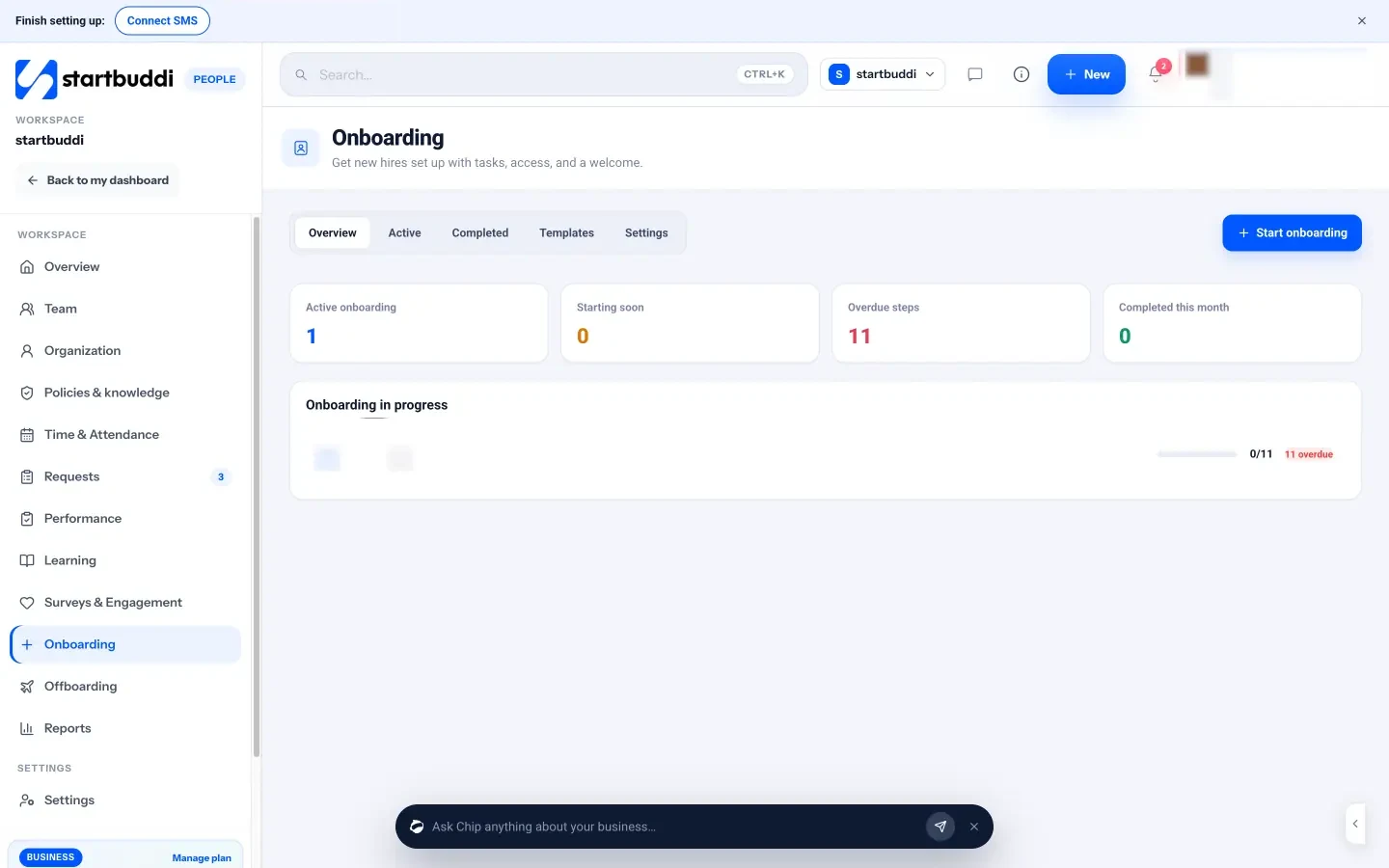
- Onboarding: in People onboarding, start an onboarding checklist for the new hire, with steps for equipment, access, training and introductions. Everyone who owns a step is notified, and the hire becomes an active employee when the checklist is complete. Inviting a brand-new hire needs a paid plan with a free seat.
For the bigger picture of growing from one person to a team, read our guide to building your first team, or see how startbuddi supports startups.
Hire well, then help them settle in
A clear talent acquisition process takes an afternoon to write and saves weeks on every hire after. Start free with startbuddi to run onboarding checklists, offer letters and interviews in one place.
Frequently asked questions
What are the stages of the talent acquisition process?
The talent acquisition process has eight stages: plan the hire, define the role, source candidates, screen applications, interview and assess, run checks, make the offer and onboard. Small businesses can combine some of them, but skipping planning or checks usually costs more time later.
How long does the talent acquisition process take?
For a small business hiring one person, four to six weeks from planning to signed offer is common, plus 30 to 90 days of onboarding. Senior or specialist roles take longer because there are fewer candidates. Writing a scorecard first is the easiest way to shorten it.
What is the difference between talent acquisition and recruitment?
Recruitment is filling a specific vacancy, from advert to offer. Talent acquisition is broader: it includes workforce planning before the vacancy and onboarding after it, and it treats hiring as an ongoing system. In a small business the same person usually does both.
Do I need an applicant tracking system as a small business?
Not for a few hires a year. A shared spreadsheet with one row per candidate, their stage and their scores is enough, as long as everyone uses it. An applicant tracking system starts to pay off when you are hiring several roles at once or getting hundreds of applications.
How do I make my hiring process fair?
Agree the scorecard before you advertise, ask every candidate the same core questions and score answers separately before discussing them. Use work samples instead of gut feel. Keep adverts and questions about the job, not personal characteristics, and keep notes of why you decided.
Should I pay candidates for a work sample?
Pay for any task that takes more than about two hours or produces something you could use. Short tasks based on made-up work don't need payment, but say up front how long they should take. Paying shows respect and gets you better work.
Tiwalade Joanna Okedara-Kalu is the founder, CEO and CTO of startbuddi, the business system that brings clients, bookings, invoices, projects, marketing and the Chip AI assistant into one place. Tiwalade builds software around how service businesses really work day to day, and writes about client management, getting paid on time and why small businesses outgrow the tools they start with.
Founded startbuddi and leads its product and engineering