Talent Acquisition Metrics: 10 Practical Ideas for Small Teams
The talent acquisition metrics that matter when you hire your first team: formulas, a worked example, and which 4 to track first so each hire gets cheaper.



Talent acquisition metrics are the numbers that show how well you find and hire people: how long it takes, what it costs, where good candidates come from and whether new hires stay and perform. A small team needs only a handful, starting with time to fill, cost per hire, offer acceptance rate and 90-day retention.
Key takeaways
- Start tracking from your first hire. Three dates and a list of costs per role are enough to calculate most of these metrics.
- Speed and cost metrics tell you about your process; quality and retention metrics tell you whether the process picks the right people.
- With fewer than ten hires a year, read each hire as a story, not a statistic. The numbers matter most when you compare one role with the next.
- Write every formula down before you start, so this year’s numbers compare with next year’s.
Why talent acquisition metrics matter when you’re small
For a five-person company, one wrong hire is a fifth of the team. It costs the salary, the time you spent hiring, the time you spend fixing the damage and the time you spend hiring again. Talent acquisition metrics won’t make that decision for you, but they show which parts of your hiring keep going wrong.
They also stop hiring from feeling like guesswork. If you know your last two roles took 40 days each, you can open the next one before the person you need is already overdue. The UK’s CIPD found in its 2024 Resourcing and talent planning report that the median cost of recruiting non-senior employees was £1,500, and £2,000 for senior managers and directors (checked on 1 October 2026). Your numbers will be different, which is exactly why you should measure your own.
The 10 talent acquisition metrics worth tracking
Each one below has a formula you can put in a spreadsheet and an example from a small team. Treat them as a menu: pick the four or five that answer your biggest hiring problem today.
1. Time to fill
Time to fill tells you how long a seat stays empty. It runs from the day you open the role to the day a candidate accepts your offer. SHRM defines it as the number of days from when the job requisition was opened until the offer was accepted, counted in calendar days including weekends and holidays, in its article on staffing metrics (checked on 1 October 2026).
Formula: offer accepted date minus role opened date.
Example: a Lagos design studio opens a junior designer role on 1 June and the chosen candidate accepts on 8 July. Time to fill is 37 days. If the studio’s busy season starts in August, it now knows to open roles by early June at the latest.
2. Time to hire
Time to hire measures how quickly you move once a good candidate appears. It runs from the day the hired person applied (or you first contacted them) to the day they accepted. A long time to fill with a short time to hire means sourcing is the problem; a long time to hire means your interviews and decisions are slow.
Formula: offer accepted date minus the hired candidate’s application date.
Example: the designer above applied on 24 June and accepted on 8 July, a time to hire of 14 days. Most of the 37 days were spent waiting for the right applicant, so better job posts would help more than faster interviews.
3. Cost per hire
Cost per hire shows what each new person costs you to find. Add the external costs (job boards, agency fees, assessment tools, background checks, travel for interviews) and the internal costs (the time you and your team spent, valued at a fair hourly rate), then divide by the number of hires in the same period.
Formula: (external costs + internal costs) ÷ number of hires.
Example: see the worked example below. Founders often leave out their own time, which is usually the biggest cost in a small company.
4. Source of hire
Source of hire tells you where your best people come from. Record where every applicant found you: referral, LinkedIn, a job board, your website, Instagram, a university. Then compare not just how many applicants each source sends, but how many reach interview and how many get hired.
Formula: hires from a source ÷ total hires × 100, alongside applicants from that source.
Example: a Nairobi software team gets 60 applicants from a paid job board and 6 from staff referrals, but makes two hires from referrals and none from the board. The board’s budget may be better spent on a referral bonus.
5. Qualified applicant rate
Qualified applicant rate shows whether your job post attracts the right people. Count how many applicants meet your must-have criteria, as a share of everyone who applied. A low rate means a vague post, the wrong channel or a salary that doesn’t match the role.
Formula: applicants meeting must-haves ÷ total applicants × 100.
Example: 12 of 80 applicants for an accounts assistant role meet the requirements, a rate of 15%. Adding the salary range and “must have used Paystack or Flutterwave reconciliation” to the post should raise it next time.
6. Interview-to-offer ratio
Interview-to-offer ratio shows how well you screen before interviewing. It’s the number of candidates you interview for each offer you make. If you interview ten people to find one you’d hire, you’re spending interview time that a better screen could have saved.
Formula: candidates interviewed ÷ offers made.
Example: a Toronto agency interviews eight people for one role, a ratio of 8:1. A 15-minute screening call before the full interview brings it to 4:1 on the next role and frees a day of the founder’s week.
7. Offer acceptance rate
Offer acceptance rate tells you whether your offers compete. If candidates say no at the last step, the cause is usually salary, slow decisions, a poor interview experience or a better offer elsewhere. Ask everyone who declines why.
Formula: offers accepted ÷ offers made × 100.
Example: four offers, three acceptances: 75%. The one decline said another company offered hybrid working, which tells you something about your offer, not your candidate pool.
8. Candidate experience score
Candidate experience score shows how applicants feel about your process. Send a two-question survey to everyone who reached interview, hired or not: “How would you rate our hiring process from 1 to 5?” and “What could we have done better?” Small companies live on reputation, and rejected candidates talk.
Formula: average rating, or the share of 4 and 5 ratings, as you’d calculate customer satisfaction.
Example: after one round, three of five rejected candidates mention they never heard back after the second interview. A same-week “no” email fixes that for free.
9. New hire retention
New hire retention shows whether people stay once they join. Measure it at 90 days and at 12 months. Early leavers usually point to a mismatch between the job advert and the job, or to weak employee onboarding.
Formula: new hires still employed after 90 days (or 12 months) ÷ new hires in the period × 100.
Example: five people joined last year and four are still there after 12 months: 80%. The one who left in week six said the role involved far more weekend events than the advert suggested.
10. Quality of hire
Quality of hire asks whether the person turned out to be a good hire. There’s no single formula, so pick two or three signals you already have: passed probation, first performance review rating, and whether the manager would hire them again. Score each and average them.
Formula (one simple version): (probation passed + review rating out of 5 converted to a percentage + “would rehire” yes) ÷ 3, each as a percentage.
Example: a new account manager passes probation (100%), scores 4 out of 5 at the six-month review (80%) and her manager would hire her again (100%). Quality of hire is (100 + 80 + 100) ÷ 3 = 93%. Track it per source, and you’ll know which channel brings people who last.
Worked example: cost per hire for a three-role quarter
A seven-person fintech startup in Nairobi hires a support lead, a sales executive and a junior developer in one quarter. The figures are illustrative.
| Cost | Amount |
|---|---|
| Job board posts (3 roles) | KES 45,000 |
| Online skills test subscription | KES 15,000 |
| Background checks (3) | KES 18,000 |
| Founder interview time: 30 hours at KES 2,500 | KES 75,000 |
| Team interview time: 6 hours at KES 2,000 | KES 12,000 |
| Total | KES 165,000 |
Cost per hire = KES 165,000 ÷ 3 = KES 55,000. Founder time is 45% of the total (75,000 ÷ 165,000), so the cheapest saving is a better screen, not a cheaper job board.
The same quarter’s other numbers, worked out from the team’s dates:
| Metric | Support lead | Sales executive | Junior developer |
|---|---|---|---|
| Role opened | 3 March | 10 March | 17 March |
| Hired candidate applied | 20 March | 1 April | 24 March |
| Offer accepted | 14 April | 21 April | 28 April |
| Time to fill | 42 days | 42 days | 42 days |
| Time to hire | 25 days | 20 days | 35 days |
Time to fill is identical, but the developer took 35 days from application to acceptance. That role had three interview rounds, so the founder cut it to two for the next technical hire.
Which talent acquisition metrics to track first
If you hire fewer than ten people a year, start with these four and add others when a problem shows up:
| If your problem is… | Track |
|---|---|
| Roles stay open too long | Time to fill and time to hire |
| Hiring feels expensive | Cost per hire and source of hire |
| Candidates say no | Offer acceptance rate and candidate experience |
| New people leave or struggle | New hire retention and quality of hire |
Set each one up as a KPI with a target, review it after every hire, and keep the definitions fixed. Our guide to building your first team covers the hiring process these numbers measure, and AI in talent acquisition looks at where software can speed up screening.
Mistakes to avoid with recruiting metrics
- Tracking everything. Ten metrics for two hires a year is admin, not insight.
- Leaving out your own time. It’s usually the largest cost in a small company.
- Changing definitions. If time to fill starts at “advert posted” one year and “role approved” the next, you can’t compare them.
- Judging a source on volume. The source with most applicants is often not the one that produces hires.
- Forgetting data rules. Keep candidate data only as long as you need it, and tell candidates how you use it.
Where startbuddi fits
startbuddi doesn’t include an applicant tracking system, so keep pre-hire numbers (applicants, interviews, offers) in a spreadsheet or your hiring tool. You can collect applications with a startbuddi form, and each response lands as a contact. Once someone joins, People covers the metrics that come after the offer.
- Onboarding. Start onboarding for a new hire with a checklist of tasks, access and a welcome, and set a probation period in People settings. Overdue steps are flagged.
- New joiner check-in. In Surveys & Engagement, the New joiner check-in template asks new people how their first weeks are going, anonymously by default.
- Reviews and reports. Performance reviews record ratings and completion, and People Reports show new starters, leavers and team growth, the raw material for retention and quality of hire.
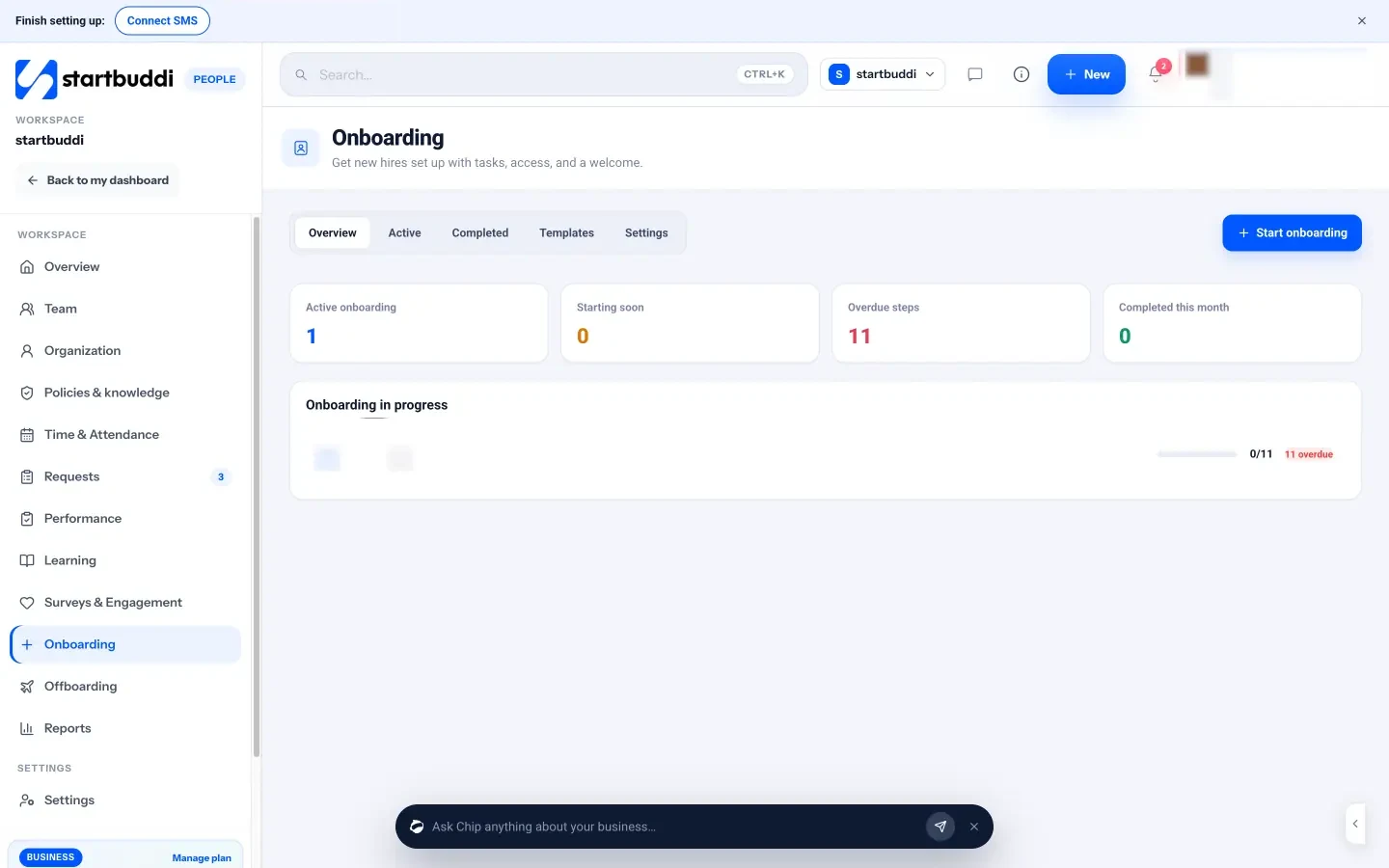
See People onboarding and surveys for details, or how startbuddi works for startups. A free plan is available; see pricing for what each plan includes.
Measure your next hire from day one
Before you open your next role, write down the date, start a cost list and decide which four metrics you’ll review when the person joins. Start startbuddi free to run onboarding, check-ins and reviews for every new hire in one place.
Frequently asked questions
What are the most important talent acquisition metrics?
For a small business, the most useful are time to fill, cost per hire, offer acceptance rate and new hire retention. Together they show how fast you hire, what it costs, whether your offers compete and whether people stay. Add quality of hire once you run performance reviews.
How do you calculate cost per hire?
Add your external hiring costs, such as job boards, agency fees and checks, to your internal costs, mainly the time you and your team spent. Divide the total by the number of hires in the same period. For example, KES 165,000 across three hires is KES 55,000 per hire.
What is the difference between time to fill and time to hire?
Time to fill runs from opening the role to the offer being accepted, so it shows how long the seat stayed empty. Time to hire runs from the hired candidate's application to acceptance, so it shows how fast your interview and decision steps are. Comparing the two tells you whether sourcing or selection is slowing you down.
How do you measure quality of hire in a small company?
Pick two or three signals you already collect, such as passing probation, the first review rating and whether the manager would hire the person again. Turn each into a percentage and average them. Track it by source to see which channels bring people who last.
How many recruiting metrics should a small business track?
Four or five is plenty for a team making fewer than ten hires a year. Choose the ones that match your biggest hiring problem, keep the formulas fixed and review them after every hire. Add more only when a new problem appears.
Tiwalade Joanna Okedara-Kalu is the founder, CEO and CTO of startbuddi, the business system that brings clients, bookings, invoices, projects, marketing and the Chip AI assistant into one place. Tiwalade builds software around how service businesses really work day to day, and writes about client management, getting paid on time and why small businesses outgrow the tools they start with.
Founded startbuddi and leads its product and engineering