Job Description Template for Small Businesses
A free job description template for small businesses: copy-ready text, how to fill each one, a filled example for a first hire and the mistakes to avoid.


Photo: Kelly Sikkema / Unsplash
A job description template is a ready-made outline for describing a role: its title, purpose, main duties, what success looks like, the skills needed, who it reports to, and the pay and working pattern. Copy the template below, fill in each section in plain words, and use the finished document for your job advert, interviews, onboarding and first review.
Key takeaways
- A good job description is about outcomes, not just tasks. Say what the person must achieve in their first 90 days.
- Split skills into “must have” and “nice to have”, and keep the must-haves short. Every extra requirement shrinks your pool of applicants.
- Use neutral wording. Phrases like “recent graduate” or “handyman” can exclude people unfairly and, in many countries, unlawfully.
- Include the pay range and working pattern. People decide whether to apply on those two lines.
- Reuse it. The same document becomes the interview scorecard, the onboarding plan and the review checklist.
Why a small business needs a written job description
When you hire your first or fifth person, the role often lives in your head, until you realise you’ve described it differently to each candidate.
Writing it down forces the decisions that matter: what this person owns, what they don’t, and how you’ll know they’re doing well. It also protects you. In the US, the Americans with Disabilities Act says that if an employer writes a job description before advertising or interviewing, it “shall be considered evidence of the essential functions of the job” (42 U.S. Code § 12111(8), checked on 1 October 2026). In the UK, Acas recommends giving applicants the job description and person specification because they “help make clear what the job requires and reduce the risk of discrimination” (Acas, advertising a job, checked on 1 October 2026).
If you’re planning your first hires as a whole, our guide on how to build your first team covers when to hire and how to bring people in.
The job description template
Copy everything in this section, replace the items in square brackets and delete anything that doesn’t apply.
Job title: [Plain title people search for, e.g. “Office administrator”, not “Chief Happiness Officer”]
Location and working pattern: [On-site at address / hybrid / remote; days and hours; any weekend or evening work]
Employment type: [Full-time / part-time / fixed-term contract / freelance]
Reports to: [Name or role]
Pay: [Salary range or hourly rate, and how often it’s paid] Benefits: [Leave, health cover, transport, training budget, equipment]
About us: [Two or three sentences: what the business does, who for, and how big the team is]
Why this role exists: [One or two sentences on the problem this hire solves]
What you’ll do (main responsibilities):
- [Responsibility 1, starting with a verb, e.g. “Answer and route every customer enquiry within one working day”]
- [Responsibility 2]
- [Responsibility 3]
- [Responsibility 4]
- [Responsibility 5]
What success looks like in the first 90 days:
- [Measurable outcome 1]
- [Measurable outcome 2]
- [Measurable outcome 3]
You must have:
- [Essential skill or experience 1]
- [Essential skill or experience 2]
- [Any legal requirement, e.g. a driving licence or a trade certificate]
Nice to have:
- [Helpful but not essential skill 1]
- [Helpful but not essential skill 2]
How to apply: [What to send, where, and by when. What happens next and how long it takes]
Our commitment: [A short statement that you welcome applicants from all backgrounds and will make reasonable adjustments in the process]
How to fill in each section
Job title
Use the title someone would type into a job site. Creative titles get fewer applicants because nobody searches for them.
Why this role exists
This is the line most templates skip, and it’s the most useful. “To take bookings, payments and customer messages off the founder’s plate so she can focus on client work” tells a candidate more than a list of tasks.
Responsibilities
Aim for five to eight. Start each with a verb and, where you can, add a standard: “Send invoices within a day of a job finishing” is clearer than “Handle invoicing”. Put the most important duty first.
What success looks like
Two to four outcomes the person should reach in the first 90 days. These become the agenda for the probation check-in and the first performance review.
Must have and nice to have
Keep “must have” to things you’d genuinely reject someone without. Years of experience are a weak proxy; describe the ability instead. “Has handled customer complaints by phone and in writing” beats “3+ years’ experience”.
Pay and working pattern
Give a range. It saves you interviewing people whose expectations are far from your budget.
Wording to avoid
Acas warns that phrases like “recent graduate” or “highly experienced” can discriminate on age, and gendered titles like “barmaid” or “handyman” should be replaced with neutral ones. In the US, the EEOC says it’s illegal to publish a job advert that “shows a preference for or discourages someone from applying” because of a protected characteristic (EEOC, prohibited practices, checked on 1 October 2026). This is general information, not legal advice; check the rules where you hire.
A filled example
These details are illustrative.
Kemi runs a home cleaning company in Lekki, Lagos, with eight cleaners. She’s hiring her first office hire.
Job title: Customer operations assistant
Location and working pattern: On-site in Lekki Phase 1, Monday to Friday, 8am to 5pm, plus one Saturday morning a month
Employment type: Full-time, three-month probation
Reports to: Kemi Adeyemi, founder
Pay: ₦180,000 to ₦220,000 a month, paid monthly. Benefits: 15 working days’ leave, a monthly transport allowance, a work phone and data
About us: We clean homes and short-let apartments across Lekki, Ikoyi and Victoria Island, with a team of eight cleaners.
Why this role exists: To make sure every customer is answered, booked and billed on time, so the founder can spend her days on quality and new contracts.
What you’ll do:
- Answer WhatsApp, phone and email enquiries within one working hour during office time
- Book cleans and assign cleaners using our booking system
- Send invoices on the day a job is done and follow up on late payments
- Confirm next-day bookings with customers and cleaners every afternoon
- Log complaints and make sure each one is resolved within 48 hours
What success looks like in the first 90 days:
Run this from one workspaceClients, projects, money and marketing, connected instead of spread across five apps.See how it works
- Every enquiry gets a reply the same working day
- Invoices go out within 24 hours of each clean
- Missed or double bookings fall to none in a typical month
You must have: Clear written English, confidence on the phone, and experience using a spreadsheet or booking app
Nice to have: Experience in a customer service or hospitality role; Yoruba or Igbo
How to apply: Send your CV and a short note on why you want the role by 15 November. We’ll invite shortlisted people to a 30-minute interview the following week.
A London version would read the same, with a pound salary range, the UK statutory holiday entitlement as a minimum, and a right-to-work check in the “how to apply” step.
Common mistakes
- A wish list, not a job. Ten must-haves describes nobody. Cut to the three or four you’d truly reject someone without.
- No pay range. It costs you applicants and wastes interviews.
- Leaving out the hard parts. If the role includes Saturday work or a long commute, say so. People who leave in month two cost more than an honest advert.
Once you’ve written the description, the rest of the talent acquisition work follows from it. Our guide to the talent acquisition process covers sourcing, shortlisting and interviews.
How to use your job description in startbuddi
startbuddi doesn’t include an applicant tracking system, so you’ll advertise the role and collect applications through your usual job sites or a simple form. Where startbuddi helps is before and after the hire:
- Draft it with Chip. Ask Chip in chat for a first draft from a few lines about the role, then edit it against the template above.
- Keep it in Documents. Save the final version so it’s easy to find for interviews, the offer and the first review.
- Collect applications with a form. A form can ask for a cover note and CV, as on our form builder for HR teams page.
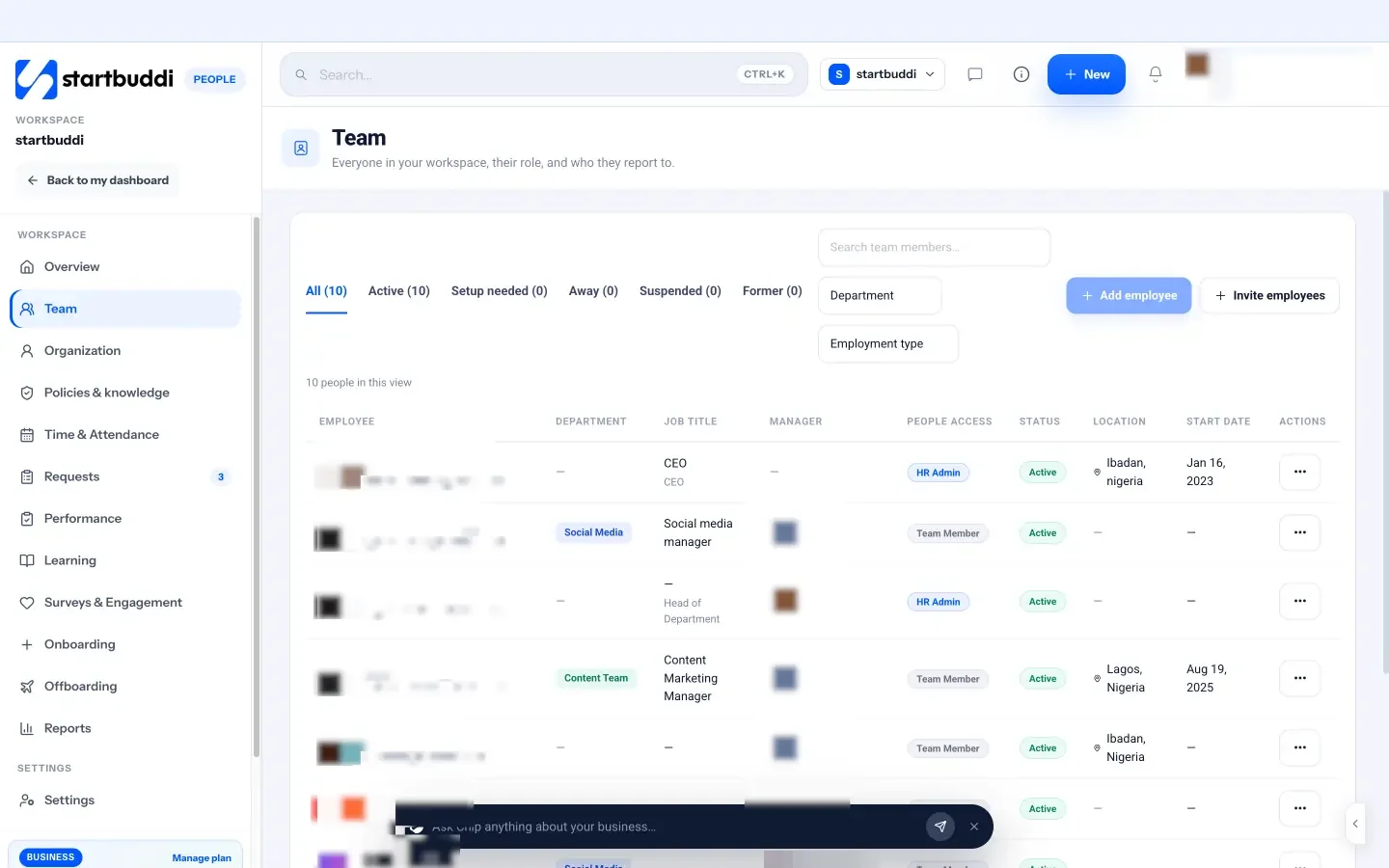
- Add the new hire in People. Their job title, department, manager and start date sit on their profile, and employee onboarding checklists start from there.
- Turn the 90-day outcomes into the review. Chip HR can draft a 30/60/90 plan and later a review summary for you to check.
For the offer itself, use the free offer letter template, and set out your policies with the employee handbook template. See more on startbuddi People, or read our HR for small business guide.
Hire with a plan, not a guess
Write the role down, then keep the new hire’s profile, onboarding and reviews in one place. Start free with startbuddi, no card needed.
Frequently asked questions
What should a job description include?
A job description should include the job title, location and working pattern, employment type, who the role reports to, pay and benefits, a short summary of the business, why the role exists, the main responsibilities, what success looks like, essential and desirable skills, and how to apply. Keep it to one or two pages.
What is the difference between a job description and a person specification?
A job description describes the role: its purpose, duties and outcomes. A person specification describes the person who could do it: the skills, knowledge and experience needed. Many small businesses combine both in one document, as the template above does.
How long should a job description be?
Most work well at 300 to 700 words. Long enough to explain the role and its outcomes, short enough that people read to the end. If it runs past two pages, cut the low-value duties.
Should I put the salary in a job description?
Yes, in most cases. A pay range helps the right people apply and saves you interviewing people whose expectations don't match your budget. Some places require pay ranges in job adverts, so check local rules.
Can I change a job description after someone is hired?
Yes, roles change as a business grows, and the description should keep up. Agree significant changes with the employee and keep the written terms of their contract in line. Reviewing it at each performance review is a simple habit.
Omolola Akiyode is the operations and project manager at startbuddi, leading cross-functional projects and the content that helps founders get set up. Omolola writes about projects, websites and getting found online, and turns complex ideas into clear, practical steps.
Runs operations and projects at startbuddi