HR Consulting for Startups: A Practical Guide for Bootstrapped Founders
HR consulting for startups explained: what a consultant does, when you need one, how they charge, what to prepare and what to keep in-house on a budget.


HR consulting for startups means hiring an outside HR professional, by the hour, the project or a small monthly retainer, to set up the people side of your business: contracts, policies, onboarding, pay structure and how to handle problems. For a bootstrapped founder, it buys expert help at the moments that carry legal risk, without a full-time HR salary.
Key takeaways
- Most startups don’t need an HR consultant on retainer. They need one for specific moments: the first hire, the first handbook, the first dismissal, the first restructure.
- Prepare before the first meeting. A consultant who spends three hours finding out what you already do is three hours you paid for.
- Get the legal basics right first. Nigeria, the UK and many other countries require written terms of employment within a set time.
- Pick a consultant with a recognised qualification and experience in companies your size, not just big-company HR.
- Keep the day-to-day (leave, records, onboarding checklists) in a simple system you run yourself, so you only pay the consultant for judgement.
What does an HR consultant do for a startup?
An HR consultant is an independent professional or small firm that advises on people matters. In a startup, the work usually falls into five areas.
| Area | What the consultant does | When you’d call them |
|---|---|---|
| Employment documents | Drafts or reviews offer letters, contracts and contractor agreements | Before your first hire, or when you switch someone from contractor to employee |
| Policies and handbook | Writes leave, conduct, remote work and disciplinary policies | Around five to ten employees, or after your first awkward incident |
| Pay and structure | Sets salary bands, job levels and benefits; advises on equity or bonuses | Before a hiring round, or when pay starts to feel unfair |
| Performance and problems | Designs a simple review cycle; guides you through a disciplinary or dismissal | When someone isn’t working out, before you act |
| Compliance check | Audits records, contracts and policies against local law | Before fundraising due diligence, or when entering a new country |
What they don’t usually do is run your HR every day. That’s the job of an in-house HR person, an outsourced HR provider or, at startup size, the founder with good tools.
Why it matters: the legal basics come early
Employment law starts with your first employee, not your fiftieth. Two examples:
- In Nigeria, section 7 of the Labour Act (checked on 1 October 2026) says that not later than three months after a worker starts, the employer must give them a written statement of the terms of employment, including the employer’s name, the nature of the job, pay, hours, holidays, sick leave and termination notice.
- In the UK, GOV.UK says employers must give employees a written statement of employment particulars (checked on 1 October 2026), with the main details (pay, hours, holiday, job title, start date) on their first day.
A good consultant knows these rules for your country and turns them into documents you can reuse. That is often the single most valuable thing they do in year one.
How HR consulting for startups works: four pricing models
Consultants usually work in one of four ways. Rates vary widely by country and experience, so ask each consultant for a written quote.
- Hourly. You pay for time spent on a question or a document. Good for one-off advice, such as “can I end this probation early?”.
- Fixed-price project. A set fee for a defined output, such as “employment contract template, offer letter and five core policies”. Good for set-up work, because you know the cost upfront.
- Monthly retainer. A fixed number of hours or an advice line each month. Useful once you have ten or more people and questions come up weekly.
- Fractional HR. A senior HR professional who works part of each week as your head of people. This is for scale-ups planning several hires a quarter, not most bootstrapped startups.
For a startup, a fixed-price set-up project followed by occasional hourly advice is usually the best value.
Worked example: what to buy and what to do yourself
This is an illustrative plan for a six-person agency in Lagos about to make two hires. The hours are examples; ask your consultant to estimate them.
| Task | Who does it | Example hours |
|---|---|---|
| Contract template, offer letter and contractor agreement | Consultant (fixed project) | 6 |
| Five core policies: leave, conduct, remote work, disciplinary, grievance | Consultant (fixed project) | 8 |
| Review of the founder’s draft handbook | Consultant (hourly) | 2 |
| Onboarding checklist and first-week plan | Founder, using a template | 0 consultant hours |
| Leave tracking and employee records | Founder, in an HR tool | 0 consultant hours |
| Probation review for the two new hires at month three | Founder, with a 1-hour call to the consultant | 1 |
Total consultant time: 17 hours, spread over three months. If the consultant’s rate were ₦40,000 an hour, that’s ₦680,000. At £90 an hour in London it would be £1,530. These rates are illustrative, not quotes; your real figures depend on the consultant and the scope.
The point of the table is the split. The consultant does the things that need expertise and carry legal risk. The founder does the routine work that just needs to be consistent.
When does a startup need an HR consultant?
You probably need one when:
- you’re hiring your first employee, or converting a freelancer to staff;
- you’re about to dismiss someone, or a dispute is brewing;
- you’re hiring in a new country;
- an investor’s due diligence is coming and your contracts are a mix of templates;
- you’ve reached about ten people and questions about leave, pay and conduct come up every week.
You probably don’t need one for routine leave requests, onboarding checklists or record keeping. Free official guidance covers a lot: in the UK, Acas gives employers and employees free, impartial advice on workplace rights, rules and best practice, with templates you can adapt. Our HR for small business guide covers the basics too.
How to choose an HR consultant
- Check qualifications. In Nigeria, look for membership of the Chartered Institute of Personnel Management of Nigeria (CIPM), the professional body for HR. In the US, SHRM certification is common. Ask what level they hold.
- Ask about startups specifically. Someone who ran HR for a bank with 3,000 staff may over-engineer things for a team of eight. Ask for examples of companies your size.
- Ask how they charge, and get a written scope for any fixed-price project, including how many rounds of changes are included.
- Ask what you’ll own at the end. You want editable documents you can reuse, not a PDF only they can change.
- Check their local knowledge. Employment law differs between Lagos, Nairobi, London and Toronto. If you hire in two countries, you may need two advisers.
How to get started (and keep the bill down)
Before your first call, gather:
- a list of everyone who works with you, their role, start date, and whether they’re an employee or a contractor;
- the contracts or offer letters you’ve used so far, even if they’re messy;
- how you currently handle leave, sick days and pay;
- what’s prompting the call: a hire, a problem, a fundraise.
Then ask the consultant for a short, prioritised list: what must be fixed now, what can wait six months, and what you can do yourself. Our guide on building your first team covers the hiring steps around this, and the post on writing an employee handbook explains what goes in one.
Common mistakes founders make with HR consultants
- Calling only when something has gone wrong. An hour of advice before a dismissal costs far less than a dispute afterwards.
- Buying a big-company handbook. Fifty pages of policy nobody reads protects no one. Start with the five policies you’ll actually use.
- Paying the consultant to do admin. Updating leave spreadsheets is not expert work. Use a tool for that.
- Treating templates as finished. A downloaded contract that doesn’t match your local law can be worse than none. Have someone qualified check it once.
- Not writing down what was agreed. Keep the consultant’s advice with the employee record, so you can show why you acted as you did.
How startbuddi helps between consultant visits
startbuddi isn’t an HR consultancy, and it doesn’t give legal advice. Its People module is where you run the day-to-day, so your consultant’s time goes on judgement.
- Keep one profile per person with job, manager, start date, leave and documents, and link offer letters and contracts from Documents.
- Run employee onboarding and offboarding as checklists, so every new hire gets the same first week.
- Publish your policies with versions and track who has read and acknowledged them.
- Handle leave requests with approvals, and run performance reviews on a simple cycle.
- Ask Chip HR questions like “How much leave do I have left?” or “Draft a 30/60/90 plan for a new hire”. It answers from your published policies, names its source, and asks before it changes anything.
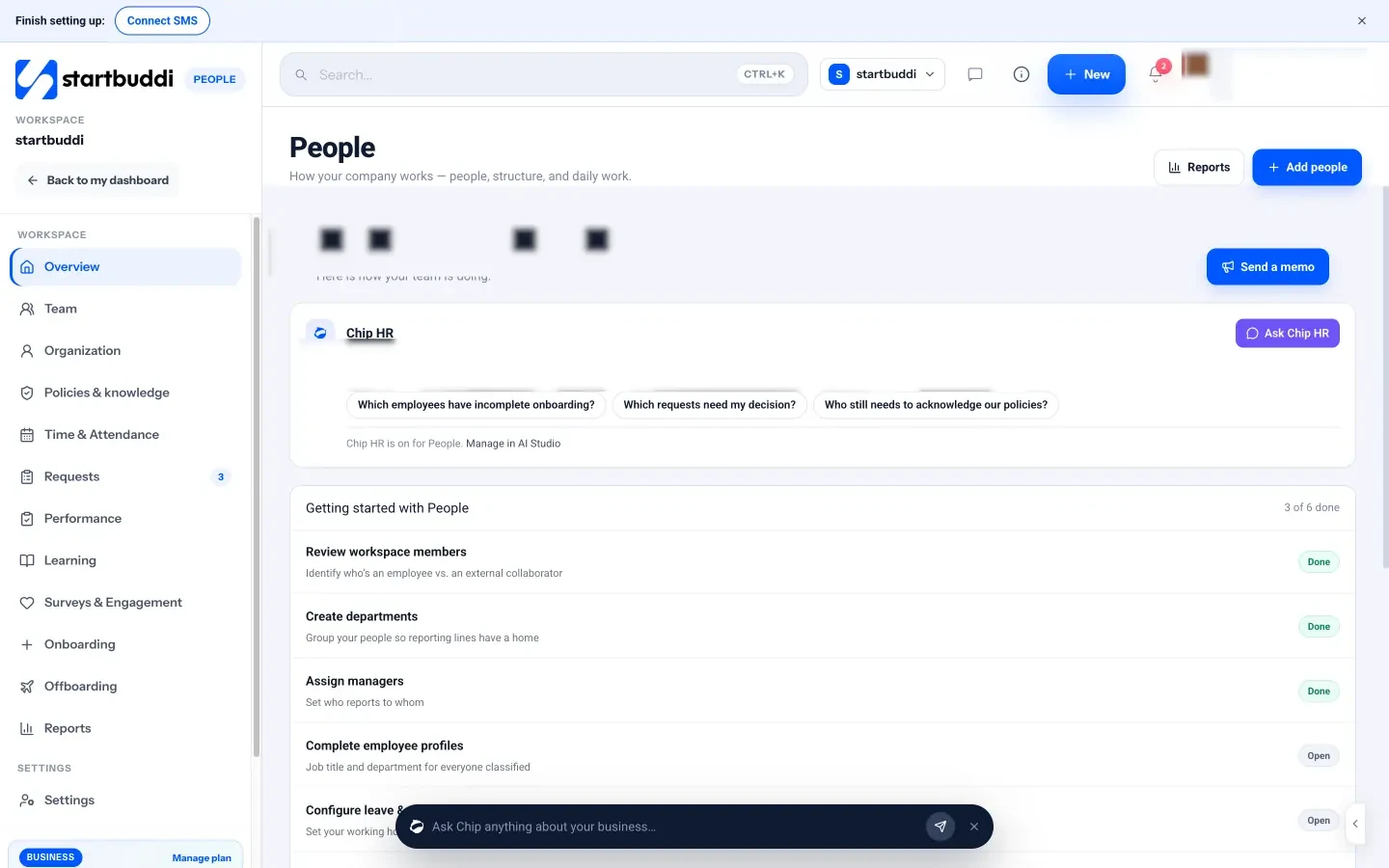
There’s no payroll or tax filing in startbuddi, so you’ll still need a payroll provider or accountant for that. On the Free plan only the owner’s seat is included; inviting teammates needs a paid plan. See pricing, the People module, or how other startups set it up. For how HR work is split between people, tools and outside help as you grow, read about the HR operating model, and for software options see our round-up of HR tools for small business.
Run the day-to-day, save the consultant for the hard parts
Set up profiles, leave, onboarding and policies once, and let your consultant focus on what needs a professional. Start free with startbuddi, no card needed.
Frequently asked questions
What is HR consulting for startups?
HR consulting for startups is outside expert advice on people matters, such as contracts, policies, pay, performance and compliance, bought by the hour, the project or a monthly retainer. It gives a young company access to HR expertise without hiring a full-time HR manager. Most startups use it for set-up work and for difficult moments.
How much does an HR consultant cost for a small business?
The cost depends on the country, the consultant's experience and the pricing model. Hourly advice suits one-off questions, while a fixed-price project suits set-up work like contracts and core policies. Ask two or three consultants for written quotes against the same scope so you can compare them fairly.
When should a startup hire an HR consultant?
A startup should bring in an HR consultant before its first employee, before any dismissal, before hiring in a new country, and before investor due diligence. Around ten employees, many startups move to a small monthly retainer because questions come up weekly. Routine admin like leave tracking doesn't need a consultant.
What is the difference between an HR consultant and outsourced HR?
An HR consultant advises on specific questions and projects, and you act on the advice. An outsourced HR provider runs ongoing HR tasks for you, often including payroll and employee queries. Startups usually begin with a consultant and consider outsourcing once the team and the admin grow.
Can I do HR myself as a founder?
Yes, many founders run day-to-day HR themselves, especially with a simple HR tool for records, leave and onboarding. Get qualified help for contracts, policies and anything that could end in a dispute. Free official guidance, such as Acas in the UK, covers many common questions.
Olabimpe Salami is the email and outreach specialist at startbuddi. Olabimpe writes about the messages that bring customers in and back: email, WhatsApp and SMS campaigns, follow-ups, and turning enquiries into paying clients.
Runs email and outreach at startbuddi