Best HR Tools for Small Businesses in 2026: 9 Options Compared
The best HR tools for small business compared on price, payroll, leave and onboarding: BambooHR, Breathe, Connecteam, Deel, Workpay, startbuddi and more.


Photo: Thomas Lefebvre / Unsplash
The best HR tools for small business depend on where you are and whether you need payroll. Breathe is the simplest pick for UK teams, with one flat price per business. Connecteam is free for up to 10 people and suits shift teams. startbuddi suits service businesses that want HR in the same app as their clients. In Nigeria and Kenya, look at Workpay or SeamlessHR for payroll. Prices were checked on 1 October 2026.
startbuddi is our product. We’ve included it where it fits and listed its limits as plainly as everyone else’s.
Key takeaways
- Decide first whether the tool must run payroll. Most “HR tools” don’t, and payroll is the part that’s tied to your country’s tax rules.
- Price models differ more than features: per employee (BambooHR, Deel), flat per business (Breathe), per hub with a user allowance (Connecteam) or by quote (Workpay, SeamlessHR).
- For a team of 3 to 15 people, the time-savers are leave requests, an onboarding checklist and one place for contracts and policies. Buy those first.
- Hiring software (an applicant tracking system) is a separate decision. Only some tools on this list include one.
HR tools for small business compared
| Tool | Best for | Starting price (checked 1 Oct 2026) | Free plan | Runs payroll | Standout feature |
|---|---|---|---|---|---|
| Breathe | UK teams of 1 to 50 | £24/month for 1 to 10 people (ex VAT) | No (14-day trial) | No | One flat price per business, not per person |
| Connecteam | Shift and field teams | $29/month per hub for the first 30 users | Yes, up to 10 users | No | Time clock, scheduling and HR in one mobile app |
| startbuddi | Service businesses that want HR, clients and work in one app | See pricing | Yes (owner seat only) | No | Chip HR answers from your own handbook |
| BambooHR | Growing US-led teams | $250/month flat for 25 or fewer employees (Core) | No | US add-on | Hiring, records and leave in one core plan |
| Zoho People | Teams already on Zoho | Shown by region on Zoho’s pricing page | Yes, for a few users | No (separate Zoho Payroll) | Low entry cost and Zoho integrations |
| Deel | Teams hiring across countries | Deel HR Core $5 per person/month | No | Through EOR and payroll products | Employer of record in 130+ countries |
| Gusto | US businesses that need payroll first | Base fee plus per person (see Gusto’s pricing page) | No | Yes (US) | Payroll with HR tools attached |
| Workpay | Payroll across Africa | By quote | No | Yes | Pays staff by bank or mobile money, 54 African countries |
| SeamlessHR | Nigerian, Ghanaian and Kenyan firms with 25+ staff | By quote | No | Yes | HR, payroll and performance from one vendor in West and East Africa |
Prices are in each vendor’s own currency, before tax, as shown on their pricing pages. Some vendors show different prices by visitor location, so check the page for your country.
How we chose these HR tools
We looked for tools that a founder with no HR department could set up and run, and judged them on:
- Core records: employee profiles, documents, an org chart.
- Time off: leave requests, approvals and balances.
- Onboarding and offboarding: checklists with owners and due dates.
- Payroll: whether the tool runs it, connects to it, or leaves it to you.
- True cost at 5, 15 and 30 people: not just the headline price.
- Where it works: the countries each vendor is built for.
Every price comes from the vendor’s own pricing page, checked on 1 October 2026. We didn’t run hands-on tests and we don’t quote review scores. Gusto’s pricing page couldn’t be loaded on that date, so we describe its price model rather than quote figures.
If you’re still working out which HR jobs you need at all, our HR for small business guide sets out the categories (core HR, payroll, hiring, onboarding, performance, time) and when each one becomes worth paying for.
1. Breathe
Breathe is UK HR software for small and medium businesses, covering staff records, holiday and absence, documents and performance.
Best for: UK businesses with up to 50 people that want a predictable monthly bill.
Key features
- Holiday and absence management, with a dashboard and reporting.
- Document and policy management.
- Performance management included on every plan.
- Paid add-ons for rota and time and attendance, learning, recruitment, expenses and health and safety.
Pricing: on Breathe’s pricing page the plans are priced per business by headcount band, ex VAT: Micro at £24 a month for 1 to 10 people, Starter at £44 for 11 to 20, and Regular at £99 for 21 to 50. Recruitment is a £16 a month add-on and rota and time and attendance is £11. There’s a 14-day trial with full access.
Pros
- You don’t pay more for each new hire until you cross a band.
- Every core feature is on every plan.
Cons
- No payroll, so you still need a payroll provider or accountant.
- Hiring and rotas cost extra.
- UK-focused; not built for Nigerian or Kenyan leave rules.
Skip it if you’re outside the UK or you want payroll in the same tool.
2. Connecteam
Connecteam is a mobile-first app for teams that don’t sit at desks: cleaners, caterers, security, field technicians, retail staff.
Best for: shift-based and field teams that need a time clock and schedules as much as HR records.
Key features
- Operations hub: time clock, scheduling, forms and tasks.
- Communications hub: chat, updates, directory, knowledge base.
- HR and Skills hub: time off, training, documents, recognition, org chart.
Pricing: Connecteam’s pricing page lists a Small Business plan that’s free for companies with up to 10 employees, including all hubs. Paid hubs are bought separately, starting at $29 a month for the first 30 users on the Basic tier, with Advanced at $49 and Expert at $99. Users beyond 30 are charged per user. Paid plans come with a 14-day trial.
Pros
- A genuinely useful free plan for very small teams.
- Built for phones, which matters for staff who never open a laptop.
- Strong on shifts and clock-in.
Cons
- Each hub is priced separately, so the full set adds up.
- No payroll.
Skip it if your team works at desks and doesn’t need a time clock.
3. startbuddi
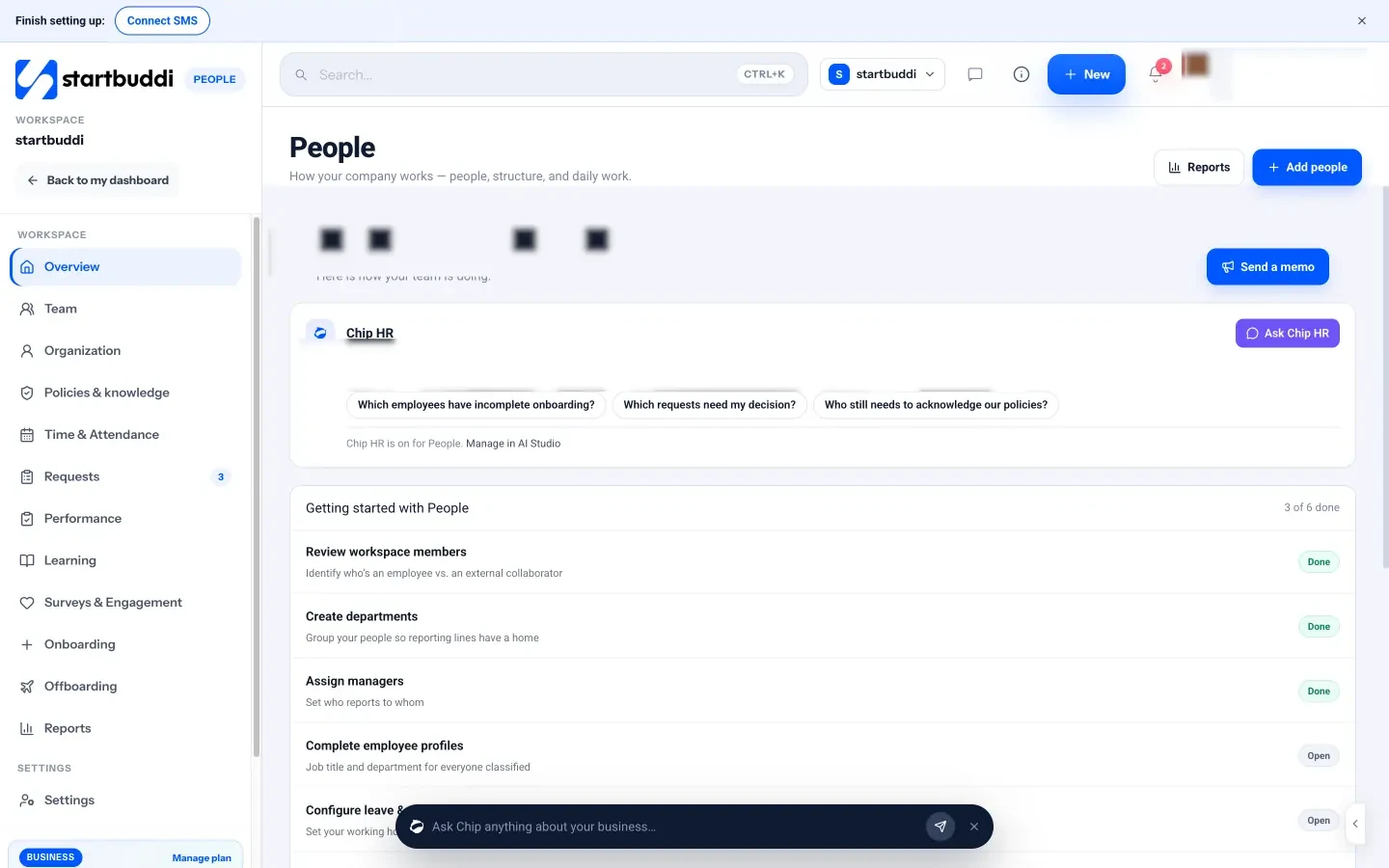
startbuddi is an all-in-one business app for service businesses. Its People module covers HR for a team that doesn’t have an HR department yet, and it sits next to the CRM, inbox, bookings, invoices and projects.
Best for: service businesses of 2 to 30 people that want HR, clients and work in one place instead of another separate subscription.
Key features
- Team directory and profiles with job, leave, performance, documents and equipment tabs, plus an org chart built from each person’s manager.
- Onboarding and offboarding checklists with steps for the new hire, their manager and whoever sets up access.
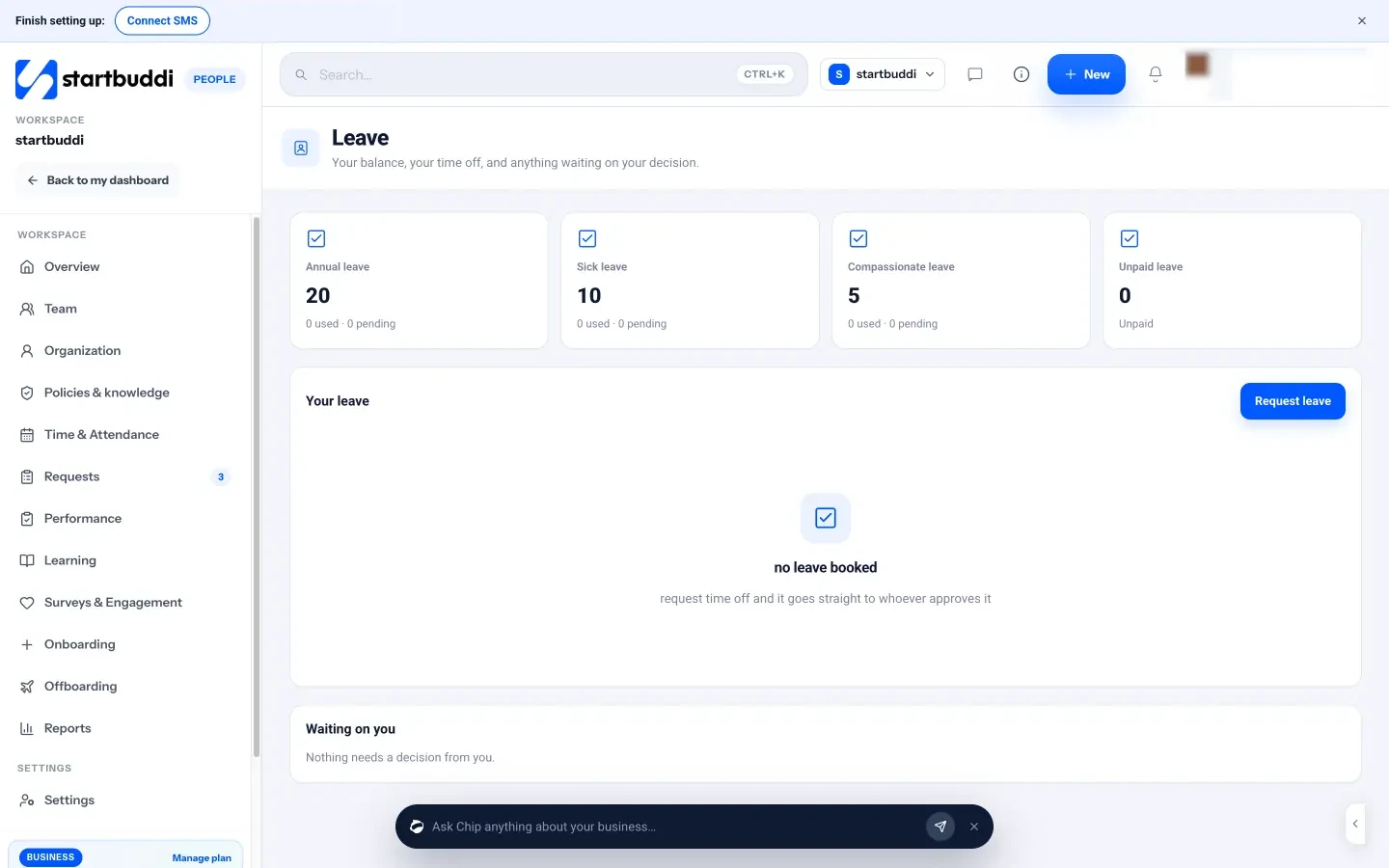
- Leave with approval chains, attendance and clock-in, and one Requests queue for approvals.
- Performance reviews and feedback, a learning library with assignments, surveys with eNPS, and a policy library with versions and sign-off.
- Chip HR, an assistant that answers staff questions from your own published handbook and says so plainly when nothing covers the question.
Pricing: a free plan is available, but it includes only the owner seat, so inviting teammates needs a paid plan. You can still create records for people before they have a seat. See pricing for what each plan includes.
Pros
- HR lives in the same app as your clients, projects and invoices, so a new hire’s onboarding can include the client work they’ll pick up.
- Leave, requests and policies are role-aware: staff see their own, managers see their team.
- Chip HR answers “how much leave do I have?” and “what’s our sick leave rule?” from your handbook, so you’re not the help desk.
Cons
- No payroll, payslips or tax filing. You’ll still need a payroll provider or accountant.
- No applicant tracking system for hiring.
- Performance reviews are deliberately simple: no 360-degree reviews or calibration.
- People reports can’t be exported yet.
Skip it if you mainly need payroll, or you hire many people a year and want a full hiring pipeline. Read more on the People module.
4. BambooHR
BambooHR is one of the best-known HR platforms for small and mid-sized companies, with core HR, hiring and time off in its entry plan.
Best for: growing teams, especially in the US, that want hiring and HR records in one core system.
Key features
- Core plan: HR data, hiring, time-off tracking and basic employee experience tools.
- Pro adds performance management and recognition.
- Elite adds compensation management and HR benchmarking.
- Add-ons for payroll, benefits, time and attendance and global employment.
Pricing: BambooHR’s pricing page shows flat rates for companies with 25 or fewer employees: $250 a month for Core, $425 for Pro and $650 for Elite. Above 25 people it’s $10, $17 or $25 per employee per month, with volume discounts. The payroll and benefits add-ons are for US employees only.
Pros
- Hiring is included in the core plan, which many rivals charge extra for.
- Plans step up as you grow.
Cons
- At 5 people, $250 a month is $50 a head, which is steep for a micro team.
- Payroll is US only.
- More than a 3-person business usually needs.
Skip it if you have fewer than about 15 people or your team isn’t in the US.
5. Zoho People
Zoho People is the HR app in the Zoho suite, with plans that add attendance, performance and more as you move up.
Best for: businesses already using Zoho CRM, Books or Mail that want HR on the same login.
Key features
- Free edition: employee database, leave and document management.
- Paid editions (Essential HR, Professional, Premium, Enterprise) add features in steps: attendance from Professional, performance management from Premium.
- Payroll is a separate product, Zoho Payroll.
Pricing: Zoho People’s pricing page shows per-user prices by region, so the figure depends on where you are, and yearly billing saves more than 20%. The free edition covers a handful of users, and paid plans have a 5-user minimum.
Pros
- Very low cost to start.
- Leave and records are free for the smallest teams.
Cons
- Attendance and performance sit on higher tiers.
- Payroll is a separate product with its own setup.
- Prices vary by region, so comparing takes a little work.
Skip it if you don’t use other Zoho products and want everything in one plan.
6. Deel
Deel started as a way to pay international contractors and now sells HR, payroll, employer of record (EOR) and hiring products.
Best for: small teams with people in several countries, or a founder hiring their first employee abroad.
Key features
- Deel HR: HRIS, with performance, learning and engagement on higher tiers.
- Contractor management and compliance.
- Employer of record: Deel employs someone on your behalf in another country and runs their payroll, tax and benefits.
Pricing: Deel’s HRIS page lists Deel HR Core at $5 per person per month, Advanced at $19 and Elite at $29. On Deel’s pricing page, contractor management is $49 per contractor per month and EOR is $599 per employee per month in 130+ countries.
Pros
- One vendor for contractors, employees and international hires.
- Low per-person price for the HR layer.
- EOR lets you hire in a country where you have no company.
Cons
- EOR is expensive per person; it only makes sense for a few key hires.
- More than a single-country team needs.
- Per-person pricing grows with every hire.
Skip it if everyone you employ is in one country and you have a local payroll provider.
7. Gusto
Gusto is US payroll software with HR tools built around it: onboarding, time off, benefits and compliance help.
Best for: US small businesses whose first HR job is paying people correctly.
Key features
- Full-service US payroll with tax filings.
- Employee self-service and onboarding.
- Benefits and time tools on higher plans.
Pricing: Gusto charges a monthly base fee plus a fee per person, with a contractor-only option. Its pricing page couldn’t be loaded when we checked on 1 October 2026, so check current figures there before you buy.
Pros
- Payroll and HR in one tool, which most of this list can’t offer.
- Strong for a first US hire.
- Contractor-only option for teams without employees.
Cons
- US only for payroll.
- Per-person fees grow with the team.
- HR features are lighter than dedicated HR platforms.
Skip it if you’re not employing people in the US.
8. Workpay
Workpay is an HR and payroll platform built for African businesses, based in Kenya and serving teams across the continent.
Best for: small and mid-sized businesses in Kenya, Nigeria and other African countries that need payroll, statutory deductions and salary payouts handled together.
Key features
- Payroll, compliance and salary disbursements, with an employee self-service app.
- Leave tracking, documents and asset management on the Grow plan.
- Outsourced payroll with statutory filing, and an EOR service for remote staff.
- Payments through banks or mobile money.
Pricing: Workpay’s pricing page lists Launch, Grow and Outsource plans in USD per month, priced by quote. It says it supports 54 African countries.
Pros
- Built for African payroll rules and mobile money.
- Can take statutory filing off your hands.
- One vendor for payroll and basic HR.
Cons
- No public prices, so you’ll need a sales call.
- HR features beyond payroll are lighter than HR-first tools.
- Not aimed at teams outside Africa.
Skip it if you have three people paid by bank transfer and an accountant who already handles PAYE.
9. SeamlessHR
SeamlessHR is an HR and payroll suite with offices in Lagos, Nairobi and Accra, used by mid-sized African companies.
Best for: Nigerian, Ghanaian and Kenyan businesses with 25 or more staff that want HR, payroll and performance from one local vendor.
Key features
- Lite: core HR, payroll and employee self-service.
- Core adds performance and potential management, requisitions and expense claims.
- Advantage adds time and attendance, disciplinary management and offboarding.
- Custom plans let you pick modules.
Pricing: SeamlessHR’s pricing page is quote-based (“Get a personalised quote”), and its plan chart starts at 25 employees.
Pros
- Local payroll knowledge for West and East Africa.
- Offices in Lagos, Nairobi and Accra.
Cons
- Sized for companies of 25+, so it’s more than a 5-person team needs.
- No public prices.
- Time and attendance only on the top plan.
Skip it if you’re under about 20 people and payroll is simple.
What do HR tools cost for a team of 8? A worked example
Headline prices hide how differently these tools charge. Here’s an illustrative team: 8 employees in one office, no shift work, payroll handled elsewhere. Figures use the prices above, before tax.
| Tool | How it charges | Monthly cost for 8 people |
|---|---|---|
| Breathe (Micro, UK) | Flat per business, 1 to 10 people | £24 |
| Connecteam | Free up to 10 users | $0 |
| Deel HR Core | $5 per person | $40 |
| BambooHR Core | Flat for 25 or fewer | $250 |
At 8 people, Breathe and Connecteam are cheapest, and BambooHR costs over six times Deel HR Core. Grow to 30 people and the picture changes: Breathe moves to the £99 band, Connecteam’s free plan no longer applies, Deel HR Core is $150 and BambooHR Core becomes $300 at $10 a head. Run the same sum for your own headcount today and in 18 months before you choose.
How to choose HR tools for your small business
Answer these in order. Each one narrows the list.
- Do you need the tool to run payroll? In the US, Gusto. Across Africa, Workpay or SeamlessHR. Across several countries, Deel. If an accountant already runs payroll, skip this and choose on HR features.
- Where are your people? Breathe is built for the UK; Workpay and SeamlessHR for African payroll rules. Check that the tool handles your public holidays and leave types.
- Do they work at desks or on shifts? Shift and field teams need a phone app and a time clock, which points to Connecteam.
- How many people will you have in 18 months? Price at that size, not today’s.
- Do you hire often? If you hire more than a handful of people a year, choose a tool with hiring included (BambooHR) or budget for a separate applicant tracking system.
- How many other apps do you already pay for? If you’d rather run clients, projects and HR in one place, an all-in-one like startbuddi saves a login and a subscription; if you already have a CRM you’re happy with, a dedicated HR tool is fine.
Whatever you pick, test it with real data for two weeks: add five people, publish your leave policy, approve a leave request and run one employee onboarding checklist. You’ll learn more from that than from any demo.
Can you run HR for a small team for free?
Yes, for a while. Connecteam is free up to 10 users, Zoho People has a free edition for a few users, and startbuddi has a free plan for the owner, with records for staff you add. Free plans usually stop at the point where you need approvals by several managers, attendance or performance reviews. For a team of three, a shared folder of contracts, a written leave policy and a calendar can work too; the guide to building your first team covers what to put in place first.
How to set up HR in startbuddi
- Add your people. In People, open Team and use Add employee for someone already in your workspace, or Invite employees to send email invitations. Set each person’s job title, department and manager, and the org chart builds itself.
- Publish your policies. In Policies & knowledge, set your leave rules and working hours, add your handbook pages and ask staff to acknowledge them.
- Start onboarding for new hires. From a profile, click Start onboarding to give the new hire, their manager and whoever sets up access their first-weeks steps.
- Let staff request leave. Requests go through one approvals queue, and managers see their own team’s requests.
If your team also tracks hours against client work, timesheets live in Work; see employee time tracking for how that fits.
Run your team and your clients from one app
If you’d rather not add another subscription for HR, try People alongside your CRM, inbox and invoices. Start free with startbuddi, no card needed, and add your team when you’re ready.
Frequently asked questions
What are the best HR tools for small business?
The best HR tools for small business depend on payroll and location. Breathe is a simple flat-price option for UK teams, Connecteam is free for up to 10 people and suits shift work, and BambooHR suits growing US teams. Workpay and SeamlessHR handle payroll in African countries, and startbuddi suits service businesses that want HR next to their clients and projects.
What HR tools does a small business actually need?
Most small businesses need four things: employee records and contracts in one place, a leave request and approval process, an onboarding checklist, and payroll. The first three can live in one HR tool. Payroll is often handled by an accountant or a separate payroll provider until the team grows.
What are the best HR apps for small business with shift workers?
Shift teams need a phone app with a time clock and scheduling, not just records. Connecteam is built for this and is free for up to 10 users. Check that whatever app you choose works offline or on weak connections if your staff work on site.
Do HR tools for small businesses include payroll?
Many don't. Breathe, Connecteam, Zoho People and startbuddi don't run payroll; BambooHR offers US payroll as an add-on; Gusto runs US payroll; Workpay and SeamlessHR run payroll in African countries; and Deel runs payroll through its employer of record and payroll products.
When should a small business start using an HR tool?
Start when you hire your second or third employee, or as soon as more than one person approves leave. Before that, a written leave policy, signed contracts in one folder and a shared calendar are usually enough. Moving later means re-entering more records, so earlier is easier.
Is startbuddi an HR system?
startbuddi includes an HR module called People, with a directory, onboarding and offboarding, leave, attendance, reviews, policies and surveys. It doesn't run payroll and has no applicant tracking system. It's best for service businesses that want HR in the same app as their clients and projects.
Tiwalade Joanna Okedara-Kalu is the founder, CEO and CTO of startbuddi, the business system that brings clients, bookings, invoices, projects, marketing and the Chip AI assistant into one place. Tiwalade builds software around how service businesses really work day to day, and writes about client management, getting paid on time and why small businesses outgrow the tools they start with.
Founded startbuddi and leads its product and engineering