HR Operating Model: A Practical Guide for Small Business Owners
What an HR operating model is, the four models small teams grow through, a canvas to fill in and a worked cost example. Design yours in one afternoon.


Photo: ThisisEngineering / Unsplash
An HR operating model is how your business organises its people work: who handles each HR task, the steps they follow, the tools they use and who signs off. In a small business, a good HR operating model is usually the owner, one shared system, written policies and outside help for payroll and legal advice.
Key takeaways
- Every business with staff already has an HR operating model. The question is whether it’s designed or accidental.
- The classic Ulrich model (shared services, centres of expertise, business partners) is built for large firms. Small teams need a simpler version of the same idea.
- Most small businesses grow through four models: owner-led, owner plus an administrator, a generalist HR person with outside specialists, and a small HR team.
- Write yours down as a one-page canvas: each HR activity, its owner, the process, the tool and what’s outsourced.
- Change the model at clear triggers, such as a legal threshold, a new location or the owner spending too many hours on admin.
What is an HR operating model?
The phrase comes from big companies, where HR departments run to hundreds of people, but the idea scales down. Your HR operating model answers six practical questions:
| Part | The question it answers | Small-business example |
|---|---|---|
| People | Who does HR work? | The founder approves leave; the office manager keeps records |
| Processes | What are the steps? | A checklist for every new starter and every leaver |
| Technology | Where does the information live? | One HR system instead of three spreadsheets and a WhatsApp group |
| Policies | What are the rules? | A handbook covering leave, conduct, expenses and remote work |
| Service delivery | How do employees get help? | Requests go through one place, not the founder’s DMs |
| Measures | How do you know it works? | Time to onboard, leave balances, staff turnover |
If you can’t answer one of these in a sentence, that’s the gap to fix first. For the wider picture of running HR without a department, see our HR for small business guide.
The Ulrich model, and why small teams adapt it
The best-known HR operating model is the “three-legged stool” credited to Dave Ulrich. The CIPD’s business partnering factsheet (checked on 1 October 2026) dates it to the late 1990s and describes the three legs:
- Shared services handle routine work such as payroll, records and casework.
- Centres of expertise are specialists in areas such as reward and learning.
- Business partners are senior HR people who advise leaders on people decisions.
The CIPD’s collection on changing HR operating models (checked on 1 October 2026) makes the point that matters here: there isn’t one model that suits every organisation, and the right one depends on strategy, size and maturity.
A 12-person agency can’t staff three legs. But it can borrow the logic. Routine admin becomes self-service in one system (your “shared service”). Specialist questions go to an accountant, a pension administrator or an employment lawyer when needed (your “centres of expertise”). And the founder, or one manager, plays business partner: the person who thinks about hiring, roles and culture.
The four HR operating models small businesses grow through
These are rules of thumb, not legal categories. Headcounts vary by industry and how much admin your team creates.
| Model | Typical size | Who does HR | What’s outsourced | Main risk |
|---|---|---|---|---|
| 1. Owner-led | 1 to 10 people | The founder, in between everything else | Payroll and tax to an accountant | Nothing written down; decisions depend on the founder’s mood and memory |
| 2. Owner plus administrator | 10 to 30 | An office or operations manager keeps records and runs checklists; the founder decides | Payroll, pensions, legal advice | The administrator becomes a bottleneck without clear policies |
| 3. Generalist plus specialists | 30 to 80 | One HR generalist owns processes and advises managers | Payroll, specialist law, benefits | One person carrying everything, with no cover when they’re on leave |
| 4. Small HR team | 80 and up | An HR lead plus administrators; managers handle their own teams | Some specialist work | Process creep; tools and forms multiplying |
Most readers of this page are in model 1 or 2. The jump that hurts is from 1 to 2, because it means the founder letting go of approvals they’ve always done personally. Our guide to building your first team covers the hiring side of that move.
Triggers that tell you to change model
- A legal threshold. In Nigeria, the National Pension Commission (checked on 1 October 2026) says private organisations with three or more employees must join the Contributory Pension Scheme, with a minimum of 10% from the employer and 8% from the employee, and keep group life insurance. In the UK, GOV.UK’s guide to employing staff for the first time (checked on 1 October 2026) lists registering with HMRC, workplace pensions and employers’ liability insurance before you hire. Each of these needs an owner in your model.
- A second location or remote staff. Records and approvals that lived in the founder’s head stop working when people aren’t in the same room.
- The founder’s hours. If HR admin takes more than a day a month, it’s time to move routine work to someone else or into a system.
- Repeated mistakes. Two leave clashes, a payslip error and a new starter with no laptop on day one all point to the same missing process.
A one-page HR operating model canvas
Copy this table into a document and fill in each row. It takes about an hour, and it becomes the backbone of your employee handbook.
| HR activity | Owner | Process (in one line) | Tool | Outsourced to | Review |
|---|---|---|---|---|---|
| Hiring | Founder | Job description, two interviews, reference check, written offer | Each hire | ||
| Onboarding | Checklist from offer accepted to day 30 | Each hire | |||
| Records and org chart | One profile per person, updated on any change | Quarterly | |||
| Leave and absence | Request, manager approves, balance updates | Monthly | |||
| Payroll and pension | Monthly run, pension remitted on time | Accountant | Monthly | ||
| Policies | Written, shared, acknowledged | Lawyer for contracts | Yearly | ||
| Performance | Check-ins and a yearly review | Twice a year | |||
| Requests and questions | One place to ask; answered within two working days | Monthly | |||
| Leaving | Exit checklist: access, equipment, final pay | Each leaver |
Two rules make the canvas useful. First, every row needs exactly one owner, even if several people help. Second, every “Tool” cell should point to the same system wherever possible, so information isn’t split across apps. An up-to-date org chart belongs in the same place, because approvals follow reporting lines.
Worked example: a 12-person agency in Lagos
A digital agency in Lagos has 12 staff. The founder handles all HR: leave by WhatsApp, records in a spreadsheet, onboarding from memory. Payroll is already done by an outside accountant. These figures are illustrative.
| Option | Founder hours a month | Cost of founder time (at ₦15,000 an hour) | Other monthly cost | Total a month |
|---|---|---|---|---|
| Today: owner-led, informal | 20 | ₦300,000 | ₦60,000 accountant | ₦360,000 |
| Owner-led, with one HR system and written policies | 8 | ₦120,000 | ₦60,000 accountant + software | ₦180,000 + software |
| Hire a full-time HR officer | 3 | ₦45,000 | ₦60,000 accountant + ₦350,000 salary | ₦455,000 |
At 12 people, writing the model down and moving routine work into one system saves the founder 12 hours a month, worth ₦180,000 at the agency’s own rate. Hiring an HR officer costs ₦95,000 a month more than today’s informal setup. The agency stays in model 1, tidied up, and plans to move to model 2 (an operations manager who also covers HR admin) at around 20 people.
Check the software line yourself against real quotes; it changes the answer only at the margin.
How to design your HR operating model in six steps
- List what you actually do. Use the canvas rows. Add anything specific to your trade, such as safety training or licences.
- Name one owner per row. If the answer is “everyone”, the answer is nobody.
- Write the process in one line. “Request in the system, manager approves within two days” beats a five-page policy nobody reads.
- Pick one system. Records, leave, onboarding and policies in one place. Compare options in our roundup of HR tools for small business.
- Decide what to buy in. Payroll, pensions and contract law are the usual candidates. Keep the decisions; outsource the specialist work.
- Set a review date and a trigger. Revisit the model every six months, or sooner if you cross a legal threshold or add a location.
Common mistakes
- Copying a big-company model. Job titles like “HR business partner” mean little in a team of eight. Name the tasks instead.
- Leaving it all in the founder’s head. When the founder is on leave, nothing can be approved.
- Too many tools. A leave app, an onboarding spreadsheet and a policies folder in someone’s drive is three places to forget.
- No data. Even basic numbers (headcount, turnover, days to onboard) show whether the model works. Our glossary entry on HR data analytics explains what to track.
- Forgetting the employee’s view. If staff don’t know where to ask a question, they’ll ask the founder on WhatsApp at 10pm.
Running your HR operating model in startbuddi
startbuddi People is built for teams in models 1 and 2, where there’s no HR department yet. It gives the canvas a home:
- Records and org chart: Team holds a profile for each person, and Organization draws the org chart from each person’s manager.
- Onboarding and leaving: checklists with step owners (new hire, manager, HR, IT or admin), each notified when a step is assigned. See employee onboarding for what a good checklist covers.
- Leave and requests: time off with approvals, and one Requests queue so questions don’t live in DMs.
- Policies: a policy library with sign-off, plus a knowledge base for how-to pages.
- Chip HR: ask questions such as who is away today or which hires have incomplete onboarding.
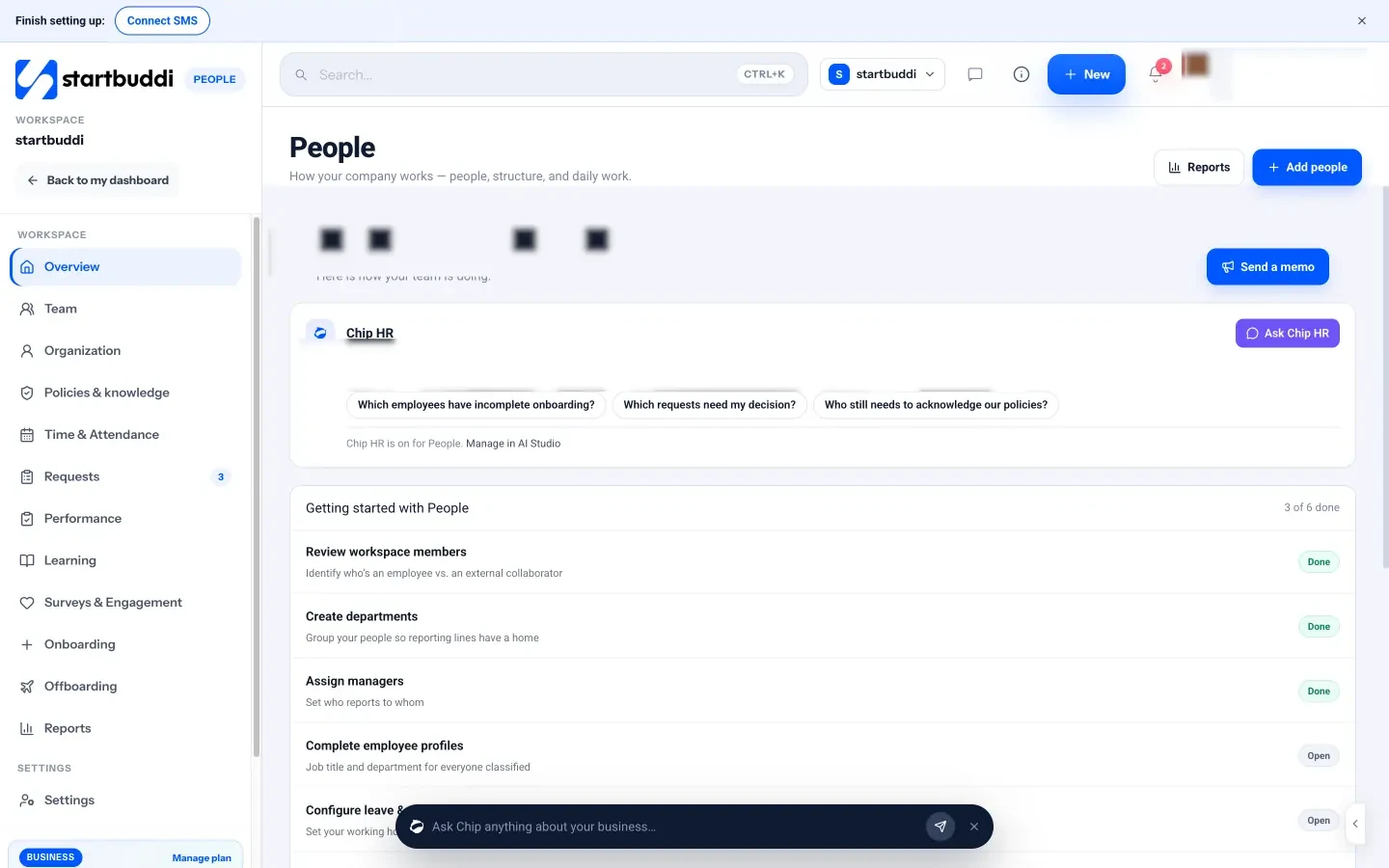
Be clear on what it doesn’t do: startbuddi doesn’t run payroll, payslips or tax filing, so keep your accountant or payroll provider on the “Outsourced to” column. People records don’t need a seat, but inviting teammates to sign in needs a paid plan. A free plan is available; see pricing, startbuddi People or startbuddi for startups.
Design yours this week
Fill in the canvas, name an owner for every row and move the routine work into one place. Our HR for small business guide goes deeper on each area, and you can start free with startbuddi to keep records, onboarding, leave and policies together.
Frequently asked questions
What is an HR operating model?
An HR operating model is the way a business organises its people work: who is responsible for each HR task, the processes they follow, the tools they use and how decisions are approved. Every business with employees has one, whether or not it's written down.
What are the three pillars of the Ulrich HR model?
The Ulrich model splits HR into shared services for routine administration, centres of expertise for specialist areas such as reward and learning, and business partners who advise leaders. It suits large organisations; small businesses usually keep the same logic with self-service tools, outside specialists and the founder as the advisor.
What is the best HR operating model for a small business?
For most businesses under about 30 people, an owner-led or owner-plus-administrator model works best. Keep decisions with the founder or managers, put routine admin into one system, write down your policies and outsource payroll and legal advice.
When should a small business hire its first HR person?
Hire when HR admin regularly takes more than a few days a month of a founder's or manager's time, or when headcount, locations or legal duties make mistakes costly. Many businesses first give HR admin to an operations or office manager before hiring a specialist.
What is the difference between an HR operating model and an HR strategy?
An HR strategy says what you want from your people, such as hiring ten engineers this year or cutting turnover. The HR operating model is the machinery that delivers it: roles, processes, tools and approvals. A good strategy fails without a working model.
Can HR be fully outsourced in a small business?
Most of the admin can be: payroll, pensions, contracts and employment law advice are commonly bought in. Decisions about hiring, pay, performance and culture should stay with the owner or managers, because they depend on knowing the business and the people.
Tiwalade Joanna Okedara-Kalu is the founder, CEO and CTO of startbuddi, the business system that brings clients, bookings, invoices, projects, marketing and the Chip AI assistant into one place. Tiwalade builds software around how service businesses really work day to day, and writes about client management, getting paid on time and why small businesses outgrow the tools they start with.
Founded startbuddi and leads its product and engineering