
How to start a food truck business: costs, permits, POS and growth
A four-part guide to starting a food truck business: plan the concept and costs, get permits and food safety right, choose a POS system and grow a loyal following.


This guide explains how to start a food truck business, from the first menu idea to a truck that serves customers, takes payments smoothly and makes a profit. It is for first-time food entrepreneurs, home cooks and chefs ready to go it alone, and restaurant owners adding a mobile kitchen, wherever you are in the world.
The short answer: choose a simple concept you can cook fast in a small space, build a realistic budget and break-even point before you buy anything, get the right registrations and food safety in place for where you will trade, pick a point of sale (POS) system that works on the street, and then build a loyal following around where and when people can find you. Each chapter starts with the business thinking, with worked numbers, checklists and common mistakes, then shows where startbuddi helps. We are clear throughout about what startbuddi is not: it is not a POS system, so chapter 3 is an honest buyer’s guide to POS systems for food trucks, and explains how startbuddi works alongside one.
Plan your concept, costs and break-even
- Research your market before you commit
- Truck, trailer, cart or kiosk?
- Build a start-up budget
- Work out your break-even point
- Price your menu from the cost up
- How food trucks are usually funded
- Plan where you will trade
- Choose a business structure
- Common planning mistakes
A food truck looks like a cheaper, faster way into the food business than a restaurant, and often it is. But it is still a food business, with food costs, staff, equipment, fuel, permits and bad-weather days. The trucks that last are the ones whose owners did the numbers before they bought the truck. This chapter helps you choose a concept, pick the right kind of vehicle, build a start-up budget and work out how much you must sell each day to break even.
How to start a food truck business: concept first, truck second
It is tempting to start by shopping for trucks. Start with the menu instead, because the menu decides everything else: the equipment you need, the size of the kitchen, how many people it takes to run, how fast you can serve and what you can charge.
The best food truck concepts share a few traits:
- A short menu. Five to eight items, built from overlapping ingredients. Fewer items means less waste, less storage and faster service.
- Fast to serve. At a busy lunch, you may have a queue of 30 people and a 45-minute window. If each order takes four minutes, you serve barely a dozen. Aim for under two minutes from order to hand-over.
- Easy to eat standing up. Wraps, bowls, tacos, burgers, dumplings, rice dishes, coffee and pastries all travel well. Dishes that need a knife and a table are harder.
- One clear idea. "Nigerian suya wraps", "Korean fried chicken" or "specialty coffee and cardamom buns" are easy to remember and easy to post about. "Global fusion street food" is not.
- Good margins. Rice, beans, flatbreads, potatoes and chicken thighs are cheaper per portion than steak or seafood. You can still use premium ingredients, but as a highlight rather than the base.
Research your market before you commit
A food truck lives or dies by whether enough people want your food, at your price, where you can park. You can test all three cheaply before spending serious money.
- Walk the patch. Visit the areas you hope to trade in at the times you would trade. Count footfall over 30 minutes, note what food is already on offer and at what prices, and watch where people queue.
- Talk to other traders. Market managers, event organisers and other food truck owners know which pitches are busy, which organisers pay on time and which events are overcrowded with food vendors.
- Run a pop-up. Before buying a truck, rent a market stall, cook at a friend's bar or sell at a community event from a gazebo, where local rules allow it. You learn what sells, how fast you can serve and what people will pay.
- Ask a small panel. Feed 20 people from your target audience and ask for honest feedback on taste, portion size and price. Write down the exact words they use to describe the food; they make good menu copy.
The goal is not certainty, which you will never have, but enough evidence that your concept can sell your break-even number of orders in the places you plan to trade.
Truck, trailer, cart or kiosk?
"Food truck" covers several kinds of mobile kitchen. Each suits different menus and budgets.
| Type | What it is | Good for | Trade-offs |
|---|---|---|---|
| Food truck | A vehicle with the kitchen built in | Moving between several locations in a day, full hot menus | Highest cost; if the engine breaks, the kitchen is off the road too |
| Trailer | A kitchen towed by a separate vehicle | Events, festivals and regular pitches where you stay put all day | Needs a towing vehicle and space to park both |
| Cart or bike | A small unit, often for one or two items | Coffee, ice cream, snacks, busy pedestrian areas | Limited menu and storage |
| Container or kiosk | A fixed or semi-fixed unit on private land | A permanent pitch with steady foot traffic | Less flexibility; rent or landlord agreement needed |
New or used? A used truck costs less up front but may need repairs and changes to meet local health rules. A new build costs more and takes longer, but you can design the kitchen around your menu. Whichever you choose, have the kitchen and gas or electrics inspected before you buy, and check with your local health department that the layout will pass inspection.
Build a start-up budget
Every truck is different, so get real quotes rather than relying on averages. The example below shows the kind of lines to include. The figures are illustrative for a used truck in the US, not a benchmark. Replace them with your own quotes.
| Start-up cost (example) | Amount (USD) |
|---|---|
| Used truck with kitchen | $45,000 |
| Repairs, kitchen changes and inspection fixes | $6,000 |
| Wrap, signage and menu boards | $4,000 |
| Small equipment and utensils | $3,000 |
| Permits, licences and registration | $2,000 |
| Insurance deposit (vehicle, liability, equipment) | $2,500 |
| POS hardware and card readers | $500 |
| Opening stock and packaging | $2,000 |
| Working capital for the first three months | $10,000 |
| Total | $75,000 |
The same structure works everywhere, even though the amounts will be very different. A kiosk in Lagos, a converted van in Manchester and a coffee bike in Nairobi each need a vehicle or unit, fit-out, permits, equipment, opening stock and a cash buffer. Do not skip the working capital line. Many food businesses fail not because the idea is bad but because they run out of cash in a slow first season.
Work out your break-even point
Your break-even point is how much you need to sell to cover all your costs. Here is a worked example for a truck selling wraps and bowls at an average order of $14.
- Food and packaging cost per order. Say 30% of the price: $4.20.
- Card processing and other per-sale costs. Assume 3% for this example: $0.42. Check your provider's actual rates.
- Contribution per order. $14.00 minus $4.20 minus $0.42 = $9.38. This is what each order contributes towards your fixed costs.
- Fixed costs per month. Commissary $800, insurance $300, loan repayment $900, fuel and gas $700, pitch fees $600, one part-time helper $2,400, phone and software $100, repairs fund $300, your own wage $3,500. Total: $9,600.
- Break-even orders per month. $9,600 ÷ $9.38 = about 1,024 orders.
- Per trading day. If you trade 20 days a month, that is about 51 orders a day.
Now ask the honest question: can you sell 51 orders a day at your planned locations, in two service windows, with your menu and your team? If a lunch pitch gives you 60 people in a good week and 25 in the rain, you need a second service window, events, catering bookings, or a cheaper set-up. The profit margin calculator helps you test prices and food costs.
Price your menu from the cost up
Many new owners price by looking at what others charge. Look at competitors, but start from your own costs. For each dish, add up the cost of every ingredient and piece of packaging in one portion, including sauces, garnish, napkins and the box. Then divide by your target food cost percentage. If a bowl costs $3.90 to make and you aim for a 30% food cost, the price is $3.90 ÷ 0.30 = $13. Round to a price that feels natural, such as $12.95 or $13.
Recheck dish costs every few months, because ingredient prices move. When costs rise, you can adjust the portion, swap an ingredient, or raise the price slightly. Combos, such as a main with a drink and a side, raise the average order value and are quick to serve. Keep your cheapest item profitable too, because it is often what first-time customers try.
How food trucks are usually funded
Most owners combine savings with one or more of: an equipment or vehicle loan, a small business loan, a lease or rent-to-own arrangement for the truck, money from family or a partner, or a grant or accelerator programme for food businesses where these exist. Whatever you choose, lenders will want to see your concept, your start-up budget, your break-even sums and evidence from your pop-ups. The monthly repayment becomes a fixed cost in your break-even calculation, so borrow only what the business can repay on a quiet month.
Plan where you will trade
Location is the food truck's biggest advantage and its biggest risk. Before you buy, spend a few lunchtimes and evenings at the places you hope to trade. Count people walking past, note what other food is nearby, and ask who manages the space. Typical options include office districts at lunch, breweries and bars in the evening, markets, festivals and events, universities, construction sites and private events such as weddings and company parties. Many owners find that private events and catering bring the most reliable money, while street trading builds the brand.
Choose a business structure
Many food truck owners start as a sole trader or sole proprietor, which is simple and cheap. Others form a limited company or LLC, which can separate business debts from personal assets and may help when borrowing or signing event contracts. The right choice depends on your country, your risk and your tax position, so it is worth a short conversation with an accountant before you sign a loan or lease. This is general information, not legal or tax advice.
Common planning mistakes
- Buying the truck before testing the menu and the locations.
- A long menu that slows service and wastes stock.
- No working capital, so one broken generator puts the business at risk.
- Ignoring the owner's wage when working out break-even.
- Assuming every day will be a good day. Plan for weather, holidays and quiet weeks.
If you want to put all of this on paper for a lender or partner, the business plan template has sections for your concept, costs and forecasts.
Plan your food truck's money in startbuddi
Before the truck earns a penny, you can use Money Manager in startbuddi to plan what you will spend, track the start-up costs as they happen and keep receipts in one place. It is not accounting software, so you will still want an accountant or bookkeeping tool for tax returns, but it gives you a clear, day-to-day view of where the money is going.
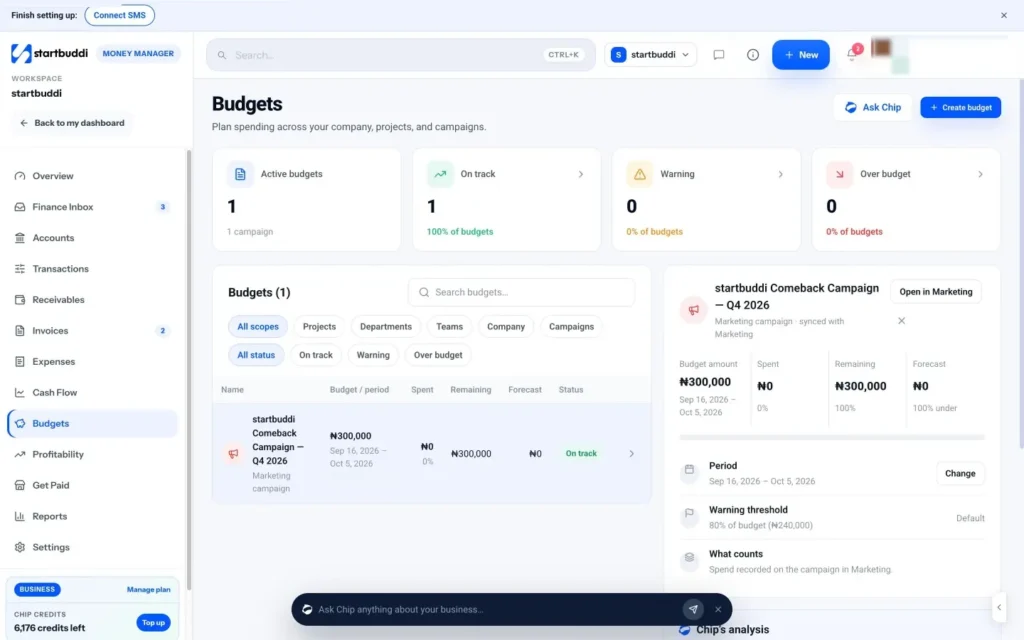
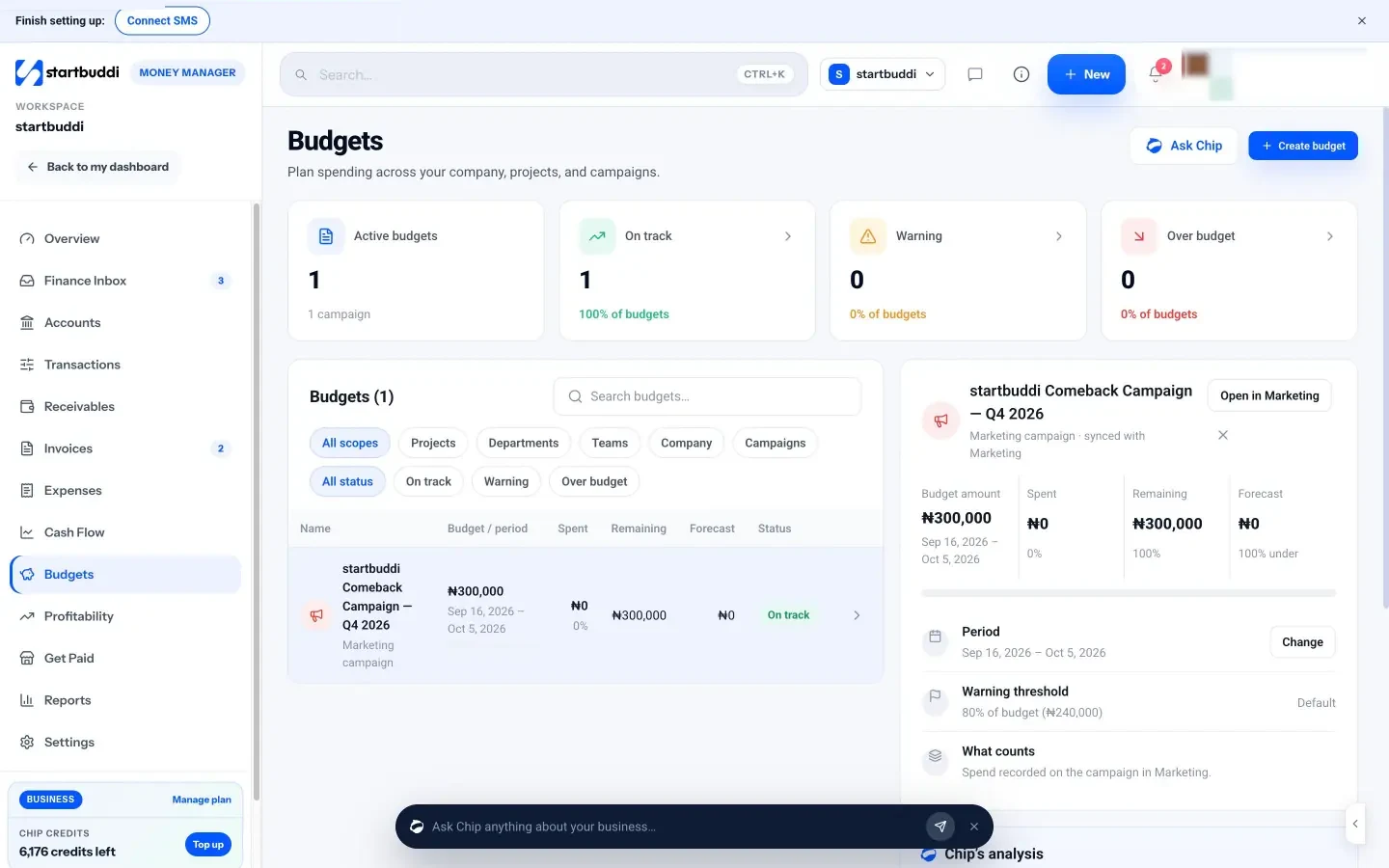
Set a budget. In Money Manager, Budgets lets you plan spending for the whole company, a project or a campaign. Create a budget for your launch project with the total you plan to spend. It tracks spending against the budget, warns you at 80% and 100%, and shows a budget versus actual chart, so you see early if the fit-out is eating the working capital.
Record start-up costs as you go. In Expenses, add each purchase with the vendor, amount, category, date, how you paid and a photo or PDF of the receipt. Expenses are included on the Free plan. If you are not sure of a category, leave it as Uncategorized and it will wait in the review queue. See expense tracking for why this matters at tax time.
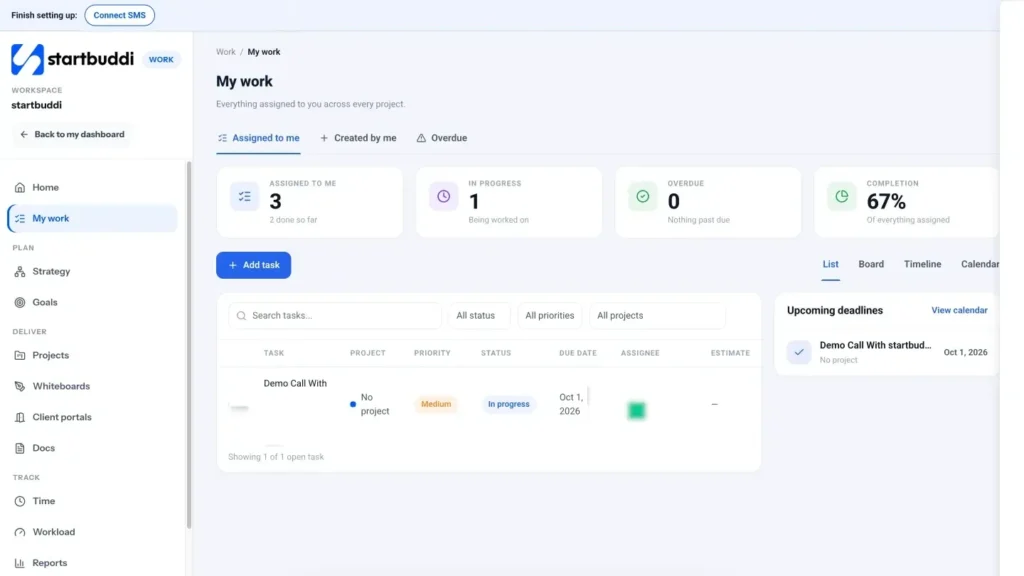
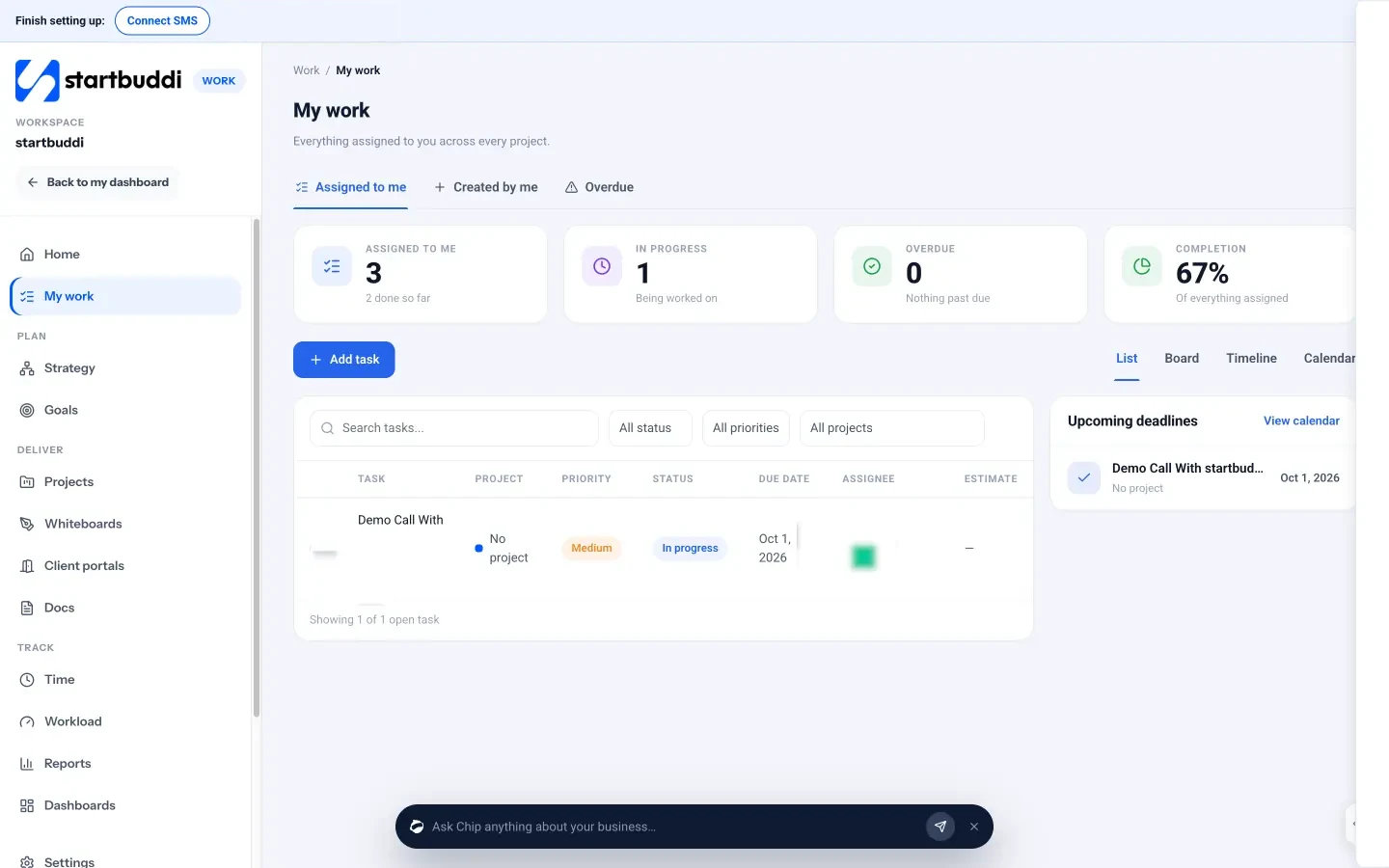
Plan the launch as a project. In Work, create a project called "Truck launch" with tasks such as "Book health inspection", "Order wrap", "Register food business" and "Test menu with 20 people", each with a date and an owner. The project timeline shows what has to happen before opening day.
Ask Chip for a second opinion. Chip, the assistant built into startbuddi, can talk through your budget lines or help you draft a launch checklist. Treat what it suggests as a starting point and check the numbers against real quotes.
Once the plan is solid, the next step is the paperwork that lets you trade legally.
Permits, licences and food safety
- Examples from different countries
- The commissary question
- Food safety basics that apply almost everywhere
- Insurance and tax
- Water, waste and power
- Passing your first inspection
- Train everyone who works on the truck
- Pitches, events and private land
- Keep the records inspectors expect
- Build routines so nothing lapses
- Plan for when something goes wrong
- Mistakes that cause trouble with inspectors
Permits and food safety are the least exciting part of starting a food truck, and the part that can close you down fastest if you get it wrong. The rules depend on your country, state or county and city, and sometimes on each place you park. This chapter explains the kinds of permission most food trucks need, the food safety basics that apply almost everywhere, and how to build simple routines so nothing expires or gets missed.
This is general information, not legal advice. Always check with the local authorities where you plan to trade before you spend money.
Food truck permits and licences: what to expect
Most food trucks need several separate permissions, often from different offices. They usually fall into five groups:
- Business registration and tax. Registering the business itself, and registering for the taxes that apply to you, such as income tax and sales tax or VAT.
- Food business registration or health permit. Permission from the health or food authority to prepare and sell food, usually after an inspection of the truck.
- Street trading or vending permission. Permission to trade in public places, often limited to certain streets, days or hours.
- Vehicle and equipment rules. Vehicle registration and roadworthiness, gas safety, fire safety, and sometimes generator or noise rules.
- Staff and food hygiene training. Food handler certificates or courses for you and anyone working on the truck.
Examples from different countries
The details vary a lot, so here are a few official examples to show how different places handle it.
- United States (New York City). NYC Health requires each person operating a cart or truck to hold a mobile food vendor licence and complete a food protection course, and the unit itself needs a separate permit. Trucks must be cleaned, serviced and stored at an approved commissary or depot, and return to it daily (NYC Health, mobile food vendors). Other US cities and counties set their own rules, and the SBA's licences and permits guide explains how federal, state and local permissions fit together.
- United Kingdom. Anyone who sells, cooks or handles food, including from a van or stall, must register with their local authority at least 28 days before trading (GOV.UK, register a food business). Many councils also require a street trading licence to trade on public streets.
- Australia. Food Standards Australia New Zealand explains that a mobile food business must notify the council where the vehicle is garaged before starting, and may also need to notify other councils it trades in (FSANZ, mobile food business).
- Nigeria, Kenya, South Africa and elsewhere. Rules are usually set by state, county or municipal governments, and markets and private sites may have their own requirements. Start with your local council or environmental health office and ask for a list of what a mobile food business needs.
Allow time. Registrations, inspections and trading permissions can take weeks, and some cities cap the number of vending permits or run waiting lists. Map out every permission on a single timeline, starting from your planned opening date and working backwards, so you know which applications must go in first. Where one approval depends on another, such as a trading permit that needs your health registration, apply in the right order to avoid delays.
The commissary question
Many places require food trucks to operate from a commissary: a licensed commercial kitchen or depot where you prepare food, store stock, fill fresh water, empty waste water and clean the truck. Even where it is not required, a commissary or shared kitchen is often the practical answer, because a truck has limited space for prep and storage. Commissary rent is a fixed monthly cost, so include it in your break-even sums.
Food safety basics that apply almost everywhere
Whatever the local rules, the principles of safe food are the same. A small kitchen with a queue outside is exactly where mistakes happen, so build habits early.
- Keep hot food hot and cold food cold. In the UK, the Food Standards Agency says hot food on display should be kept above 63°C and cold food at 8°C or below, which is a legal requirement in England, Wales and Northern Ireland (FSA, chilling food). The US FDA Food Code, which states and local agencies adopt as a model, uses 135°F (57°C) or above for hot holding and 41°F (5°C) or below for cold holding.
- Check and record temperatures. Use a probe thermometer and write down fridge and hot-holding temperatures at set times. Records show an inspector that you are in control.
- Separate raw and ready-to-eat food. Colour-coded boards and containers help in a tight space.
- Hand washing. A dedicated hand-washing sink with hot water, soap and paper towels is usually a legal requirement, not a nice extra.
- Cleaning routines. Written opening, during-service and closing checklists, signed each day.
- Allergens. Know exactly what is in every dish, including sauces and oils, and be able to tell customers.
Insurance and tax
A food truck typically needs vehicle insurance that covers commercial use, public or general liability insurance in case a customer is hurt or made ill, and cover for the equipment and stock inside. Events and markets often ask to see your liability certificate before they give you a pitch. If you employ staff, employer's liability or workers' compensation may be required too.
On tax, keep every receipt from day one and know which sales taxes apply to you. In the UK, for example, HMRC's guidance says hot takeaway food that meets certain tests is standard-rated for VAT, while most cold takeaway food is zero-rated (HMRC VAT Notice 709/1). In the US, the IRS self-employed hub covers income tax, and your state handles sales tax. In Nigeria, the Nigeria Revenue Service covers federal taxes. An accountant who knows food businesses is worth paying for in the first year.
Water, waste and power
Inspectors look closely at the systems customers never see. Check that your fresh water tank is large enough for a full day of hand washing and cleaning, that the waste water tank is larger than the fresh water tank (a common requirement), and that you have an approved place to empty it. Grease and cooking oil need proper disposal, not a drain. For power, decide between a generator, battery systems and mains hook-ups at events, and check each site's rules on noise and fuel. Gas cylinders, hoses and appliances should be installed and checked by a qualified professional, and many events ask to see a current gas safety certificate before you arrive.
Passing your first inspection
Treat the first inspection as a rehearsal of a normal day. Have your registration and permits ready, your temperature logs started, cleaning checklists on the wall, allergen information prepared and a stocked hand-washing sink. Walk the inspector through your opening routine and how you would handle a busy service. If they point out problems, write them down, ask what "good" looks like, fix them quickly and confirm in writing. Inspectors generally prefer a business that asks questions to one that argues or hides things.
Train everyone who works on the truck
Many places require food handlers to complete a food hygiene or food safety course, and even where it is not required, it is the fastest way to build good habits. Train new staff on your procedures before their first busy shift: hand washing, temperature checks, allergen questions, cleaning, cash handling and what to do if something goes wrong. A short written induction checklist, signed by each new starter, gives you a record that training happened.
Pitches, events and private land
Permission to trade often depends on where you park. Public streets usually need council or city permission. Markets and events have their own application process, pitch fees and paperwork, often including your registration, insurance and gas certificate. Private land, such as a business park, brewery or petrol station forecourt, needs the landowner's written agreement, and sometimes planning or local authority permission as well. Keep a simple file for each regular pitch with the contact, the agreement, the fee and any conditions.
Keep the records inspectors expect
Good records protect you if something goes wrong, and they make inspections faster. Most food businesses keep some version of these:
| Record | What to write down | How often |
|---|---|---|
| Fridge and freezer temperatures | Time, temperature, initials, action if out of range | At opening and during service |
| Hot holding and cooking checks | Dish, core temperature, time, initials | Each batch or at set times |
| Cleaning checklist | Areas cleaned, products used, initials | Daily |
| Deliveries | Supplier, items, temperature on arrival, any rejected items | Each delivery |
| Allergen matrix | Every dish and the allergens it contains | Whenever a recipe or supplier changes |
| Staff training | Who was trained, on what, and when | Each new starter and refresher |
In the UK, the Food Standards Agency's Safer food, better business packs are a free, ready-made way to set up these records. Other countries have similar resources from their food authorities.
Build routines so nothing lapses
Once you are trading, the risk shifts from "getting the permits" to "keeping them". Licences, insurance, gas safety checks, vehicle inspections and staff certificates all expire on different dates. Keep one list with every permit, its reference number, its expiry date and who issued it, and set reminders a month before each renewal.
Written procedures help too. A short standard operating procedure (SOP) for opening, closing, cleaning, temperature checks and allergen questions means anyone on the truck does things the same way, and gives an inspector confidence. The SOP template is a quick way to write your first ones.
Plan for when something goes wrong
Write a short plan for the problems you hope never happen: a fridge that fails mid-service, a customer who reports feeling ill, an allergic reaction at the window, a gas smell or a minor fire. For each, note who does what, who to call and what to record. Keep the plan in the truck and go through it with every new starter. If a customer complains of illness, record the details politely, keep any records of what they ate and when, and contact your local food authority for advice if needed. Being calm and organised in a bad moment protects your customers and your reputation.
Mistakes that cause trouble with inspectors
- Buying a truck built for another city's rules and assuming it will pass locally.
- No temperature records, or records filled in at the end of the week from memory.
- A hand-washing sink used for storage because space is tight.
- Staff who cannot answer an allergen question with confidence.
- Letting a licence or insurance certificate lapse because the renewal reminder went to an old email address.
Keep permits, checklists and procedures organised in startbuddi
No software can apply for permits for you, but startbuddi can make sure nothing is forgotten and that everyone on the truck works from the same instructions.
Renewals as repeating tasks. In Work, open My work and add a task for each renewal, such as "Renew food business insurance" or "Book gas safety check", with a due date a month before the expiry. Tasks can repeat daily, weekly or monthly, so daily jobs like "Record fridge temperatures" and "Closing clean" can repeat automatically, with subtasks as the checklist. Assign them to whoever is on shift once you have a team.
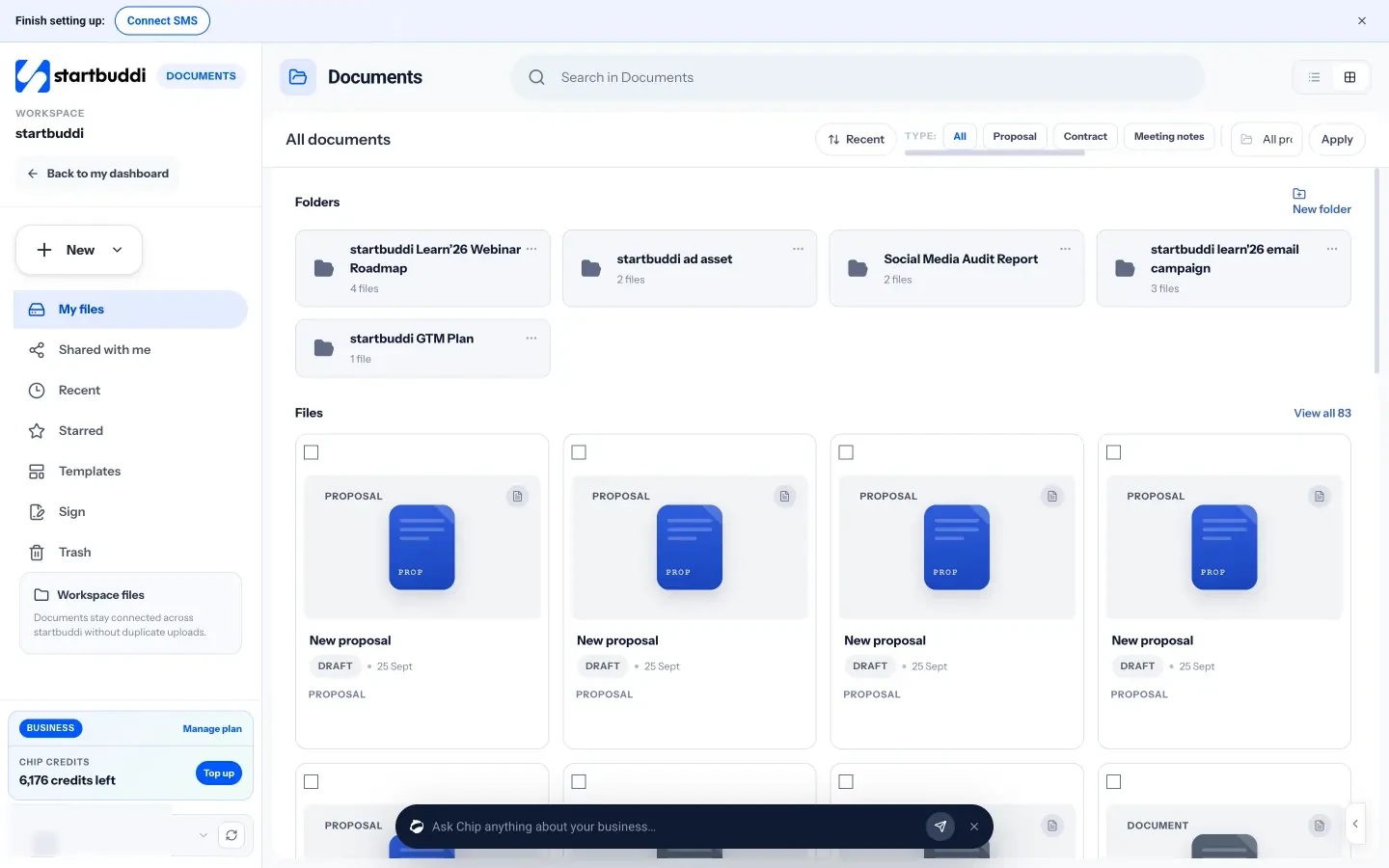
Procedures and permits in Documents. Keep your SOPs, allergen matrix, permit copies and insurance certificates in Documents, organised in folders, so you can find them in seconds when an inspector or event organiser asks. You can link a document to a task, so the "Closing clean" task opens the closing checklist.
Costs of compliance. Record permit fees, inspection costs and insurance premiums in Money Manager Expenses. The Recurring tab keeps regular payments like insurance or commissary rent in view, and they feed your cash forecast.
POS systems for food trucks: how to choose
- What to look for in the best POS system for a food truck
- Examples of POS options for food trucks
- Is there a free POS system for a food truck?
- A hardware checklist for the truck window
- Cash, tips and refunds
- Online ordering and delivery apps
- How to decide in five steps
- Work out the real cost of a POS
- Receipts, records and your accountant
- Accepting the payment methods your customers prefer
- Test your set-up before launch day
- Common payment mistakes on food trucks
On a busy street, your point of sale is part of your kitchen. If the card reader loses signal, the queue stops. If the menu on the screen is slow to tap through, service slows down. This chapter is a buyer's guide to POS systems for food trucks: what they do, what to look for, what free options exist and how to decide. It also explains honestly where startbuddi fits: it is not a POS system, and you will need one; but it can handle the payments and money work that a POS does not.
POS systems for food trucks: what they do
A point of sale system is the combination of software and hardware you use to take orders and payments. For a food truck, that usually means an app on a tablet or phone, a card reader, and optionally a receipt printer, a cash drawer and a kitchen display or ticket printer. A good food truck POS lets you:
- tap in orders quickly from a menu with modifiers, such as "no onions" or "extra sauce";
- take card, contactless, mobile wallet and cash payments;
- send orders to the kitchen, on a screen or as printed tickets;
- keep working when the mobile signal drops;
- track what sold, when, and at which location;
- track stock of key items, so you know when you are about to run out;
- handle tips, discounts and refunds;
- report sales and taxes for your bookkeeping.
What to look for in the best POS system for a food truck
Not every restaurant POS suits a truck. Check each option against the realities of mobile trading.
| Question | Why it matters on a truck |
|---|---|
| Does it take card payments offline? | Signal is patchy at festivals, car parks and busy events. Some systems store card payments and process them later, with limits and risks you should read about. |
| How fast is order entry? | Count the taps for your five best-selling orders. Every extra tap slows the queue. |
| What hardware is needed, and what does it cost? | A phone and a small reader may be enough. Kitchen screens and printers add cost and need power. |
| What are the processing fees? | Fees are charged on every sale, so small differences add up. Compare in-person, online and manual-entry rates. |
| Which payment methods work in your country? | Contactless cards dominate in some markets; mobile money, bank transfers or QR payments in others. |
| How does it handle battery and power? | Tablets and readers must last a full service. Check charging options in the truck. |
| Can it cope with several locations? | Sales reports by location or event show where to go back to. |
| Does it do online or pre-orders? | Pre-orders smooth out lunch rushes and help at events. |
| How do you get your data out? | You will want sales data for your accountant and your own analysis. |
Examples of POS options for food trucks
There are many POS providers, and availability and pricing depend on your country. These are examples of the kinds of options food trucks use, with links to their own pages so you can check current features and prices. We are not ranking them.
- Square. Square for Restaurants lists a free plan alongside paid plans, with processing fees on each sale (Square for Restaurants pricing, US). Square also documents how offline mode works for card payments.
- Toast. A restaurant POS with food truck set-ups, including handheld devices (Toast).
- SumUp. Card readers that pair with a phone, popular with market traders in the UK and Europe (SumUp card readers, UK).
- Yoco. Card machines and a POS app for small businesses in South Africa (Yoco fees).
- Mobile money. In Kenya, many traders accept payments through an M-PESA till number (Safaricom Buy Goods), sometimes alongside a card reader.
Is there a free POS system for a food truck?
Yes, in the sense that some providers offer POS software with no monthly subscription, like Square's free plan. "Free" usually means you pay processing fees on each card sale instead of a monthly fee, and you pay for hardware such as card readers. For a new truck with modest sales, a free plan plus a card reader is often a sensible start. As sales grow, a paid plan may be worth it for features like kitchen displays, online ordering or better reporting. Do the maths on your own expected sales: a monthly fee that saves you money on processing or time in the queue can be cheaper overall.
A hardware checklist for the truck window
- A primary device for orders, such as a tablet or phone, with a mount that keeps it off the counter.
- At least two card readers, fully charged, so one failure does not stop card sales.
- Power banks or a charging point for every device.
- A mobile hotspot or a second SIM from a different network, in case one signal is weak.
- A way to get orders to the cook: a kitchen screen, a ticket printer or a simple numbered-ticket system.
- A cash float and a locked cash box if you accept cash.
- A printed QR code as a last-resort way for customers to pay on their own phone.
Cash, tips and refunds
Even in card-heavy markets, some customers pay cash. Start each shift with a set float, count the cash at the end, and record it against the POS totals the same day. If you share tips with staff, write down how they are split and pay them promptly, following the rules where you are. Decide your refund policy in advance: most trucks replace a dish that is wrong rather than refunding, but have a clear way to refund a card payment when needed. Consistent habits here prevent the small disagreements that sour a team.
Online ordering and delivery apps
Some trucks add pre-ordering or delivery, especially at lunch. Options range from your POS provider's own online ordering to marketplace apps that charge a commission on each order. Pre-orders reduce queues and let you prepare in advance, but they need a clear collection time and space at the window. Delivery apps can bring new customers, but commissions can eat much of your margin, so price delivery menus with that in mind and check each app's terms before signing up.
How to decide in five steps
- List the payment methods your customers use most where you trade.
- Shortlist two or three POS providers available in your country that support them.
- Check hardware cost, processing fees and offline rules on each provider's own site.
- Run a timed trial with your real menu.
- Check how sales data exports, so your bookkeeping and money tracking stay simple.
Our post on POS systems for food trucks goes deeper on this comparison.
Work out the real cost of a POS
Compare POS options on their total monthly cost at your expected sales, not just the headline subscription. A worked example, using round numbers you should replace with each provider's published rates: you expect $20,000 of card sales a month. Option A has no monthly fee and a 2.9% card rate, so fees are about $580 a month. Option B costs $60 a month with a 2.6% rate, so fees are $520 plus $60, or $580 in total. At this volume they cost the same; above it, option B becomes cheaper, below it option A wins. Add hardware, spare readers and any add-ons you need, such as a kitchen display, and do the sum again for a quiet month and a busy one.
Receipts, records and your accountant
Whatever POS you choose, make sure it can give customers a receipt when they ask, usually by email or text, and that you can export daily sales by payment type. Download or note the totals at the end of each trading day, together with your cash count, so your bookkeeping is always up to date. That daily habit makes tax time, loan applications and pricing decisions far easier, and it stops small errors becoming big ones.
Accepting the payment methods your customers prefer
What customers expect varies a lot by country. In the UK and much of Europe, contactless card and phone payments are the norm at street food stalls. In Kenya, mobile money is everyday. In Nigeria, many customers pay by bank transfer or POS terminal, and some still prefer cash. Offer the two or three methods most of your customers use, display them clearly on the menu board, and make sure every member of staff knows how to take each one quickly. A sign saying "card, transfer or cash" prevents awkward conversations at the window.
Test your set-up before launch day
Before your first public service, run a full rehearsal. Invite friends to order the whole menu in a rush, use real cards and a real cash float, and try the backup options on purpose: turn off the main device, switch to the second card reader, and take one payment through a QR code. Time how long each order takes from first tap to food in hand, and fix the slowest step. Fifteen minutes of rehearsal saves an embarrassing first day.
Common payment mistakes on food trucks
- Relying on one card reader with no backup, so a flat battery stops all card sales.
- Not testing mobile signal at a new pitch before event day.
- Taking cash without counting and recording it at the end of each shift.
- Mixing personal and business payments in one account.
- Taking big event bookings on a handshake, with no deposit.
Where startbuddi fits alongside your POS
To be clear, startbuddi is not a POS. It has no kitchen display, order tickets, menu modifiers, stock-by-ingredient tracking or card reader. Use a dedicated POS at the truck window. Where startbuddi helps is the money that does not happen at the window, and the tracking that ties the business together.
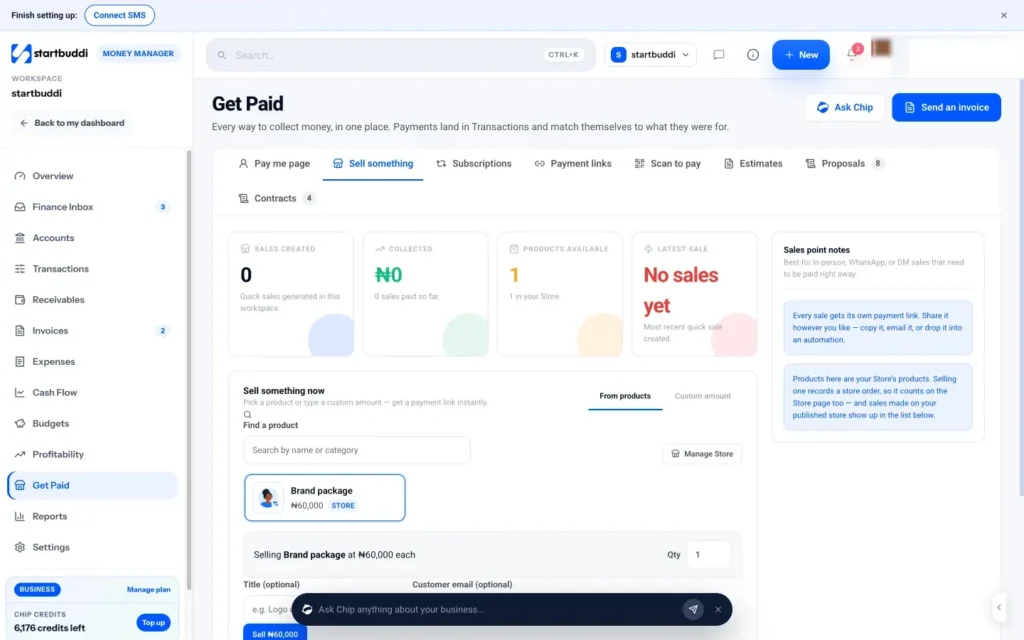
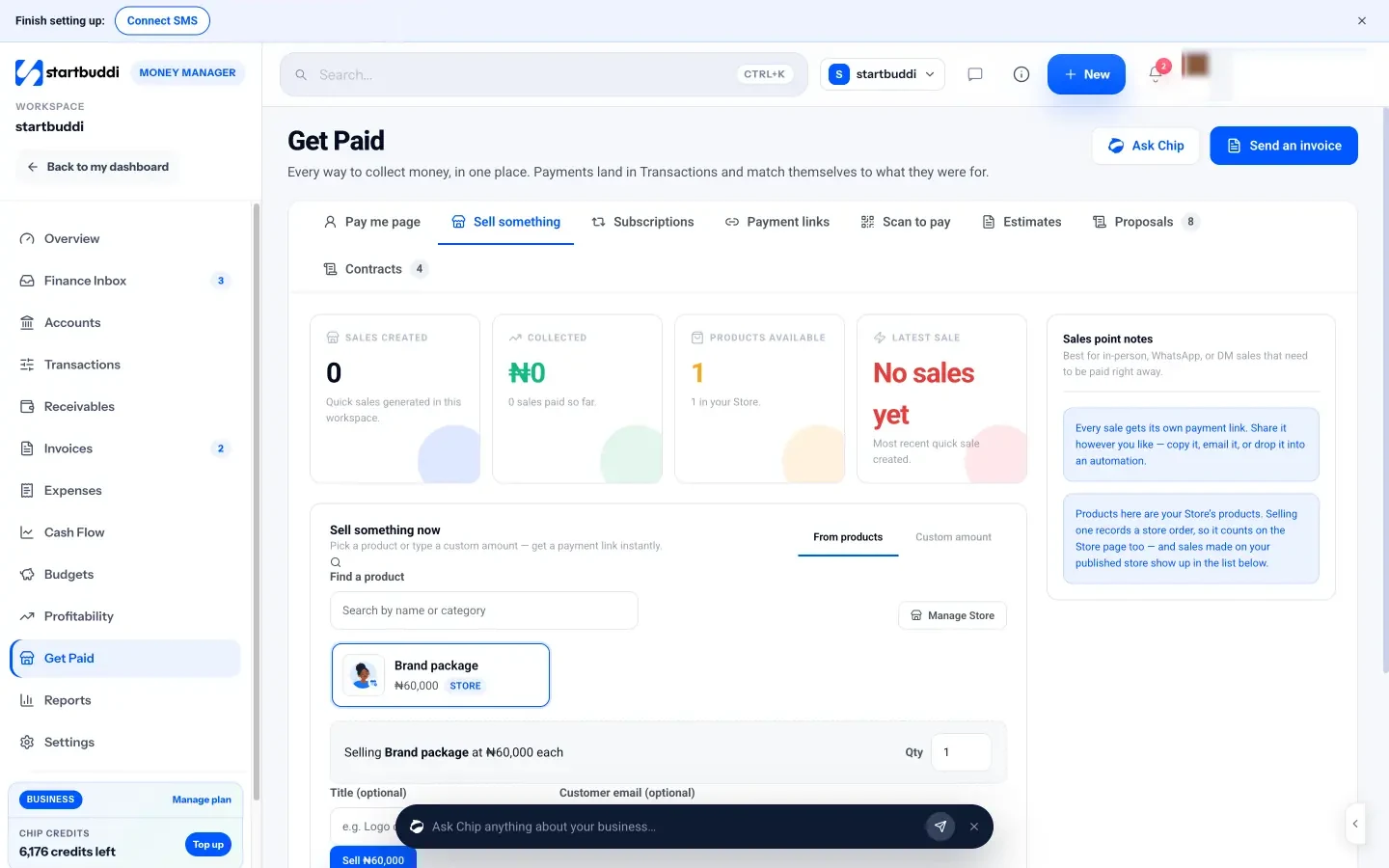
Quick sales and backup payments. In Money Manager, the Get Paid hub has a Sell something tab: pick a product or type a custom amount and it creates a payment link straight away, which the customer can open on their phone or receive by email. It is handy as a backup if your card reader fails, or for a one-off sale away from the truck. The Scan to pay tab creates printable QR codes for your pay me page, its items and your payment links, so a customer can scan and pay by card, bank transfer or mobile money through your connected Paystack or Stripe account. Money goes straight to your own provider account. See Get Paid for every option.
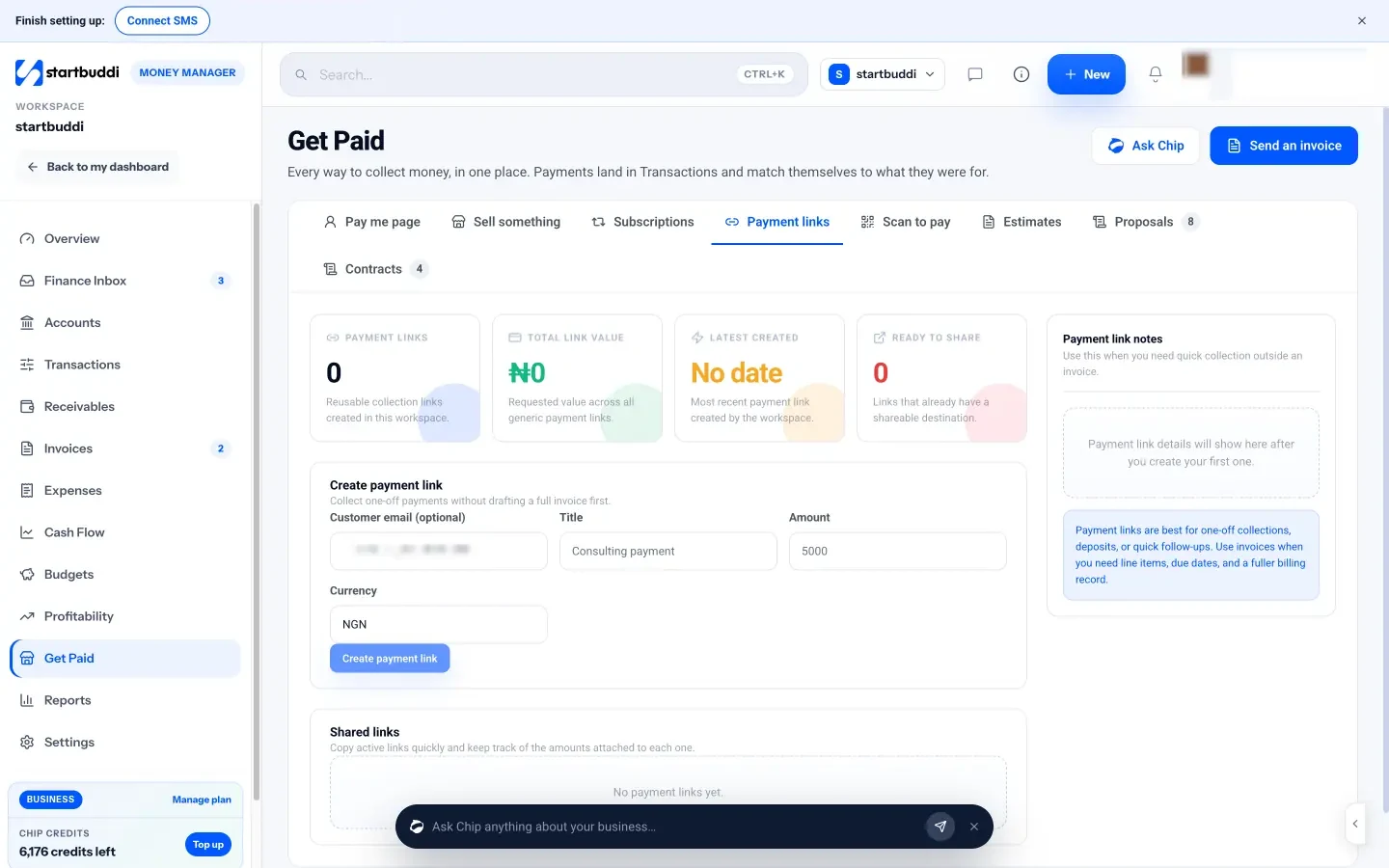
Deposits for private events and catering. Private bookings are often the most profitable work a truck does. When a company or a couple books you for an event, send an estimate from Get Paid, convert it to an invoice when they agree, and take a deposit with a payment link. Payment links are "best for one-off collections, deposits, or quick follow-ups", as the app puts it. The glossary explains payment links if they are new to you, and our list of payment link tools compares options.
Pre-orders from your link in bio. A link in bio page can show your menu with a WhatsApp button for orders, a payment block and today's location. For pre-orders you can set up the Store in catalogue mode, where each item has an Enquire button that opens WhatsApp or a form, so you confirm orders by message.
One place for all income. Payments taken through startbuddi land in Transactions and match themselves to what they were for. Sales through your POS stay in your POS reports, so export them for your bookkeeping alongside what startbuddi tracks. The next chapter shows how to use the numbers to grow.
Find customers, add events and track profit
- Add private events and catering
- Track the numbers that matter
- Turn first-time customers into regulars
- Keep the menu working hard
- Hire and train your first team
- A weekly review routine
- Partner with venues and other traders
- Handle complaints and reviews well
- Plan for the seasons
- When to grow
- Use data from every event
- Keep an eye on your own time
- Mistakes that hold food trucks back
- Your next step
Once the truck is on the road, the work becomes a weekly rhythm: decide where to trade, tell people, serve well, count the money, and adjust. The owners who grow a food truck into a lasting business do three things consistently. They make it easy for regulars to find them, they add higher-value work such as private events and catering, and they watch the numbers closely enough to drop what does not pay.
Growing a food truck business: be easy to find
A restaurant has an address. A food truck has a schedule. If customers cannot easily find out where you will be today, they will eat somewhere else. Treat your schedule as your most important piece of marketing.
- Publish the week's schedule every Monday. Post it on your social channels, pin it to the top of your profile and put it on your link in bio page.
- Post on the day. A photo from the truck with "We're at the market until 3pm" gets far more response than a generic post.
- Keep a regular pattern where you can. "Tuesdays at the business park, Fridays at the brewery" builds habits.
- Build a direct list. Social platforms change what they show people. A WhatsApp broadcast list or an email list of regulars reaches them directly. Only message people who have agreed to hear from you, and make it easy to opt out.
- Look after your Google listing and reviews. Many people search "food near me". Ask happy customers for a review and reply to every review, good or bad.
Add private events and catering
Street trading is unpredictable. Private events are booked in advance, paid in advance, and often priced per guest. Many food truck owners find that weddings, birthdays, corporate lunches, film sets, school events and festivals become the steadiest part of the business.
To make events work:
- Create simple event packages. For example: "Lunch for 50: two mains, one side, drinks, two hours of service, $1,400" or a per-person price with a minimum spend.
- Use an enquiry form. Ask for the date, location, number of guests, dietary needs, budget and power or parking access.
- Send a written quote. Include what is included, travel, service time, extras and the deposit.
- Take a deposit to confirm. Many trucks ask for 30 to 50 per cent to hold the date, with the balance due before the event.
- Confirm details a week before. Final numbers, arrival time, contact on the day, and any site rules.
A worked example: a company lunch for 60 at $22 per head is $1,320. Food cost at 30% is $396, staff for four hours $180, fuel and extras $80. That leaves around $664 towards fixed costs and profit from a single, pre-paid service, compared with roughly 71 street orders at the $9.38 contribution from chapter 1.
Track the numbers that matter
Food truck profits are made or lost in small percentages. Review these every week:
| Number | What it tells you | Example target |
|---|---|---|
| Sales by location and day | Which pitches are worth going back to | Drop pitches below break-even after a fair trial |
| Average order value | Whether combos and add-ons are working | Rising over time |
| Food cost percentage | Waste, portion control and supplier prices | Stable, around your planned figure |
| Labour cost percentage | Whether staffing matches demand | Lower on slow days |
| Cash in the bank and bills due | Whether you can cover the next month | At least one month of fixed costs |
| Private event income | How much predictable money you have | Growing share of income |
If money is tight, look at cash flow before profit. A truck can be profitable on paper and still run out of cash if a big repair and an insurance renewal land in the same week. Our guide on how to track cash flow explains the difference, and the post on tracking profit and loss shows a simple monthly routine.
Turn first-time customers into regulars
Regulars are the backbone of a food truck. They come back weekly, bring friends and forgive the odd slow day. A few simple habits help: learn names and usual orders, run a stamp card or "tenth meal free" scheme, give regulars first look at new dishes, and thank people by name in posts when they agree to it. Ask new customers how they found you, and put more effort into the channels that bring people back.
Keep the menu working hard
Every few months, look at each dish's sales and profit. Dishes that sell well and make good money are your stars: put them first on the board and in photos. Popular dishes with low margins may need a small price rise or a cheaper ingredient. Dishes that neither sell nor make money should go, freeing space, prep time and stock. Limited-time specials give regulars something new and let you test ideas without changing the core menu.
Hire and train your first team
Most trucks need at least two people at busy times: one cooking and one taking orders and payments. When you hire, look for people who stay calm under pressure and are friendly at the window; cooking can be taught. Write down the basics for each role, train on quiet days and pair new starters with an experienced person for their first busy shift. Check the employment rules where you are, including minimum wage, working hours and breaks, and put everyone's terms in writing.
A weekly review routine
Block 30 minutes each week, ideally on your quietest day. Look at sales by pitch, average order, food and labour costs, cash in the bank, upcoming bills, event bookings and reviews. Pick one thing to change next week, such as dropping a weak pitch, adding a combo or following up event enquiries, and one thing to keep doing. Small, regular adjustments are how a good first year becomes a sustainable business.
Partner with venues and other traders
Breweries, taprooms, bars without kitchens, co-working spaces, sports clubs and office parks often want food on site but do not want to run a kitchen. A regular slot at a venue gives you a predictable crowd, and the venue gets happier customers who stay longer. Agree the basics in writing: days and hours, any fee or revenue share, where you park, power and water, and who promotes the slot. Food truck parks and markets, where several traders share a site, can work well too, as long as the mix of cuisines is not too similar.
Handle complaints and reviews well
Every food business gets complaints. Handled well, they turn into loyalty. At the window, listen, apologise, and fix it on the spot with a replacement or a refund. Online, reply to every review within a day or two. Thank people for good reviews by name. For bad ones, stay calm, acknowledge the problem, say what you have changed and invite them back. Never argue in public. Future customers read your replies as much as the reviews themselves.
Plan for the seasons
Most food trucks have busy and quiet seasons, whether that is summer festivals in the UK, the rainy season in West Africa or holiday periods when office workers disappear. Use busy months to build a cash buffer. In quiet months, shift towards private events, catering and pre-orders, do maintenance, update the menu and train staff. If the quiet season is long, consider a fixed winter pitch, a pop-up in a bar or a shared kitchen producing takeaway.
When to grow
Signs you are ready for a second truck, a trailer or a permanent site include regularly selling out, turning down events because the truck is already booked, and a menu and procedures that run well without you on every shift. Grow from strength, with written procedures, a trained team and money in the bank, rather than to fix a cash problem.
Use data from every event
After each event or new pitch, spend five minutes writing down what happened: orders served, sales, the busiest half hour, what sold out, what was left over, weather and anything unusual. After a few months these notes become your best planning tool. You will know how much stock to bring to a festival of a given size, which events are worth the fee, and which dishes to push in cold weather. The same notes help you quote accurately for private events, because you know how many portions an hour your team can really serve.
Keep an eye on your own time
Owners often underestimate the hours outside service: shopping, prep, cleaning, driving, admin, social posts and event enquiries. Track your real hours for two weeks. If a pitch needs eight hours of your time for a small profit, it may be better to drop it and spend the time on events or rest. The business should pay you for all of your hours, not just the ones behind the window, and a sustainable routine matters more than squeezing in one more service.
Mistakes that hold food trucks back
- Posting about the food but not about where the truck will be.
- Saying yes to every event without checking it covers costs.
- Not recording daily takings and expenses until the accountant asks.
- Ignoring reviews and messages because service is busy.
- Running at full effort all year with no plan for quiet months.
Grow and track your food truck in startbuddi
This is where the rest of startbuddi earns its place: telling people where you are, handling event bookings and keeping a clear view of the money.
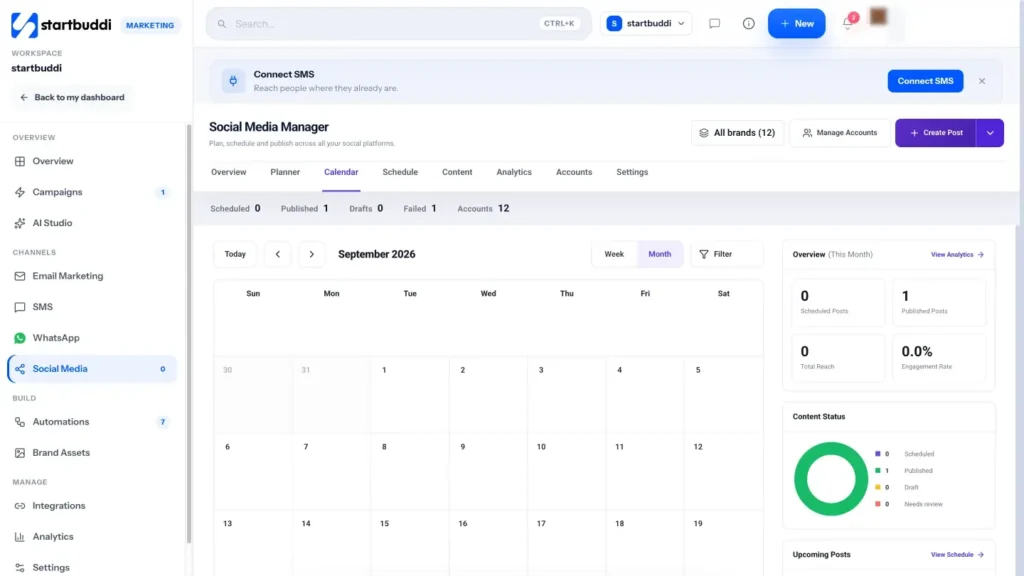
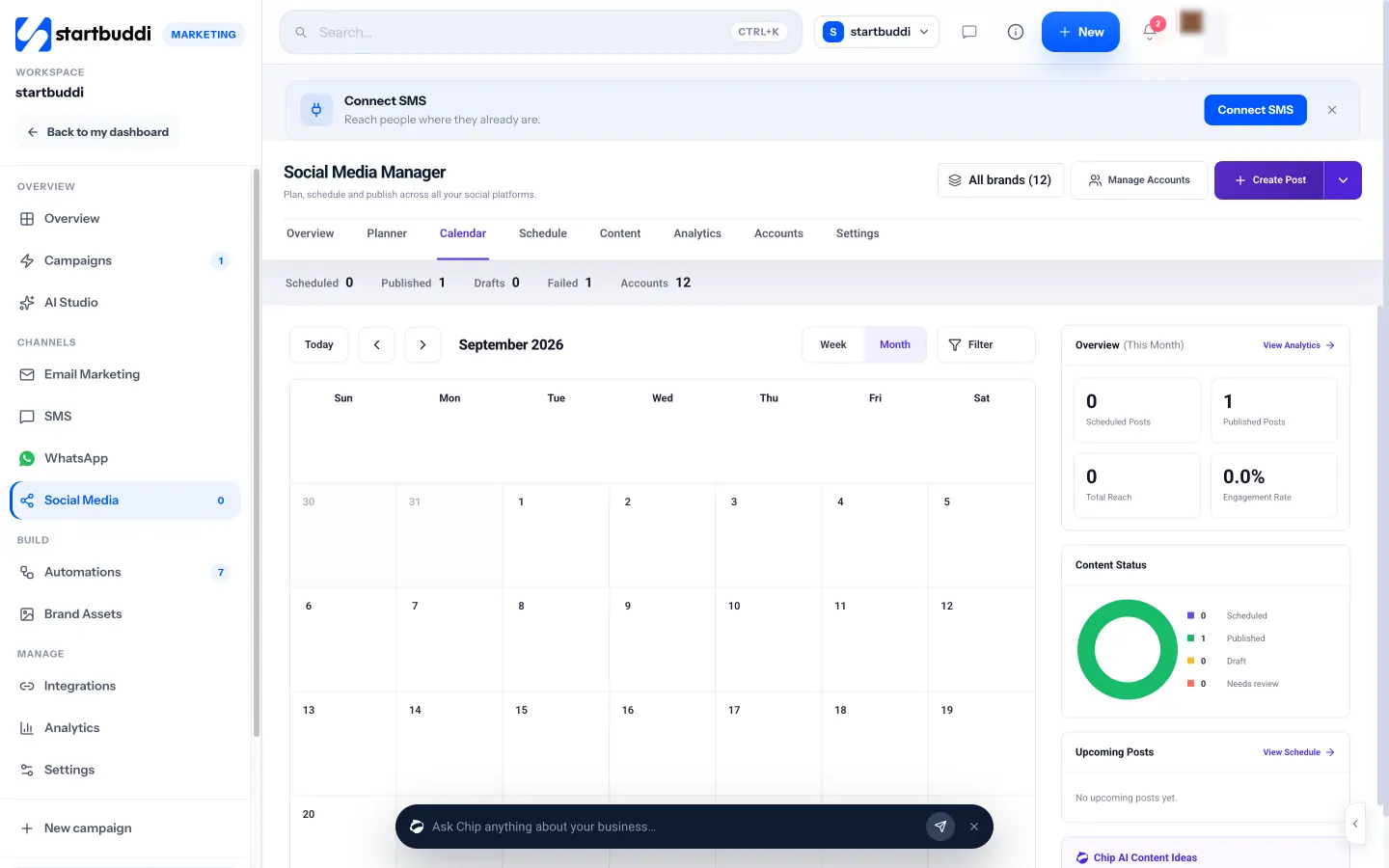
Schedule your weekly posts. In Marketing, the Social Media Manager lets you plan and schedule posts to Facebook, Instagram, LinkedIn, X, YouTube and Pinterest from one calendar. Plan with Chip drafts a set of posts from a short note about your week, such as "Tuesday business park, Friday brewery, new jollof bowl", which you edit and approve before they go on the calendar. The Marketing module needs the Starter plan or above. See social media for details.
Keep event customers in one list. Everyone who fills in your event enquiry form, books a call or pays an invoice becomes a contact in Customers, with their history on one page. In Forms, the Catering Inquiry template is a quick starting point for an event enquiry form, and each submission lands in your contacts so no enquiry is lost in a busy week. That makes it easy to invite last year's wedding clients to book again, or to send your corporate clients a new lunch menu.
Invoice event clients properly. For weddings and corporate lunches, send an estimate, convert it to an invoice when the client agrees and let them pay online by card or bank transfer. Invoice reminders help you collect balances before the event. The Free plan includes 5 invoices a month, and Starter and above are unlimited.
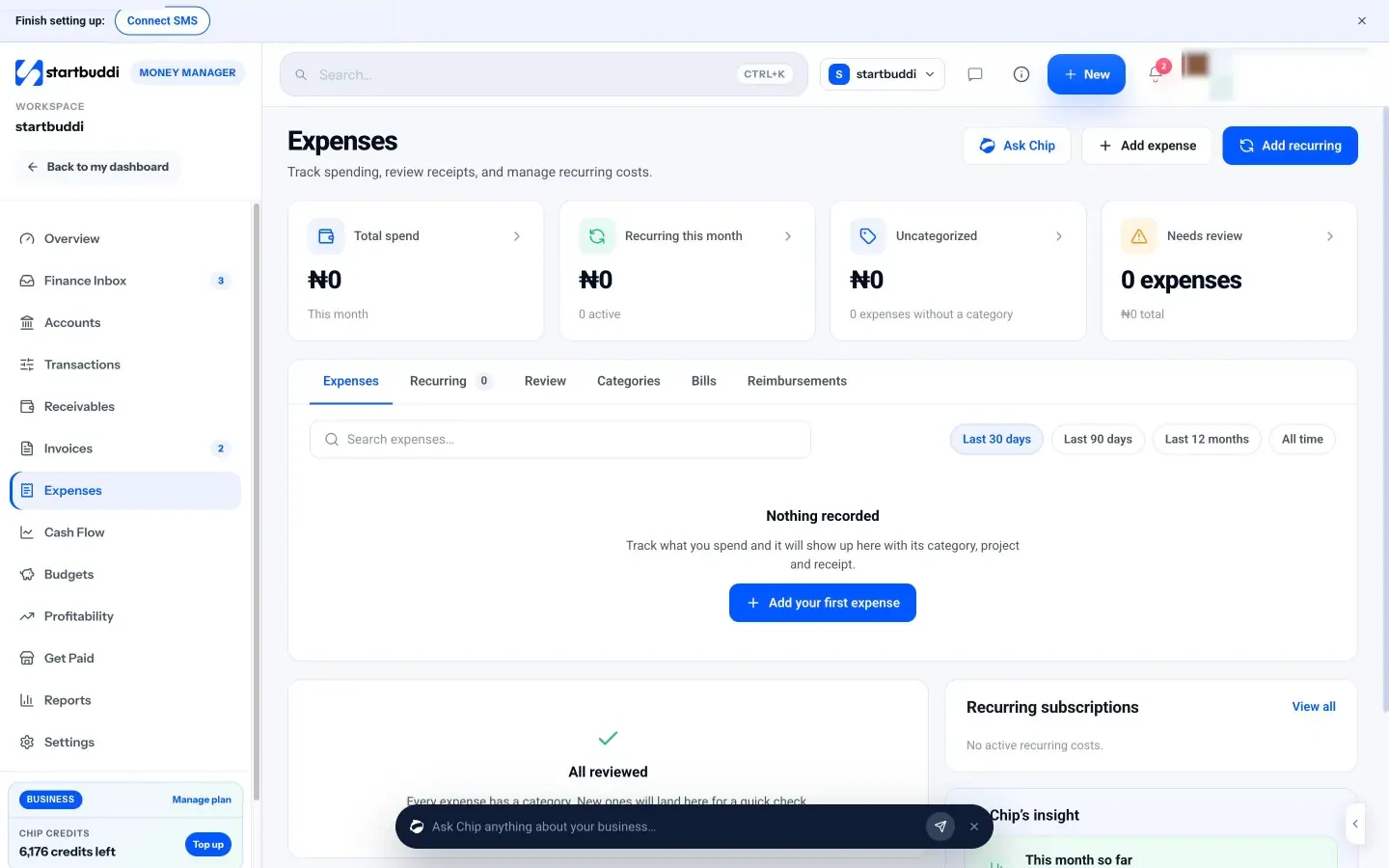
Track spending and profit. Log supplier invoices, fuel, gas and repairs in Expenses with receipt photos. Recurring costs such as commissary rent and insurance go in the Recurring tab and feed the forecast. The Money Manager overview shows money in, money out and what is outstanding, and Reports includes a profit and loss view.
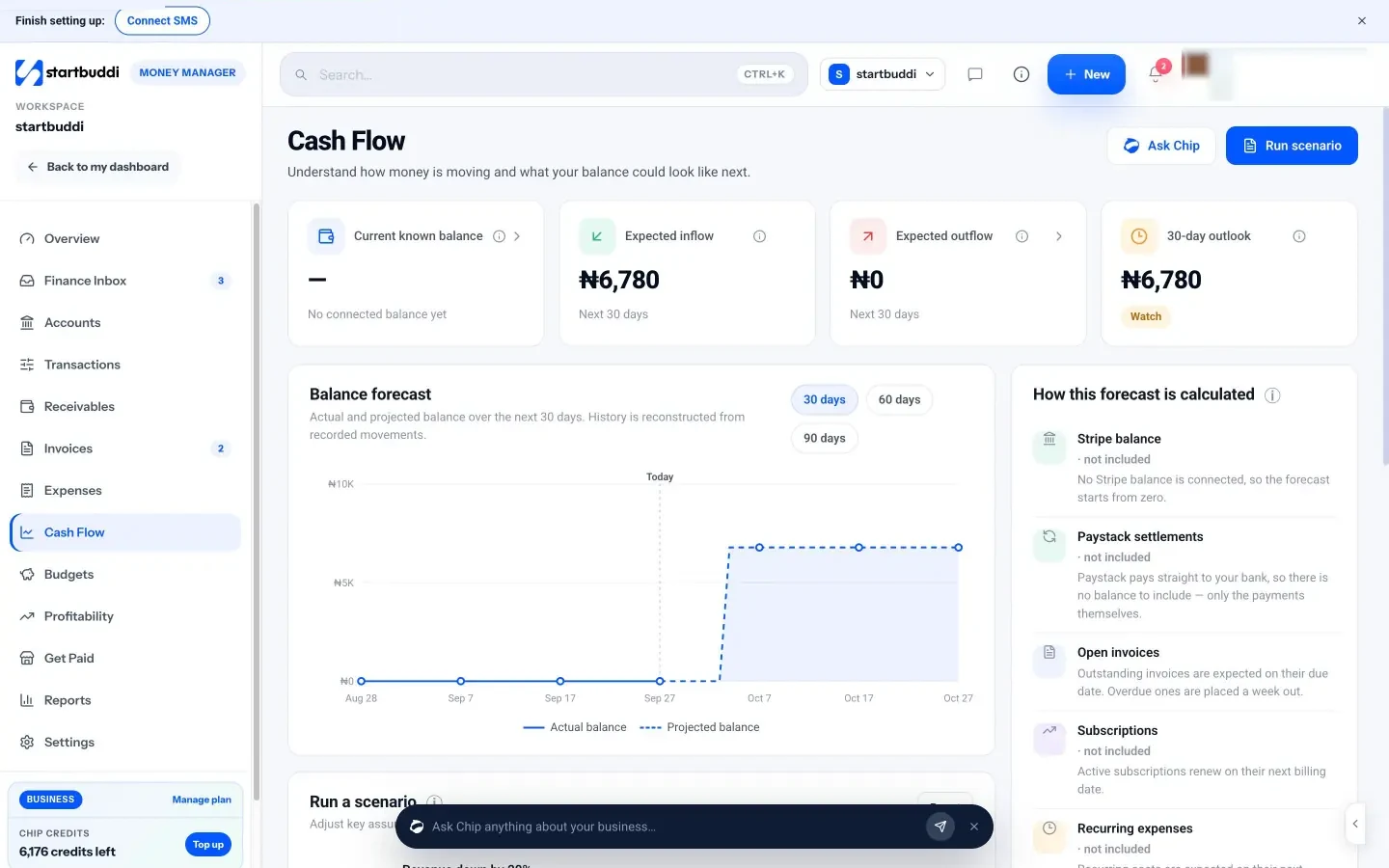
See what is coming. Cash Flow shows how money is moving and what your balance could look like next, with a forecast built from open invoices, subscription renewals, recurring expenses and bills. Run a scenario, such as revenue down 20% in the rainy season, to see how the forecast changes without touching your records.
Your next step
Write your menu, cost each dish and work out your break-even orders per day before you shop for a truck. Then set up your launch budget and task list in startbuddi on the Free plan, and unlock Starter from the pricing page when you want to schedule social posts and send updates to your regulars. Every paid plan has a 30-day trial.
Tiwalade Joanna Okedara-Kalu is the founder, CEO and CTO of startbuddi, the business system that brings clients, bookings, invoices, projects, marketing and the Chip AI assistant into one place. Tiwalade builds software around how service businesses really work day to day, and writes about client management, getting paid on time and why small businesses outgrow the tools they start with.
Founded startbuddi and leads its product and engineering