Startup Marketing Plan: A Practical Guide for Bootstrapped Founders
A startup marketing plan on one page: goals worked back from revenue, budget by channel, a 12-week calendar and numbers to review. Free template inside.



A startup marketing plan is a short written document that sets one revenue goal for the next quarter, works backwards to the leads you need, assigns a budget and weekly actions to two or three channels, and fixes the numbers you’ll review every week. For a bootstrapped founder it fits on one or two pages and changes every quarter.
Key takeaways
- The plan starts from a revenue goal and works backwards to the number of leads you need. Channels come after the maths, not before.
- Two or three channels with a named owner and a weekly action beat a long list of tactics.
- Set a budget in money and in founder hours. For most bootstrapped startups, hours are the bigger cost.
- Review four numbers every week and rewrite the plan every quarter. A plan that never changes isn’t being used.
- The template below has nine sections. A filled example for a software startup follows it.
What a startup marketing plan is, and what it isn’t
Our guide to startup marketing covers the approach: talk to customers by hand, test two channels, track cost per customer. This page is about the document that turns that approach into a quarter’s work.
A marketing plan for a startup is not a business plan, and it’s not a go-to-market strategy. Your go to market strategy decides who you sell to first, what you offer and how they pay. The marketing plan takes those decisions as given and answers the next questions: how many customers this quarter, from which channels, at what cost, done by whom, and checked when.
The US Small Business Administration’s guide to writing a business plan (checked on 1 October 2026) says the marketing section should describe how you’ll attract and keep customers and how a sale actually happens, and that the strategy should change as you learn. That’s a good test for your plan: if it doesn’t say how a stranger becomes a paying customer, it isn’t finished.
Why a bootstrapped startup needs a written plan
When marketing lives only in your head, three things go wrong. You chase whatever channel someone mentioned last week. You can’t tell a bad month from a bad channel. And when a co-founder or first hire joins, there’s nothing to hand them.
A written plan, even a rough one, fixes all three. It also makes the trade-offs visible. If the plan says 60% of your hours go to LinkedIn outreach, you’ll notice when you’ve spent the week redesigning the logo instead.
How to build a startup marketing plan in nine sections
Each section below matches a row in the template. Fill them in this order, because each one depends on the one before.
1. The quarter’s goal
Pick one goal in paying customers or revenue, not followers or traffic. “12 new paying customers by 31 December” is a goal. “Grow brand awareness” isn’t.
2. The funnel maths
Work backwards from the goal using your conversion rate at each step. If you don’t know your rates yet, use your best guess and correct it after a month. This one calculation tells you how much activity the plan needs.
3. The customer
Describe the one group you’re targeting this quarter as a buyer persona: who they are, the problem in their own words, where they already spend time. If you haven’t interviewed anyone yet, our guide to market research for small business shows how to run ten quick interviews.
4. The message
One sentence that says who it’s for, what changes for them and why you. Add two or three proof points you can back up: a pilot result, a named partner, a guarantee.
5. Channels and weekly actions
Choose two channels, three at most. For each, write the weekly action and who does it. “LinkedIn: 3 posts and 25 personal messages a week, founder A” is a plan. “Social media” isn’t.
6. Budget
Write two budgets: money and hours. Founder time is the main cost for most early startups, so price it. Even a modest hourly figure makes it obvious when a channel eats time without producing customers.
7. The 12-week calendar
Give each fortnight a theme or a push: a launch, a webinar, a case study, a referral offer. The calendar stops the plan turning into “post when I remember”. Our free content calendar template works for the detail.
8. Metrics and targets
Track four numbers every week: leads, conversations or demos, new customers, and spend. From those you get customer acquisition cost by channel. Tag your links so you know which channel each lead came from; the free UTM builder does this in a minute.
9. Rules, owners and review rhythm
Name who owns each channel, when the weekly review happens and what would make you drop a channel early. Add the rules you must follow. In the UK, for example, the ICO’s guidance on email marketing (checked on 1 October 2026) says you can’t send marketing emails to individuals without specific consent, apart from a limited exception for existing customers. Sole traders count as individuals. Check the equivalent rules wherever your buyers are.
Startup marketing plan template
Copy this table into a doc or spreadsheet. Keep the “How to fill it in” column until the second quarter, then delete it.
| Section | How to fill it in | Your plan |
|---|---|---|
| 1. Quarter goal | One number in customers or revenue, with a date | |
| 2. Funnel maths | Goal ÷ close rate = demos needed; demos ÷ lead-to-demo rate = leads needed | |
| 3. Customer | One group: role, size, location, problem in their words, where they gather | |
| 4. Message | One sentence plus 2 or 3 proof points you can back up | |
| 5. Channels | 2 or 3 channels, each with a weekly action and an owner | |
| 6. Budget | Money per month per channel, plus founder hours per week per channel | |
| 7. 12-week calendar | A theme or push for each fortnight | |
| 8. Metrics | Leads, demos, customers and spend per channel, weekly; CAC monthly | |
| 9. Rules and review | Owners, review day, drop rule, consent and privacy rules that apply |
Example: a software startup marketing plan
Here is the template filled in for an illustrative software startup: two founders in Accra selling fee-collection software to private schools at GHS 900 a month. All figures are illustrative.
| Section | Their plan |
|---|---|
| 1. Quarter goal | 12 new paying schools by 31 December |
| 2. Funnel maths | 25% of demos become customers: 12 ÷ 0.25 = 48 demos. 30% of leads book a demo: 48 ÷ 0.30 = 160 leads |
| 3. Customer | Bursars and proprietors of private primary schools with 200 to 800 pupils in Accra and Kumasi. Problem: “Parents pay in five different ways and we spend the first two weeks of term reconciling.” |
| 4. Message | “Fee collection that tells you who’s paid, without the spreadsheet.” Proof: two pilot schools, a free first term |
| 5. Channels | Phone and WhatsApp outreach to schools’ published office numbers (founder A, 40 schools a week); talks at school owners’ association meetings (founder B, 2 a month); referrals from pilot schools |
| 6. Budget | GHS 3,000 a month: GHS 1,800 for event travel and printed one-pagers, GHS 1,200 for a part-time caller. Hours: founder A 12 a week, founder B 6 a week |
| 7. 12-week calendar | Weeks 1 to 2: pilot case study. Weeks 3 to 4: association talk. Weeks 5 to 6: “before next term” offer. Weeks 7 to 8: referral push. Weeks 9 to 10: second talk. Weeks 11 to 12: review and next plan |
| 8. Metrics | Leads, demos, schools signed and spend, per channel, every Monday |
| 9. Rules and review | Monday 30-minute review. Drop a channel if it books fewer than 4 demos in 4 weeks. Contact schools on their published office numbers only, and stop at the first “no” |
Their budget for the quarter is GHS 9,000 (3 × 3,000). If they hit the goal, the money CAC is GHS 750 a school (9,000 ÷ 12), less than one month’s subscription. The hours tell a harder story: 18 a week for 12 weeks is 216 founder hours, or 18 hours per school. That’s the number to bring down next quarter, which is why referrals are in the plan.
The same structure works for any startup business marketing plan. A two-person bookkeeping app in Manchester would have different channels and pounds instead of cedis, but the same nine rows.
Common startup marketing plan mistakes
- Starting with channels. If you choose Instagram before doing the funnel maths, you don’t know whether it can produce 160 leads.
- Goals you can’t count. “Awareness” and “engagement” can’t tell you whether the quarter worked.
- Ignoring founder hours. A free channel that takes 20 hours a week isn’t free.
- Too many channels. Five channels done badly teach you nothing about which one works.
- Writing it once. Revisit the funnel rates after four weeks. Your first guesses will be wrong, and that’s fine.
- Copying a big company’s plan. You don’t need brand guidelines, a media mix model or a 40-page deck. You need the nine rows.
Running your marketing plan in startbuddi
startbuddi can hold most of the plan in one workspace, so the weekly review doesn’t mean opening six tabs.
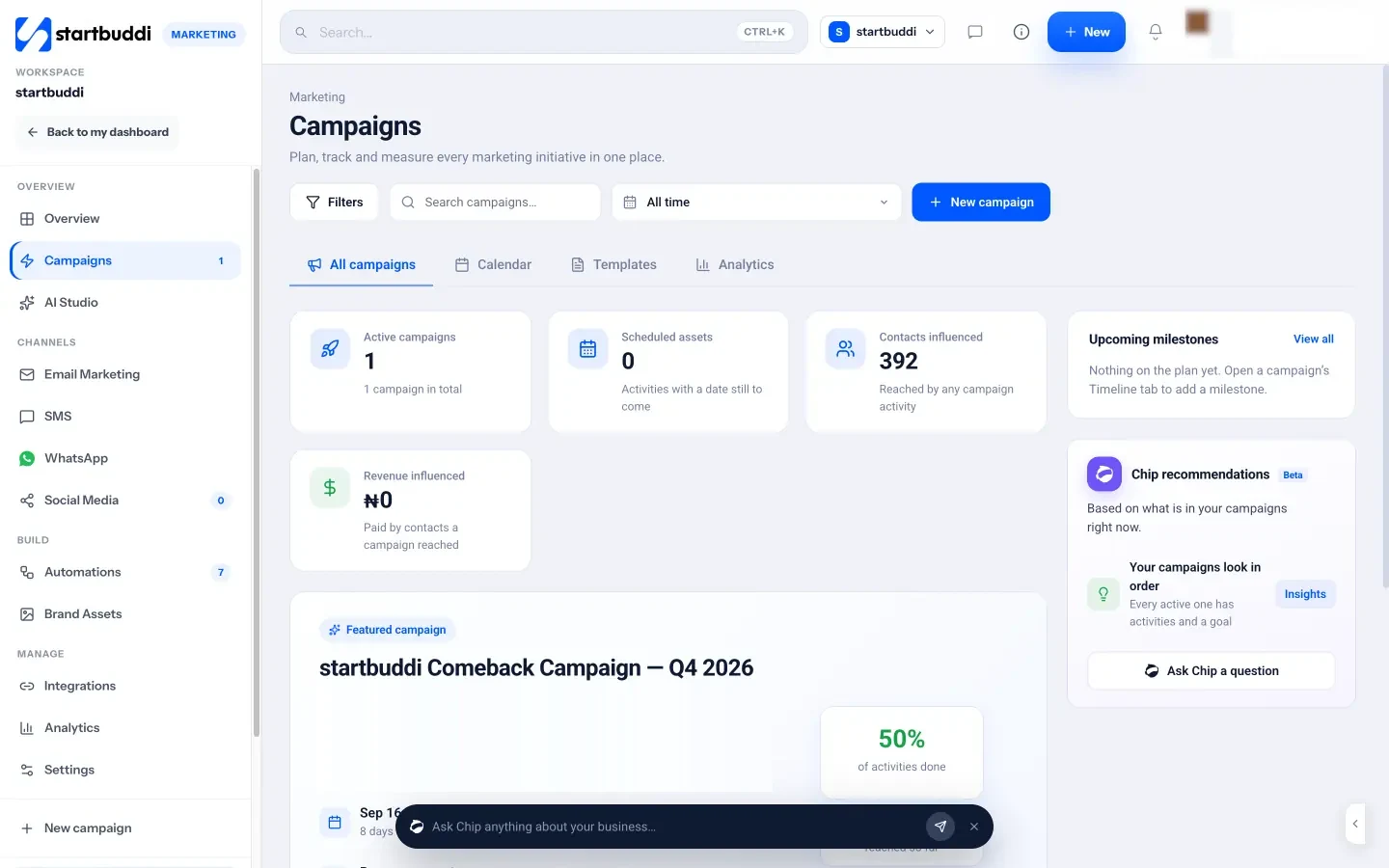
- Set up the quarter as a campaign. In Marketing, Campaigns groups everything for one push: emails, WhatsApp campaigns, social posts, landing pages, forms, milestones and goals. You can set a budget and track spend against it, and the Calendar tab shows the 12 weeks.
- Capture leads with their source. A landing page and form built in Publish send new sign-ups to your contacts, so you can see which channel brought each one.
- Track demos as deals. Each conversation becomes a deal in the Customers pipeline, from first message to won.
- Review on Mondays. Campaigns shows the contacts each campaign brought in and the revenue it influenced, and the pipeline shows deals won and win rate.
The Marketing module is available on paid plans; the CRM and pipeline work on the free plan. See pricing for what each plan includes, or read how startbuddi works for startups. If your startup has moved past its first customers, our guide on how to market a small business covers the steadier, repeatable side.
Write your plan this week
Copy the template, do the funnel maths, and pick your two channels before Monday. Then start startbuddi free to keep your leads, deals and weekly numbers in one place.
Frequently asked questions
What should a startup marketing plan include?
A startup marketing plan should include one goal for the quarter, the funnel maths behind it, the target customer, a one-line message, two or three channels with weekly actions and owners, a money and hours budget, a 12-week calendar, weekly metrics and a review rhythm. It should fit on one or two pages.
How long should a marketing plan for a startup be?
One or two pages is enough for a bootstrapped startup. The plan's job is to guide this quarter's work, not to impress anyone. Investors may want more detail, but that belongs in a separate deck.
How much should a startup spend on marketing?
There's no fixed percentage that suits every startup. Start from the goal: work out how many leads you need, estimate what each channel costs per lead, and set the budget from that. Then compare your cost per customer with what a customer pays you over the first few months.
How is a startup marketing plan different from a go-to-market strategy?
A go-to-market strategy decides who you sell to first, what you offer, the price and how people buy. A startup marketing plan takes those decisions and turns them into a quarter's goals, channels, budget, calendar and metrics. Most startups write the strategy once and the marketing plan every quarter.
What makes a software startup marketing plan different?
A software startup marketing plan usually tracks trials or demos as well as leads, and watches trial-to-paid conversion closely. Monthly subscriptions mean customer acquisition cost should be compared with how many months it takes a customer to pay it back.
How often should I update my startup marketing plan?
Review the numbers every week and rewrite the plan every quarter. Change a channel mid-quarter only if it misses the drop rule you set at the start, so you're not reacting to one bad week.
Olabimpe Salami is the email and outreach specialist at startbuddi. Olabimpe writes about the messages that bring customers in and back: email, WhatsApp and SMS campaigns, follow-ups, and turning enquiries into paying clients.
Runs email and outreach at startbuddi