Digital Marketing for a Startup: A Practical Guide for Bootstrapped Founders
Digital marketing for a startup on a small budget: the order to build your page, tracking, search, email and social, a worked budget and the consent rules.


Digital marketing for a startup means building a small set of online channels in the right order: one clear page that captures interest, tracking so you know where people came from, a way to be found in search, an email list and one social channel. Paid ads come last, once the page already turns visitors into conversations.
Key takeaways
- Build owned channels first (your page, your list), then earned ones (search, social), then paid ads.
- Set up tracking before you post anything. Without it you can’t tell which channel brought a customer.
- One social channel done every week beats four done once a month.
- Spend on ads only when your page converts visitors without them.
- Email and WhatsApp marketing need consent. The rules differ in the UK, the US and Nigeria.
What is digital marketing for a startup?
Startup digital marketing is the online part of finding customers: your website or landing page, search, email, social media, messaging and paid ads. It sits alongside founder-led sales, the calls and messages that win most startups their first customers. Our guide to startup marketing covers that side, including how to pick a customer and a one-line offer.
The difference for a startup is that you don’t yet know which channel works. A plumbing firm in Leeds can copy what other plumbers do online. A new app for Nairobi pharmacies, or a booking service for Toronto dog groomers, has to test. So digital marketing for a startup is less about campaigns and more about building a few channels cheaply, measuring them honestly and dropping the ones that don’t bring customers.
It helps to sort channels into three groups:
| Type | What it is | Examples | Cost to start |
|---|---|---|---|
| Owned | Channels you control | Your landing page, email list, WhatsApp Business number | Mostly time |
| Earned | Attention you win | Search results, Google Business Profile, social posts, mentions | Time, and patience |
| Paid | Attention you buy | Search ads, social ads, sponsored newsletters | Money from day one |
Owned channels keep their value if an algorithm changes. Earned channels compound slowly. Paid channels are fast but stop the day you stop paying.
The startup digital marketing stack: what to build first
You need fewer things than most tool lists suggest. These are the jobs, in the order to set them up.
| Order | Job | Why it comes here | Done when |
|---|---|---|---|
| 1 | A page with one offer and a form | Every other channel sends people here | A stranger can say what you sell after 10 seconds |
| 2 | Tracking | So each visit and sign-up has a source | Analytics is live and links carry UTM tags |
| 3 | Search basics and a Google Business Profile (if you serve an area) | Search brings people who are already looking | Your page is indexed and your profile is verified |
| 4 | An email list | The one audience no platform can take away | Sign-ups get a welcome email automatically |
| 5 | One social channel | Where your buyers already spend time | You post on a fixed schedule for 8 weeks |
| 6 | Paid ads | To scale what already converts | Your page converts without ads |
1. Build one page that converts
Start with one landing page, not a five-page website. It needs a headline that says who it is for and what changes for them, a short list of what they get, one piece of proof (a pilot result, a logo, a named early user who agreed to be quoted) and one form or button. Track its conversion rate: sign-ups divided by visitors.
A good test: show the page to five people in your target market for ten seconds, then ask what you sell. If two of them get it wrong, rewrite the headline before you send anyone there.
2. Set up tracking before you post
Google Analytics is free to set up on your page. Add UTM tags to every link you share, so a visit from your LinkedIn post is recorded separately from one from your newsletter. Our free UTM builder makes the tagged links for you.
Keep one simple sheet or dashboard with four numbers per channel each week: visits, sign-ups, conversations and customers.
3. Get found in search
Search works when people already look for what you sell. Google’s SEO starter guide (checked on 1 October 2026) covers the basics: help Google find your pages, write titles and text in the words people search, and make content that is useful to people. Expect months, not weeks.
If you serve customers in a place, such as a cleaning startup in Lekki or a mobile mechanic in Manchester, set up a free Google Business Profile (checked on 1 October 2026). It is often the fastest way to appear when someone searches for a service near them. Our small business SEO guide goes further.
4. Start an email list on day one
Every visitor who isn’t ready to buy should be able to leave an email address. Give them a reason: early access, a checklist, a short weekly note on the problem you solve. Send a welcome email straight away, then write once a week or once a fortnight.
In markets where customers live on WhatsApp, such as Nigeria, Ghana or Kenya, a WhatsApp Business number works alongside email. Use it for replies and updates people asked for, not cold blasts.
5. Pick one social channel
Choose the platform your buyers already use. B2B founders usually start with LinkedIn; consumer and local startups with Instagram or TikTok. Post on a fixed schedule for at least eight weeks before judging it. Two posts a week that answer questions buyers actually ask will do more than daily posts about your product.
6. Add paid ads last
Ads amplify a page that already works. If 2 in 100 visitors sign up without ads, paid traffic gives you more sign-ups at a cost you can measure. If none sign up, ads buy you an expensive lesson. Start with a small daily budget, one audience and one offer, and judge it on cost per customer, not clicks.
Worked example: a ₦300,000 monthly budget
The figures below are illustrative. A two-founder startup in Lagos sells a stock-tracking app to pharmacies and has ₦300,000 a month for digital marketing, plus founder time.
| Month | Where the money goes | Founder time each week | What they measure |
|---|---|---|---|
| 1 | ₦0 on ads; ₦40,000 on a designer for the landing page | 6 hours: page, tracking, Google Business Profile | Page conversion rate |
| 2 | ₦60,000 on a freelance writer for 4 search articles | 4 hours: LinkedIn posts, weekly email | Sign-ups by source |
| 3 | ₦150,000 on a social ads test; ₦60,000 writer | 4 hours | Cost per demo and per customer |
By the end of month 3, the page, the articles, LinkedIn and the weekly email had brought 9 demos and 4 customers for ₦160,000 of spend (₦40,000 + ₦60,000 + ₦60,000). The ads test brought 6 demos and 1 customer for ₦150,000.
So the customer acquisition cost was ₦40,000 for the organic channels (₦160,000 ÷ 4) and ₦150,000 for ads (₦150,000 ÷ 1). If a pharmacy pays ₦20,000 a month, an organic customer pays back in 2 months and the ad customer in 7.5 months. The founders pause ads and put the budget into more articles and a part-time person for LinkedIn outreach.
The same arithmetic works in pounds or dollars. A London startup spending £600 on ads to win 2 customers has a CAC of £300; at £40 a month per customer, payback takes 7.5 months.
Email and messaging consent rules by country
Getting consent wrong can cost you more than a weak campaign. A short summary, which is general information rather than legal advice:
- UK: under PECR, you generally need consent to send marketing emails to individuals. The ICO’s guide to electronic mail marketing (checked on 1 October 2026) explains the “soft opt-in” for existing customers.
- US: the CAN-SPAM Act doesn’t require prior consent for commercial email, but it does require an honest sender and subject, a physical address and a working unsubscribe link. The FTC’s compliance guide for business (checked on 1 October 2026) lists the rules.
- Nigeria: the Nigeria Data Protection Commission’s General Application and Implementation Directive (2025), issued under the Nigeria Data Protection Act 2023, says consent is required for any direct marketing, and people must get a clear option to accept or decline.
The safe habit everywhere: only add people who asked to hear from you, record where and when they signed up, and make leaving easy.
Best digital marketing tools for startups and small businesses
Pick tools by job, not by brand. Free options cover most of what a startup needs in the first three months.
| Job | Free starting point | Pay when |
|---|---|---|
| Landing page and form | A page builder’s free plan | You need your own domain or more forms |
| Analytics | Google Analytics and Google Search Console | Rarely in year one |
| Local search | Google Business Profile | Not needed |
| An email tool’s free tier | Your list or sends pass the free limit | |
| Social scheduling | The platforms’ own schedulers | You post to three or more channels |
| Contacts and follow-up | A free CRM | You add teammates or automations |
The hidden cost is switching between six logins and copying sign-ups from one tool to another. That is the main reason to keep the page, the form, the contact list and the emails in one place.
Common startup digital marketing mistakes
- Building a big website first. One page that converts beats ten that don’t.
- No tracking. Without UTM tags and analytics, every channel looks equally good.
- Four social channels at once. Pick one and stick with it for two months.
- Buying ads to fix a weak page. Fix the headline and the offer first.
- Buying email lists. It breaks consent rules in many countries and ruins your sender reputation.
- Judging on likes. Count sign-ups, conversations and customers.
How to run startup digital marketing in startbuddi
startbuddi keeps the page, the contact list and the follow-ups in one workspace:
- Publish a landing page with a form from Publish. New sign-ups land in Customers → Contacts with their source.
- Send a welcome email and a regular newsletter from Marketing → Email Marketing, and plan posts in Social Media.
- Track every conversation that turns serious as a deal in your pipeline.
- Check the Marketing → Overview page to see sends and performance by channel, then ask Chip, startbuddi’s AI assistant, which sources brought your last ten customers.
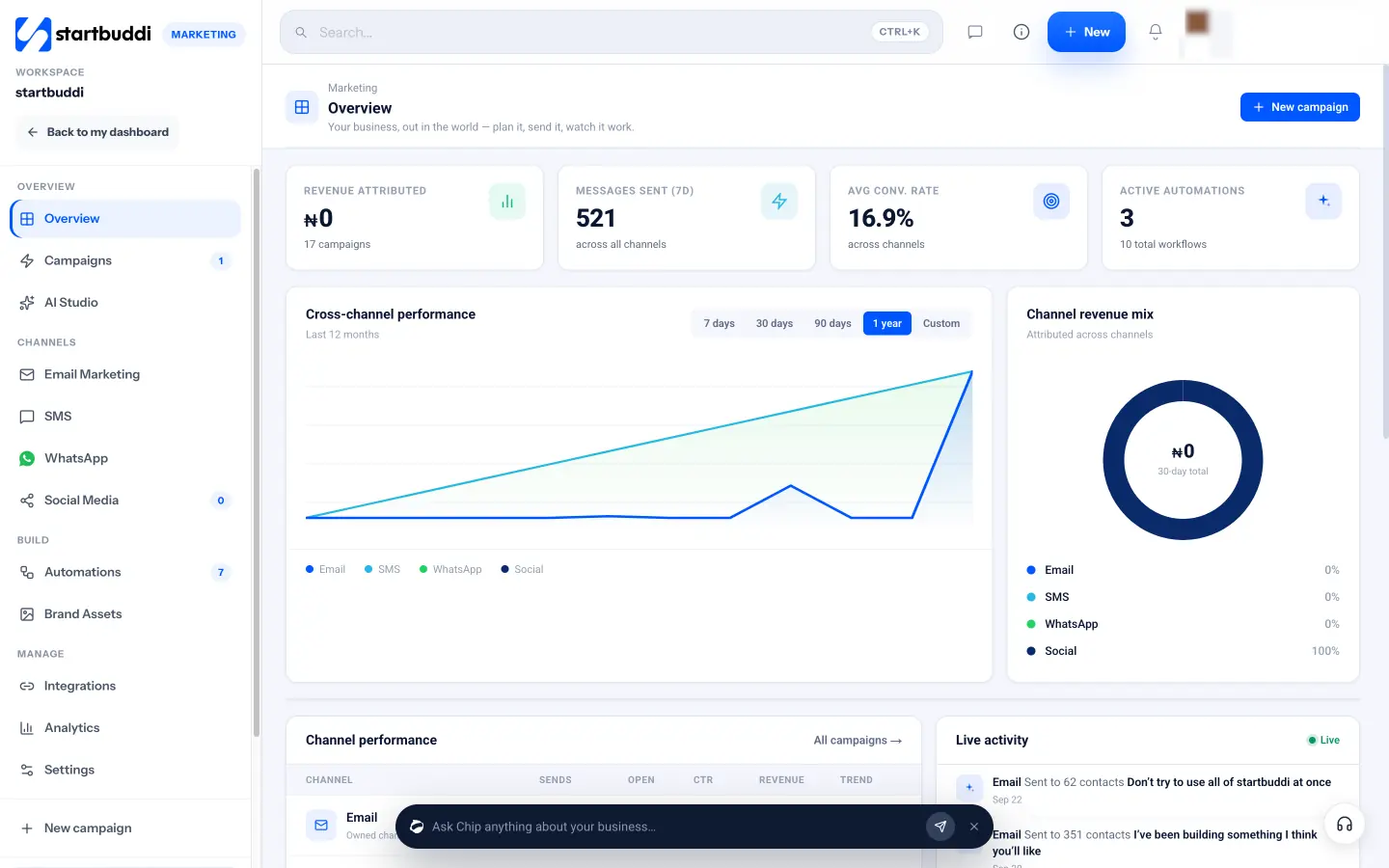
The Marketing module is on paid plans, and a free plan is available; see pricing for what each plan includes. If you’re building something new, see how startbuddi works for startups, and use our go to market strategy for startups to decide who to target before you build any channel.
Build your first channel this week
Write the headline for your landing page today, then set up tracking before you share it anywhere. Start startbuddi free to put your page, your contacts and your follow-ups in one place.
Frequently asked questions
How do I start digital marketing for a startup with no budget?
Start with owned and earned channels that cost time, not money: one landing page with a form, free analytics, a Google Business Profile if you serve an area, an email list and one social channel. Track where every sign-up came from, and spend money only on what already brings customers.
Which digital marketing channel is best for a startup?
The best channel is the one your buyers already use and that brings customers at the lowest cost. B2B startups often do best with LinkedIn, email and search; local startups with Google Business Profile and WhatsApp; consumer apps with social and creators. Test two for 30 to 60 days and keep the winner.
How much should a startup spend on digital marketing?
There is no fixed percentage that suits every startup. Set a monthly test budget you can afford to lose, measure cost per customer for each channel, and increase spend only where a customer pays back what they cost within a few months.
Should a startup run paid ads straight away?
Usually not. Ads send more people to your page, so they only work if the page already turns visitors into sign-ups. Prove the page converts with free traffic first, then test ads with a small daily budget.
Is SEO worth it for a new startup?
Yes, if people already search for the problem you solve, but it is slow. New pages often take months to rank. Start with a few useful pages that answer your buyers' questions, and run a faster channel alongside while search builds.
What is the difference between startup marketing and digital marketing?
Startup marketing covers everything a new company does to find customers, including founder-led sales, partnerships and events. Digital marketing is the online part: your page, search, email, social, messaging and ads. Most startups need both, with founder-led sales first.
Olabimpe Salami is the email and outreach specialist at startbuddi. Olabimpe writes about the messages that bring customers in and back: email, WhatsApp and SMS campaigns, follow-ups, and turning enquiries into paying clients.
Runs email and outreach at startbuddi