Startup Marketing: A Practical Guide for Bootstrapped Founders
Startup marketing for founders with no budget: find your first customers, pick two channels, track CAC and follow a 90-day plan you can start on Monday.

Startup marketing is how a new company finds its first customers, learns why they buy and turns that into a repeatable way to grow. For a bootstrapped founder it means talking to customers one by one, picking two channels that fit your buyers, measuring what each new customer costs, and only then spending money to scale what works.
Key takeaways
- Early startup marketing is mostly founder-led selling. Do things by hand until you know what works.
- Pick one customer type and two channels. Spreading thin is the most common way to waste a small budget.
- Track one number from the start: customer acquisition cost (CAC).
- Your first marketing asset is a clear one-line offer, not a logo or a big website.
- Startup marketing tools matter less than a weekly routine you actually keep.
What is startup marketing?
Startup marketing is marketing done before you know exactly who buys, why and through which channel. A corner bakery in Ibadan or a dental clinic in Leeds can copy what similar businesses do. A startup selling something new has to find that out, so its marketing is part experiment, part sales.
That changes the order of work. Established businesses plan campaigns. Startups run small tests, talk to the people who respond and repeat what brings paying customers.
How is marketing a startup different from marketing a small business?
| Small business marketing | Startup marketing | |
|---|---|---|
| What you know | Who buys and why | Very little yet |
| Main goal | Steady bookings and repeat customers | Prove that a repeatable way to win customers exists |
| Typical first channel | Google Business Profile, referrals, local word of mouth | Founder outreach, communities, partnerships |
| Budget use | Spread over proven channels | Small tests, then double down |
| Main measure | Revenue per month | Cost per customer and how fast it falls |
If your business already has a proven offer, our guide on how to market a small business is the better fit.
Why does startup business marketing matter so early?
Building the product feels like progress, so founders put off marketing. The risk is finishing a product that nobody hears about, or that the wrong people try. Early marketing is how you find out, cheaply, whether the market cares.
Paul Graham’s essay Do Things that Don’t Scale (July 2013) makes the case that founders should recruit their first users by hand. That is still the most reliable advice for a bootstrapped startup: your first 20 customers come from you, not from an algorithm.
How startup marketing works: the five stages
1. Pick one customer you can name
Write a buyer persona from real conversations, not guesses: job, company size, the problem in their words, what they use today. “Operations managers at Lagos logistics firms with 20 to 100 riders” beats “SMEs in Africa”.
2. Write your offer in one line
One sentence: who it is for, what changes for them and why you. Test it in ten conversations. If people ask “so what does it do?”, rewrite it.
3. Get your first 20 customers by hand
Make a list of 50 people who match your persona. Message them personally on LinkedIn, email or WhatsApp, ask for 15 minutes, and sell or learn in every call. Founder-led sales gives you the language your marketing will use later.
4. Choose two channels and test them for 30 days
Choose channels where your buyers already spend time:
- B2B software or services: LinkedIn posts and outreach, partnerships, a short email newsletter.
- Consumer apps: communities, creators, app store pages, referrals.
- Local or service startups: Google Business Profile (Google’s guide to getting started), WhatsApp, referrals.
- Anyone with patience: search content. Google’s SEO starter guide covers the basics, but expect months before it brings steady traffic.
5. Measure, then scale what works
Track leads, conversations and customers from each channel every week. After 30 days, cut the weaker channel and put the time and money into the stronger one.
The first 30 days in each channel: what to do and what to count
A 30-day test only tells you something if you decide in advance what you will do each week and which number settles it. Here is a starting point for the channels bootstrapped startups use most. The targets are illustrative; set your own from your price and the hours you have.
| Channel | What to do each week | What to count | Keep it if, by day 30 |
|---|---|---|---|
| Founder outreach (LinkedIn, email, WhatsApp) | 25 personal messages to people on your list, each mentioning their situation | Replies, calls booked, customers | Roughly 1 in 10 messages gets a reply and some calls become customers |
| Communities and groups | 2 useful answers or posts where your buyers ask questions, with no links in the first week | Direct messages and sign-ups that mention the group | People start asking you for help by name |
| Partnerships | 3 conversations with businesses that already serve your buyers, such as an accountant who works with clinics | Introductions made, customers from them | One partner sends customers without being chased |
| Search content | 2 articles answering questions your buyers type, written from your sales calls | Impressions in Google Search Console, sign-ups from those pages | Too early to judge; keep it only as a long-term bet next to a faster channel |
| Paid social | A small daily budget on one audience, using a message that already works in outreach | Cost per lead, cost per customer | CAC is below what a customer pays you in the first three months |
Two rules make the table work. First, change one thing at a time: if the audience, the message and the budget all change in the same week, you won’t know which change mattered. Second, log every lead with its source on the day it arrives. A spreadsheet column is enough, but it has to be filled in daily, because by day 30 nobody remembers whether a customer came from the WhatsApp group or the LinkedIn post.
A short example, with illustrative numbers. A founder in Nairobi selling stock-control software to pharmacies sends 100 WhatsApp messages and emails over four weeks. She gets 14 replies and 6 demos, and signs 2 pharmacies. In the same month she answers questions in two pharmacists’ groups, which brings 9 direct messages, 3 demos and 1 customer for about a quarter of the hours. Outreach won more customers, but the groups won them for less of her time, so she keeps both for a second month and parks the search articles until she has more customer questions to write from.
When a channel misses its target, look at where people dropped off before you drop the channel. Plenty of replies but no calls usually means the offer is unclear. Plenty of calls but no customers usually means the price, or the buyer, is wrong.
A worked example: CAC for two channels
Customer acquisition cost is what you spend to win one customer. The figures below are illustrative.
A two-founder startup in Lagos sells booking software to clinics. In September it tests two channels.
| LinkedIn outreach | Instagram ads | |
|---|---|---|
| Money spent | ₦0 (tools already paid) | ₦250,000 |
| Founder hours | 20 hours at ₦7,500 an hour = ₦150,000 | 4 hours = ₦30,000 |
| Total cost | ₦150,000 | ₦280,000 |
| Demos booked | 14 | 9 |
| Paying customers | 5 | 2 |
| CAC | ₦30,000 | ₦140,000 |
If each clinic pays ₦25,000 a month, LinkedIn customers pay back their cost in just over a month, and ad customers take almost six. The founders move the ad budget into a part-time assistant for outreach.
The same logic works anywhere. A Berlin startup spending €1,200 on ads to win 3 customers has a CAC of €400; if those customers pay €50 a month, payback takes 8 months, which a bootstrapped company may not survive.
A 90-day startup marketing plan
| Weeks | Focus | Output by the end |
|---|---|---|
| 1 to 2 | Persona and one-line offer | 10 customer conversations, offer rewritten |
| 3 to 6 | Founder-led sales | 50 people contacted, first 5 to 10 customers |
| 7 to 10 | Two channel tests | Leads and CAC per channel |
| 11 to 12 | Review | Keep one channel, drop one, set next quarter’s target |
Run it with a weekly 30-minute review: what went out, who replied, who paid, what changes next week. If you haven’t yet settled who buys first, what you charge and how they pay, our go to market strategy for startups turns those decisions into a one-page plan you can fill in before week 1.
Startup marketing tools: what you actually need
A bootstrapped startup needs five things, whichever brands you pick:
- A contact list and pipeline so no conversation is forgotten.
- One landing page and a form that captures interest.
- Email for follow-ups and a simple newsletter.
- A social scheduler if social is one of your two channels.
- A sheet or dashboard with leads, customers and CAC by channel.
A lead magnet, such as a checklist or calculator, can come later, once you know which problem your buyers search for.
Common startup marketing mistakes
- Marketing to everyone. No one recognises themselves in “for businesses”.
- Paying for ads before the offer converts. Ads amplify a working message; they do not create one.
- Five channels, five minutes each. Two channels done every week beat five done once.
- Measuring likes. Count conversations and customers, not reach.
- Stopping sales when the product ships. Founder-led sales should continue until someone else can do it as well as you.
How to run startup marketing in startbuddi
startbuddi keeps the whole loop in one workspace, which helps when the founder is also the sales team:
- Add your first 50 targets to the CRM, or ask Chip, startbuddi’s AI assistant, to find prospects that match your ideal customer, with the reasons it picked each one.
- Track every conversation as a deal in your pipeline, from first message to paid.
- Publish a landing page with a form; new sign-ups land in your contacts with their source.
- Send follow-up emails and plan posts from the Marketing module.
- Check which source brought each customer before you decide where the next naira goes.
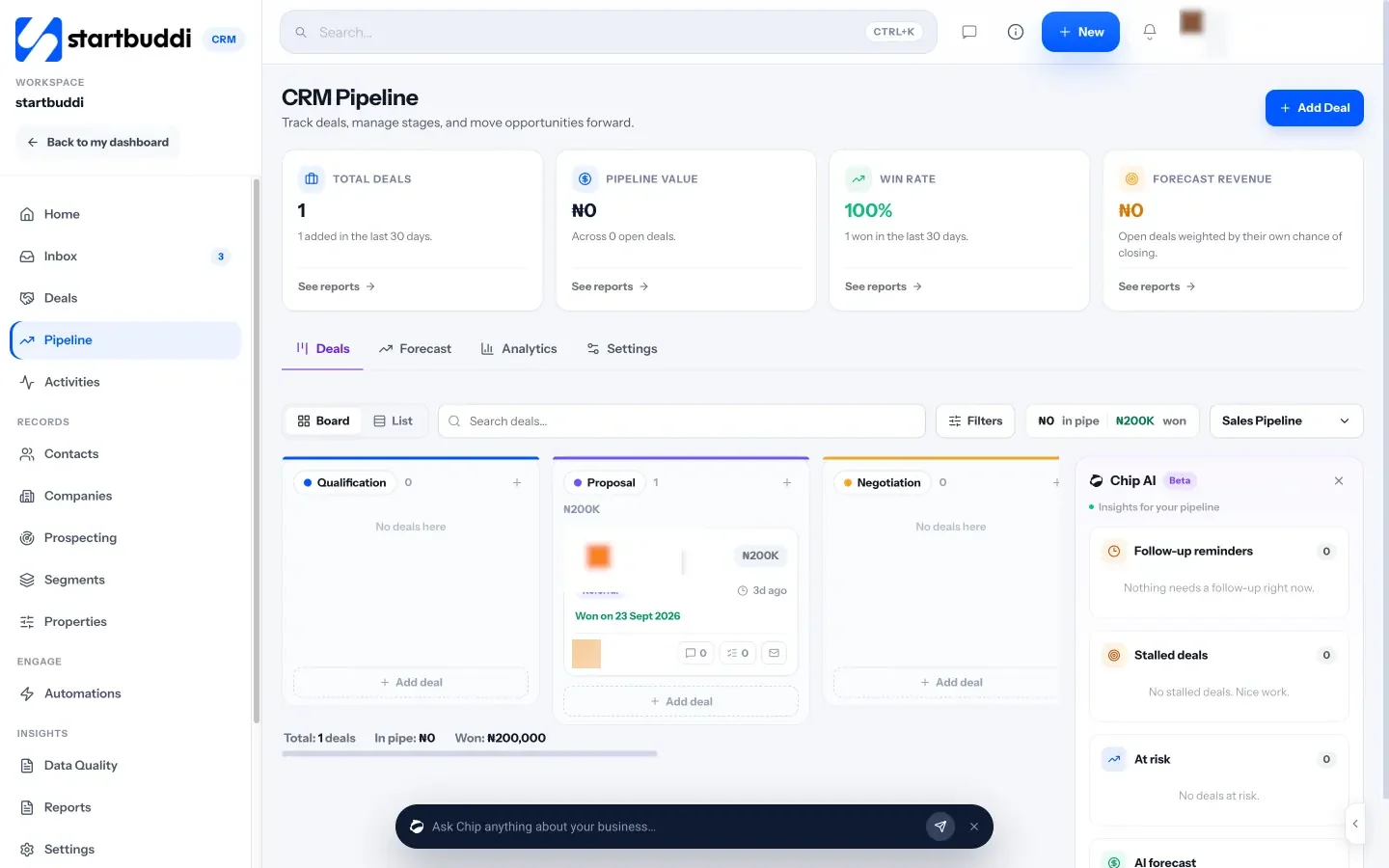
The Marketing module is on paid plans, and a free plan is available for the CRM; see pricing. Building something new? See how startbuddi works for startups.
Start with your first 20 customers
Write your one-line offer this week and list 50 people to talk to. Then start startbuddi free to keep every conversation, deal and follow-up in one place, and read how to market a small business when you are ready to grow beyond founder-led sales.
Frequently asked questions
What is startup marketing in simple words?
Startup marketing is how a new company finds and wins its first customers, then turns what worked into a repeatable process. In the early months it is mostly direct conversations and small tests rather than big campaigns.
How do I start marketing a startup with no money?
Start with founder-led outreach to 50 people who match your ideal customer, using LinkedIn, email or WhatsApp. Add free channels such as a Google Business Profile or community posts. Spend money only once you know which message turns conversations into customers.
How much should a startup spend on marketing?
There is no single right number. Set a monthly test budget you can lose without hurting the business, track cost per customer for each channel, and increase spend only where the cost is lower than what a customer pays you over a few months.
What are the best marketing channels for a startup?
The best channels are the ones your buyers already use. B2B startups often start with LinkedIn, partnerships and email; consumer startups with communities, creators and referrals; local service startups with Google Business Profile and WhatsApp. Test two and keep the one with the lowest cost per customer.
What startup marketing tools do I need first?
A contact list with a simple pipeline, one landing page with a form, email, and a way to track leads and customers by channel. Add a social scheduler only if social is one of your main channels. One connected tool saves time over five separate ones.
When should a startup hire a marketer?
Hire once you have a channel that works and you are the bottleneck. A part-time or freelance marketer can run a proven channel; a senior hire makes sense when you need someone to set strategy across several channels.
Olabimpe Salami is the email and outreach specialist at startbuddi. Olabimpe writes about the messages that bring customers in and back: email, WhatsApp and SMS campaigns, follow-ups, and turning enquiries into paying clients.
Runs email and outreach at startbuddi