Go to Market Strategy for Startups: 12 Practical Ideas That Work
A go to market strategy for startups in 12 steps: pick one customer, price the offer, choose two channels and track the funnel. Free one-page plan inside.

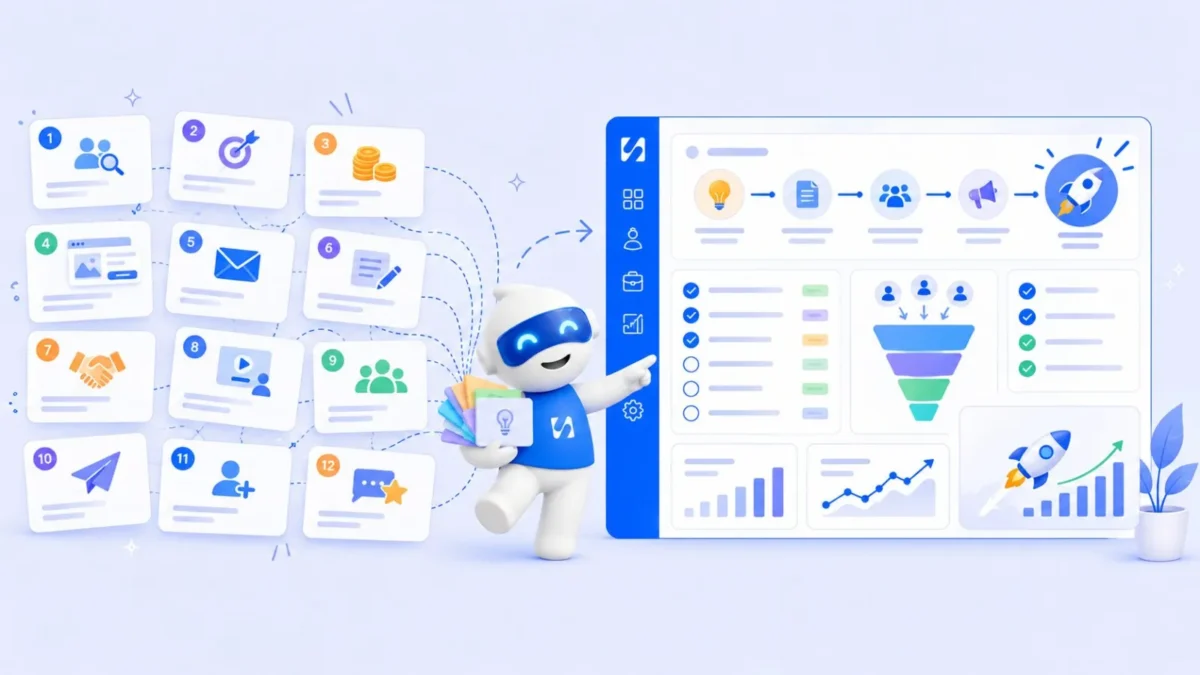
A go to market strategy for startups is your plan for how the first paying customers hear about you, decide to buy and pay. Keep it small: one customer group, one offer with a clear price, two channels you can work every week, and a simple funnel you measure and change every Friday.
What a go to market strategy for startups has to answer
A startup go to market strategy is not a marketing plan with a launch party at the end. It answers five questions in writing: who buys first, what problem you solve for them, what they pay, how they find you, and how a conversation turns into money. If you can’t fill in each one in a sentence, that is the gap to close before you spend on ads.
The 12 ideas below go in roughly the order you will need them. If you want the wider picture of marketing on a small budget, read our startup marketing guide for bootstrapped founders after this one.
1. Pick one customer group you can reach this week
Start with the smallest group that has the problem badly and that you can contact directly. A narrow group lets you learn fast, because every conversation sounds like the last one.
Paul Graham’s essay Do Things that Don’t Scale (July 2013, checked on 1 October 2026) makes the same point: start with a contained market and build up there before spreading out.
2. Write the problem in the customer’s own words
Talk to 10 to 20 people in that group before you write any copy. Ask what they do today, what it costs them and what they have already tried. Write down the exact phrases they use.
The US Small Business Administration’s market research guide (checked on 1 October 2026) lists the questions worth answering: demand, market size, location, how many alternatives exist and what people pay for them. Turn your notes into a short buyer persona you can share with anyone who helps you sell.
Example: the laundry founder hears “I lose my whole Saturday to washing” far more than “I need a laundry service”. That sentence goes on the landing page.
3. Make one offer with a price and a reason to act now
A clear offer has a name, what is included, a price and a deadline or limit. “Weekly pickup and delivery, up to 15 items, ₦25,000 a month, first 50 customers get the second month free” is an offer. “Affordable laundry solutions” is not.
Your value proposition is the one sentence that sits on top: who it is for, the result, and why you rather than the alternatives.
4. Match how you sell to what you charge
The price of your offer decides which sales motion you can afford. A ₦5,000 product can’t carry a 45-minute sales call. A ₦2,000,000 contract can’t be sold by a “buy now” button alone.
| Price per customer per year | How it usually sells | What the founder does |
|---|---|---|
| Low (impulse buy) | Self-serve: page, payment link, done | Write the page, run content and referrals |
| Medium | Conversation in DMs, WhatsApp or a short call | Reply fast, send a link, follow up twice |
| High | Demo, proposal, sometimes a pilot | Book meetings, write proposals, chase decisions |
Pick the row that matches your price and design everything else around it.
5. Choose two channels, not ten
Pick two channels where your first customer group already spends time, and commit to a weekly action for each. For a B2B startup that might be LinkedIn posts and direct outreach. For a consumer startup in Nigeria it is often Instagram and WhatsApp status, plus referrals.
Give each channel 6 to 8 weeks before you judge it. Most channels look like they fail in week two.
6. Recruit the first customers by hand
Your first 10 to 50 customers will come from you, personally, asking. Message people you know who fit the group, ask for introductions, attend the events they attend and offer to set them up yourself.
This is slow and it doesn’t scale, which is the point. Each conversation teaches you what makes people say yes. Our guide to getting clients for a service business has scripts and channels you can borrow.
7. Build one page that answers the questions people ask
A single page with the offer, the price, proof and one button is enough to start. List the five questions you heard most in your conversations and answer each one on the page.
Example: the Toronto design studio’s page answers “how long does it take”, “how many revisions”, “what do I get at the end” and “what does it cost”, then has one “Book a 20-minute call” button.
8. Make paying the easiest step
Every extra step between “yes” and “paid” loses customers. In Nigeria that means accepting card, bank transfer and USSD, because customers have strong preferences. Elsewhere, a simple card payment page is usually the place to start.
Send a payment link straight into the chat where the customer said yes, instead of asking them to visit a website and find the right page.
9. Reply fast, everywhere
Early-stage buyers are often deciding between you and doing nothing, so speed wins. Set a rule, such as a reply within one working hour, and hold yourself to it.
The hard part is that messages arrive on WhatsApp, Instagram, email and your website at once. Put them in one inbox so nothing waits because you forgot to check an app.
10. Turn customers into a referral channel
Your first happy customers are your cheapest channel. Ask every customer, at the moment they are happiest, for one introduction. Make it easy: a message they can forward, and a small thank-you for both sides.
Example: the laundry startup gives both the referrer and the new customer one free pickup. Partners work the same way: a co-working space in Yaba recommends the service to members in exchange for a member discount.
11. Track four numbers every week
Count conversations started, offers sent, customers won and what you spent to win them. Divide what you spent by customers won and you have your customer acquisition cost. Together, the four numbers show where the funnel leaks, and comparing them channel by channel tells you which channel to keep.
Here is a worked example with illustrative figures. The Toronto design studio from idea 1 spends its first 30 days on two channels: direct outreach to coffee shops opening a first location, and introductions from a local coffee roaster that supplies them.
| Number | Direct outreach | Roaster introductions |
|---|---|---|
| Conversations started | 60 | 12 |
| Proposals sent | 9 | 6 |
| Customers won | 2 | 3 |
| Founder hours spent | 25 | 6 |
| Conversations that became proposals | 15% (9 of 60) | 50% (6 of 12) |
| Proposals that became customers | about 22% (2 of 9) | 50% (3 of 6) |
Outreach brings five times as many conversations, but only 15% of them turn into a proposal. That is where the leak is, and the studio’s call notes explain it: most of the shop owners it reached were not opening soon enough to need a brand. Introductions are few, but half become proposals and half of those become customers, for about a quarter of the hours.
So the studio doesn’t simply send more cold messages. For the next sprint it adds one question to its outreach (“are you opening in the next three months?”) before booking any call, and asks the roaster for a regular mention in its monthly email to new accounts. Same two channels, but each change targets the step that leaked.
12. Run it as a 30-day sprint, then review
Treat your first go-to-market plan as an experiment with an end date. Write the plan, run it for 30 days, then sit down with the four numbers and decide what to keep, change and drop.
Repeat the cycle three times and you will have a go-to-market strategy based on evidence, not guesses.
A one-page go-to-market plan you can copy
Fill this in before you start your 30-day sprint. The example column uses the laundry startup.
| Section | Your answer | Example |
|---|---|---|
| First customer group | Young professionals in two Yaba estates | |
| Their problem, in their words | “I lose my whole Saturday to washing” | |
| Offer and price | Weekly pickup, up to 15 items, ₦25,000/month | |
| Reason to act now | First 50 customers get month two free | |
| How you sell | WhatsApp conversation, then payment link | |
| Channel 1 and weekly action | Instagram: 3 posts and 20 DMs a week | |
| Channel 2 and weekly action | Referrals: ask every customer after delivery 2 | |
| Where people pay | Payment link sent in WhatsApp | |
| 30-day targets | 120 conversations, 15 customers | |
| Review date | Friday of week 4 |
Common go-to-market mistakes startups make
- Launching to everyone. A broad message sounds like nobody in particular.
- Choosing channels before the price. You end up with a sales process your margins can’t pay for.
- Waiting for the product to be “ready”. Sell the offer you can deliver now and learn from the first customers.
- Counting followers instead of customers. Likes don’t pay rent. Track conversations and customers won.
- Not following up. Many deals close on the second or third message, not the first.
How to run your go-to-market in startbuddi
startbuddi puts the pieces of an early go-to-market plan in one workspace, so the founder isn’t copying leads between six apps.
- Publish one page. In Publish, create a landing page with your offer and a form. Form entries go straight into your contacts.
- Answer every message in one inbox. The Inbox in Customers brings email, WhatsApp, Instagram, Messenger, Telegram, SMS and website chat together, and Chip can draft replies.
- Track deals in a pipeline. Add each conversation as a deal and move it through stages from “conversation” to “won”, so your four weekly numbers are counted for you.
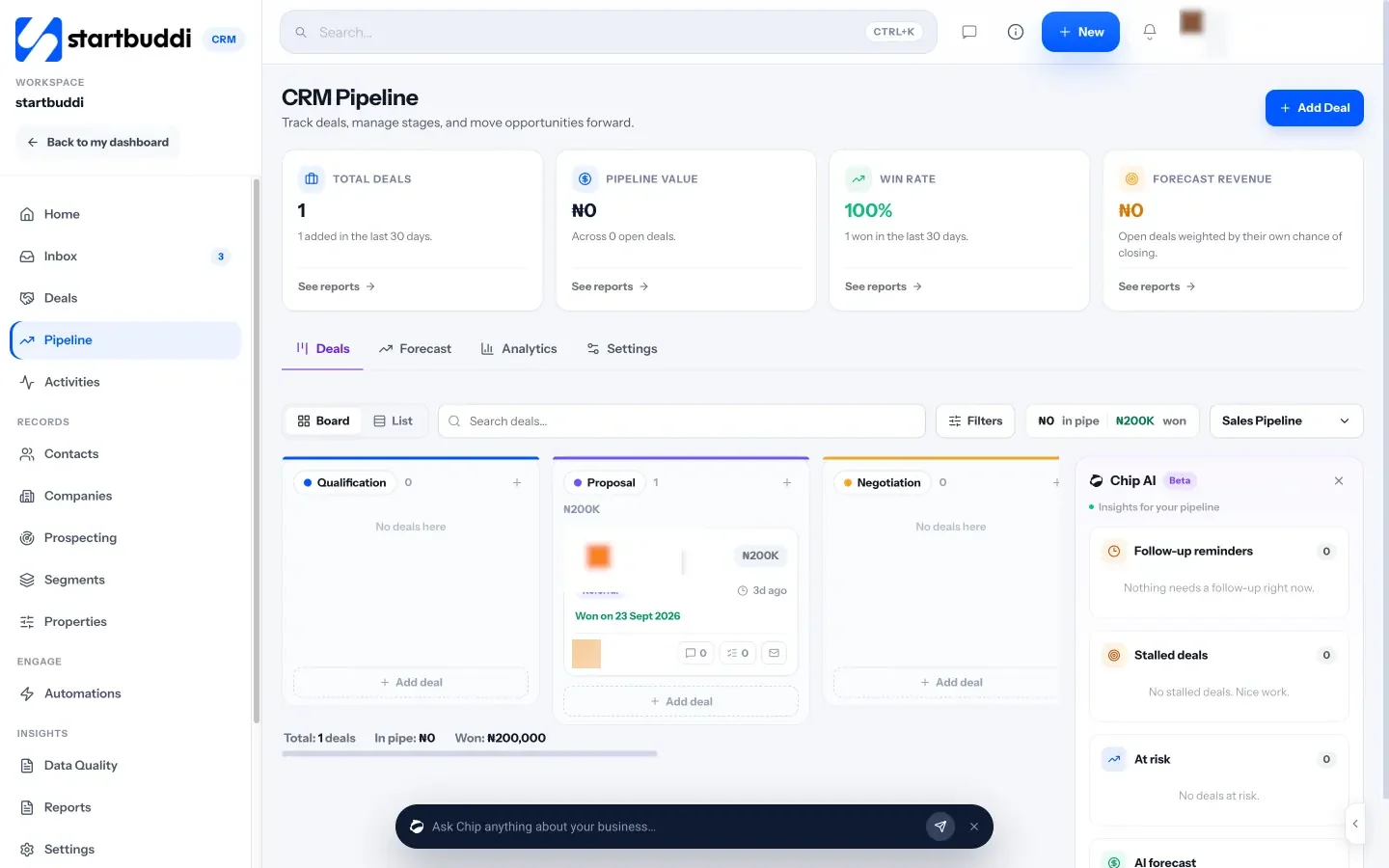
- Find more people like your best customers. In Prospecting, tell Chip who your ideal customer is and it finds people and companies with the reasons and sources, using Chip credits. You decide who goes into your contacts.
- Get paid in the chat. In Money Manager, open Get Paid and create a payment link with Paystack or Stripe, then paste it into the conversation.
- Review on Friday. Analytics shows revenue and pipeline in one place for your weekly review.
Email campaigns to your list are part of Marketing, which is on paid plans. A free plan is available for everything else above; see pricing for details, or the startbuddi page for startups.
Start your go-to-market sprint
Copy the one-page plan, pick your two channels and start the 30 days on Monday. When you are ready to keep your leads, inbox, pipeline and payment links in one place, start free with startbuddi.
Frequently asked questions
What is a go to market strategy for startups?
A go to market strategy for startups is a written plan for how a new business wins its first paying customers. It names the first customer group, the offer and price, the channels, how a conversation becomes a sale and the numbers you will track. It is usually tested and rewritten every month in the early stage.
How do you write a startup go to market strategy?
Write a startup go to market strategy by answering five questions: who buys first, what problem you solve, what they pay, how they find you and how they pay. Put the answers on one page with 30-day targets. Run it for a month, then review your numbers and adjust.
What are the main types of go-to-market strategy for startups?
The main types are self-serve (customers find you and buy online), sales-led (conversations, demos and proposals) and partner-led (another business sells or recommends you). Your price usually decides which one fits. Many startups mix two, such as self-serve with referrals from partners.
How long should a go to market strategy startup plan cover?
Plan in 30-day sprints for the first three to six months. A short cycle forces you to look at real numbers before you spend too much on a channel that isn't working. Once one or two channels work reliably, you can plan a quarter at a time.
How much should a startup spend on go-to-market?
There is no fixed amount, but you should know what one customer is worth before spending. Work out how much a customer contributes each month after delivery costs, and keep your cost to win a customer well below a few months of that. Spend more only on the channels where that holds true.
What is the difference between a go-to-market strategy and a marketing plan?
A go-to-market strategy covers the whole path to a first sale: customer, offer, price, sales motion, channels and payment. A marketing plan is one part of it and focuses on how people hear about you. Startups need the go-to-market strategy first, because marketing can't fix a wrong customer or price.
Omolola Akiyode is the operations and project manager at startbuddi, leading cross-functional projects and the content that helps founders get set up. Omolola writes about projects, websites and getting found online, and turns complex ideas into clear, practical steps.
Runs operations and projects at startbuddi