Selling a Business Checklist: Step-by-Step List + Free Template
A selling a business checklist for small service firms: prepare the numbers, value it, find a buyer, get through due diligence, close and hand over well.



A selling a business checklist takes you from deciding to sell to handing over the keys: clean up your numbers, reduce how much the business depends on you, set a value, find a buyer, agree terms, get through due diligence, sign, then hand over clients, staff and systems. For a small service business, plan on six to twelve months.
Key takeaways
- Start preparing at least a year before you want to sell. Buyers pay for clean records and a business that runs without the owner.
- Most small service businesses are valued on a multiple of the owner’s profit, so every unrecorded expense and every client who only trusts you lowers the price.
- Keep the sale confidential until you have a serious buyer, and use an NDA before you share numbers.
- Whether you sell the company’s shares or its assets changes the tax, the paperwork and what happens to staff and contracts.
- Get an accountant and a lawyer who handle business sales in your country before you sign anything.
Why you need a checklist for selling a business
Most owners sell a business once, and the problems that sink deals are rarely dramatic: two years of profit figures when the buyer wants three, a key client contract in the owner’s personal name, a manager who hears about the sale from a supplier. A written checklist stops those surprises, and shows a buyer the business is run properly.
The complete selling a business checklist
Work through it in order. Phases 1 and 2 are what move the price; the rest protects the deal.
Phase 1: Decide and plan (12 or more months before)
Phase 2: Make the business sellable (6 to 12 months before)
Phase 3: Value the business (3 to 6 months before)
Phase 4: Find and screen buyers
Phase 5: Agree the main terms
Phase 6: Due diligence
Phase 7: Contracts and closing
Phase 8: Handover and after the sale
How a small service business is valued: a worked example
Many small service businesses are priced on a multiple of seller’s discretionary earnings (SDE): the profit one full-time owner takes out of the business. The figures below are illustrative, not a market rate.
A cleaning company in Abuja reports net profit of ₦18,000,000 for the year. The owner paid themselves a salary of ₦9,000,000, and ran ₦1,500,000 of personal car costs through the business. There was also a one-off ₦1,000,000 legal bill that won’t happen again.
| Item | Amount |
|---|---|
| Net profit | ₦18,000,000 |
| Add back the owner’s salary | ₦9,000,000 |
| Add back personal car costs | ₦1,500,000 |
| Add back the one-off legal bill | ₦1,000,000 |
| Seller’s discretionary earnings | ₦29,500,000 |
| At 2x SDE | ₦59,000,000 |
| At 2.5x SDE | ₦73,750,000 |
Every add-back needs proof. If the owner can’t show receipts for the car costs, a buyer will ignore them and the value at 2x falls by ₦3,000,000.
What moves the multiple up or down:
| Pushes the price up | Pushes the price down |
|---|---|
| Recurring contracts and repeat clients | Most revenue from one or two clients |
| A manager who runs day-to-day work | Clients who only deal with the owner |
| Three years of clean, consistent records | Missing or mixed personal and business records |
| Written processes and trained staff | Knowledge that lives in the owner’s head |
| Growing revenue | Falling revenue or a recent big loss |
Country notes: tax and filings when you sell
These are starting points to discuss with your adviser, checked on 1 October 2026.
- United States. The SBA’s guide to closing or selling your business says to set a value before you approach buyers, using income, market or asset approaches, and to have an attorney review the sales agreement. The IRS treats the sale of a business for a lump sum as a sale of each individual asset, and buyer and seller allocate the price across the assets with the residual method. Where goodwill is involved, both usually file Form 8594. Buyers can use SBA 7(a) loans for a change of ownership.
- United Kingdom. A sole trader who sells tells HMRC, files a final Self Assessment return, cancels VAT registration if registered and works out Capital Gains Tax. Business Asset Disposal Relief can reduce that tax: the rate is 18% for disposals from 6 April 2026, with a £1 million lifetime limit, and a sole trader must have owned the business for at least 2 years. When TUPE applies to a business transfer, employees usually move to the new owner on their existing terms, so take advice before you talk to staff.
- Nigeria. Changes in who owns a company’s shares, or who owns a registered business name, are recorded with the Corporate Affairs Commission; ask your lawyer or company secretary which filings apply and when. The FCCPC only needs to be notified of a merger when the combined Nigerian turnover of buyer and target is ₦1 billion or more, or the target’s is ₦500 million or more, so most small service-business sales fall below it. Bring your tax filings with the Nigeria Revenue Service and your state tax authority up to date before a buyer asks for them.
- Canada. The CRA’s guide to selling a business covers cancelling your Business Number and closing a payroll account. Seller and buyer may jointly elect not to charge GST/HST when the buyer acquires at least 90% of the property needed to run the business. Owners selling qualifying small business corporation shares may be able to claim the lifetime capital gains exemption, which was $1,250,000 for 2025 dispositions.
How to do this selling a business checklist in startbuddi
startbuddi won’t value your business or replace your lawyer. It does keep the records a buyer asks for, and the checklist itself, in one place:
- Turn the checklist into tasks. In Work, create a project called “Sale of the business”, add each phase as a task with the checklist items as subtasks, and give each one a due date. Keep the project private to you and your advisers until the sale is public.
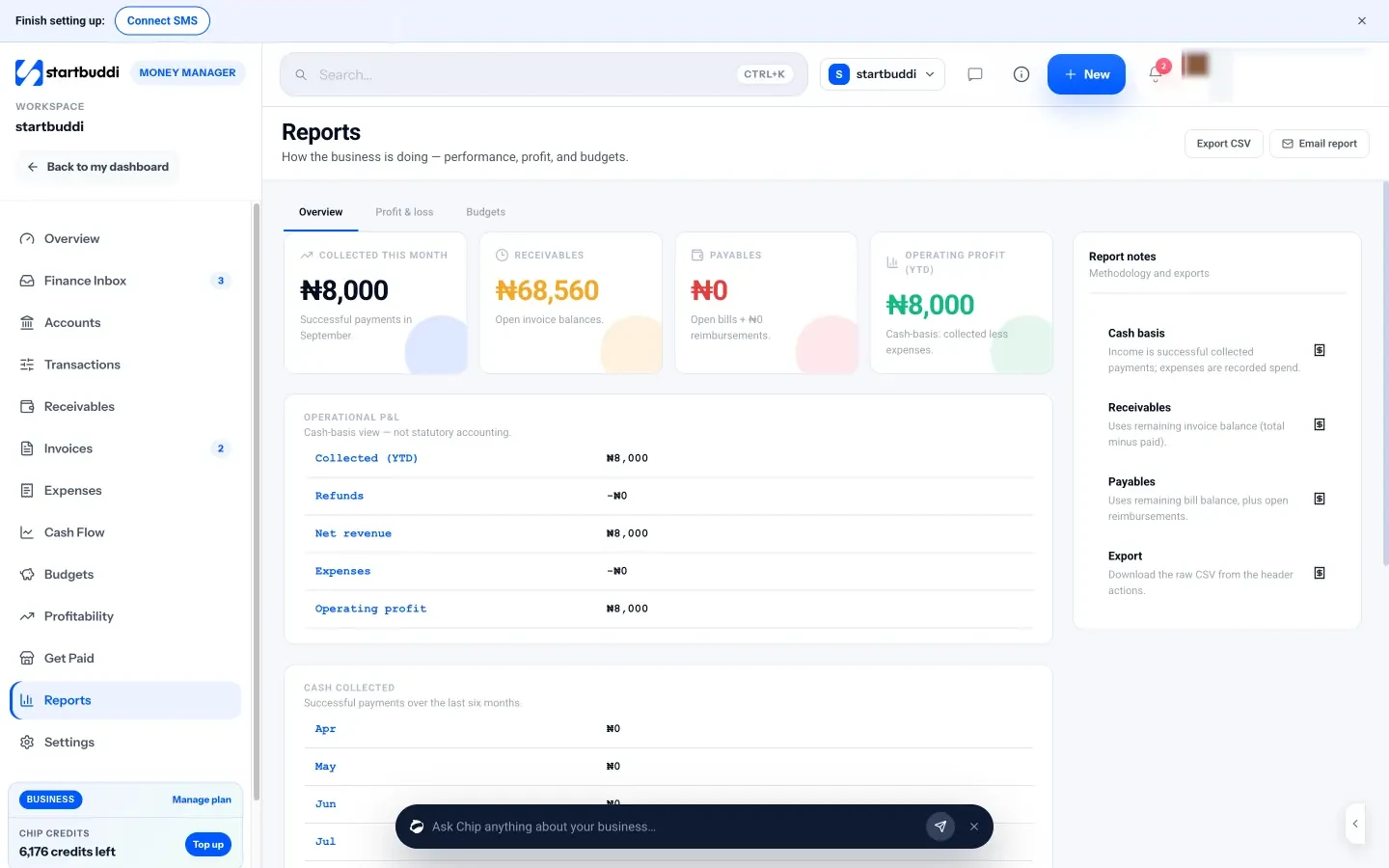
- Pull your profit and loss. In Money Manager, open Reports → Profit & loss, choose the period and use Export CSV to send the figures to your accountant. Expenses with receipts attached make add-backs easy to prove.
- Show the client base. In Customers, every client has a record with their history of deals, invoices and messages, so you can show revenue per client. Export the list to CSV or Excel when the buyer needs it.
- Keep the sale documents together. In Documents, keep the NDA, heads of terms and process notes in one folder, and send documents for e-signature from the same place.
A free plan is available; see pricing for what each plan includes, or read how startbuddi works as a CRM for service businesses.
Start preparing your business for sale
Copy the checklist above and start with phase 2 this month: three years of clean numbers and written client contracts add more to your price than anything you do in the final weeks. Start startbuddi free to keep your records, clients and checklist in one place.
Frequently asked questions
What should be on a checklist for selling a business?
A checklist for selling a business should cover planning, preparing the numbers and contracts, valuing the business, finding and screening buyers, agreeing heads of terms, due diligence, signing the sale agreement and handing over. For a small business, most of the price is decided in the preparation phase.
How long does it take to sell a small business?
Six to twelve months is a common timeline once you start preparing, and longer if your records need work. Finding the right buyer often takes the longest. Due diligence and contracts usually take one to three months once a buyer is agreed.
How do I value my small business before selling?
Most small service businesses are valued on a multiple of seller's discretionary earnings, which is net profit plus the owner's pay and personal or one-off costs. Equipment and stock are added separately. Ask an accountant or broker what multiples similar businesses in your sector and area have sold for.
Should I sell the shares or the assets of my business?
It depends on how the business is set up and on tax. In a share sale, the buyer takes over the company with its history, contracts and liabilities. In an asset sale, the buyer picks the assets and contracts they want, and the seller keeps the company. Ask your accountant and lawyer which suits you before you agree terms.
When should I tell my employees I'm selling my business?
Usually once a deal is close and you can explain what happens to their jobs. Telling staff too early can lead to people leaving. In some countries the law also sets rules on informing and consulting employees, so take legal advice on the timing.
Omolola Akiyode is the operations and project manager at startbuddi, leading cross-functional projects and the content that helps founders get set up. Omolola writes about projects, websites and getting found online, and turns complex ideas into clear, practical steps.
Runs operations and projects at startbuddi