What is recurring revenue?
Also called: Repeat revenue, subscription revenue, MRR (monthly recurring revenue), ARR (annual recurring revenue), retainer income
Recurring revenue is income a business can expect to receive again and again on a regular schedule, such as monthly retainers, memberships, subscriptions or service plans, rather than one-off sales.
Recurring revenue is money that comes in again and again on a schedule, without you having to win a new sale each time. A monthly retainer from a client, a gym membership, a software subscription and a quarterly maintenance plan are all recurring revenue. So what is recurring revenue worth to a small business? Predictability: you start each month knowing part of your income is already on its way.
It is the opposite of one-off, project-based income, where every month begins at zero.
What is recurring revenue and why does it matter?
- Steadier cash flow. You can plan hiring, rent and spending around income you can see coming.
- Less time selling. Keeping a customer is usually cheaper than finding a new one.
- Higher customer value. A client paying $500 a month for two years is worth $12,000, far more than a single $2,000 project. See customer lifetime value.
- A more valuable business. Buyers and lenders generally see repeating income as less risky than one-off sales.
Types of recurring revenue
| Type | How it works | Example |
|---|---|---|
| Retainer | A client pays a fixed amount each month for agreed work or availability | A marketing agency’s $1,500 monthly social media retainer |
| Membership | Members pay regularly for access | A coworking space or fitness studio |
| Subscription | Customers pay for a product or service delivered on a schedule | A monthly coffee box or software plan |
| Service plan | Ongoing maintenance or support after a one-off job | An HVAC company’s annual service plan |
| Usage-based repeat billing | Regular bills that vary with use | A cleaner who bills monthly for weekly visits |
For service businesses, retainers are usually the easiest place to start. Our guide on how to sell and bill retainers walks through pricing and contracts.
How to measure it: MRR and ARR
Monthly recurring revenue (MRR) is the total you expect to receive each month from recurring customers. Annual recurring revenue (ARR) is the same figure for a year, usually MRR × 12. Only count repeating income: one-off setup fees and projects do not belong in MRR.
Worked example: Ifeoma runs a bookkeeping service in Lagos.
- 6 clients on a ₦80,000 monthly plan = ₦480,000
- 3 clients on a ₦150,000 monthly plan = ₦450,000
- 2 clients paying ₦900,000 a year, counted as ₦75,000 a month each = ₦150,000
Her MRR is ₦1,080,000 and her ARR is ₦12,960,000. If one ₦80,000 client leaves and two new ₦150,000 clients join, her MRR rises to ₦1,300,000.
The number that eats MRR: churn
Churn rate is the share of recurring customers or revenue you lose each period. A business adding ten clients a month but losing eight is growing slowly. Watch churn as closely as new sales.
How to build recurring revenue
- Look for the repeat need. What do customers keep coming back for, or need after the main job? That is your plan.
- Turn one-off work into ongoing care. Offer a maintenance or support plan when a project ends well. This is a natural upsell.
- Make the scope clear. State what the monthly fee covers and what costs extra.
- Automate billing. Card subscriptions or recurring invoices mean no one has to remember to pay.
- Give a reason to stay. Regular reports, check-ins and small wins remind clients what they are paying for.
Common mistakes
- Underpricing to win the retainer. A cheap retainer that eats your week is worse than none.
- Unlimited scope. “Unlimited changes” quietly turns a retainer into a loss.
- Counting one-off fees as recurring. It makes growth look better than it is.
- Ignoring failed payments. Expired cards cause some customers to lapse without meaning to.
Recurring revenue in startbuddi
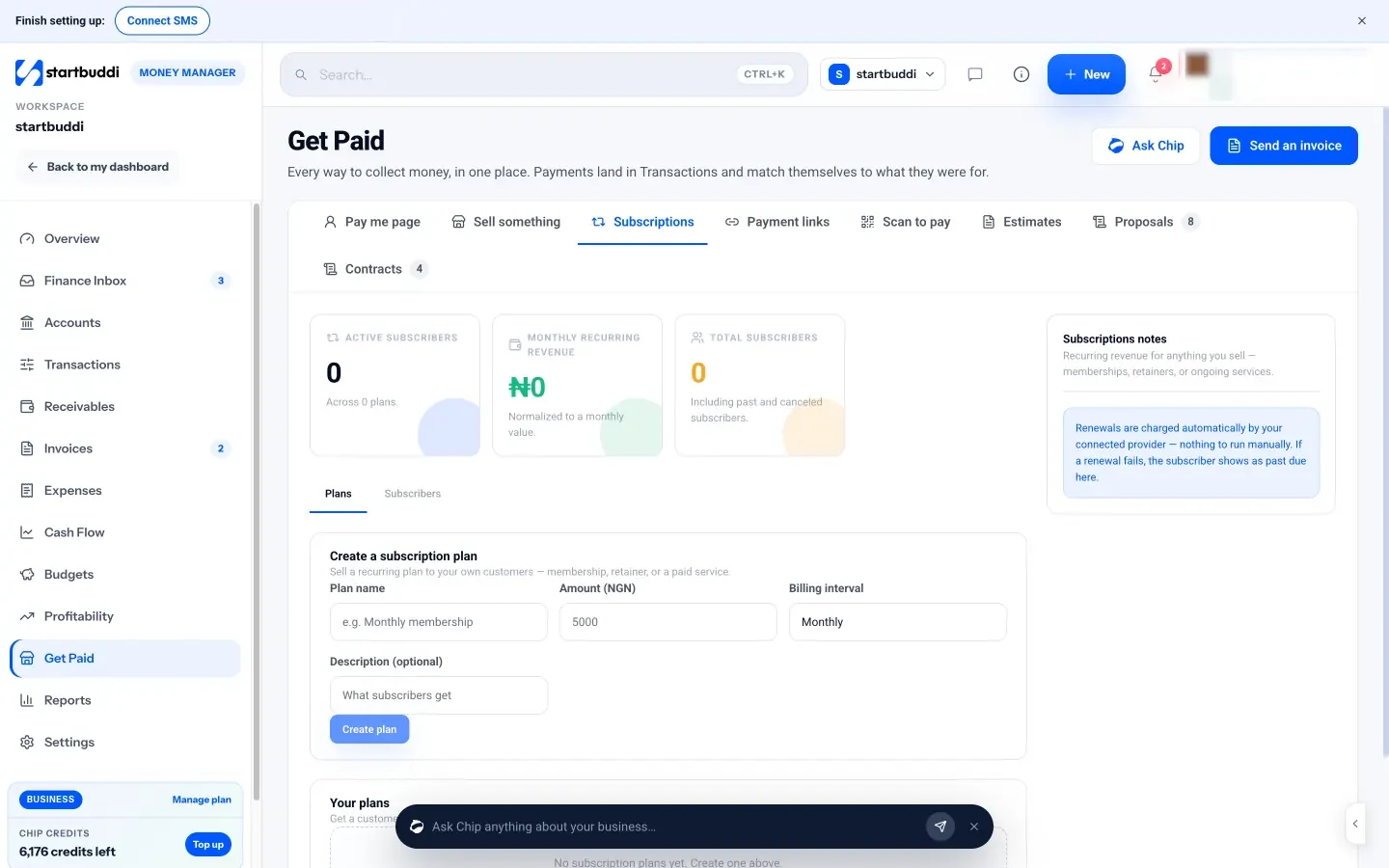
Money Manager gives you two ways to bill on a schedule. In Get Paid, the Subscriptions tab lets you create a plan (monthly or annual) through your connected Paystack or Stripe account, invite subscribers with a subscribe link, and see active subscribers and monthly recurring revenue. Renewals are charged automatically by the provider, and you can cancel a subscriber when they stop.
For clients who pay by invoice, recurring billing sets up a monthly or quarterly schedule once, and a new draft invoice is created when each one is due. See recurring invoicing for how that differs from card subscriptions. Both feed the 30-day cash forecast. Your next step: pick one service you already sell and write down what a monthly version of it would include, then compare options on the subscriptions page.
Related terms
FAQ
What is the difference between recurring revenue and repeat revenue?
Recurring revenue is contracted or scheduled, such as a subscription or retainer. Repeat revenue comes from customers who buy again but are not committed to a schedule.
How do I calculate MRR?
Add up what every recurring customer pays per month. Convert annual or quarterly plans to a monthly figure and leave out one-off fees.
Can a service business have recurring revenue?
Yes. Retainers, maintenance plans, memberships and monthly packages are all ways for service businesses to earn recurring revenue.
Is recurring revenue the same as recurring invoicing?
No. Recurring revenue is the income itself. Recurring invoicing is one way to collect it, by sending the same invoice on a schedule.
Tiwalade Joanna Okedara-Kalu is the founder, CEO and CTO of startbuddi, the business system that brings clients, bookings, invoices, projects, marketing and the Chip AI assistant into one place. Tiwalade builds software around how service businesses really work day to day, and writes about client management, getting paid on time and why small businesses outgrow the tools they start with.
Founded startbuddi and leads its product and engineering