What is a payment gateway?
Also called: Online payment gateway, payment processor, payment provider, checkout provider, PSP (payment service provider)
A payment gateway is a service that securely collects a customer's payment details online, sends them to the banks and card networks for approval, and tells your website or app whether the payment succeeded. Examples include Stripe, Paystack and PayPal.
A payment gateway is the service that lets you take payments online. When a customer types their card details on your checkout page, or chooses bank transfer or mobile money, the gateway collects those details securely, sends them to the banks for approval, and tells your site “paid” or “declined” in a few seconds. So what is a payment gateway in everyday terms? It is the online version of the card machine on a shop counter.
Well-known examples include Stripe, Paystack and PayPal. Many of these companies also act as the payment processor and move the money into your bank account, so small businesses usually deal with a single provider for everything.
What is a payment gateway used for?
- A checkout on your website or online store.
- A pay button on an emailed invoice.
- A payment link you send on WhatsApp, Instagram or email.
- Recurring charges for memberships and subscriptions.
- In-app payments on mobile.
Without a gateway, a small business is limited to cash and manual bank transfers, which means checking statements, chasing references and waiting. A gateway lets a customer pay the moment they decide, from any device, and tells you straight away that the money is on its way.
How a payment gateway works
- The customer pays on your checkout page, invoice or payment link.
- The gateway encrypts the details and sends them on.
- The card network (Visa, Mastercard, Verve and others) routes the request to the customer’s bank.
- The customer’s bank approves or declines, checking the balance and fraud signals, sometimes asking the customer for a one-time code.
- The gateway tells you the result and shows the customer a confirmation.
- Settlement: the money, minus fees, lands in your bank account on the provider’s schedule.
Example: a yoga teacher in Cape Town sends a R450 class-pack payment link. The student pays by card on her phone, the bank approves it, the teacher sees “paid”, and the money reaches her bank after the provider’s settlement period.
Payment gateway vs processor vs merchant account
| Part | What it does |
|---|---|
| Payment gateway | Collects and passes on payment details securely, and returns the result. |
| Payment processor | Moves the transaction between the banks and card networks. |
| Merchant account | Where card payments are held before they settle to your bank. |
Older setups needed all three from different companies. Most providers now bundle them, which is why the words are often used as if they mean the same thing.
What to look for when choosing one
- Countries and currencies: can it pay out to your bank, in your currency, and accept payments from where your customers are?
- Payment methods: cards, bank transfer, USSD, mobile money, Apple Pay and Google Pay matter differently in each market.
- Fees: check the per-transaction fee, international card fees, currency conversion and dispute fees on the provider’s own pricing page.
- Settlement time: how many days until money reaches your bank.
- Disputes and refunds: how chargebacks are handled and how easy refunds are.
- Recurring billing: if you sell memberships or retainers.
- Setup and verification: what documents you need and how long approval takes.
Common mistakes
- Choosing on headline fee alone. A gateway that your customers cannot pay with, or that settles slowly, costs more in lost sales.
- Collecting card numbers by email or form. Never ask customers to send card details directly. Let the gateway handle them.
- Forgetting to test. Make a small real payment end to end before you launch.
- Not matching payments to invoices. Payments that arrive without a clear reference create hours of admin later.
Payment gateways in startbuddi
To be clear, startbuddi is not a payment gateway itself. It connects to two: Paystack (cards, bank transfer, USSD and mobile money in Nigeria, Ghana, Kenya and South Africa) and Stripe (cards, worldwide). You connect them in Money Manager settings, and payments go straight to your own account. Your money never passes through startbuddi, and no cut is taken; the provider’s own fees still apply.
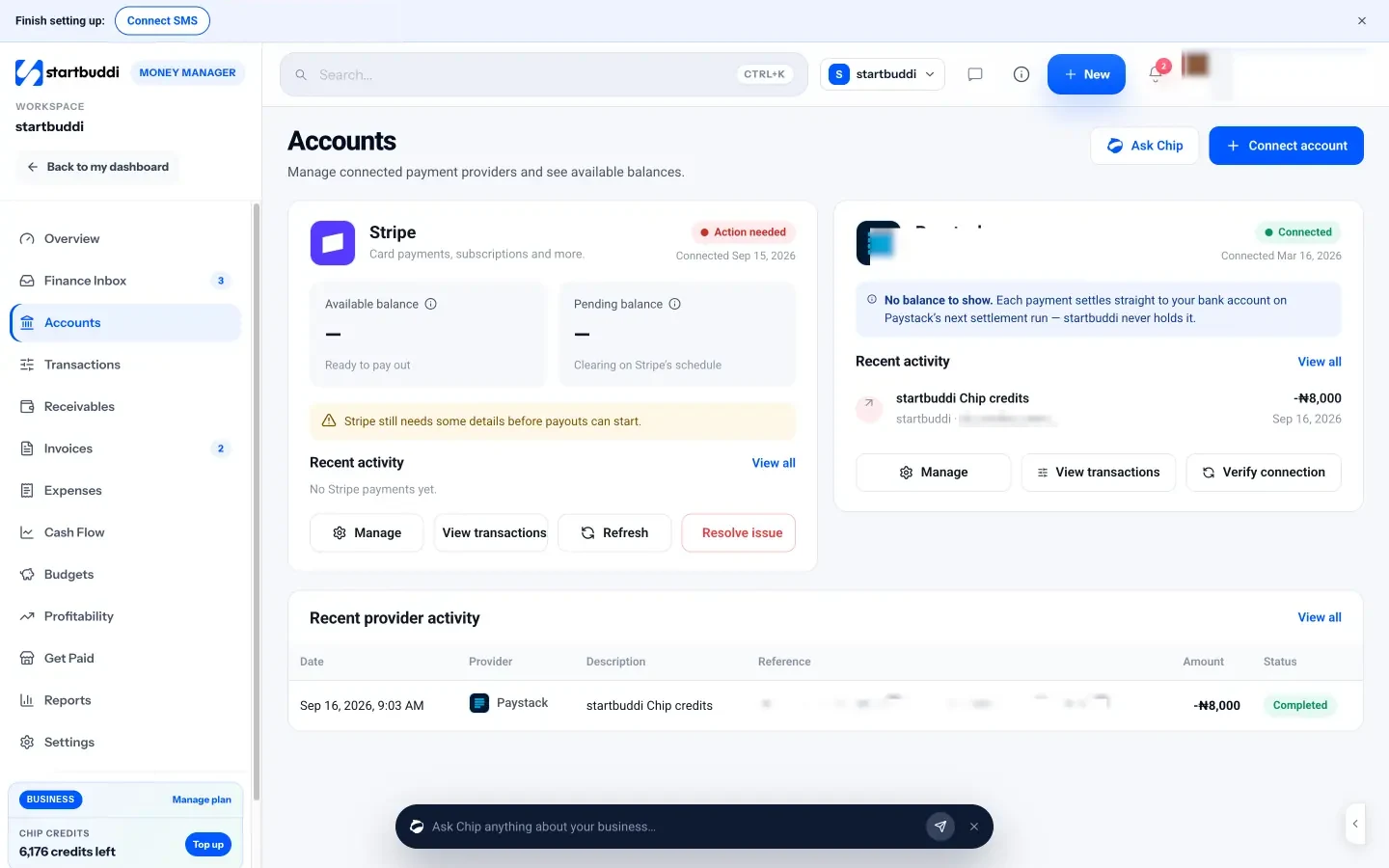
Once connected, the same providers power the pay button on your invoices, payment links, a pay me page and QR codes in Get Paid, and recurring plans in subscriptions. Payments land in Transactions and match themselves to the invoice or link they were for. Bank transfer and PayPal details can also be shown on invoices, but those payments are recorded by hand. For Nigerian businesses, our guide on how to accept payments in Nigeria compares the options. Your next step: list the three ways your customers most like to pay, then check which provider supports all three.
Related terms
FAQ
Is Paystack a payment gateway?
Yes. Paystack is a payment gateway and processor focused on Africa, accepting cards, bank transfer, USSD and mobile money in the countries it supports.
Do I need a website to use a payment gateway?
No. Most gateways also offer payment links and invoices, so you can take payments by sharing a link in a message or email.
What is the difference between a payment gateway and a payment processor?
The gateway collects and passes on payment details securely. The processor moves the transaction through the banking system. Many providers do both.
How much does a payment gateway cost?
Most charge a fee per successful transaction, sometimes with extra fees for international cards or disputes. Check each provider's official pricing page for your country.
Tiwalade Joanna Okedara-Kalu is the founder, CEO and CTO of startbuddi, the business system that brings clients, bookings, invoices, projects, marketing and the Chip AI assistant into one place. Tiwalade builds software around how service businesses really work day to day, and writes about client management, getting paid on time and why small businesses outgrow the tools they start with.
Founded startbuddi and leads its product and engineering