What is a chargeback?
Also called: Card dispute, payment dispute, disputed charge, reversal
A chargeback is the reversal of a card payment by the customer's bank after the customer disputes the charge. The money is taken back from the business, usually with a dispute fee, while the bank decides who is right.
A chargeback happens when a customer asks their bank or card issuer to reverse a card payment they made to you, and the bank pulls the money back from your account. So what is a chargeback, in short? It is a forced refund that goes through the banks instead of through you, usually with a fee on top, while the bank decides whose side to take.
Chargebacks exist to protect cardholders from fraud and from businesses that do not deliver. For an honest small business they can still hurt, because you can lose the sale, the goods or time you already gave, and the fee.
What is a chargeback and why does it matter to a small business?
Every card payment you take, whether through a payment gateway on your website, a payment link sent on WhatsApp or a pay button on an invoice, can be disputed later. For a small business the cost is more than the sale: you may already have delivered the goods or the hours, you pay a fee, and a high dispute rate can lead your payment provider to look more closely at your account. Knowing how chargebacks work helps you avoid most of them.
How a chargeback works
- The customer disputes the charge with their bank, for example saying they did not recognise it or never received what they paid for.
- The bank opens a dispute through the card network (Visa, Mastercard and so on).
- Your payment provider takes the money back from your balance, usually with a dispute fee, and tells you.
- You respond with evidence before a deadline, or accept the dispute.
- The customer’s bank decides. If you win, the money comes back to you. If you lose, the customer keeps it.
Why chargebacks happen
| Reason | What is usually going on |
|---|---|
| Fraud | A stolen card was used; the real cardholder disputes it. |
| Not recognised | The name on the bank statement does not match your business name. |
| Not received | The customer says goods or services never arrived. |
| Not as described | The customer is unhappy with what they got. |
| Duplicate or wrong amount | They were charged twice or the amount was wrong. |
| Cancelled subscription | They cancelled but were charged again, or think they did. |
| “Friendly fraud” | The customer did buy but disputes anyway, sometimes by mistake. |
In the US, consumers also have legal rights to dispute billing errors on credit cards. The Consumer Financial Protection Bureau explains the 60-day window for written billing disputes.
Chargeback vs refund
A refund is you giving money back by choice. A chargeback is the bank taking it back. Refunds are cheaper and friendlier: no dispute fee, and no mark against your record with your payment provider. If a customer has a genuine complaint, a fast refund or a credit note is almost always better than letting it become a chargeback.
How to prevent chargebacks
- Use a clear business name on card statements, one customers will recognise.
- Describe exactly what people are buying, with dates, quantities and what is not included.
- Send receipts and delivery confirmations by email every time.
- Make cancellation and refunds easy, and state your policy before they pay. Our cancellation policy template helps.
- Answer complaints quickly. Most chargebacks start as unanswered emails.
- Remind subscribers before renewals on longer plans, so no charge comes as a surprise.
- Watch for fraud signs: rushed large orders, mismatched names and addresses, several failed card attempts.
How to respond to a chargeback
- Act fast. Missing the deadline usually means you lose automatically. Paystack, for example, says disputes that are not answered in time are accepted and the customer is refunded (Paystack: how to resolve chargebacks).
- Decide if it is worth fighting. If the customer is right, accept it and learn from it.
- Send focused evidence: the invoice or order, proof of delivery, emails showing the customer received the service, your terms and your refund policy.
- Keep it factual. Banks decide on evidence, not on how annoyed you are.
Chargebacks in startbuddi
When customers pay startbuddi invoices, payment links or subscriptions by card, the payment goes through your own connected Stripe or Paystack account, and startbuddi never holds the money. That also means disputes are raised and answered in your Stripe or Paystack dashboard, not inside startbuddi; there is no dispute-handling screen in Money Manager.
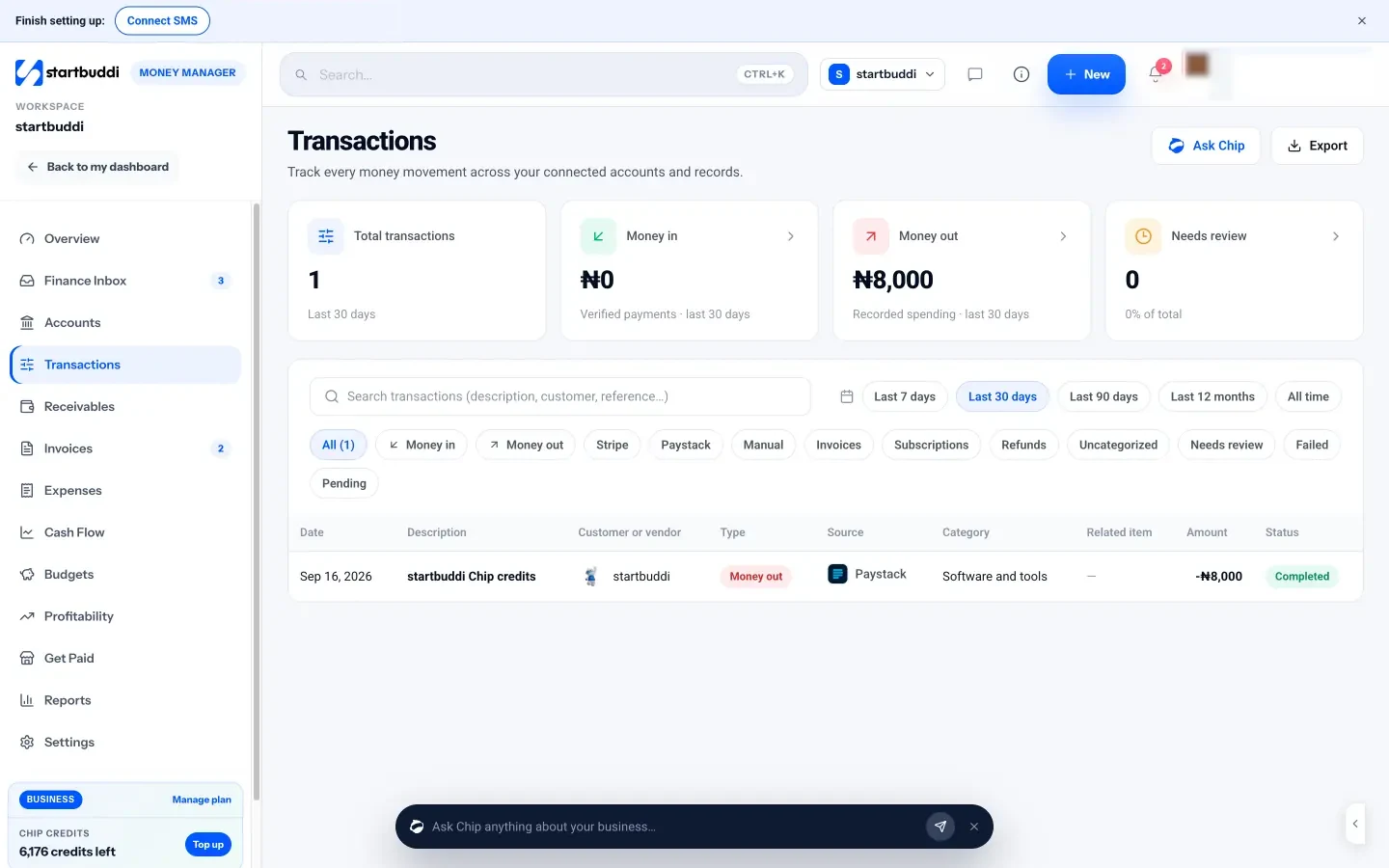
What startbuddi does help with is the evidence. Each invoice keeps a collection timeline (created, sent, viewed, paid), the customer’s contact record keeps your emails and notes, and the Transactions feed lets you filter by refunds, failed and pending payments. The Get Paid page lists every way you take payment. Your next step: check that your business name on card statements is one your customers will recognise, in your Stripe or Paystack settings.
Related terms
FAQ
Can a customer do a chargeback on a bank transfer?
Chargebacks are mainly a card payment process. Bank transfers and some local payment methods have their own dispute or recall rules, which vary by country and provider.
How long does a customer have to file a chargeback?
It depends on the card network and the case. Stripe says networks typically allow about 120 days from the payment, sometimes longer, for example when the service date is in the future.
Do I lose the dispute fee if I win?
It depends on your provider and country. Check your payment provider's pricing page, as some fees are not returned even when you win.
What is friendly fraud?
When a real customer disputes a genuine purchase, for example because they forgot it or did not recognise the name on their statement.
Tiwalade Joanna Okedara-Kalu is the founder, CEO and CTO of startbuddi, the business system that brings clients, bookings, invoices, projects, marketing and the Chip AI assistant into one place. Tiwalade builds software around how service businesses really work day to day, and writes about client management, getting paid on time and why small businesses outgrow the tools they start with.
Founded startbuddi and leads its product and engineering