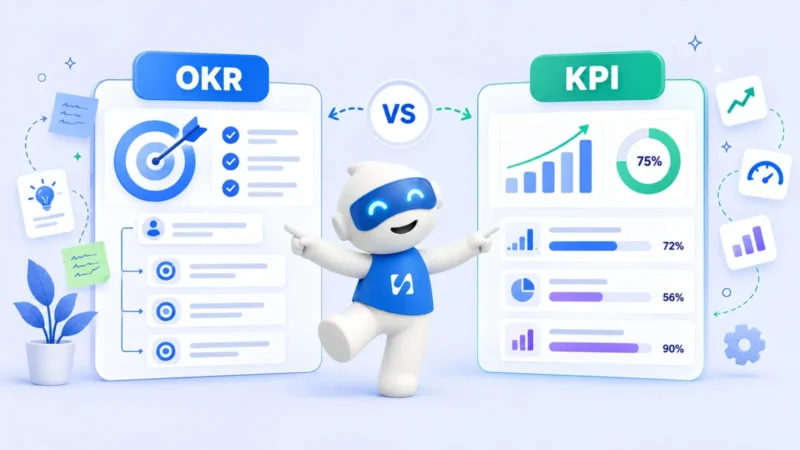
How to set OKRs for an agency your team will actually follow
How to set OKRs when client work eats every hour: a step-by-step method, examples for studios, agencies and consultants, and a weekly routine that keeps goals alive.


Chinonye wrote this while on the startbuddi team. The product has changed since, so the team updated it on .

- Set two or three objectives about the business, not client deliverables, with two to four measurable key results each. Mix leading and lagging numbers, name one owner per key result, link each to real projects, and check in for 15 minutes a week.
To set OKRs for an agency or any service business your team will actually follow, pick two or three objectives for the next quarter that describe how the business itself should improve (not what you will deliver for clients), give each one two to four measurable key results, and link them to the few projects that will move those numbers. Then check in every week, score honestly at the end of the quarter, and reset.
That sounds simple, and it is. The hard part for agencies, consultancies, studios and other service firms is that client work eats every hour, so your own goals quietly slide to “next quarter” forever. This guide shows how to set OKRs that survive a busy client calendar, with examples you can copy for a two-person studio or a 20-person agency.
What OKRs are, in one minute
OKR stands for objectives and key results. The method was created by Andy Grove at Intel and popularised by John Doerr, who introduced it to Google’s founders in 1999, as What Matters explains. Grove’s own framing was that the objective is the direction and the key results are measurable milestones that show you got there.
- Objective: a short, qualitative statement of where you want to go. “Become the go-to brand studio for food businesses in Nairobi.”
- Key results: two to four numbers that prove progress. “Win 4 new food and drink clients”, “Raise average project value from KES 180,000 to KES 250,000”.
If you want the fuller definition, read our glossary on what OKRs are. In short, KPIs are the numbers you watch all the time; OKRs are the few you are deliberately trying to change this quarter. The rest of this post is about doing it in a service business.
Why OKRs work differently in an agency or service business
Product companies set OKRs around a product they control. Service businesses sell time and expertise, which creates three traps.
Trap 1: client deliverables pretending to be goals
“Launch the new website for Client X” is a project, not an objective. It would happen with or without OKRs because the client is paying for it. Good agency OKRs are about the business: winning better work, keeping clients longer, making projects more profitable, building a capability or getting your own marketing done.
Trap 2: no spare capacity
If your team is booked at close to 100% on client work, any OKR that needs time will fail. Setting OKRs forces an honest capacity question: how many hours a week can we actually protect for the business? For a small team, even four hours a week per person is a real budget if you guard it.
Trap 3: lumpy, lagging numbers
Revenue in a service business arrives in chunks, often months after the sales work. A key result like “£60,000 revenue this quarter” might be decided by one late invoice. Balance lagging results (revenue, retention) with leading ones you can influence week by week (proposals sent, discovery calls held, case studies published).
How to set OKRs for an agency, step by step
Block two hours near the end of the quarter. For a team, include everyone who owns a key result. Work through these steps in order.
Step 1: look back before you look forward
Pull the numbers from last quarter: revenue by client, gross margin by project if you track it, hours logged, new clients won, clients lost, where leads came from. Ask three questions: What went well? What hurt? What are we tired of fixing by hand? The answers usually point straight at your objectives.
Step 2: choose two or three objectives
Google’s re:Work guide to OKRs suggests three to five objectives at company level. For a small service business, two or three is plenty. Fewer objectives means each gets real attention.
Good objectives for service firms tend to fall into five themes:
- Better clients: more of the right kind, fewer of the wrong kind.
- Retention and growth of existing clients: retainers renewed, more services per client.
- Profitability: fewer overruns, higher rates, less unbilled time.
- Delivery quality and speed: faster turnaround, fewer revisions, happier clients.
- Team and capability: a new service line, hiring, training, documented processes.
Step 3: write two to four key results for each
Each key result should pass the test that What Matters sets out: specific, time-bound, measurable and verifiable. If two people could argue about whether it happened, rewrite it.
Watch the difference between outputs and outcomes. “Publish 6 case studies” is an output, which is fine as a leading key result. “Get 10 inbound enquiries that mention a case study” is an outcome. A healthy set mixes both.
Step 4: set the stretch honestly
OKRs are meant to stretch you. Google’s guidance describes the sweet spot as “somewhere in the 60-70% range”, and warns that always hitting 100% means the goals weren’t ambitious enough. That’s the right mindset for a growth objective. For something the business must deliver (for example, “all invoices sent within 2 days of delivery”), aim for 100% and treat it as a commitment.
Step 5: name one owner per key result
One person, not “the team”. In a three-person studio the founder may own most of them, and that’s fine. The owner doesn’t do all the work; they make sure progress is visible and raise the alarm early.
Step 6: link each key result to the work
This is where most small-business OKRs die. For each key result, list the one to three projects or habits that will move it, and put them into your project tool with dates. Our guide to project management for agencies covers how to run that work alongside client jobs.
OKR examples for agencies and service businesses
Copy, adapt and cut. These are examples, not targets for your business; set numbers from your own baseline.
A two-person design studio (Lagos)
Objective: Stop living project to project.
- Convert 3 existing clients to monthly retainers of at least ₦250,000
- Raise the share of revenue from retainers from 20% to 45%
- Send every retainer invoice on the 1st of the month, 3 months in a row
A 10-person marketing agency (Manchester)
Objective: Make every project profitable.
- Log 95% of hours against a project or client each week
- Cut projects that run more than 15% over budget from 6 last quarter to 2
- Raise average blended hourly rate from £68 to £75
The first key result is a leading habit: without time tracking you cannot measure the other two. Our post on tracking billable hours explains how to make that habit stick.
A solo consultant (Toronto)
Objective: Build a pipeline I don’t have to scramble for.
- Hold 12 discovery calls with qualified prospects
- Send 8 proposals within 48 hours of the call
- Win 3 new clients at CAD 6,000 or more
A cleaning or trades business (Johannesburg)
Objective: Turn one-off jobs into regular customers.
- Get 40% of one-off customers to book a second visit within 60 days
- Collect 25 new Google reviews
- Reduce missed appointments from 8% to under 4%
A 20-person software services firm (Bengaluru)
Objective: Deliver faster without burning out the team.
- Cut average time from signed contract to kickoff from 12 days to 5
- Keep every team member under 40 logged hours a week, 10 weeks out of 13
- Reach a client satisfaction score of 8/10 or higher on every project closed this quarter
Company, team and personal OKRs: how many layers?
Large companies cascade OKRs from the board down to every team. A service business with fewer than 20 people rarely needs that. A simple rule of thumb:
- Under 5 people: one set of company OKRs. Everyone owns a key result or two.
- 5 to 20 people: company OKRs, plus optional team OKRs for a department that has its own goal (for example, the design team cutting revision rounds).
- Personal OKRs: skip them, or keep them for development goals agreed in one-to-ones. They add admin without much benefit at this size.
Whatever the structure, every team key result should connect to a company objective. If it doesn’t, ask whether it belongs on this quarter’s list at all.
Running OKRs through a busy quarter
Setting OKRs takes an afternoon. Keeping them alive takes fifteen minutes a week.
The weekly check-in
Each owner updates their key results before a short weekly meeting: the current number, a confidence rating (on track, at risk, off track) and one sentence on what changed or what’s blocking it. Keep it to 15 minutes. If you already run a weekly planning meeting, add OKRs as the first five minutes. Our project kickoff meeting guide covers the same habit of agreeing owners and dates at the start.
Protect the capacity you promised
Put OKR work into the calendar like client work, with an owner and a deadline. When a client emergency eats a week, move the OKR task, don’t delete it. At the check-in, “at risk because we had no hours” is useful information: it tells you the team is over capacity, which might be the real objective for next quarter.
Mid-quarter review
Around week six or seven, look at every key result. If one is clearly wrong (the number was based on bad data, or the market changed), fix it and write down why. Changing OKRs mid-quarter is fine when the reason is honest; changing them because they got hard is not.
End-of-quarter scoring
Score each key result from 0 to 1 (or 0% to 100%) and write two sentences per objective: what worked and what you’d do differently. Then start the next cycle from those notes. If you want a shorter planning format to sit alongside OKRs, see our post on a small-business approach to OKRs.
Common mistakes when setting OKRs in a service business
| Mistake | What it looks like | Fix |
|---|---|---|
| Too many objectives | Seven objectives, twenty key results | Two or three objectives, cut the rest to a “later” list |
| Tasks as key results | “Redesign our website” | “Get 20 enquiries a month from the website” |
| Only lagging numbers | Revenue, profit, retention only | Add leading key results you can move weekly |
| OKRs tied to bonuses | People sandbag targets | Keep pay and OKRs separate, discuss performance on its own |
| No baseline | “Improve margin” with no current number | Measure the starting point before setting the target |
| Set and forget | Nobody looks until the last week | Weekly check-ins, a mid-quarter review |
How startbuddi helps you track OKRs
startbuddi keeps goals in Work, under Goals, next to the projects, tasks and time that move them. Here’s what it does today.
Goals and key results
Click New goal and write the objective, then add key results as a number, percentage, currency amount or yes/no, each with a target and an owner. You can set a goal period (weekly, monthly, quarterly or custom), a reporting cadence and a check-in day, and choose who can see it: the whole workspace, a team, or just you.
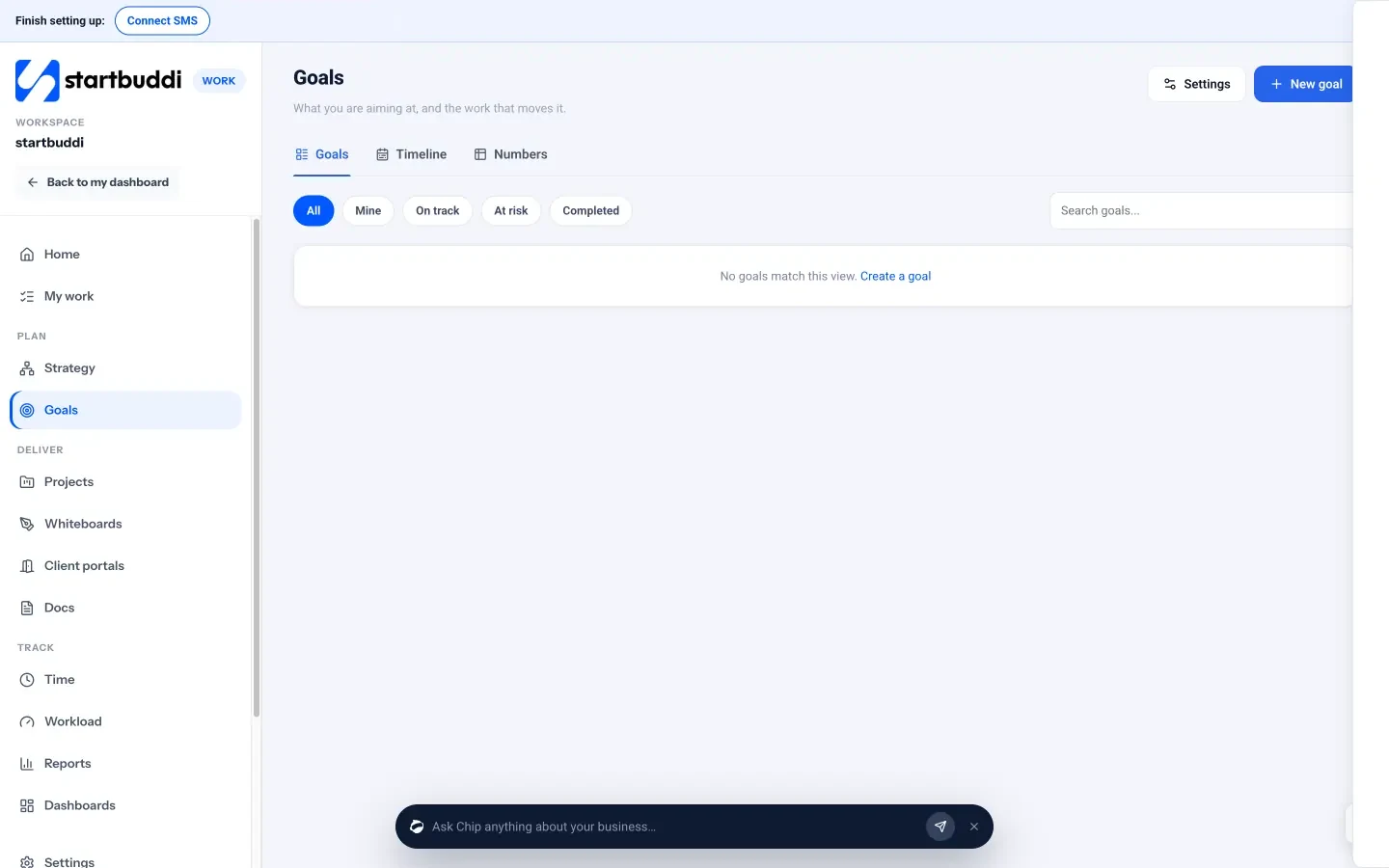
Each goal has a Check in button that asks how it’s going (on track, at risk or off track), whether you’ll hit it, and what changed. If you’re short on time, “Draft it for me” asks Chip to write the check-in from what changed since the last one, for you to review. That uses Chip credits.
Linking goals to the work
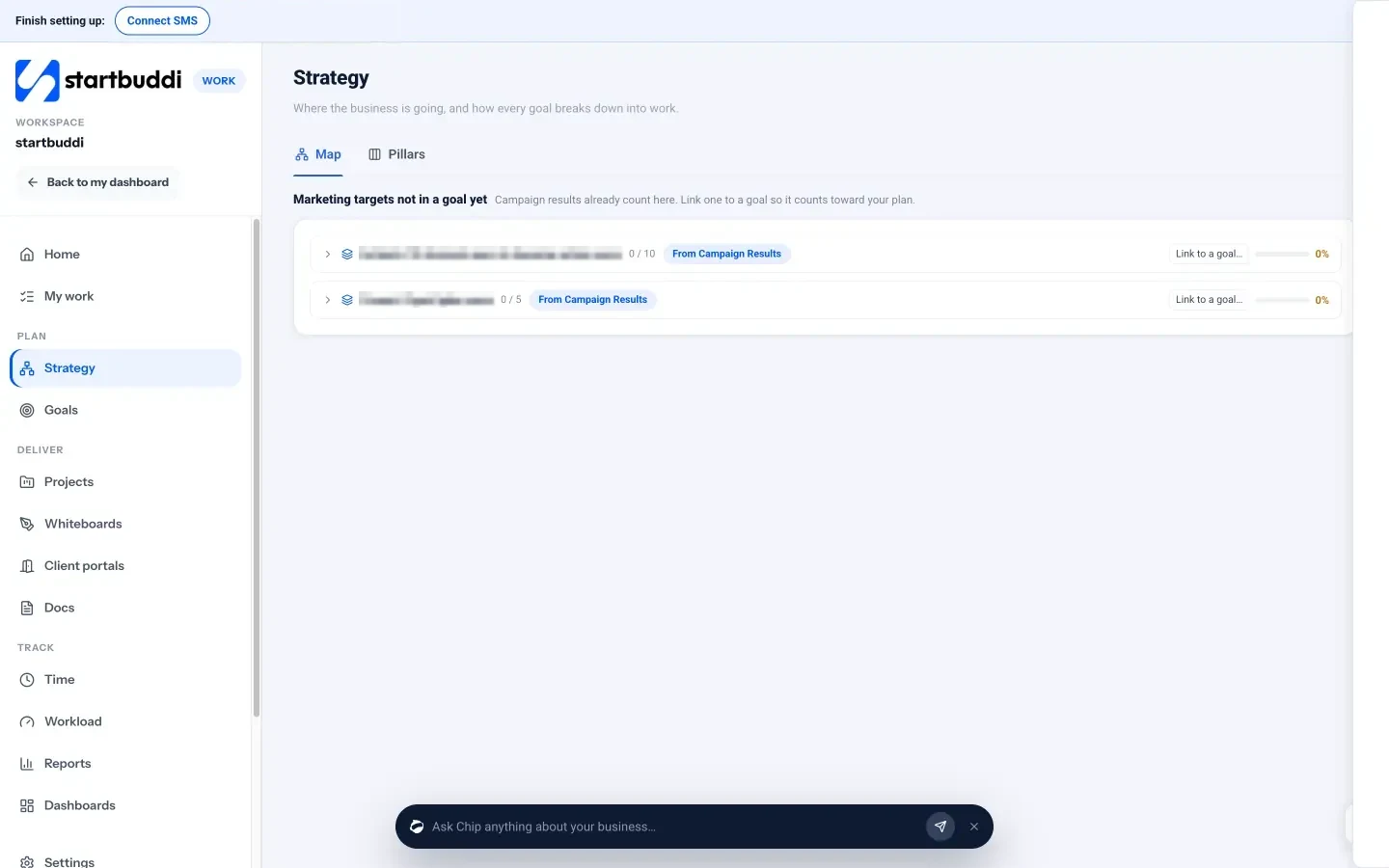
The Strategy map shows how each goal breaks down into key results, initiatives, projects, milestones and tasks, all editable in place. Key result progress can be updated by hand or calculated from linked tasks or milestones, so the number moves when the work gets done.
Numbers that fill themselves in
The Numbers view tracks business measures month by month. Some can fill in automatically from elsewhere in startbuddi: money coming in and going out from Money Manager, new contacts, form submissions, social posts published and emails opened. That makes key results like “raise retainer revenue” or “get 40 enquiries a month” easy to follow without a spreadsheet.
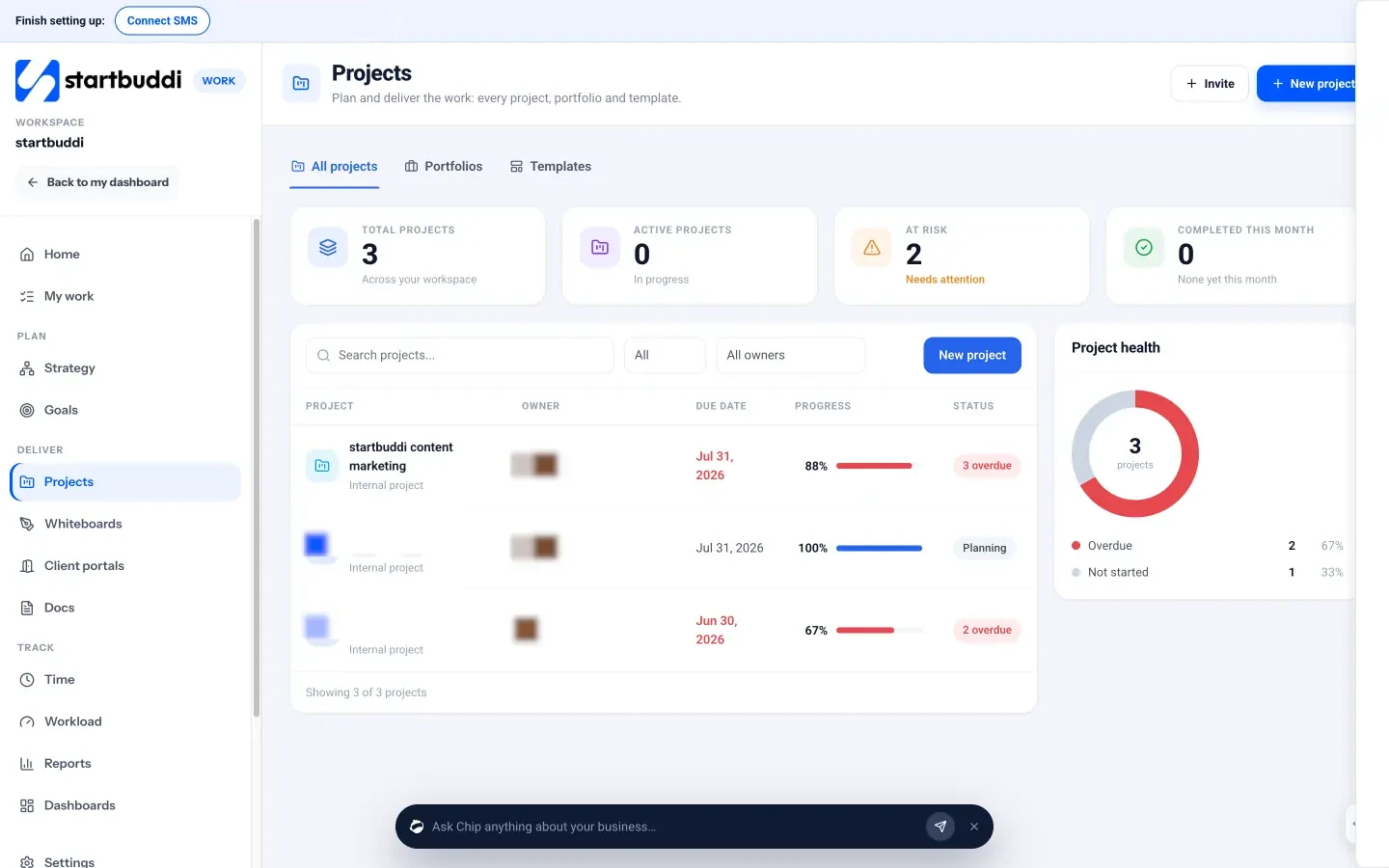
Because projects and time tracking live in the same place, the agency examples above (hours logged, project overruns, turnaround time) sit next to the goals they serve.
What it isn’t
startbuddi won’t choose your objectives for you, and it isn’t a performance-management or bonus system. The help article on setting up OKRs in startbuddi and the guide to tracking goal progress week over week show the screens step by step.
Your next step
Before the end of this week, write down one objective for next quarter that is about your business, not a client. Give it three key results with a starting number and a target, pick an owner, and book a 15-minute weekly check-in. If you’d like goals, projects and time in one place, see how startbuddi handles OKRs for agencies or compare the plans.
Sources
- Google re:Work: Set goals with OKRs
- What Matters: What is an OKR?
- What Matters: What is a key result?
- What Matters: The origin story of OKRs (Andy Grove and Intel)
Frequently asked questions
How many OKRs should a small agency have?
Two or three objectives a quarter, each with two to four key results. A solo consultant can do well with just one objective.
Should client projects be OKRs?
Usually not. Client work happens anyway because it's paid for. Use OKRs for improving the business itself: better clients, retention, margins, delivery speed or new services.
How often should we check OKR progress?
Weekly, in a short 15-minute check-in, with a fuller review mid-quarter and scoring at the end of the quarter.
What is a good OKR score?
For stretch goals, Google suggests 60 to 70% is the sweet spot. For commitments the business must hit, aim for 100%.
Should OKRs be linked to bonuses?
It's generally better not to. When pay depends on hitting OKRs, people set safe targets, which defeats the purpose of stretching.
SEO Copywriter| Email growth Specialist| I help businesses increase revenue with strategic SEO content & high-converting email funnels.