How to set business goals for the next 90 days (your 90 day plan)
A simple 90 day plan for small businesses: pick one to three goals, make them measurable, break them into weeks and check in every week.



- A 90 day plan sets one to three clear business goals for the next quarter, each with two or three measurable results and weekly actions. Break the quarter into monthly milestones, use if-then plans to make weekly actions happen, and hold a 15-minute check-in every week.
A 90 day plan is a short business plan for the next three months: one to three clear goals, the numbers that show you’re getting there, and the weekly actions that move those numbers. It works better than a yearly plan for most small businesses because 90 days is long enough to achieve something real and short enough that you can’t put it off until “later in the year”.
This guide walks you through setting business goals for the next 90 days in seven steps, with examples, a template you can copy, and a 15-minute weekly check-in that keeps the plan alive. You can do the whole thing in an afternoon.
Why a 90 day plan works for small businesses
Annual plans often fail small businesses for a simple reason: too much changes. A big client arrives or leaves, prices rise, a new competitor opens down the road. By March, the January plan feels like it belongs to someone else.
A quarter is a better unit. It’s the same rhythm many large companies use for goal-setting. Google’s guide to setting goals with OKRs describes setting both annual and quarterly goals and grading them every quarter. For a small business, the quarterly part is where the value is.
There’s solid research behind writing goals down clearly. In a review of decades of studies published in American Psychologist, Edwin Locke and Gary Latham found that specific, challenging goals consistently led to better performance than vague instructions to “do your best”. A 90 day plan forces that specificity.
Step 1: Look back before you look forward
Spend 30 minutes on the last 90 days before setting new goals. Answer these questions in writing:
- What brought in most of our money? Which clients, products or services?
- What took the most time for the least return?
- What did we say we’d do and didn’t? Why not?
- What surprised us, good or bad?
- What are customers asking for that we don’t offer yet?
Pull a few real numbers too: revenue, new customers, enquiries, and money still owed to you. If you don’t know which numbers to watch, our post on 7 numbers every small business should track is a good starting list.
Step 2: Choose one to three goals
This is the hard part. It’s tempting to write eight goals, work on all of them a little, and finish none. For a small business with limited time, one to three goals is the right number. If you’re a solo founder, one main goal plus one smaller one is plenty.
Ask: “If we only achieved one thing in the next 90 days, what would make the biggest difference?” That’s goal one.
Here are examples by type of business:
| Business | Example 90 day goal |
|---|---|
| Freelance designer | Move from one-off jobs to steady monthly income |
| Cleaning company | Win more repeat commercial contracts |
| Consultant | Fill the calendar with better-paid projects |
| Online store | Grow repeat orders from existing customers |
| Small agency | Get paid faster and stop chasing invoices |
| Restaurant or café | Build a busy weekday lunch trade |
Notice these are outcomes, not tasks. “Launch a new website” is a task. “Get more enquiries from people who find us online” is an outcome, and a new website might be one way to get there.
Step 3: Turn each goal into two or three measurable results
A goal tells you the direction. Measurable results tell you whether you’re getting there. This is the idea behind OKRs (objectives and key results), and it works just as well for a team of one. Google’s guidance suggests about three key results for each objective.
Good key results are numbers with a deadline. Compare:
- Vague: “Get more retainer clients.”
- Measurable: “Sign 3 retainer clients by 31 December.”
Mix two kinds of measures:
- Result measures show the outcome, such as revenue, new customers or repeat orders. You can’t control them directly.
- Activity measures show the effort that drives the result, such as proposals sent, sales calls booked or follow-up messages sent. You control these fully.
Having at least one activity measure per goal matters. If the result is slow to move, the activity number tells you whether you’re doing the work or whether the approach needs to change. For more on the difference between goals and ongoing numbers, see OKR vs KPI.
Aim a little high. Google’s guide suggests that hitting around 60 to 70% of an ambitious target is a good result; if you always hit 100%, your targets are probably too safe. For a small business, a sensible rule is: the target should feel possible, but not certain.
Step 4: Break the quarter into months and weeks
Ninety days is roughly 13 weeks. Split each goal into monthly milestones, then into what needs to happen each week. Here’s an example for a freelance designer whose goal is steady monthly income.
| Month | Milestone | Weekly actions |
|---|---|---|
| Month 1 | Retainer offer ready and priced | Define 2 retainer packages, write a one-page offer, list 15 past clients to approach |
| Month 2 | Offer in front of the right people | Contact 5 past clients a week, post the offer twice a week, follow up within 3 days |
| Month 3 | Retainers signed and running | Send proposals, agree terms, set up monthly invoices, ask for referrals |
If a monthly milestone slips, you’ll notice in week five, not in month eleven. That’s the whole point of a short plan. Leave the last week or two of the quarter lighter than the rest, too. Something always takes longer than planned, and a little slack stops one late task from sinking the whole plan.
Step 5: Make weekly actions specific with “if-then” plans
Plans often fail at the point of starting, not the point of finishing. A useful trick from psychology is the “implementation intention”: a plan that says exactly when and where you’ll act. A meta-analysis by Peter Gollwitzer and Paschal Sheeran of 94 studies found that these if-then plans had a medium-to-large effect on whether people reached their goals.
In practice, it means turning “follow up with past clients” into:
- “Every Tuesday at 9am, before opening email, I’ll message two past clients about the retainer offer.”
- “If a client says ‘maybe later’, then I’ll add a follow-up task for 14 days’ time before closing the chat.”
Put these actions in your calendar or task list with a day and time. Anything without a slot tends to get pushed out by client work.
Step 6: Hold a 15-minute weekly check-in
A plan you look at once a quarter is a wish list. A plan you look at every week is a steering wheel. Book 15 minutes at the same time each week, alone or with your team, and answer four questions:
- Where are the numbers? Update each key result.
- Are we on track, at risk or off track? Be honest.
- What got in the way? Name the blocker in one sentence.
- What are the two or three most important actions this week?
If you work with a team, fold this into your regular planning meeting. Our guide to a 30-minute weekly planning meeting for small teams shows how.
Step 7: Review and reset at the end of the quarter
In the last week of the quarter, score each key result: how much of the target did you reach? Then ask three questions:
- What worked that we should keep doing?
- What didn’t work that we should stop?
- What did we learn that changes the next 90 days?
Then go back to Step 1 and write the next plan. Some goals will carry over with new targets. Some will be finished. Some you’ll drop, and that’s fine. Dropping a goal on purpose is very different from forgetting it.
A worked example: a small cleaning company
Here’s how the steps come together for an imaginary three-person cleaning business in Lagos that mostly does one-off home cleans.
Looking back: the owner notices that the two office clients they cleaned for last quarter paid on time, booked weekly and needed almost no selling. One-off home cleans, by contrast, took lots of WhatsApp back-and-forth for small jobs.
Goal: build steady weekly income from small office contracts.
Key results:
- Sign 4 new weekly office contracts by the end of the quarter (result).
- Get 90% of office invoices paid within 14 days (result).
- Visit or call 10 local offices every week (activity).
Monthly milestones: month one, a simple office cleaning price list and a one-page offer; month two, 40 offices contacted and 8 site visits done; month three, contracts signed and recurring invoices set up.
If-then actions: “Every Monday and Thursday at 10am, I’ll visit five offices on one street with the offer sheet.” “If an office manager asks for a quote, then I’ll send it the same day.”
Not doing this quarter: a new website, carpet cleaning as a new service, and paid adverts.
Notice how every part connects. The weekly visits drive the site visits, the site visits drive the contracts, and the contracts drive the income. At each weekly check-in, the owner can see exactly which link in the chain is weak. If visits are happening but nobody asks for a quote, the offer needs work. If quotes go out but nobody signs, the price or follow-up needs work.
A 90 day plan template you can copy
Use this structure on a single page. If you’d like to go further, our free business plan template and the guide to writing a one-page business plan help with the bigger picture.
Quarter: [start date] to [end date]
Looking back: [three things that worked, three that didn’t]
Goal 1: [the outcome in one sentence]
Key results: [number and deadline], [number and deadline], [activity measure]
Month 1 milestone: [ ] Month 2 milestone: [ ] Month 3 milestone: [ ]
Weekly if-then actions: [when, where, what]
Run this from one workspaceClients, projects, money and marketing, connected instead of spread across five apps.See how it worksGoal 2 (optional): [same structure]
Weekly check-in: [day, time, who]
Not doing this quarter: [the good ideas you’re deliberately parking]
That last line is underrated. Writing down what you won’t do protects your time from every shiny new idea.
Common mistakes with 90 day goals
- Too many goals. Three goals done well beat eight goals half done.
- Tasks dressed up as goals. “Redesign the website” is a project. Ask what outcome it’s for.
- No numbers. Without a number, you can’t tell if you’re winning.
- No owner. In a team, every goal and key result needs one named person.
- Skipping the weekly check-in. This is where most plans quietly die.
- Setting and forgetting. A plan should change when the facts change. Adjust the actions, keep the goal.
How startbuddi helps
Goals in startbuddi sit inside Work, next to the projects and tasks that deliver them, so your 90 day plan and your daily work live in the same place.
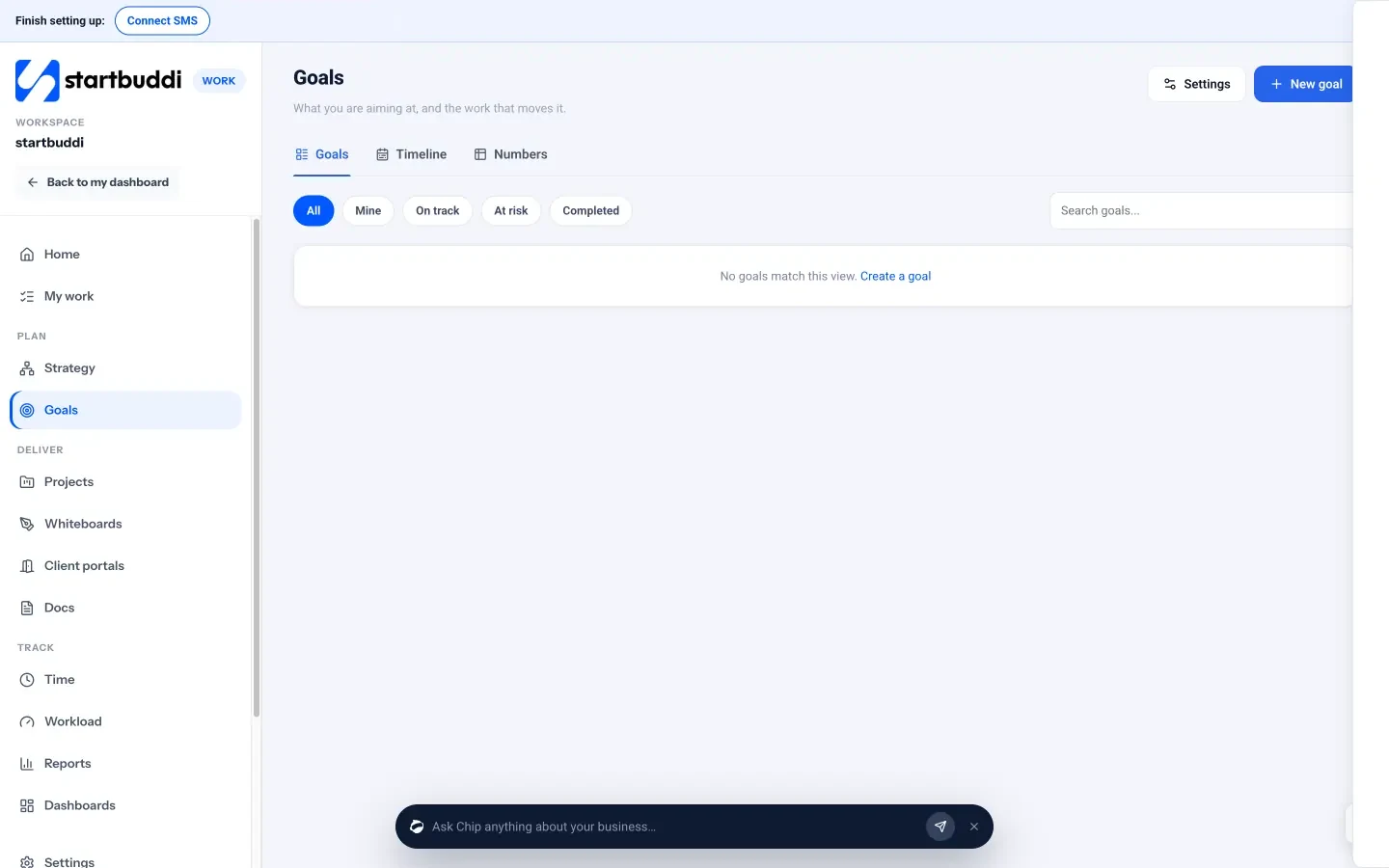
- Set a goal for the quarter. Open Work, then Goals, and click New goal. Write the goal, choose an owner and a quarterly goal period, and add key results as a number, percentage, currency amount or yes/no, each with a target.
- Link the work. Connect projects and tasks to each goal, so you can see what’s moving it. The Strategy map shows how each goal breaks down into initiatives, projects, milestones and tasks.
- Check in weekly. Use Check in on a goal to mark its health as on track, at risk or off track, add your confidence and note what changed. Chip can draft the check-in from what’s changed since last time with Draft it for me (this uses Chip credits).
- Let the numbers fill themselves in. The Numbers board tracks figures month by month. Some can fill in automatically from startbuddi, such as money coming in, money going out, new contacts, form submissions, posts published and emails opened. Others you enter yourself.
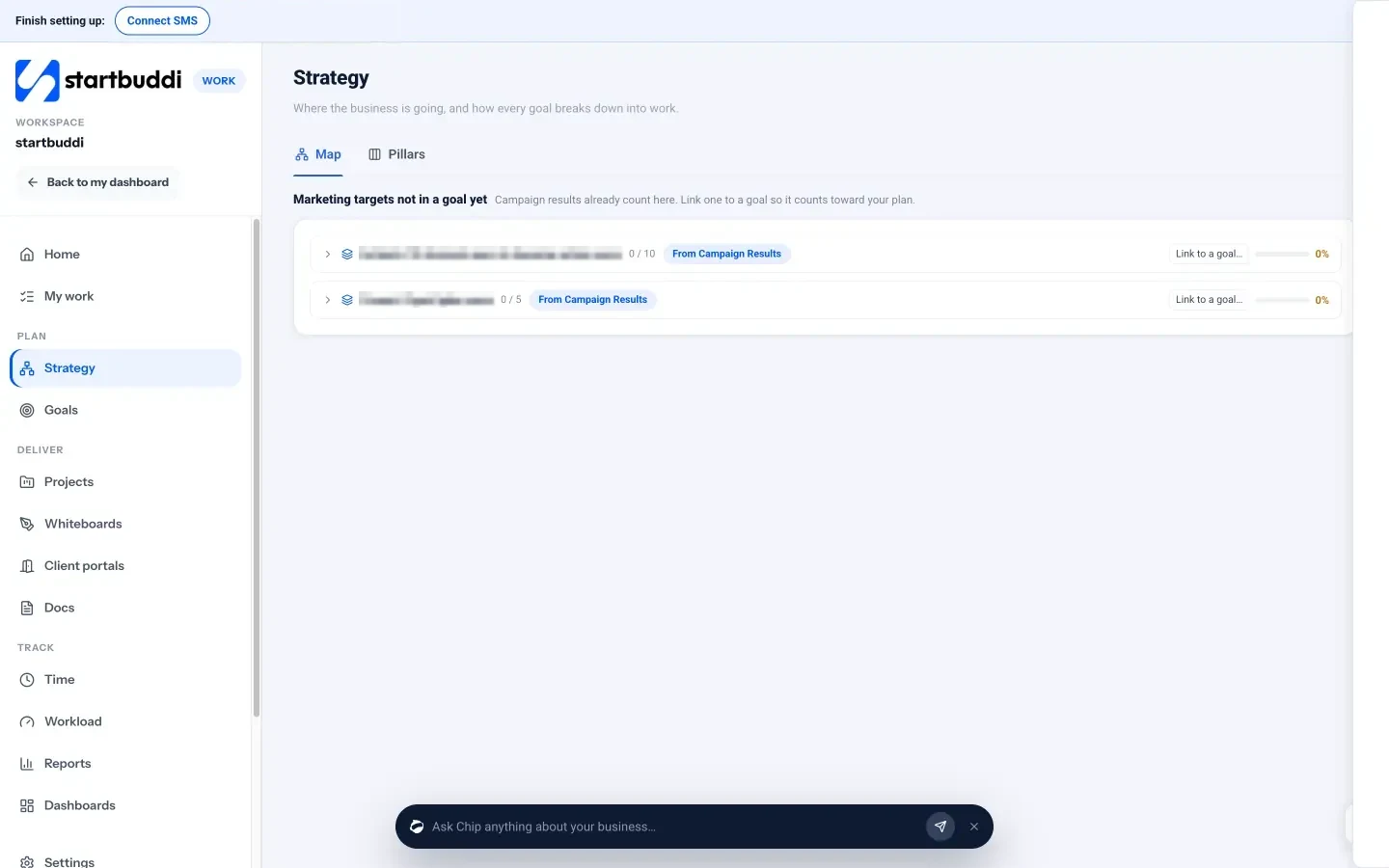
Because goals are connected to your projects and tasks, the weekly actions from your plan become real tasks with owners and due dates. If you’re new to structured goals, read what OKRs are and how small businesses use them.
Your next step
Block two hours this week. Do the look-back, choose one to three goals, and write two or three measurable results for each. Then put a 15-minute check-in in your calendar for the same time every week. If you’d like your goals, projects and numbers in one place, you can start with startbuddi for free.
Sources
- Locke and Latham (2002), Building a practically useful theory of goal setting and task motivation, American Psychologist
- Gollwitzer and Sheeran (2006), Implementation intentions and goal achievement: a meta-analysis
- Google re:Work: Set goals with OKRs
Frequently asked questions
How many goals should a 90 day plan have?
One to three. A solo founder usually does best with one main goal and one smaller one.
Is a 90 day plan the same as OKRs?
Close. OKRs are one way to write a 90 day plan: an objective with a few measurable key results. You don't need the jargon to use the idea.
What if I miss my 90 day goals?
Score how far you got and learn from it. Hitting most of an ambitious target is often a good quarter. Then set the next plan.
When should I start a 90 day plan?
Any time. Calendar quarters are convenient, but starting on the next Monday works just as well.
Omolola Akiyode is the operations and project manager at startbuddi, leading cross-functional projects and the content that helps founders get set up. Omolola writes about projects, websites and getting found online, and turns complex ideas into clear, practical steps.
Runs operations and projects at startbuddi