What are OKRs?
Also called: Objectives and key results, OKR framework, OKR goals
OKRs (objectives and key results) are a goal-setting method: an objective says what you want to achieve, and three to five measurable key results show whether you got there, usually within a quarter.
OKRs (objectives and key results) are a simple way to set goals. The objective is what you want to achieve, written in plain words. The key results are two to five numbers that prove you got there. If you can say “we want X, and we will know we have it when A, B and C happen”, you have written an OKR.
The method started at Intel under Andy Grove and was later made popular by investor John Doerr, who introduced it to Google and wrote about it in Measure What Matters. The What Matters history of OKRs tells that story. You do not need to be a tech company to use them. A two-person bakery can write an OKR in ten minutes.
What are OKRs, in plain words?
An objective is a clear, motivating outcome, such as “Become the go-to caterer for office events in Ikeja”. It should make sense to anyone on the team and it should not contain a number.
A key result is a measurable sign of progress towards that objective. What Matters describes key results as specific, time-bound and measurable, with no room for argument about whether they happened. Most teams use three to five per objective.
Together they answer two questions every small business owner asks: “What matters most this quarter?” and “How will we know it is working?”
Why OKRs matter for a small business
When you run a small business, everything feels urgent. OKRs help you pick a few things and say no to the rest. That focus is often the difference between a busy quarter and a productive one.
- Focus: one to three objectives a quarter stop you spreading your time across ten half-finished ideas.
- Alignment: when you hire your first person, they can see exactly what the business is aiming at and how their work fits in.
- Honest progress: numbers make it obvious when something is not working, so you can change course early.
- Better weekly decisions: “Does this task move a key result?” is a quick filter for your to-do list.
How OKRs work: an example
Imagine Tolu runs a small branding studio in Lagos. Her goal for the next quarter might look like this:
Objective: Win more retainer clients so income is steady.
KR1: Sign 4 new monthly retainers.
KR2: Raise retainer income from ₦600,000 to ₦1,200,000 a month.
KR3: Send 30 proposals to warm leads.
Notice that the key results measure outcomes, not effort. “Post on Instagram every day” is a task. “Get 20 enquiries from Instagram” is a key result. The tasks and projects that move the numbers (a new retainer package, a follow-up email sequence, a portfolio refresh) are sometimes called initiatives.
Each week, Tolu checks in: where is each number, is she on track, and what is blocking her? At the end of the quarter she scores each key result, learns from the misses and writes the next set.
Key parts of an OKR system
Committed and aspirational OKRs
Some OKRs are committed: you fully expect to hit them, such as “Send every invoice within two days of finishing a job”. Others are aspirational stretch goals where getting most of the way there is a good result. Say which kind each one is, so nobody feels they failed when a stretch goal lands at 70%.
A time period
Most teams set OKRs quarterly. It is long enough to get real results and short enough to adjust. Very small teams sometimes prefer monthly goals while things change fast.
Check-ins and scoring
Weekly check-ins keep OKRs alive. A short update on each key result, a health rating (on track, at risk, off track) and a note about blockers is enough. Scoring can be simple, such as a 0 to 1 scale or red, amber and green.
Common mistakes to avoid
- Too many objectives. Five objectives with five key results each is 25 things to watch. Start with one or two.
- Key results that are really tasks. “Launch a new website” is a task. “Get 50 booking requests from the new website” is a result.
- Set and forget. OKRs written in January and read again in April do not change anything. Put a weekly check-in in your diary.
- Using OKRs to judge people. Linking stretch goals to pay makes people set easy targets. Use OKRs to steer the business, not to punish.
- No link to the work. If your goals live in one document and your tasks in another, the goals are soon forgotten.
Related terms
KPIs (key performance indicators) are the ongoing numbers you watch all the time, like monthly revenue or repeat customers. OKRs are about change: moving a number to a new level in a set time. Our guide to the difference between OKRs and KPIs goes deeper. A goal-tracking system is the tool or routine you use to record goals and progress, and project management software is where the initiatives behind your key results get done.
For a longer walk-through with more examples, read what OKRs are and how small businesses use them, or see how to set OKRs for a service business.
OKRs in startbuddi
In startbuddi, goals and OKRs live in Work, under Goals. You create a goal, add key results (a number, a percentage, an amount of money or a simple yes or no), pick an owner and a period, and link the projects and tasks that move it.
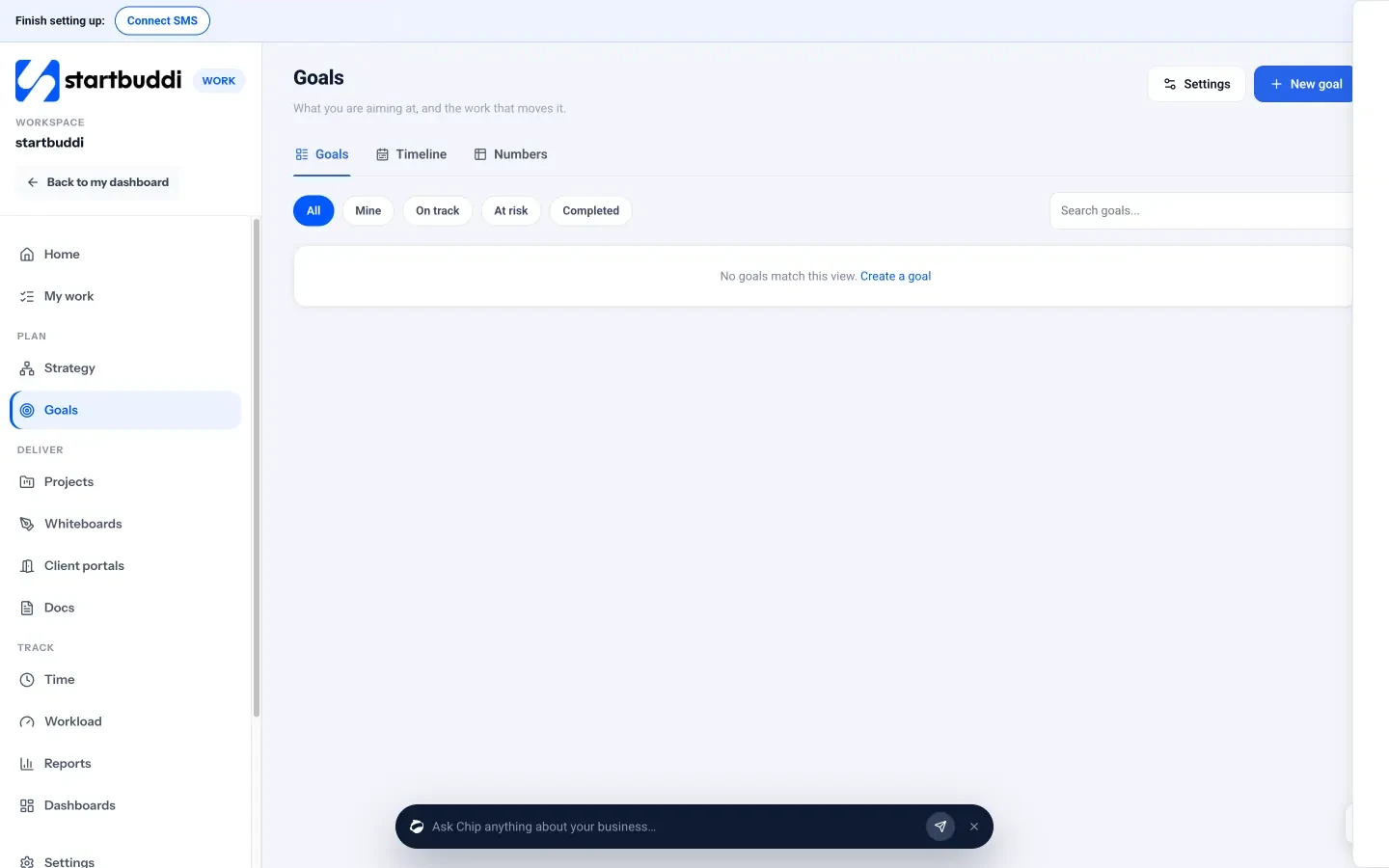
Each goal has a Check in button where you rate its health and note what changed. Chip can draft the check-in for you from what has happened since the last one, and you edit it before saving. A Strategy map shows how each goal breaks down into key results, initiatives, projects and tasks, so your goals stay tied to the actual work.
For the ongoing numbers, the Numbers view tracks KPIs month by month. Some fill themselves in from other parts of startbuddi, such as money coming in, new contacts, form submissions and emails opened, and you can enter any others by hand.
Your next step: write one objective and three key results for the next 90 days, then add them to Goals and book a 15-minute weekly check-in. You can start on the Free plan.
Sources
Related terms
FAQ
How many OKRs should a small business have?
Start with one or two objectives a quarter, each with three to five key results. Fewer goals you actually check every week beat a long list nobody reads.
What is the difference between an objective and a key result?
The objective is the outcome in words, such as "Win more retainer clients". Key results are the numbers that prove it, such as "Sign 4 new monthly retainers".
Is it bad to hit only 70% of an OKR?
Not for a stretch goal. Aspirational OKRs are meant to be hard, so getting most of the way there is often a good result. Committed OKRs are different: you expect to hit those fully.
Can a solo founder use OKRs?
Yes. OKRs work well for one person because they force you to choose what matters this quarter and give you a weekly check on whether your time is going to the right things.
Chinedu Kalu is the co-founder and chief operating officer of startbuddi, responsible for how the company runs day to day. Chinedu writes about the operational side of a small business: registering and running the company, money, hiring and the routines that keep a team on track.
Co-founded startbuddi and runs its operations