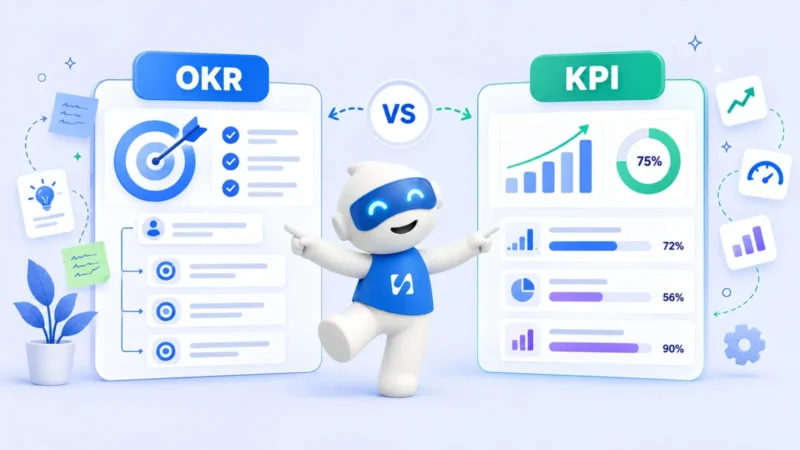
OKR implementation for small businesses: a practical guide to setting and tracking goals
How to implement OKRs in a business of one to twenty people: the basics, a first-quarter plan, weekly check-ins, scoring and whether you need OKR software.


Chinonye wrote this while on the startbuddi team. The product has changed since, so the team updated it on .
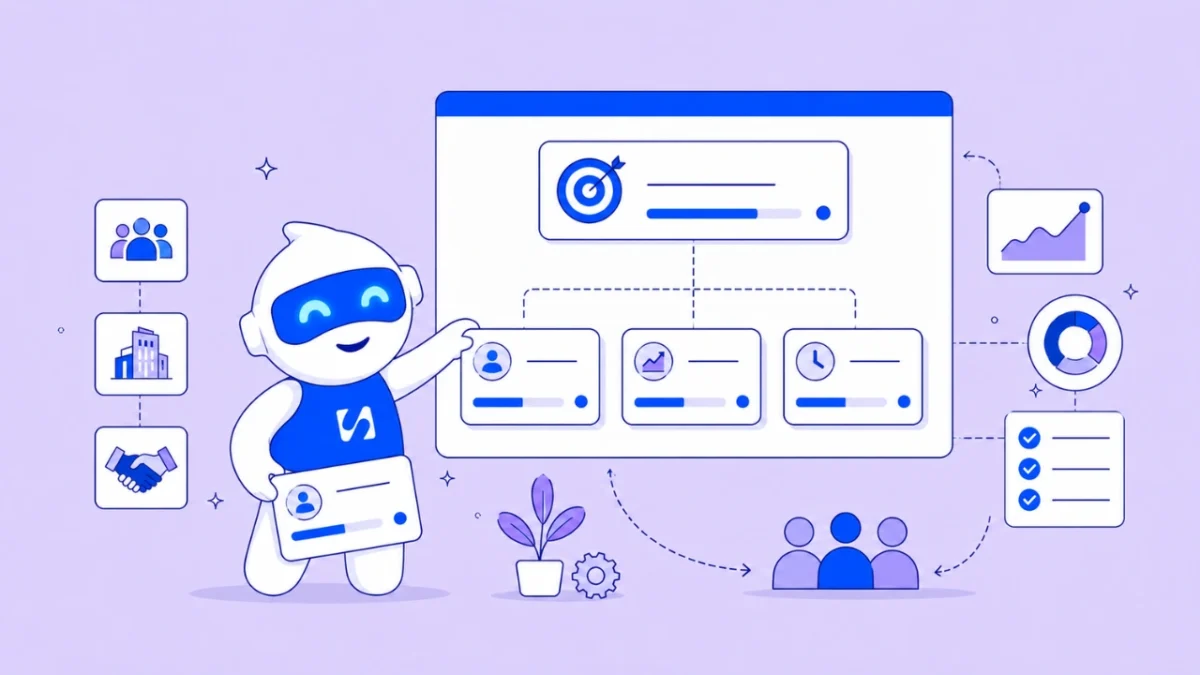
- OKR implementation in a small business is four steps: set one to three objectives with two to four measurable key results each, link them to real work, check in for 15 minutes a week, and score from 0 to 1.0 at quarter end, where 0.6 to 0.7 on stretch goals is a good result.
OKR implementation in a small business is simpler than the big-company playbooks suggest. OKRs, short for objectives and key results, pair one goal written in plain words with two to four measurable numbers that prove you got there. To implement them, a small business sets one to three OKRs a quarter, links each one to the work that will move it, checks progress every week, and scores them at the end of the quarter.
That’s the short answer. The rest of this guide is a practical OKR implementation plan for a business of one to twenty people: how OKRs work, worked examples for different kinds of business, how to score them, and when OKRs are the wrong tool.
What are OKRs? A plain definition
According to What Matters, the OKR resource founded by investor John Doerr, OKRs are a collaborative goal-setting method for setting ambitious goals with measurable results. An objective is “what is to be achieved”. Key results show how you’ll know you’ve achieved it, and they must be measurable and verifiable.
A quick way to remember it:
I will (objective), as measured by (key results).
For example: “We will become the go-to bakery for office orders in our area, as measured by 15 new corporate accounts, 40% of weekday revenue from pre-orders, and a 4.6 average Google rating.”
The idea isn’t new. Andy Grove developed OKRs at Intel, building on Peter Drucker’s management by objectives, and Doerr introduced them to Google’s founders in 1999. Google still publishes a guide to setting goals with OKRs on its re:Work site. For a shorter glossary version, see what are OKRs.
Why OKRs work, even for small businesses
OKRs aren’t magic. They work because they apply a well-researched idea: specific, stretching goals beat vague ones. In a review of 35 years of research published in American Psychologist, Edwin Locke and Gary Latham found that specific, difficult goals consistently led to higher performance than simply telling people to “do your best”.
For a small business, that translates into three practical benefits:
- Focus. When everything feels urgent, OKRs force you to pick the one to three things that matter this quarter, and say no to the rest.
- Alignment. Even a team of three pulls in different directions without a shared target. OKRs put the target where everyone can see it.
- Learning. Scoring at the end of each quarter shows what you over- or under-estimated, so your next plan is better.
How OKRs work: the key parts
Objectives
An objective is qualitative and motivating. It says where you want to be, not how to get there. Good objectives are short enough to remember and specific enough to guide choices. “Grow the business” is too vague. “Make repeat customers the backbone of our revenue” gives direction.
Key results
Key results are numbers with a deadline. Google’s guide suggests around three key results per objective. Each should measure an outcome, not an activity. “Send 10 emails” is an activity. “Get 5 past clients to book again” is an outcome.
Initiatives
Initiatives are the projects and tasks you’ll do to move the key results. They’re not part of the OKR itself, but they need a home, usually your project or task list. The link between key results and the work is where many small teams lose the thread.
Cadence
Google sets annual and quarterly OKRs. For a small business, quarterly OKRs with a weekly check-in are usually enough. A quarter is long enough to achieve something real and short enough to change course.
Scoring
At the end of the quarter, score each key result from 0 to 1.0 and average them for the objective. Google’s guide calls 0.6 to 0.7 the sweet spot for stretch goals. If you hit 1.0 on everything, your goals were probably too easy.
OKR examples for small businesses
Here are sample OKRs for different kinds of business. Use them as starting points, then swap in your own numbers from last quarter.
| Business | Objective | Key results |
|---|---|---|
| Design studio in Lagos | Move from one-off projects to steady monthly income | Sign 4 clients to retainers; retainers reach 50% of monthly revenue; no client over 25% of revenue |
| Hair salon in Manchester | Keep the chairs full on weekdays | Weekday bookings up from 55% to 75% of slots; no-show rate below 5%; 80 new reviews |
| Bookkeeping practice in Toronto | Make onboarding painless for new clients | Average onboarding time down from 14 to 7 days; 90% of new clients complete the intake form in week one; onboarding satisfaction score of 4.5 or more |
| Online store in Nairobi | Build a customer base that buys again | Repeat purchase rate from 12% to 20%; email list grows to 3,000 subscribers; returns below 3% |
| Consultant in Sydney | Win work from referrals, not cold outreach | 6 new clients from referrals; ask 100% of finished clients for a referral; 2 case studies published |
Notice what these have in common: each objective fits in one line, each key result is a number someone can check, and none of them is a to-do item.
Your OKR implementation plan: set your first OKRs in an afternoon
- Look back. Pull last quarter’s numbers: revenue, new customers, repeat customers, enquiries and anything else you track. Our guide to the difference between OKRs and KPIs explains which numbers to keep an eye on all the time.
- Choose one to three objectives. Ask, “If we only improved one thing this quarter, what would make the biggest difference?” For a team under five, one objective is often plenty.
- Write two to four key results each. Start each with a verb and a number: “increase”, “reduce”, “reach”. Include a starting value and a target.
- Stretch, but not fantasy. Aim for targets you’d be pleased to hit 70% of. If a key result feels impossible, the team will ignore it.
- Give each key result an owner. One name, not “the team”. In a business of one, that’s you, and that’s fine.
- List initiatives. Under each key result, write the projects and tasks that will move it, and put them in your task list with dates.
- Book the check-ins. Fifteen minutes every week, and an hour at the end of the quarter to score and reset.
If you’d rather start with a single 90-day push, our guide to setting OKRs for a service business or agency walks through a full example.
Running weekly OKR check-ins
OKRs fail quietly when they’re written in January and read again in April. A weekly check-in keeps them alive. Keep it short and use the same three questions every time:
- Where is each key result now? Update the number.
- How confident are we? On track, at risk or off track.
- What’s blocking us, and what will we do this week? One or two actions, each with an owner.
If a key result is off track for three weeks running, talk about it. Maybe the initiative isn’t working, or maybe the target was wrong. Changing course mid-quarter is allowed. Pretending nothing is wrong isn’t.
Once a month, step back a little further. Look at the trend of each key result, not just this week’s number, and ask whether the initiatives you chose are the right ones. At the end of the quarter, score everything, write down three lessons, and carry unfinished work into next quarter’s plan only if it still deserves a place.
Where you keep OKRs matters less than keeping them in one place everyone opens every week. A shared document works for a team of two. As the team grows, keeping goals next to projects and tasks saves you from updating the same numbers in three places.
An example quarter: one OKR from start to finish
Here’s how one OKR might play out for a small cleaning company with four staff.
Objective: Turn one-off cleans into regular contracts.
- Key result 1: 25 customers on a weekly or fortnightly plan (from 9).
- Key result 2: Regular contracts reach 60% of monthly revenue (from 35%).
- Key result 3: Fewer than 3 regular customers cancel in the quarter.
Weeks 1 to 4. The owner adds a “make it regular” offer to every quote and emails past one-off customers. After four weeks there are 13 regular customers. Confidence: on track.
Weeks 5 to 8. Sign-ups slow down. The weekly check-in shows why: people like the idea but don’t want to commit by phone. The team adds an online booking link with a regular-clean option. By week 8 there are 18.
Weeks 9 to 13. Two regulars cancel after a missed appointment, so the team adds a reminder the day before each visit. The quarter ends with 22 regular customers, 54% of revenue from contracts and 2 cancellations.
Scoring. Key result 1 scores about 0.8 (13 of 16 extra customers), key result 2 about 0.8 (19 of 25 percentage points), and key result 3 scores 1.0. The objective averages about 0.86, right where a stretch goal should land. More important than the score is what they learned: an easy online booking option mattered more than the sales pitch. That shapes next quarter’s OKR.
OKRs for a team of one vs a team of ten
OKRs scale down better than people expect, but they work a little differently depending on your size.
Solo founders and freelancers use OKRs mainly for focus. Skip team-level OKRs and alignment meetings. Write one objective, keep it on your wall or your home screen, and do your weekly check-in on Friday afternoon. The biggest benefit is saying no to good ideas that don’t serve this quarter’s objective.
Teams of three to ten usually set company OKRs together, then let each person own one or two key results. Resist the urge to create separate OKRs for every person. At this size, shared company OKRs with clear owners keep everyone pulling the same way without extra paperwork.
At any size, keep your OKRs visible. A goal that lives in a document nobody opens isn’t a goal. It’s a wish.
Common OKR mistakes (and when not to use OKRs)
- Too many OKRs. Five objectives with four key results each is twenty priorities, which means none.
- Key results that are tasks. “Launch the new website” is a project. “Get 200 enquiries a month from the website” is a key result.
- Tying OKRs to pay. Google’s guide is clear that OKRs aren’t the same as employee evaluations. Link them to bonuses and people set safe, easy targets.
- No link to daily work. If the tasks that move a key result live somewhere else, nobody sees the connection.
- Measuring what’s easy instead of what matters. Social media followers are easy to count. Paying customers matter more.
OKRs aren’t always the right tool. If you’re in survival mode and just need to make payroll this month, a short list of weekly priorities will serve you better. If your business is stable and you mainly want to keep an eye on health, a handful of KPIs may be enough. OKRs shine when you want to change something meaningful in the next three months.
Do you need OKR software?
Not to start. A shared document with the objective, the key results, an owner for each and a weekly score is enough for your first quarter. Software earns its place when you have several people updating progress, when key results depend on numbers that live in other tools, or when you want each key result linked to the projects and tasks behind it. When you compare tools, check four things: how easy the weekly check-in is, whether numbers can update themselves, whether goals connect to real work, and what it costs per person. Our list of OKR software for teams sets out the options.
How startbuddi helps with OKR implementation
startbuddi puts goals, OKRs and KPIs inside Work, next to your projects and tasks, so the link between key results and the work behind them is built in.
- New goal. Write the goal, then add key results as a number, percentage, currency amount or yes/no, each with a target and an owner. Set the goal period (weekly, monthly, quarterly or custom) and a check-in day.
- Check-ins. Record how a goal is going, its health (on track, at risk or off track), your confidence and any blockers. Chip, the built-in AI assistant, can draft the check-in from what changed since the last one. That uses Chip credits.
- Strategy map. See how each goal breaks down into key results, initiatives, projects, milestones and tasks, and add them inline. Pillars let you name the few big themes everything ladders up to.
- Numbers that fill themselves in. On the Numbers board, track figures such as money coming in, new contacts, form submissions, social posts published or emails opened, pulled from the rest of startbuddi, or enter a number yourself.
- Timeline. See what lands when across the quarter.
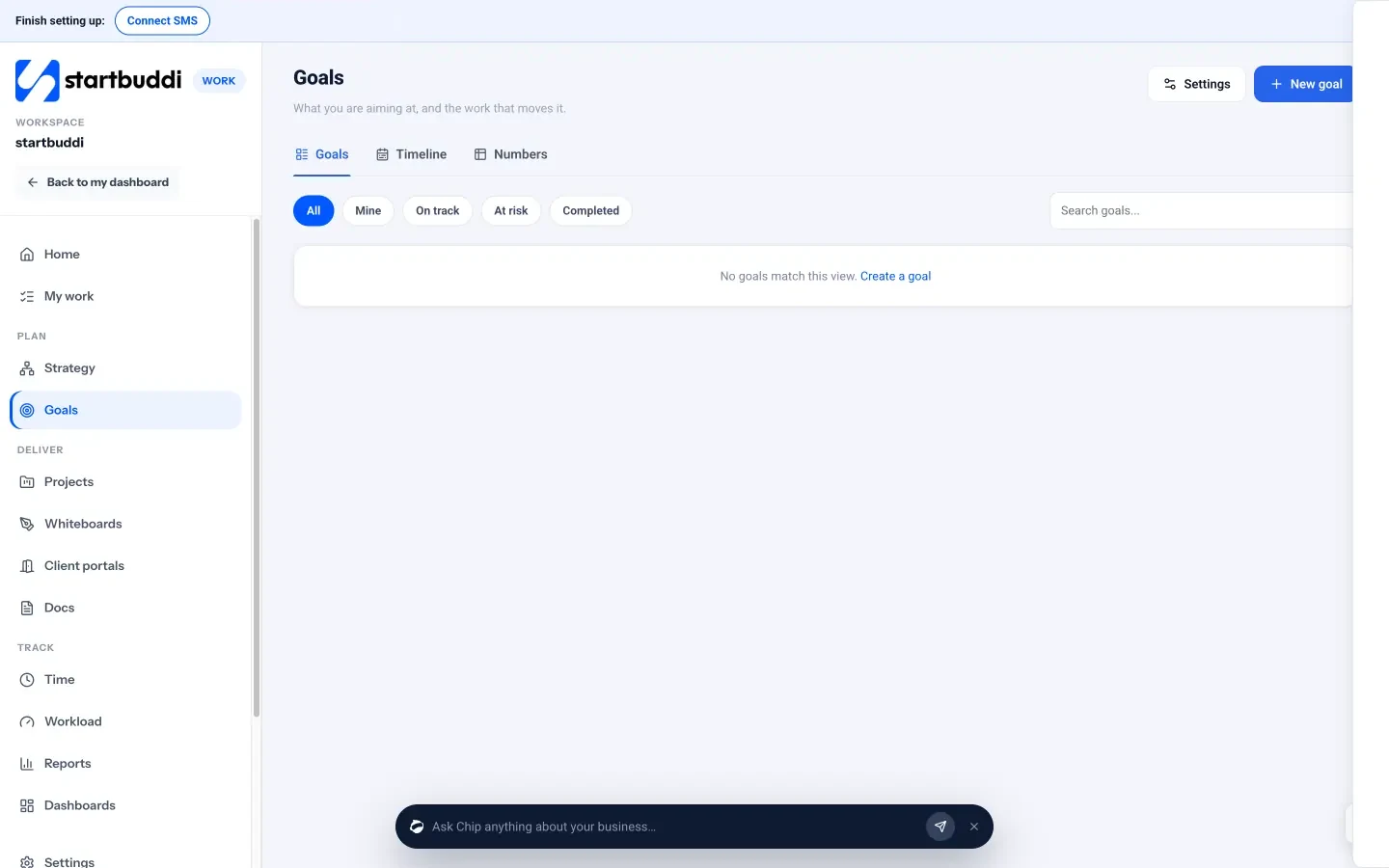
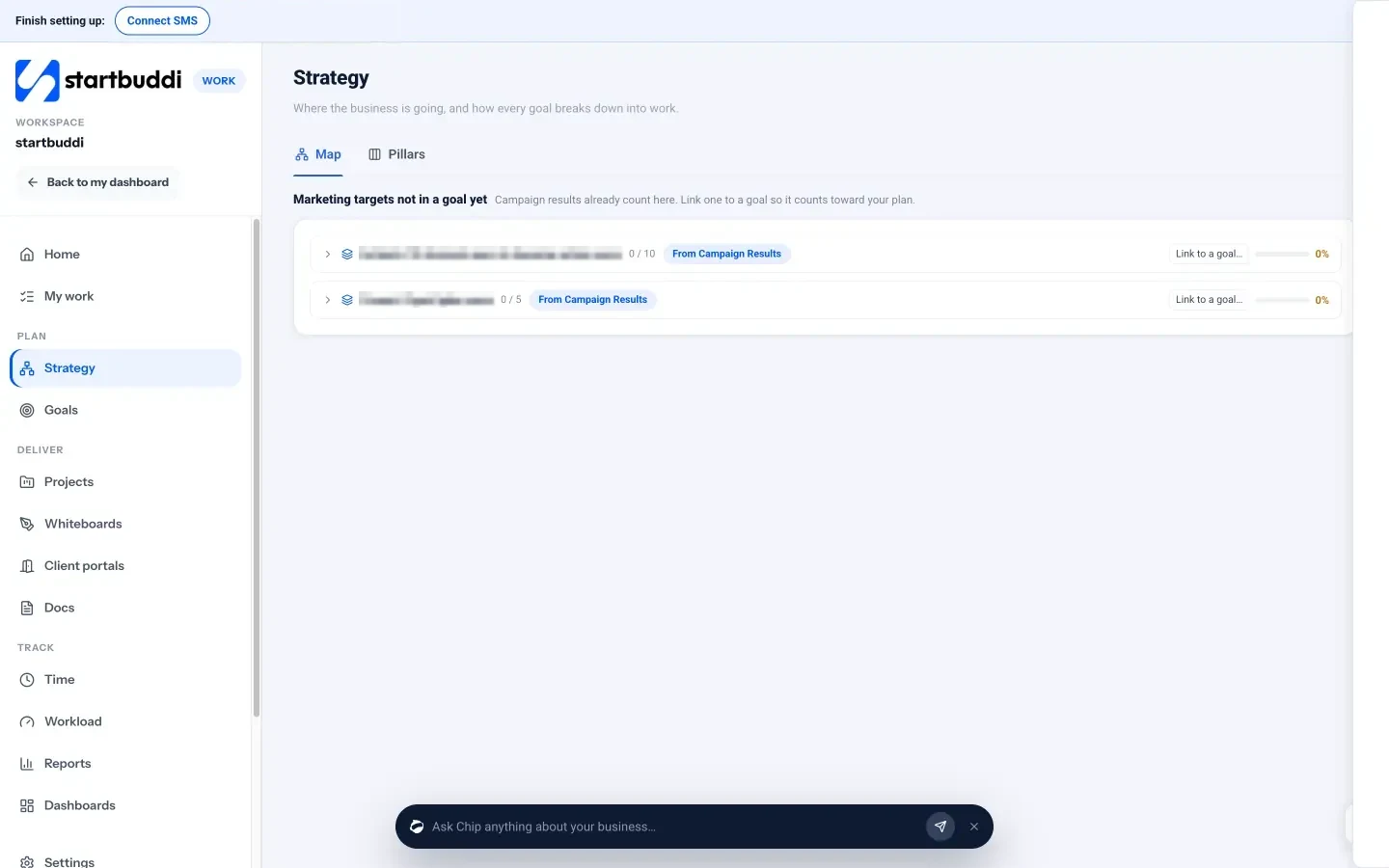
What it doesn’t do: startbuddi won’t set your objectives for you, and it isn’t a performance-review system for OKRs (reviews live separately in People). It also can’t pull numbers from tools outside startbuddi automatically, so anything tracked elsewhere is entered by hand. See the goals and OKR tracker page for more, or the help article on setting up OKRs for step-by-step instructions.
Your next step
Block out one afternoon this week. Pull last quarter’s numbers, write one objective with three key results, and book a 15-minute weekly check-in. If you want the goal, the work and the numbers in one place, you can set it up in startbuddi; see the pricing page for plans and the 30-day trial.
Sources
- What Matters: OKR meaning, definition and examples
- Google re:Work: Set goals with OKRs
- Locke and Latham (2002), Building a practically useful theory of goal setting and task motivation, American Psychologist
Frequently asked questions
How many OKRs should a small business have?
One to three objectives a quarter, each with two to four key results. A team of under five often does best with a single objective.
Are OKRs the same as KPIs?
No. KPIs track the ongoing health of the business. OKRs set out a change you want to make in a set period, and may use KPIs as key results.
Can a solo founder use OKRs?
Yes. Skip the alignment part and use OKRs for focus: one objective, three key results and a weekly check-in with yourself.
What score should I aim for?
On stretch goals, around 0.6 to 0.7. Scoring 1.0 every time usually means the targets were too safe.
SEO Copywriter| Email growth Specialist| I help businesses increase revenue with strategic SEO content & high-converting email funnels.