OKR vs KPI: what is the difference and which should you use?
KPIs tell you how the business is doing; OKRs describe what you want to change. Here's how they differ, how they work together, and examples for small businesses.


Photo: ThisisEngineering / Unsplash
- A KPI is an ongoing health measure; an OKR is a time-bound goal to change something, with measurable key results. Track five to ten KPIs monthly, pick the one heading the wrong way, and turn it into one to three OKRs for the quarter with weekly check-ins.
The quick answer to OKR vs KPI: a KPI (key performance indicator) is a number you watch all the time to check the business is healthy, like monthly revenue or how fast customers pay. An OKR (objectives and key results) is a short-term goal to change something, made of one clear objective and a few measurable results that prove you got there. KPIs tell you how things are. OKRs describe how you want them to be by a set date.
You don’t have to choose one. Most small businesses should track a handful of KPIs every month and set one to three OKRs a quarter, usually aimed at the KPI that’s heading the wrong way. This post shows how the two work, how to pick between them for a given problem, and worked examples for a freelancer, a service business and a small shop.
What is a KPI?
A KPI is a measurement that tells you whether an important part of the business is working. It runs continuously, it usually has a normal range or a target, and you notice when it drifts.
Examples for a small business:
- Money coming in each month
- Gross margin on your main service
- Average days for customers to pay an invoice
- New enquiries per month
- Share of enquiries that become paying customers
- Repeat customer rate
The idea of measuring a business through a small set of balanced indicators, not just the bank balance, was popularised by Robert Kaplan and David Norton in their Harvard Business Review article on the balanced scorecard. Their point still stands: looking only at financial results tells you what already happened, not what’s about to.
What is an OKR?
An OKR has two parts. The objective is a short, clear statement of what you want to achieve. The key results are two to four measurable outcomes that show whether you achieved it. The method came from Andy Grove at Intel and was later brought to Google by John Doerr, as explained on What Matters, the site that grew out of Doerr’s book.
A small business example:
- Objective: Get paid on time, every time.
- KR1: Cut average days to pay from 38 to 21 by the end of the quarter.
- KR2: Reduce invoices more than 30 days overdue from 9 to 2.
- KR3: 80% of new invoices paid through an online payment link.
Google’s re:Work guide to OKRs suggests three to five objectives with around three key results each for a team, and treats 60 to 70% achievement as the sweet spot for ambitious goals. For a small business, fewer is better: one to three objectives a quarter is plenty.
For a fuller introduction, see what OKRs are and how small businesses use them, or our glossary entry on OKRs.
OKR vs KPI: the key differences
What Matters sums it up neatly: KPIs are measures of health, OKRs are measures of change. The table below breaks that down.
| KPI | OKR | |
|---|---|---|
| Purpose | Monitor how the business is doing | Change something that matters |
| Time frame | Ongoing, checked monthly or weekly | Fixed, usually a quarter |
| Question it answers | “Are we OK?” | “What are we trying to improve, and did we?” |
| Target level | Realistic, a normal range | Stretching; hitting 70% can be a good result |
| How many | 5 to 10 for a small business | 1 to 3 objectives at a time |
| What happens at the end | Nothing; you keep tracking | You score it, learn, and set the next one |
| Comes with a plan of work? | No | Yes: projects and tasks that move the key results |
Our glossary page on the difference between OKRs and KPIs has a shorter summary if you need one to share with your team.
How KPIs and OKRs work together
The two aren’t rivals. They work in a loop:
- Track your KPIs every month.
- Spot one that’s off: too low, falling, or stuck.
- Turn it into an OKR for the next quarter, with key results that describe the improvement you want.
- Attach the work: the projects and tasks that should move those key results.
- Check in weekly on progress, and adjust the work if nothing is moving.
- At the end of the quarter, score the OKR. If the KPI is now healthy, it goes back to simple monitoring, and you pick the next problem.
Often, a KPI becomes a key result directly. “Average days to pay” is a KPI; “cut average days to pay from 38 to 21 by 31 March” is a key result built on it.
Which should you use? A decision guide
Ask these questions about the thing you’re thinking of measuring.
- Is it already fine and you just want to know if it slips? Make it a KPI.
- Do you want it to be meaningfully different in three months? Make it an OKR.
- Will changing it take new work, not just the usual work? OKR. KPIs don’t come with projects; OKRs do.
- Is it something you’ll always care about? KPI, even if it’s also the subject of an OKR this quarter.
- Is it a task, like “launch the new website”? Neither. That’s a project. Ask what result the website should produce, and measure that.
Research on goal setting backs up the OKR half of this. In a review of 35 years of studies, psychologists Edwin Locke and Gary Latham found that specific, challenging goals led to higher performance than vague “do your best” goals (Locke and Latham, American Psychologist, 2002). A clear key result with a number and a date is exactly that kind of goal.
Worked examples by business type
A freelance copywriter in Melbourne
KPIs she tracks monthly: money in (AUD), hours worked, effective hourly rate, number of active clients, share of income from her largest client.
This quarter’s OKR: Objective: “Stop depending on one client.” KR1: largest client below 40% of income (from 65%). KR2: three new retainer clients signed. KR3: 12 discovery calls booked.
A plumbing and repairs business in Leeds
KPIs: jobs completed per week, average job value (GBP), callback rate for repeat fixes, reviews received, days to pay.
This quarter’s OKR: Objective: “Become the most trusted plumber in our area.” KR1: 40 new Google reviews at 4.8 stars or above. KR2: callback rate down from 8% to 3%. KR3: 30% of jobs from repeat or referred customers.
A small online fashion shop in Lagos
KPIs: monthly sales (NGN), orders, average order value, return rate, email and WhatsApp list size.
This quarter’s OKR: Objective: “Turn one-time buyers into regulars.” KR1: repeat purchase rate from 12% to 25%. KR2: 1,500 customers opted in to WhatsApp updates. KR3: two sales run for existing customers only, each above ₦1,500,000 in orders.
Notice the pattern. The KPIs are the dashboard. The OKR picks one area and pushes it hard for a quarter.
If you run client work, our guide to setting OKRs for a service business or agency has more templates.
Leading and lagging KPIs: why you need both
Not all KPIs are equal. A lagging KPI tells you the result after it has happened: revenue, profit, customers lost. A leading KPI moves first and hints at what’s coming: enquiries this week, quotes sent, discovery calls booked, proposals opened.
Small businesses tend to watch only lagging numbers, because they’re the ones on the bank statement. The trouble is that by the time revenue drops, the cause happened two months ago. Pair each lagging KPI with one leading one:
| Lagging KPI (the result) | Leading KPI (the early signal) |
|---|---|
| Monthly revenue | Quotes or proposals sent this month |
| New customers | Enquiries and discovery calls booked |
| Days to pay | Invoices sent on the day the work finished |
| Repeat customer rate | Customers contacted after their first purchase |
Leading KPIs make especially good key results, because you can influence them within a quarter.
How to write key results that actually work
Most weak OKRs fail at the key results. Here are three rewrites.
- Weak: “Improve customer service.” Better: “Reply to every enquiry within two working hours, measured weekly, by the end of the quarter.”
- Weak: “Post more on Instagram.” Better: “Get 20 enquiries a month that name Instagram as the source, up from 6.”
- Weak: “Launch the referral scheme.” Better: “15 new customers from referrals this quarter, up from 3.”
Each good version has a starting point, a target and a way to check it. If you can’t say how you’ll measure a key result on the last day of the quarter, rewrite it.
Common mistakes with OKRs and KPIs
- Too many of both. Twenty KPIs means none of them get attention. Five OKRs in a two-person business means none get done.
- Key results that are tasks. “Send a newsletter every week” is a task. “Grow newsletter-driven sales to $3,000 a month” is a key result.
- Using OKRs to judge people. Google’s guide is explicit that OKRs are not the same as employee evaluations. If people are punished for 70%, they’ll set safe goals.
- Setting and forgetting. An OKR you check once at the end of the quarter is just a wish. Check in weekly, even if it takes five minutes.
- KPIs nobody owns. Every KPI needs one person who watches it and raises a flag.
- Measuring what’s easy, not what matters. Social media followers are easy to count. Enquiries from social media are harder, and far more useful.
A simple rhythm for a small business
| When | What | Time needed |
|---|---|---|
| Weekly | Check in on each OKR: on track, at risk or off track, and why | 10 minutes |
| Monthly | Review your KPIs against last month and the same month last year | 30 minutes |
| Quarterly | Score the OKRs, pick the next KPI to improve, set new OKRs | 1 to 2 hours |
| Yearly | Revisit which KPIs matter, and set the big themes for the year | Half a day |
At the quarterly review, keep the conversation to four questions. Which key results did we hit, and which did we miss? What did we learn about why? Which KPI now needs the most attention? And what will we stop doing to make room for the next OKR? That last question matters most in a small business, because a new goal without dropping something old usually means working longer hours rather than getting better results.
How startbuddi helps
In startbuddi, both live under Goals, OKRs and KPIs in the Work module, so the numbers and the goals sit next to the projects and tasks that move them.
Goals and key results
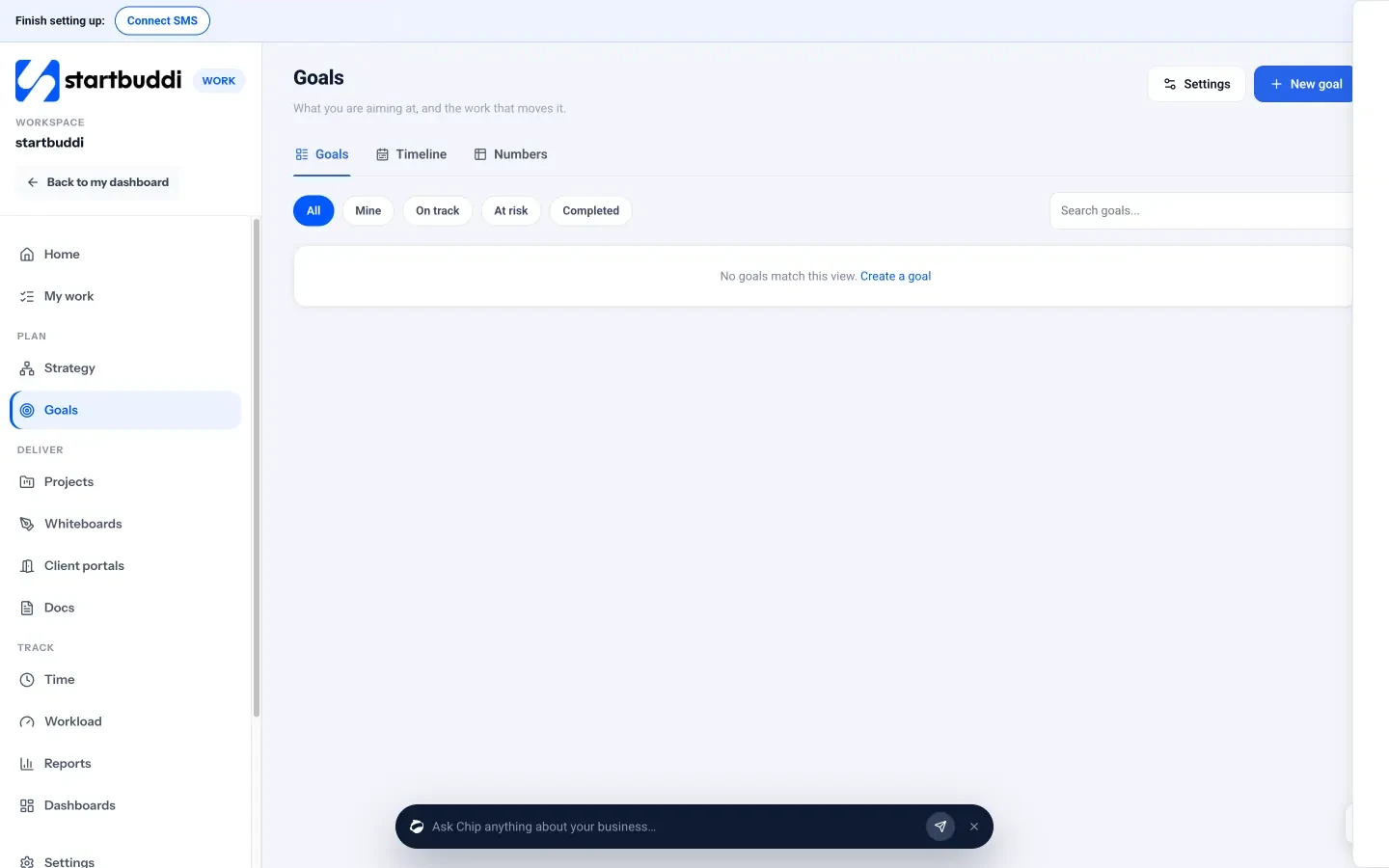
The Goals page has three views: Goals (“What you are aiming at”), Timeline (“What lands when”) and Numbers (“Month by month”). When you create a goal you give it an owner, a period (weekly, monthly, quarterly or custom) and key results measured as a number, percentage, currency amount or yes/no. You can link projects and tasks, then check in on the goal with a health status (on track, at risk or off track), your confidence, and what changed. Chip can draft a check-in from what changed since the last one, using Chip credits.
KPIs that fill themselves in
The Numbers view is a month-by-month board of the numbers you track. Some can update automatically from the rest of startbuddi: money coming in and going out from Money Manager, new contacts, form submissions, posts published and emails opened. Anything else, you enter by hand. You can set a target and an owner for each number.
Strategy map
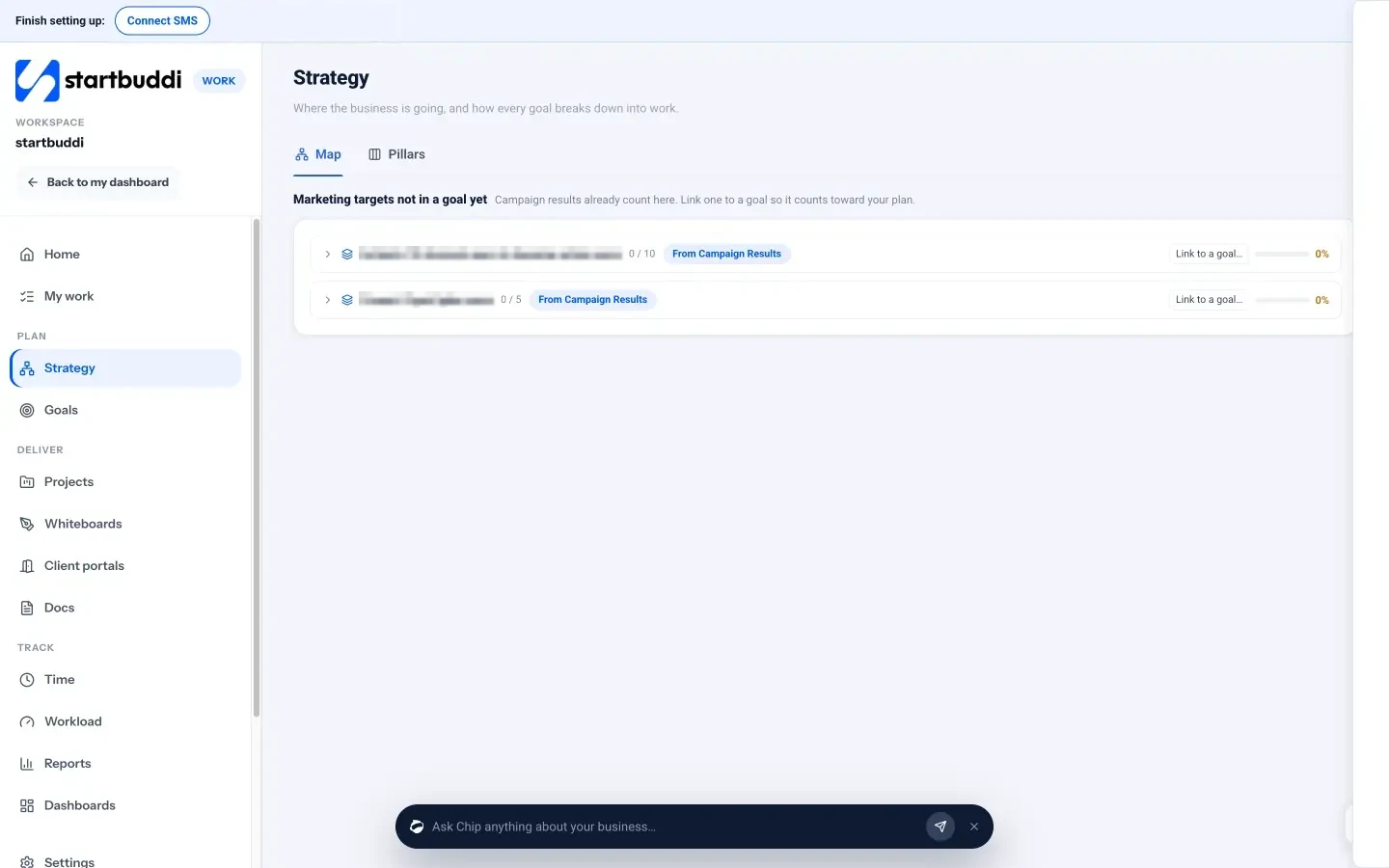
The Strategy page shows how each goal breaks down into key results, initiatives, projects and tasks, and Pillars holds the few big themes everything ladders up to. Marketing campaign targets appear there too, ready to be linked to a goal.
startbuddi isn’t a full business intelligence tool, and the automatic number sources are the ones listed above. For wider reporting, see Analytics and Money Manager reports.
Your next step
Write down five KPIs for your business and last month’s value for each. Circle the one you’d most like to change, and write one objective with two or three key results for the next 90 days. If you want those goals, numbers and the work behind them in one place, see what’s included on the pricing page.
Sources
- What Matters: OKR meaning, definition and examples
- Google re:Work: Set goals with OKRs
- Harvard Business Review: The Balanced Scorecard, Measures that Drive Performance (Kaplan and Norton, 1992)
- Locke and Latham: Building a practically useful theory of goal setting and task motivation (American Psychologist, 2002)
Frequently asked questions
Can a KPI be a key result?
Yes, and it often should be. A KPI such as average days to pay becomes a key result when you add a target and a date, for example cutting it from 38 to 21 days by the end of the quarter.
Do small businesses really need OKRs?
Not always. If everything is healthy, KPIs are enough. OKRs are useful when you want to change something specific and need to focus effort on it for a few months.
How many KPIs should a small business track?
Five to ten is plenty. Choose ones that cover money, customers and delivery, and make sure each one leads to an action when it moves.
Is SMART the same as an OKR?
No. SMART is a checklist for writing any single goal. An OKR pairs an objective with several measurable key results, and SMART thinking helps you write good key results.
Chinedu Kalu is the co-founder and chief operating officer of startbuddi, responsible for how the company runs day to day. Chinedu writes about the operational side of a small business: registering and running the company, money, hiring and the routines that keep a team on track.
Co-founded startbuddi and runs its operations