What is the difference between OKRs and KPIs?
Also called: OKRs vs KPIs, objectives and key results vs key performance indicators
A KPI (key performance indicator) is a number you watch continuously to check business health, like monthly revenue. An OKR (objective and key results) is a time-bound goal for change: an objective plus a few measurable results that show you got there.
The short answer to OKR vs KPI: a KPI tells you how your business is doing, and an OKR tells you what you’re trying to change. A KPI (key performance indicator) is a number you keep an eye on all the time, like monthly revenue or customer complaints. An OKR (objective and key results) is a goal for a set period, usually a quarter, made of one objective and a few measurable key results.
The OKR framework site What Matters puts it neatly: KPIs are measures of health, OKRs are measures of change. You need both, and they work best together.
OKR vs KPI at a glance
| KPI | OKR | |
|---|---|---|
| What it is | A single number you monitor | A goal: an objective plus 3 to 5 key results |
| Question it answers | How are we doing? | What do we want to change, and how will we know? |
| Time frame | Ongoing, no end date | Fixed period, often a quarter |
| Target | A healthy level or range | A stretch result you’re aiming for |
| Example | Average days to get paid | Objective: get paid faster. Key result: cut average days to pay from 21 to 10 |
Why the difference matters for a small business
Small teams can’t afford confusion about priorities. Mixing up the two usually goes one of two ways.
- Everything becomes a goal. If every number you track is treated as something to improve this quarter, nothing gets real focus.
- Nothing gets watched. If you only set quarterly goals, you can miss a slow slide in something important, like repeat customers, until it’s a crisis.
Keeping them separate gives you a dashboard (KPIs) and a short to-change list (OKRs). When a KPI moves the wrong way, that’s often the signal to write an OKR about it.
How they work together: an example
Ngozi runs an online skincare shop. She tracks five KPIs every month: revenue, number of orders, average order value, repeat customer rate and refund rate. Most are healthy, but the repeat customer rate has dropped from 30% to 18% over six months.
So for next quarter she sets an OKR:
- Objective: turn first-time buyers into regulars.
- Key result 1: raise the repeat customer rate from 18% to 28%.
- Key result 2: send a follow-up message to 100% of first-time buyers within 7 days.
- Key result 3: launch a refill subscription with at least 40 subscribers.
The KPI told her there was a problem. The OKR focuses the team on fixing it. Once the rate is healthy again, it goes back to being a KPI she simply watches.
Where OKRs and KPIs come from
KPIs have been part of business management for decades and simply mean the few numbers that matter most for performance. OKRs were developed by Andy Grove at Intel, and investor John Doerr introduced them to Google’s founders in 1999, according to What Matters. The usual shape is one objective with three to five key results.
Best practices and common mistakes
- Keep the KPI list short. Five to seven numbers is plenty for a small business. If you can’t check them in two minutes, there are too many.
- Write key results as outcomes, not tasks. “Launch a newsletter” is a task. “Get 500 newsletter subscribers” is a key result.
- Limit OKRs. One to three objectives per quarter for a small team. Focus is the whole point.
- Use KPIs as key results when it fits. “Raise repeat rate to 28%” is a KPI given a target and a deadline.
- Check in weekly. OKRs set in January and read in March rarely get hit.
- Don’t punish missed stretch goals. OKRs are meant to be ambitious. Learn from the gap and reset.
For a longer read, see our blog posts on choosing between OKRs and KPIs and setting OKRs for a service business.
Related terms
- OKRs: the full explanation of objectives and key results. See what OKRs are.
- Goal-tracking system: the routine that keeps goals and numbers reviewed. See what a goal-tracking system is.
- SMART goals: a checklist for writing clear goals: specific, measurable, assignable, realistic and time-related.
- Dashboard: a screen that shows your KPIs at a glance.
OKRs and KPIs in startbuddi
In startbuddi, both live in Work. On the Goals page you create goals with key results (a number, percentage, currency amount or yes/no), an owner and a period, then check in on them. The Numbers view is a month-by-month board for KPIs: add a number to track, set its target, and choose where it comes from.
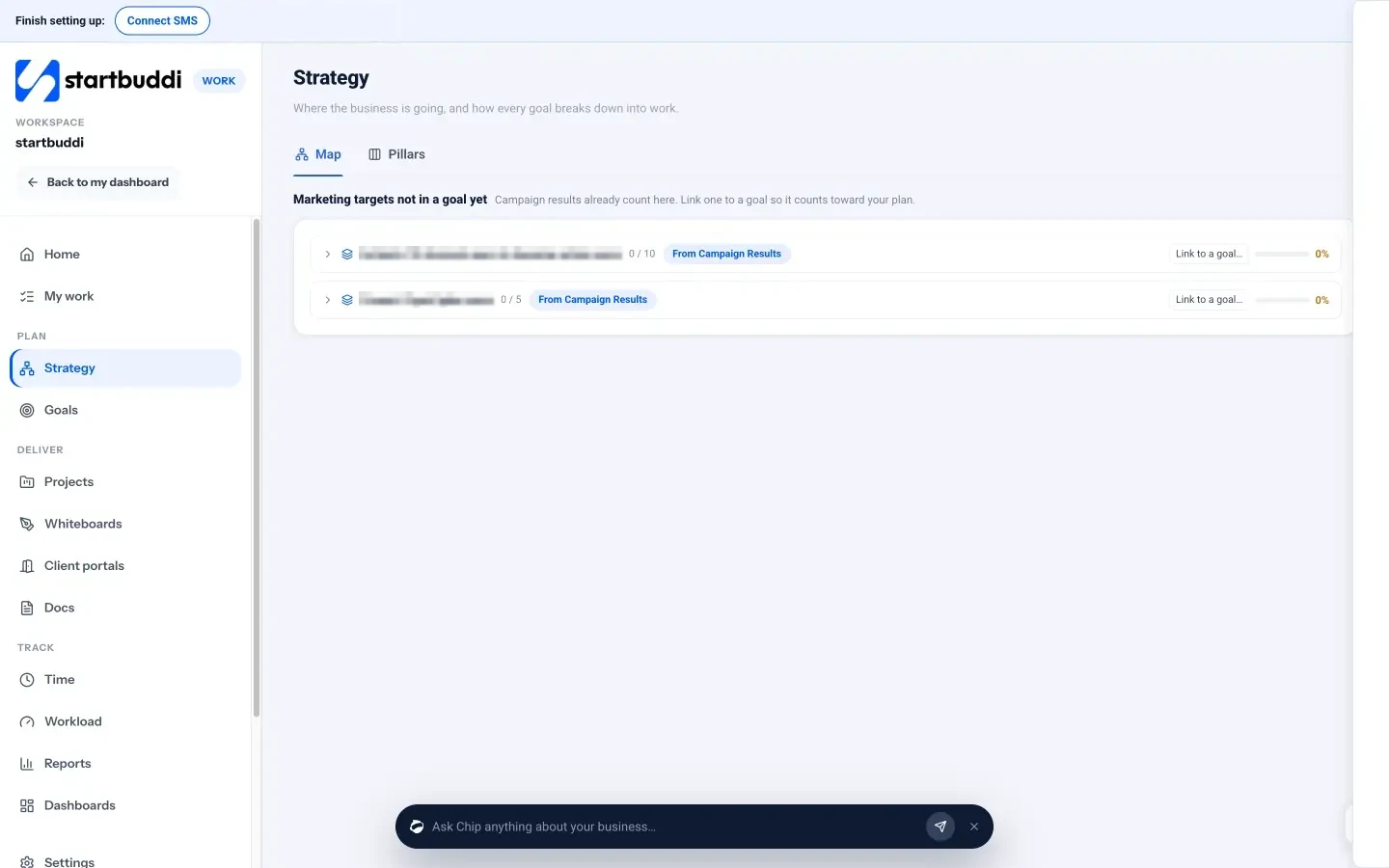
Several KPIs can fill themselves in from the rest of startbuddi: money coming in and going out, new contacts, form submissions, posts published and emails opened. Anything else you enter by hand. The Strategy map shows how each goal breaks down into key results, initiatives, projects and tasks, so every OKR is tied to real work. Chip can draft a goal check-in from what changed since the last one.
Learn more on the goals, OKRs and KPIs page.
Next step: write down five numbers that tell you your business is healthy. Pick the one that worries you most and turn it into a single OKR for next quarter.
Related terms
FAQ
Can a KPI be a key result?
Yes. A key result is often a KPI given a target and a deadline, such as raising the repeat customer rate from 18% to 28% this quarter.
Should a small business use OKRs or KPIs?
Both. Track a handful of KPIs all the time, and set one to three OKRs each quarter for the things you most want to change.
How many key results should an OKR have?
Usually three to five. Fewer can miss the full picture, and more makes the objective hard to focus on.
How often should OKRs be reviewed?
Check in weekly and score them at the end of the period, usually each quarter.
Chinedu Kalu is the co-founder and chief operating officer of startbuddi, responsible for how the company runs day to day. Chinedu writes about the operational side of a small business: registering and running the company, money, hiring and the routines that keep a team on track.
Co-founded startbuddi and runs its operations