What is agile project management?
Also called: Agile methodology, agile, Scrum, kanban, iterative project management
Agile project management is a way of running projects in short cycles (often one or two weeks), delivering small usable pieces of work, getting feedback and adjusting the plan as you learn, instead of planning everything up front.
Agile project management is a way of running projects in short cycles. Instead of planning everything up front and delivering it all at the end, you deliver a small, usable piece of work every week or two, show it to the people it is for, learn from their feedback and plan the next piece.
The idea comes from software teams. In 2001, seventeen developers met in Utah and wrote the Manifesto for Agile Software Development, which values individuals and interactions, working results, customer collaboration and responding to change. Today agile methods are used well beyond software: marketing teams, agencies, event planners and consultants all use them.
What agile project management means in practice
Traditional project management, often called waterfall, moves in one direction: requirements, design, build, test, launch. It works well when the goal is fixed and well understood, such as fitting out a shop.
Agile assumes you will learn along the way. You break the project into small pieces, deliver the most valuable ones first and keep adjusting. If a client changes their mind in week three, that is expected, not a disaster.
Why agile matters for a small business
- Clients see progress early. Showing a first draft after one week builds trust and catches misunderstandings before they get expensive.
- Less wasted work. You stop building things nobody asked for, because you check in often.
- Easier to handle change. Small teams and small budgets cannot afford to throw away months of work. Short cycles limit the damage.
- A steady rhythm. Regular planning and review meetings replace last-minute panic before a big deadline.
How agile works: an example
Ngozi’s three-person agency is building a new website for a restaurant. Rather than disappearing for eight weeks, the team works in two-week sprints.
- Backlog: they list everything the site needs: menu page, booking form, photo gallery, contact page, reviews section. This list is the backlog.
- Sprint planning: for sprint one, they pick the home page and menu page, because the owner says those matter most.
- Daily check-in: each morning, a ten-minute chat covers what was done yesterday, what is next and what is blocking anyone.
- Sprint review: after two weeks, they show the owner the working pages. She asks for prices to be bigger on the menu.
- Retrospective: the team discusses what went well and what to improve, then plans sprint two with the feedback included.
By week four the restaurant has a usable site with its two most important pages, even though the gallery is still to come.
Types of agile methods
Scrum
Scrum organises work into sprints of one month or less, with set events: sprint planning, a daily scrum, a sprint review and a retrospective. The official Scrum Guide describes three accountabilities: the product owner, the scrum master and the developers. Small teams often use a lighter version where one person wears several hats.
Kanban
Kanban uses a board with columns such as To do, In progress and Done. Work moves across the board, and you limit how many tasks can sit “in progress” at once so things actually get finished. There are no fixed sprints, which suits teams handling a steady flow of requests, like a support desk or a design studio. The Kanban Guide explains the method in more depth.
Hybrid approaches
Many small businesses mix the two: a kanban board for daily work, with a fortnightly planning session and a short review. That is perfectly fine. Agile is a set of habits, not a rulebook.
Key parts of agile project management
- Backlog: a ranked list of everything that could be done.
- Sprint or iteration: a fixed period, often one or two weeks, with a clear goal.
- Story points or estimates: a rough sense of how big each task is.
- Velocity: how much the team usually finishes in a sprint, which makes planning more realistic.
- Burndown chart: a chart of the work left in the sprint, so you can see early if you are behind.
- Review and retrospective: showing the work and improving how you work.
Common mistakes
- Calling it agile without the feedback. Short cycles only help if someone actually looks at the work and responds.
- Endless meetings. For a team of three, a ten-minute daily check-in and a 30-minute review are plenty.
- No fixed scope for a paid job. Agile welcomes change, but clients still need to know what they are paying for. Agree how changes are priced up front.
- Skipping the retrospective. It is the cheapest way to get better every fortnight.
Related terms
Project management software is where you run agile projects: boards, sprints and timelines. A task management system covers the individual jobs inside each sprint. OKRs set the bigger goals that your sprints should move. For a hands-on walk-through, read agile project management for small teams.
Agile project management in startbuddi
Every project in startbuddi’s Projects has a Sprints tab. You can create a sprint with a name, start and end dates and an optional goal, pull tasks in from the backlog, add story points and see a burn chart as work gets done. When you complete a sprint, you choose whether unfinished tasks go back to the backlog or into the next sprint, and startbuddi shows your average velocity over the last three sprints.
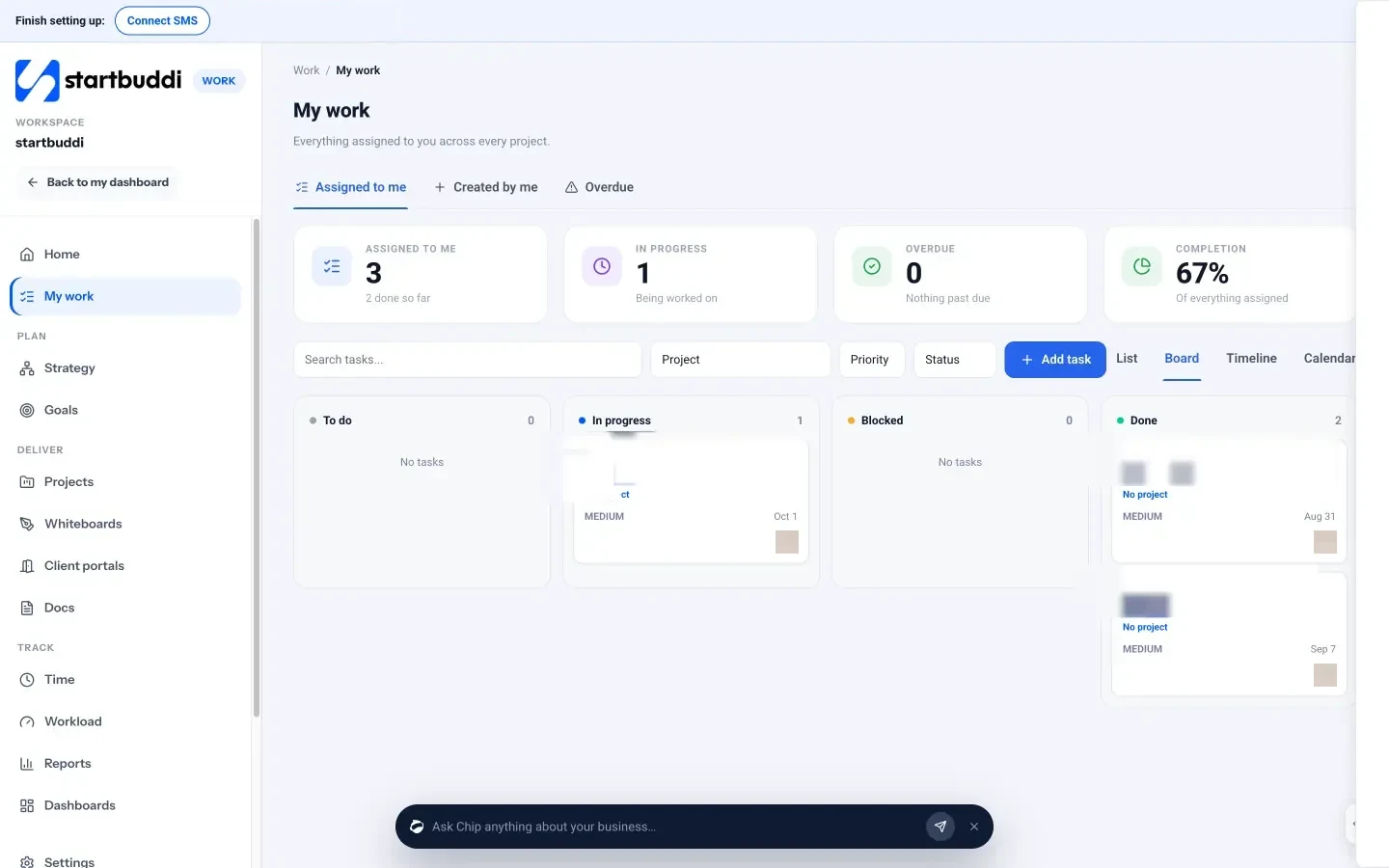
Tasks can be viewed as a board, a list, a timeline or a calendar, so kanban-style teams can work straight from the board. Each task can have an assignee, a priority, an estimate and “blocked by” dependencies.
Your next step: pick one client project, write its backlog, and run a two-week sprint with a review at the end. You can try it on the Free plan.
Sources
Related terms
FAQ
What is the difference between agile and waterfall?
Waterfall plans everything first and delivers at the end. Agile delivers small pieces in short cycles and changes the plan based on feedback. Waterfall suits fixed, well-understood jobs; agile suits work where you learn as you go.
How long should a sprint be?
One or two weeks suits most small teams. The Scrum Guide says a sprint should be one month or less.
Is agile only for software teams?
No. Agencies, marketing teams, consultants and event planners use agile habits such as backlogs, short cycles, kanban boards and regular reviews.
Should I use Scrum or kanban?
Use Scrum if your work fits into planned chunks with a clear goal each cycle. Use kanban if requests arrive in a steady flow. Many small teams mix the two.
Tiwalade Joanna Okedara-Kalu is the founder, CEO and CTO of startbuddi, the business system that brings clients, bookings, invoices, projects, marketing and the Chip AI assistant into one place. Tiwalade builds software around how service businesses really work day to day, and writes about client management, getting paid on time and why small businesses outgrow the tools they start with.
Founded startbuddi and leads its product and engineering