What is a goal-tracking system?
Also called: Goal tracker, goal management system, goal-setting framework, business goal tracking
A goal-tracking system is a simple, repeatable way to set business goals, measure progress against them, and review them on a schedule. It links each goal to an owner, a number, a deadline and the work that moves it forward.
A goal-tracking system is a repeatable way to set goals for your business, measure progress against them and review them regularly. It turns “we want to grow this year” into something concrete: a clear goal, a number that shows progress, a person responsible, a deadline, and a regular moment to check how it’s going.
The system doesn’t have to be fancy. A notebook reviewed every Monday is a goal-tracking system. What matters is that goals are written down, measured and looked at often enough to change what you do.
Why a goal-tracking system matters for a small business
Small businesses are busy by default. Client work, messages and daily fires fill every hour, and bigger goals like “launch a second service” or “get ten new retainer clients” quietly slip to next quarter, then next year.
- It keeps goals visible. A goal you look at weekly competes with daily work. One you set in January and forgot doesn’t.
- It shows progress early. You find out in week four that you’re behind, not in week twelve when it’s too late.
- It links goals to real work. Each goal should connect to the projects and tasks that move it. Otherwise it’s just a wish.
- It aligns a team. When everyone can see the same few goals, people make better decisions about what to work on.
How a goal-tracking system works
Most systems follow the same loop: set, measure, check in, adjust.
- Set a goal with a clear outcome and a deadline.
- Choose how you’ll measure it, ideally with a number that updates as you go.
- Assign an owner who is responsible for progress and updates.
- Link the work: the projects and tasks that should move the number.
- Check in on a schedule, usually weekly: how are we doing, will we hit it, what’s in the way?
- Adjust. Change the plan, not just the goal, when progress stalls.
An example
Segun runs a cleaning company with six staff. His goal for the quarter is “Grow monthly contract revenue from ₦1.2 million to ₦1.8 million”. He measures it by monthly contract income, owns it himself, and links two projects: a flyer campaign in three estates and a referral offer for existing clients. Every Friday he spends ten minutes checking in: current revenue, whether he’s on track, and what’s blocking progress. In week five the flyers have brought few enquiries but referrals are working, so he moves effort to referrals.
Key parts and popular frameworks
The parts every system needs
- Goal: the outcome you want, written plainly.
- Measure: the number or milestone that shows progress.
- Owner: one person accountable for it.
- Time frame: a start and end date, often a quarter.
- Check-ins: short, regular progress updates.
- Linked work: the projects and tasks behind the goal.
Frameworks you’ll hear about
| Framework | What it is |
|---|---|
| SMART goals | A checklist for writing goals, first proposed by George T. Doran in a 1981 Management Review article. Goals should be specific, measurable, assignable, realistic and time-related. |
| OKRs | An objective (what you want) plus a few measurable key results (how you’ll know). See what OKRs are. |
| KPIs | Ongoing numbers that show business health, like monthly revenue or new contacts. See OKRs vs KPIs. |
You don’t need to pick one strictly. Many small businesses write SMART-style goals, track a handful of KPIs and use OKRs for their few big quarterly priorities.
Best practices and common mistakes
- Set fewer goals. Three goals you work on beat ten you forget.
- Make the measure automatic where you can. If revenue or new contacts already live in your software, let the number fill itself in.
- Keep check-ins short. Five to ten minutes a week is enough. Long check-ins get skipped.
- Record confidence, not just progress. “40% done and confident” is different from “40% done and stuck”.
- Don’t confuse activity with results. “Post five times a week” is a task. “Get 50 enquiries from social” is a goal.
- Close the loop. At the end of each period, note what worked before setting the next goals.
For a starting point, our business plan template helps you decide which goals matter this year.
Related terms
- OKRs: objectives and key results, a popular goal framework.
- KPI: a key performance indicator, a number you watch continuously.
- Task management system: where the day-to-day work behind each goal lives. See what a task management system is.
- Check-in: a short, regular progress update on a goal.
Goal tracking in startbuddi
In startbuddi, goals live in Work, next to your projects and tasks. The New goal form covers the goal, owner, team, visibility, period, reporting cadence, check-in day and key results (a number, percentage, currency amount or yes/no). Goals can be viewed as a list, on a timeline, or as a Numbers board that tracks figures month by month.
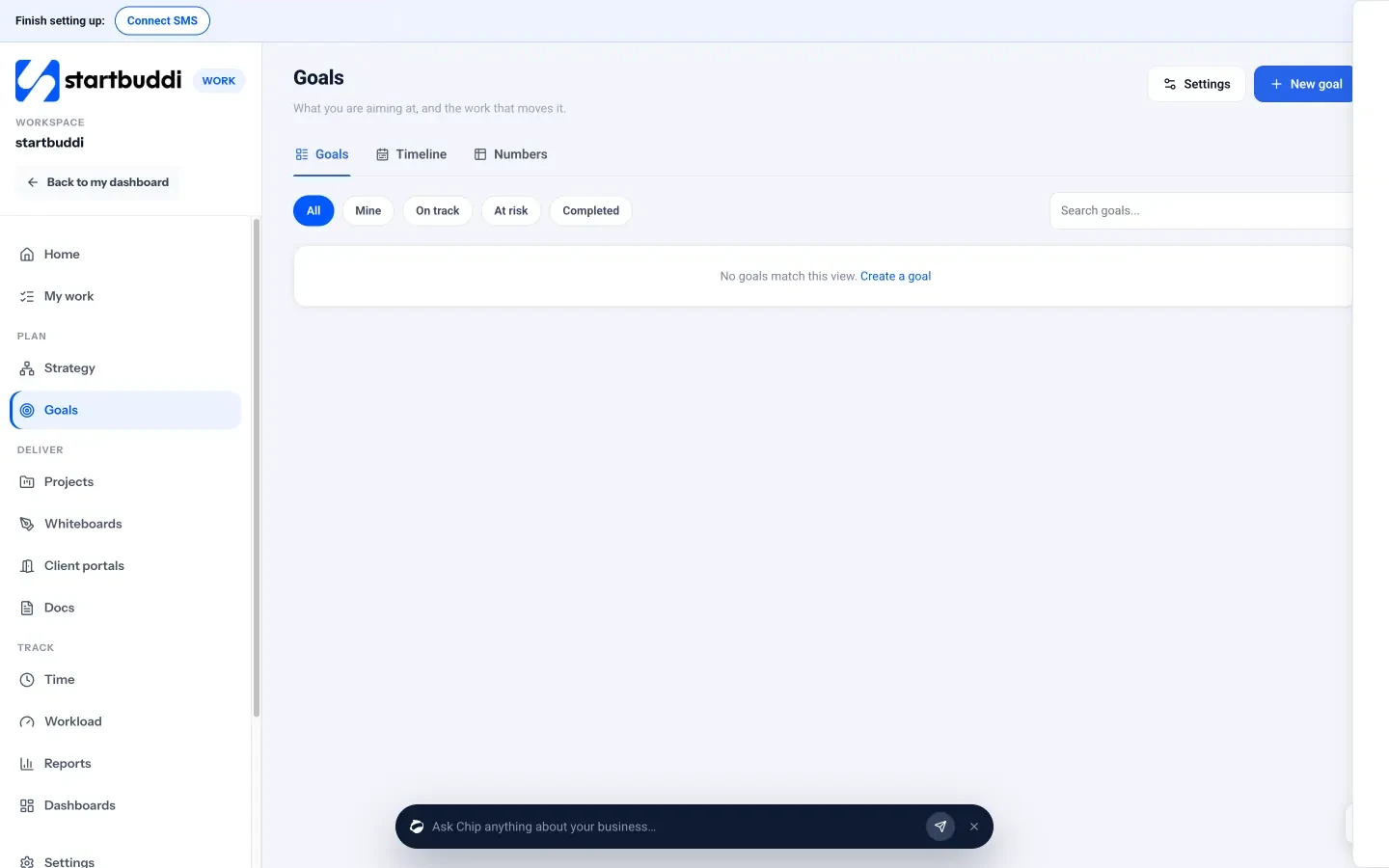
Some numbers can fill themselves in from the rest of startbuddi, such as money coming in, new contacts, form submissions, posts published and emails opened. Check-ins record health (on track, at risk or off track), your confidence and any blockers, and Chip can draft a check-in from what changed since the last one. The Strategy map shows how each goal breaks down into key results, projects and tasks.
See more on the goals and OKRs page.
Next step: write down the one goal that would make the biggest difference this quarter, give it a number and an owner, and put a 10-minute weekly check-in in your calendar.
Related terms
FAQ
How many goals should a small business track?
Usually three to five at a time. More than that and focus drifts, especially in a small team.
How often should I review goals?
A short weekly check-in works well for most teams, with a bigger review at the end of each month or quarter.
What's the difference between a goal and a task?
A goal is an outcome you want, like more revenue. A task is a piece of work that helps get there, like sending ten proposals.
Can I track goals in a spreadsheet?
Yes, and many people start there. It gets harder when goals need linking to projects, owners and numbers that change daily.
Tiwalade Joanna Okedara-Kalu is the founder, CEO and CTO of startbuddi, the business system that brings clients, bookings, invoices, projects, marketing and the Chip AI assistant into one place. Tiwalade builds software around how service businesses really work day to day, and writes about client management, getting paid on time and why small businesses outgrow the tools they start with.
Founded startbuddi and leads its product and engineering