One-Page Marketing Plan Template for Small Businesses (Copy and Fill In)
A one-page marketing plan template for small businesses: 10 sections to copy, how to fill each in and a worked example for a cleaning company in Abuja.


A marketing plan template for a small business should fit on one page and cover ten things: where you are now, one 90-day goal, who you serve, the offer you’ll push, why people should pick you, two or three channels, how you follow up, how you keep clients, a budget in money and hours, and the numbers you’ll check weekly.
Key takeaways
- One page, one quarter, one goal. A plan you can read in two minutes is a plan you’ll look at on Monday.
- Work the goal back to how many enquiries you need before you pick channels.
- Slow follow-up wastes the enquiries your marketing pays for, so plan the follow-up too.
- Budget hours as well as money. Posting on Instagram is free; three hours a week isn’t.
- Copy the template below into a doc or spreadsheet, fill in the right-hand column, and rewrite it every 90 days.
The one-page marketing plan template
Copy this table as it is. The middle column tells you what to write; replace the right-hand column with your answers.
| # | Section | What to write | Your plan |
|---|---|---|---|
| 1 | Where we are now | Last 90 days: revenue, number of clients, and where the last 10 clients came from | |
| 2 | 90-day goal | One number with a date, in clients or revenue | |
| 3 | Who we serve | One type of client: who they are, where they are, the problem in their words | |
| 4 | The offer | The one service or package this plan pushes, with its price | |
| 5 | Why us | One sentence on why they should choose you, plus three proof points you can show | |
| 6 | Where they’ll find us | Two or three channels. For each: the weekly action and who does it | |
| 7 | From enquiry to booking | How fast you reply, what you send, when you follow up and how they pay | |
| 8 | Keeping clients | How you ask for reviews and referrals and get the next booking | |
| 9 | Budget | Money per month per channel, and hours per week per person | |
| 10 | Numbers every Monday | Enquiries, quotes, new clients and spend, by channel |
Underneath the table, add three lines: the review day, the date you’ll rewrite the plan, and the rule for dropping a channel that isn’t working.
If you’re a startup working towards product-market fit or investor targets rather than local clients, use our startup marketing plan instead: it adds funnel maths for demos and a 12-week calendar.
How to fill in the marketing plan template
1. Start with where you are now
Look back before you look forward. Write last quarter’s revenue, how many paying clients you had, and where your last ten clients came from. Often this shows that one or two channels bring most of the work, and that’s useful to know before you spend a naira or a pound on something new.
2. Set one 90-day goal
Pick one number: “15 new regular clients by 31 March” or “₦2 million in bookings this quarter”. Not “more awareness”. If you can’t count it on the last day, it isn’t a goal.
3. Describe one type of client
Write a short buyer persona: who they are, where they live or work, and the problem in the words they’d use. “Working couples in Gwarinpa with no time to clean on weekends” is better than “homeowners”.
4. Choose the offer you’ll push
A cleaner might push a fortnightly plan. A physiotherapist might push a three-session back-pain package. Write the price next to it.
5. Write why people should pick you
Write one sentence, your value proposition, then three proof points you can actually show: reviews, before-and-after photos, a guarantee, years in business, a qualification.
6. Pick two or three channels
Choose where your clients already look. For local service businesses that’s often a Google Business Profile, Instagram or Facebook, WhatsApp, referrals and local partners. Google says a Business Profile lets you manage how your business appears on Maps and Search at no charge (Google Business Profile Help, checked on 1 October 2026). For each channel, write the weekly action and the name of the person doing it. If a channel has no weekly action, it isn’t in the plan.
7. Plan the follow-up
Write down your reply time (“within one working hour”), what a new enquiry gets (prices and a booking link), and when you follow up if they go quiet (day 2 and day 7, say).
8. Plan how you keep clients
Decide when you ask for a review (straight after a job that went well), whether you reward referrals, and how you book the next visit before the client leaves.
9. Set the budget in money and hours
The US Small Business Administration’s advice is to “include a complete breakdown of the costs of your marketing plan” and to compare marketing and sales costs with the revenue they bring in (SBA: marketing and sales). Add your own hours to the money.
10. Choose the numbers you’ll check
Four is enough: enquiries, quotes or consultations, new clients and money spent, each split by channel. At the end of the quarter, divide spend by new clients to get your customer acquisition cost.
Marketing plan example: a home cleaning company in Abuja
Here’s the template filled in for an illustrative three-person cleaning company. All figures are made up for the example.
| # | Section | Their plan |
|---|---|---|
| 1 | Where we are now | ₦1.8 million revenue last quarter, 22 regular clients. Last 10 clients: 6 referrals, 3 Instagram, 1 Google |
| 2 | 90-day goal | 15 new regular clients by 31 March |
| 3 | Who we serve | Working couples and young families in Gwarinpa, Jabi and Wuse 2: “We’re too tired to clean on Saturdays” |
| 4 | The offer | Fortnightly home clean, ₦40,000 a month, first clean with a free fridge and oven add-on |
| 5 | Why us | “Vetted, trained cleaners who turn up on time, with the same cleaner every visit.” Proof: Google reviews, ID-checked staff, re-clean guarantee |
| 6 | Where they’ll find us | Google Business Profile: 2 photos and 1 post a week (Amina). Instagram: 3 before-and-after posts a week (Amina). Estate notice boards and residents’ WhatsApp groups where admins allow it: monthly (Tunde) |
| 7 | From enquiry to booking | Reply within one working hour on WhatsApp with prices and a booking link. Follow up on day 2 and day 7. First clean paid on booking |
| 8 | Keeping clients | Ask for a Google review after the second clean. ₦5,000 off next month for every referral who books |
| 9 | Budget | ₦150,000 a month: ₦90,000 social ads, ₦40,000 printed flyers, ₦20,000 referral rewards. Hours: Amina 5 a week, Tunde 2 a week |
| 10 | Numbers every Monday | Enquiries, quotes sent, new regulars and spend, per channel |
The maths behind the goal (illustrative): if one in three quotes becomes a regular client, 15 clients need 45 quotes (15 × 3). If half of enquiries ask for a quote, 45 quotes need 90 enquiries (45 × 2), about 7 or 8 a week over 12 weeks. The quarter’s budget is ₦450,000 (3 × ₦150,000). If they hit the goal, that’s ₦30,000 per new client (₦450,000 ÷ 15), less than one month’s fee.
The same page works anywhere. A sports massage therapist in Manchester would swap the channels for local running clubs and Google, price in pounds, and keep all ten rows.
Mistakes to avoid
- Choosing channels first. Decide the goal and the enquiries you need, then pick channels that can deliver them.
- Too many channels. Two done every week beat six done when you remember.
- Forgetting follow-up. Paying for enquiries you answer the next day is the most expensive mistake on this page.
For the bigger picture on choosing channels, our guide to how to market a small business goes channel by channel. For the posts themselves, use the free content calendar template.
How to run this marketing plan in startbuddi
- Make the quarter a campaign. In Marketing → Campaigns, create a campaign with the objective, dates, budget and channels. Add a goal on a live number, such as bookings or contacts, and its progress fills in by itself. The campaign also tracks spend against the budget.
- Put the weekly actions on the calendar. The campaign calendar shows emails, WhatsApp campaigns, social posts, landing pages, forms and milestones by date.
- Send enquiries to one list. Forms and landing pages built in startbuddi add new enquiries to your contacts, and the shared inbox brings WhatsApp, email and website chat into one place, so row 7 has somewhere to happen.
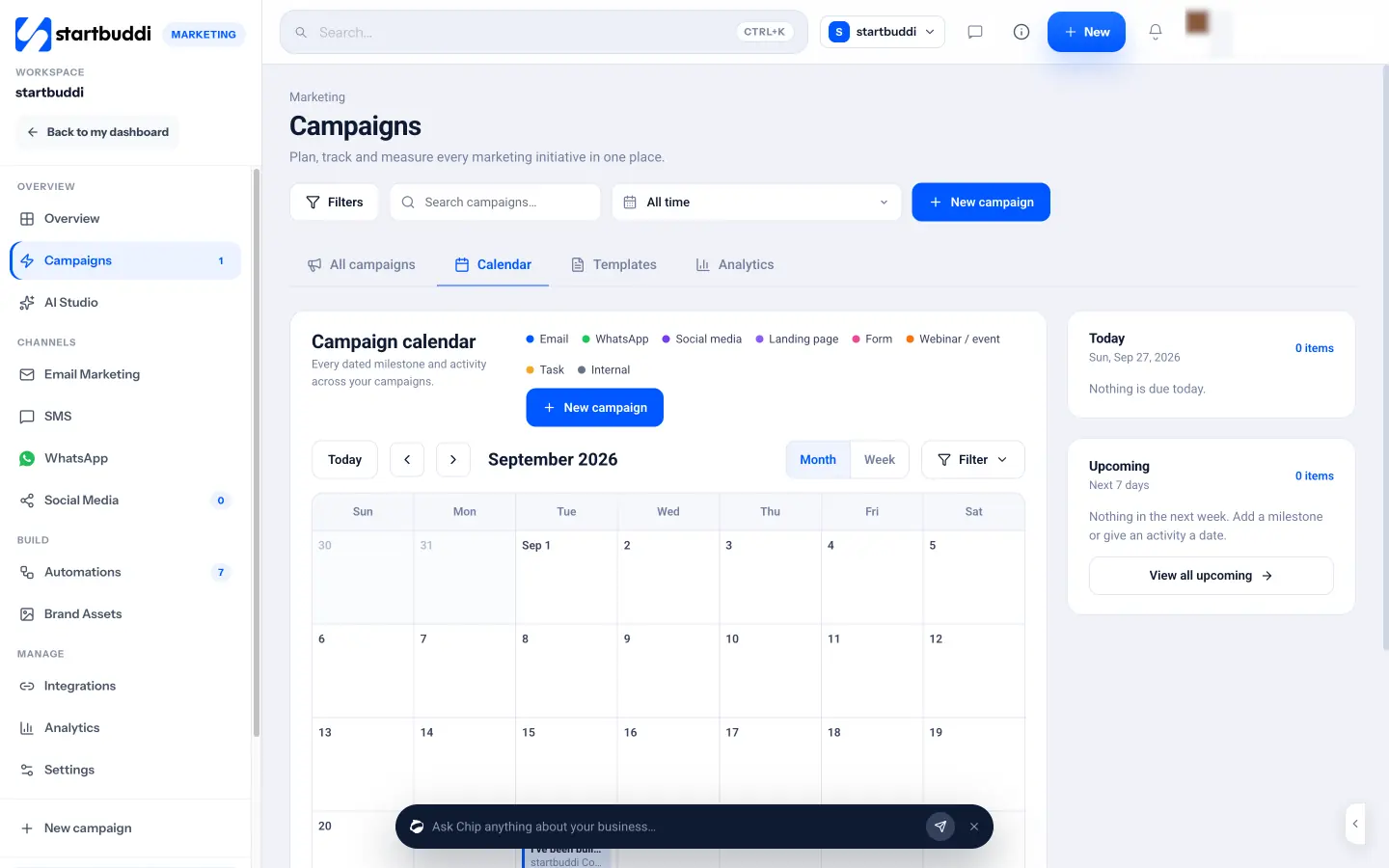
The Marketing hub, including Campaigns, is on paid plans; see pricing for what each plan includes. If your business is a cleaning company, see how startbuddi works as a CRM for cleaning businesses.
Put your plan to work
Copy the template above, fill it in this week, then run the quarter as a campaign in startbuddi with your budget, calendar and enquiries in one place. Start free.
Frequently asked questions
What should a one-page marketing plan include?
It should include where you are now, one goal for the next 90 days, the client you serve, the offer you'll push, why people should choose you, two or three channels with weekly actions, how you follow up and keep clients, a budget in money and hours, and the numbers you'll check each week.
How long should a small business marketing plan be?
One page is enough for most small businesses. A short plan gets read and updated; a long one usually gets filed. Keep the detail (post ideas, ad copy) in separate documents.
How often should I update my marketing plan?
Review the numbers every week and rewrite the plan every 90 days. Weekly reviews tell you which channel to drop or push; the quarterly rewrite resets the goal using what you learned.
How much should a small business spend on marketing?
There's no single right figure. Start from your goal: work out how many new clients you need and what you can afford to pay to win each one, then set the monthly budget. The SBA recommends comparing marketing and sales costs with the revenue they bring in, and checking it regularly.
What is the difference between a marketing plan and a marketing strategy?
The strategy is the big choice: who you serve and why they should pick you. The plan is the next 90 days of action: the goal, the channels, the weekly tasks, the budget and the numbers. This template holds both on one page.
Olabimpe Salami is the email and outreach specialist at startbuddi. Olabimpe writes about the messages that bring customers in and back: email, WhatsApp and SMS campaigns, follow-ups, and turning enquiries into paying clients.
Runs email and outreach at startbuddi