Follow Up Email Template: 8 Copy-Ready Emails for Every Stage
Eight follow up email template examples for service firms: after an enquiry, a call, a quote, silence, a finished job and a quiet past client. Copy them.


A good follow up email template is short, refers to your last conversation, adds one useful thing and asks one clear question. Below are eight copy-ready templates for a service business: after an enquiry, after a call, after a quote, after silence, a polite close, after the job, a review request and a past client check-in.
Key takeaways
- Every follow-up should give the reader a reason to reply, not just “check in”.
- Match the email to the stage. A lead who hasn’t seen your price needs something different from a client whose job finished last week.
- Space follow-ups out: two or three days early on, a week or more later.
- Stop after three or four tries with no reply, and say so politely. It often gets the reply the others didn’t.
- Save the templates where you write emails, so you edit them in seconds instead of starting from a blank page.
When to send each follow-up email
| Stage | Template | When to send |
|---|---|---|
| New enquiry, they went quiet | 1. After an enquiry | 2 days after your first reply |
| After a call or meeting | 2. After a meeting | Same day |
| Quote or proposal sent | 3. After a quote | 2 to 3 days after sending |
| No reply to anything | 4. Nudge after no response | 5 to 7 days after your last email |
| Still nothing | 5. Close the loop | 7 to 10 days after the nudge |
| Job finished | 6. After the job | 2 to 5 days after delivery |
| Happy client | 7. Review request | A week after the job, if they were pleased |
| Past client gone quiet | 8. Past client check-in | 3 to 6 months after the last job |
Payment chasing is its own sequence; use our payment reminder email templates for that.
8 follow up email template examples
Replace everything in square brackets. Keep the rest short.
1. After an enquiry (they went quiet)
Subject: Your [service] enquiry, [first name]
Hi [first name],
Thanks again for getting in touch about [what they asked for]. To give you an accurate price, I just need two things: [question 1] and [question 2].
If it’s easier to talk, here’s a link to book 15 minutes: [booking link].
[Your name]
2. After a meeting or call
Subject: Notes from our call, and next steps
Hi [first name],
Thanks for your time today. Here’s what I took away:
- You need [outcome] by [date].
- The main concern is [concern].
- Budget is around [range].
Next step: I’ll send a proposal by [day]. If I’ve missed anything, just reply to this email.
[Your name]
3. After sending a quote
Subject: Any questions on the quote for [job]?
Hi [first name],
I sent the quote for [job] on [day]. Happy to walk you through it or adjust the scope if the total is higher than you planned.
The dates I pencilled in ([dates]) are held until [date].
[Your name]
For the full quote sequence, timing and what to do when they say it’s too expensive, see how to follow up after sending a quote.
4. Polite nudge after no response
Subject: Quick question, [first name]
Hi [first name],
I know things get busy. Is [project] still on your list for [month], or has it moved?
Either answer is fine; I just want to plan my diary.
[Your name]
5. Close the loop
Subject: Should I close your file?
Hi [first name],
I haven’t heard back, so I’ll assume [project] isn’t a priority right now and stop following up.
Put this into practiceEverything in this article works inside startbuddi, free to start.Start freeIf anything changes, reply to this email and we’ll pick it up from where we left off.
[Your name]
6. After the job is done
Subject: How is [delivered thing] working out?
Hi [first name],
It’s been a few days since we finished [job]. Is everything working as you expected? If anything needs a tweak, tell me and I’ll sort it this week.
[Your name]
7. Review request
Subject: A small favour
Hi [first name],
I’m glad [job] went well. If you have two minutes, a short review here would help other [type of client] find us: [review link].
Thank you, it makes a real difference to a small business like ours.
[Your name]
8. Past client check-in
Subject: Ready for [next logical job]?
Hi [first name],
It’s been [time] since we did [job]. Many clients come back around now for [next job, e.g. a service, refresh or audit].
If that’s on your mind, reply with a good week and I’ll hold a slot.
[Your name]
How to fill in a follow up email template
Use the details from your last conversation
Pull one specific detail from your notes: their deadline, their concern, the room or system you discussed. It proves the email was written for them.
Give them one thing and ask one question
Every template above offers something (an answer, a held date, a fix) and ends with one question or action. Two questions get half an answer.
Keep the subject line plain
Use their name, the job or a real question. Avoid “Re:” on a new email and avoid fake urgency; both damage trust.
Write it down in your contact record
Log the date you sent each follow-up and the next date to send. Without that, follow-ups depend on memory, which is where most of them die.
A filled example: an interior designer in Lekki
This is illustrative. Tolu runs a small interior design studio in Lekki. On Monday she met Mr Adebayo about refitting his two-bedroom flat before his family arrives in December. Here’s template 2, filled in the same afternoon:
Subject: Notes from our call, and next steps
Hi Mr Adebayo,
Thanks for your time today. Here’s what I took away:
- You want the living room and guest room finished by 10 December.
- The main concern is fitting in the furniture you already own.
- Budget is around ₦4.5 million to ₦5 million.
Next step: I’ll send a proposal with two layout options by Thursday. If I’ve missed anything, just reply to this email.
Tolu
On Thursday she sends the proposal. When there’s no reply, template 3 goes out on Saturday, template 4 the following Friday and template 5 eight days after that. That’s four follow-ups across roughly three weeks, each with something new.
Common mistakes with follow-up emails
- “Just checking in.” It asks the reader to do the work of remembering. Say what you’re following up about.
- Following up too fast. Three emails in three days reads as pressure, not service.
- Never stopping. After the close-the-loop email, stop. Mark the contact as lost and set a reminder for months later, not days.
- Sending marketing as if it were a follow-up. Replying to someone’s enquiry is service. Emailing old clients with offers is marketing, and the rules are stricter. In the UK, the ICO’s guidance on electronic mail marketing (checked on 1 October 2026) explains the “soft opt-in” for existing customers, which needs a clear chance to opt out in every message. In the US, the FTC’s CAN-SPAM compliance guide (checked on 1 October 2026) requires commercial emails to include a postal address and an opt-out that you honour within 10 business days.
If you want the bigger picture of why follow-up matters, read our definition of follow-up, our guide on how to follow up with leads, and the sales process guide. When the same emails go out automatically in order, that’s an email drip sequence.
How to use these follow-up emails in startbuddi
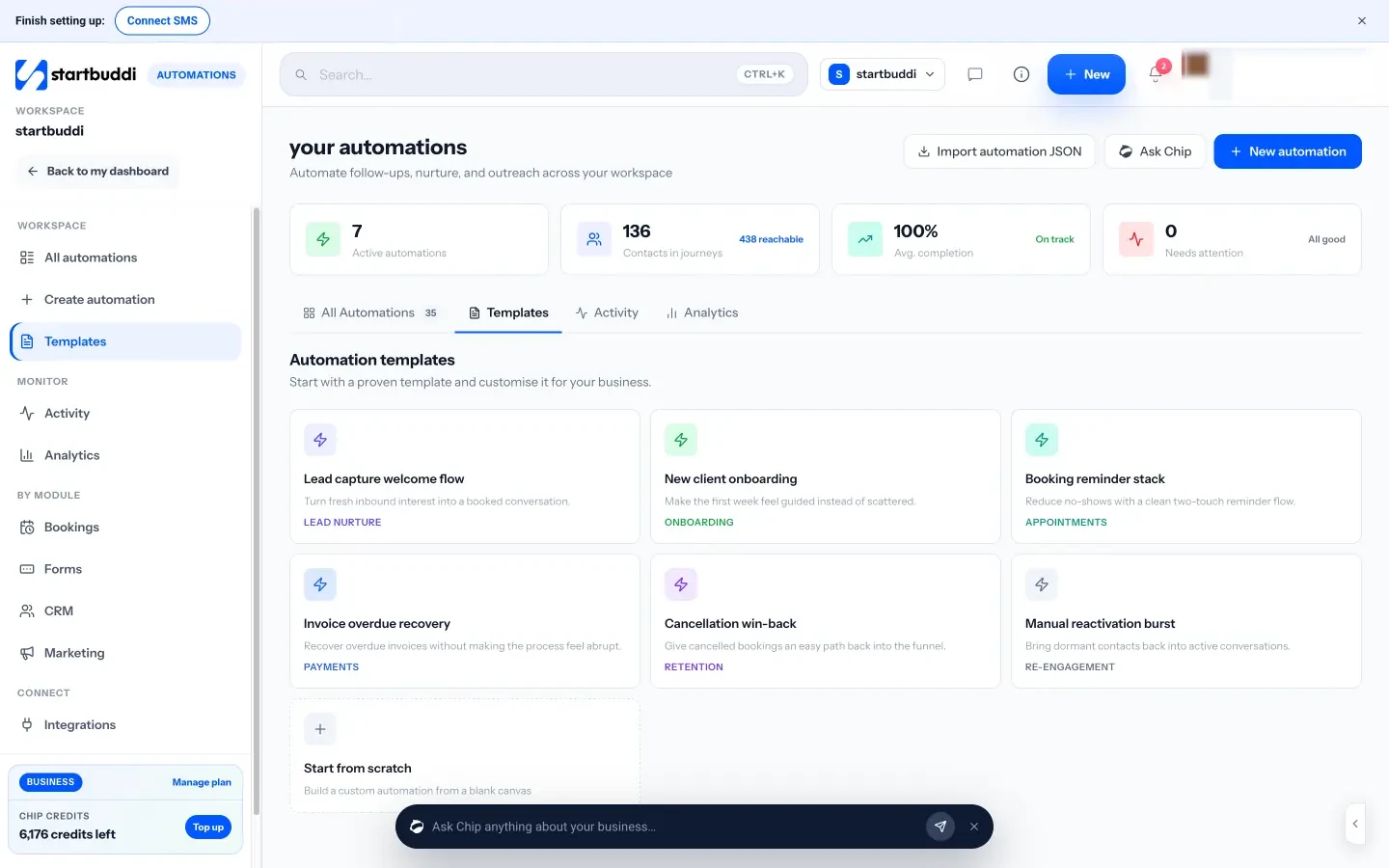
- Save them as quick replies. In the startbuddi Inbox, quick replies are ready-made openers you edit before sending, so the eight templates sit one click away when you reply by email.
- Let Chip draft from the history. On a contact, ask Chip to draft a follow-up. It uses what’s on the record, and you edit before anything is sent.
- Turn a stage into a sequence. On a contact, choose Nurture with Chip, describe the goal and Chip drafts a short email sequence you can edit, save as a reusable automation and enrol the contact in.
- Run it from Automations. In Automations, start a follow-up when something happens, such as a form submitted or a deal won. Automations need a paid plan.
A free plan is available. See pricing, or how email automation sequences work for small businesses.
Make follow-up a habit, not a memory test
Copy the eight templates into your email today. When you’re ready to send them from one place and see who’s due next, start free with startbuddi.
Frequently asked questions
How do you write a polite follow-up email?
Refer to your last conversation, add one useful thing, and ask one clear question. Keep it to a few lines and give the reader an easy way to say no. A polite email respects their time more than it apologises for yours.
How long should I wait before sending a follow-up email?
Two to three days is a good first gap after an enquiry or a quote. Leave five to seven days before the next one, then a week or more. Send a meeting recap the same day.
How many follow-up emails is too many?
Three or four follow-ups with no reply is usually enough for one opportunity. End with a short close-the-loop email that says you'll stop. After that, only contact them again if something genuinely changes or months have passed.
What should the subject line of a follow-up email be?
Make it specific and plain: the person's name, the job or a real question. "Notes from our call" or "Any questions on the quote for your kitchen?" works better than "Following up". Avoid fake "Re:" subjects.
Should I follow up by email or WhatsApp?
Use the channel the client used with you. Email suits detail, quotes and records; WhatsApp suits short nudges if they messaged you there first. Don't send the same follow-up on both channels on the same day.
Is it OK to send a follow-up email after no response?
Yes. Silence usually means busy, not no. One or two well-spaced nudges are normal business courtesy, as long as each adds something and you stop after a clear final email.
Olabimpe Salami is the email and outreach specialist at startbuddi. Olabimpe writes about the messages that bring customers in and back: email, WhatsApp and SMS campaigns, follow-ups, and turning enquiries into paying clients.
Runs email and outreach at startbuddi