Data Driven Talent Acquisition: A Practical Guide for Small Business Owners
Data driven talent acquisition for small teams: a scorecard, a hiring log, weighted scores and a fairness check, with a worked example you can copy today.



Data driven talent acquisition means deciding where to look, who to shortlist and who to hire using evidence you write down, not gut feel. For a small business it comes down to four habits: a scorecard agreed before you advertise, a simple hiring log, structured interviews scored the same way, and a six-month check on whether the scores were right.
Key takeaways
- You don’t need software or big numbers. A spreadsheet with the right columns is enough to start.
- Decide what “good” looks like before you read a single CV, and weight it. That’s the step most founders skip.
- Score candidates separately before you discuss them, so the loudest opinion doesn’t win.
- With three hires a year, your numbers are a prompt to look closer, never proof. Pool them over time.
- Collect only the candidate data you need and delete it when you no longer need it.
What is data driven talent acquisition?
Talent acquisition is everything you do to find and hire people: planning the role, finding candidates, assessing them and making the offer. Making it data driven means each of those decisions leaves a record you can check later. Where did the person you hired come from? What did you score them on, and why did they beat the others? Did the score predict how they did in the job?
Big companies do this with recruiting teams, applicant tracking systems and HR data analytics. A ten-person agency in Lagos or a three-person IT support firm in Nairobi can’t, and doesn’t need to. The useful part for a small business isn’t the dashboards. It’s the discipline of writing things down in the same way every time.
Why it matters when you only hire a few people a year
When a team has five people, one hire is a fifth of the company. A wrong hire costs you months of salary, the time you spent training them and the work that didn’t get done, and a small team feels every bit of that.
Small teams also hire in the way most likely to go wrong: the founder interviews alone, asks different questions each time, and picks the person they enjoyed talking to most. That isn’t a character flaw. Without a written standard, it’s simply what happens.
A data driven approach fixes three things:
- Consistency. Everyone is judged on the same criteria, so you’re comparing like with like.
- Memory. Six months later you can see why you chose someone, instead of reconstructing it.
- Learning. After a few hires, you can see which sources and which interview questions actually led to good people.
The small-numbers problem
Here’s the honest limit. If you hire three people this year, you can’t run statistics on them. One great hire from a referral doesn’t prove referrals are your best source. Two weak hires from a job board might be bad luck.
Even regulators accept this. The US Uniform Guidelines on Employee Selection Procedures, which set the “four-fifths” test for unfair selection rates, say large differences may not count as adverse impact where they’re based on small numbers and aren’t statistically significant (checked on 1 October 2026). The same caution applies to every number in your hiring log.
So treat small-team hiring data in two ways. In the moment, it makes each decision consistent and fair. Over time, it builds up until patterns are worth acting on, usually after ten or more hires for the same kind of role.
How to make talent acquisition data driven in 6 steps
If you haven’t mapped out your hiring stages yet, start with our guide to the talent acquisition process. The steps below add the evidence layer to each stage.
1. Write a weighted scorecard before you advertise
List four to six things the person must be good at to succeed in the first six months. Give each a weight that adds up to 100%. Write one sentence for what a 1, a 3 and a 5 looks like on each.
Do this before you post the job. If you write the scorecard after meeting candidates, you’ll quietly write it around the person you already like. A clear job description and the scorecard should say the same things.
2. Keep a hiring log
One row per candidate, from application to decision. This is your raw data. The template below has the columns that matter.
3. Ask structured questions and score them the same way
A structured interview asks every candidate the same questions in the same order and rates the answers against the same standards. The US Office of Personnel Management’s guide to structured interviews (checked on 1 October 2026) explains the method in plain terms. Write two or three questions per scorecard criterion, and note what a strong answer includes.
4. Score independently, then decide with a rule
If two people interview, each scores alone and writes a short reason before you compare notes. Then apply a rule you set in advance, for example: “the highest weighted score wins, unless the top two are within 0.2 points, in which case both do a short paid work sample.”
5. Track a few process numbers
Source of hire, time to hire and offer acceptance are enough to start. Our post on talent acquisition metrics explains how to work each one out. Pick numbers you’ll act on, the same way you’d choose any KPI.
6. Close the loop at three and six months
Add the new hire’s probation outcome and first review rating to the log. Then compare: did the people you scored highest turn out best? Which criteria matched real performance? This is the step that turns a tidy process into a learning one.
A hiring log template you can copy
Paste this into a spreadsheet. Use a reference number instead of names in the columns you’ll share or analyse.
| Column | What to record |
|---|---|
| Candidate ref | A number, e.g. AM-07 |
| Role | Job title and level |
| Date applied | Day the application arrived |
| Source | Where they found the job: referral, LinkedIn, job board, your website |
| Screen result | Pass or fail, with a one-line reason |
| Score per criterion | 1 to 5 for each scorecard line |
| Weighted total | Each score times its weight, added up |
| Work sample score | If you used one, 1 to 5 |
| Decision and reason | Offer, reject or hold, with one sentence |
| Offer and start dates | For time to hire and acceptance |
| 3-month check | Passed probation? Any concerns? |
| 6-month rating | From the first review |
Worked example: hiring an account manager in Lagos
A twelve-person digital agency in Lagos is hiring its first account manager. All figures are illustrative.
The scorecard. Client communication 30%, organisation 25%, commercial sense 20%, writing 15%, reporting tools 10%.
The sources. 46 applications came in over two weeks: 22 from LinkedIn, 18 from a job board and 6 from staff referrals. Shortlisted after the screen: 3 from LinkedIn (14%), 2 from the job board (11%) and 3 from referrals (50%). Eight people were interviewed, and three reached the final round.
The final three. Each was scored 1 to 5 by the founder and the operations lead separately, then averaged.
| Criterion (weight) | Candidate A | Candidate B | Candidate C |
|---|---|---|---|
| Client communication (30%) | 4 | 5 | 3 |
| Organisation (25%) | 3 | 4 | 5 |
| Commercial sense (20%) | 4 | 3 | 4 |
| Writing (15%) | 5 | 3 | 4 |
| Reporting tools (10%) | 3 | 4 | 5 |
| Weighted total | 3.80 | 3.95 | 4.05 |
Candidate C’s total is (3 × 0.30) + (5 × 0.25) + (4 × 0.20) + (4 × 0.15) + (5 × 0.10) = 0.90 + 1.25 + 0.80 + 0.60 + 0.50 = 4.05.
The founder’s instinct favoured Candidate B, who was the most engaging in the interview. On the agency’s own scorecard, C came out ahead, and B and C were within the 0.2-point tie-break band, so both did a two-hour paid task: turning a messy client brief into a one-page plan. C did it better and got the offer.
What the agency learned. Referrals gave 3 of the 8 interviewees from just 6 applications. That’s one hiring round, so it’s a hint, not a rule. If the pattern holds over the next few hires, the agency could pay a referral bonus and spend less on job board posts.
Check your process is fair
Data can make hiring fairer, or it can hide unfairness behind numbers. Two checks help.
First, look at pass rates at each stage. The US four-fifths test compares selection rates between groups: if one group passes the screen at less than 80% of the rate of the group that does best, that’s a signal to look closer. For example, if 10 of 20 applicants from one group pass (50%) and 6 of 20 from another pass (30%), the ratio is 30 ÷ 50 = 0.6. With numbers that small it proves nothing on its own, but it’s a reason to read your screening criteria again.
Second, test each scorecard line against the job. “Graduated from a top university” or “good culture fit” often screens out good people for reasons unrelated to the work. Equality law differs by country, so check what applies where you hire.
Handle candidate data properly
Your hiring log holds personal data, so treat it that way. The UK ICO’s guidance on storage limitation (checked on 1 October 2026) says to keep personal data no longer than you need it, and to delete it or make it anonymous when you’re done. In Nigeria, the Nigeria Data Protection Act 2023 sets similar duties, and Kenya’s Data Protection Act 2019 does too.
In practice: ask only for what the scorecard needs, tell candidates how long you’ll keep their details, and strip names from old rows before you analyse them. This is general information, not legal advice.
Common mistakes
- Writing the scorecard after the interviews. It ends up describing the person you already preferred.
- Too many criteria. Ten weighted lines are hard to score and nobody uses them. Four to six is plenty.
- Comparing notes before scoring. The first opinion spoken anchors everyone else.
- Treating one round as proof. A single great referral hire doesn’t make referrals your best channel.
- Never closing the loop. If you don’t record how hires actually did, you can’t learn which scores mattered.
- Collecting data you don’t need. Date of birth, marital status and photos rarely belong in a hiring log.
Where startbuddi fits
startbuddi doesn’t include an applicant tracking system, so the hiring log itself lives in a spreadsheet. Two parts of startbuddi help either side of it.
Before the hire, you can collect applications with a startbuddi form (there’s a Job Application template). Each response is stored with where it came from and the device used, which helps with your source column, and the applicant’s details are saved as a contact.
After the hire, People holds the outcome data you need for steps 5 and 6. Start onboarding with a checklist and a probation period, run a review in Performance, and use the new joiner check-in survey to hear how the first weeks went.
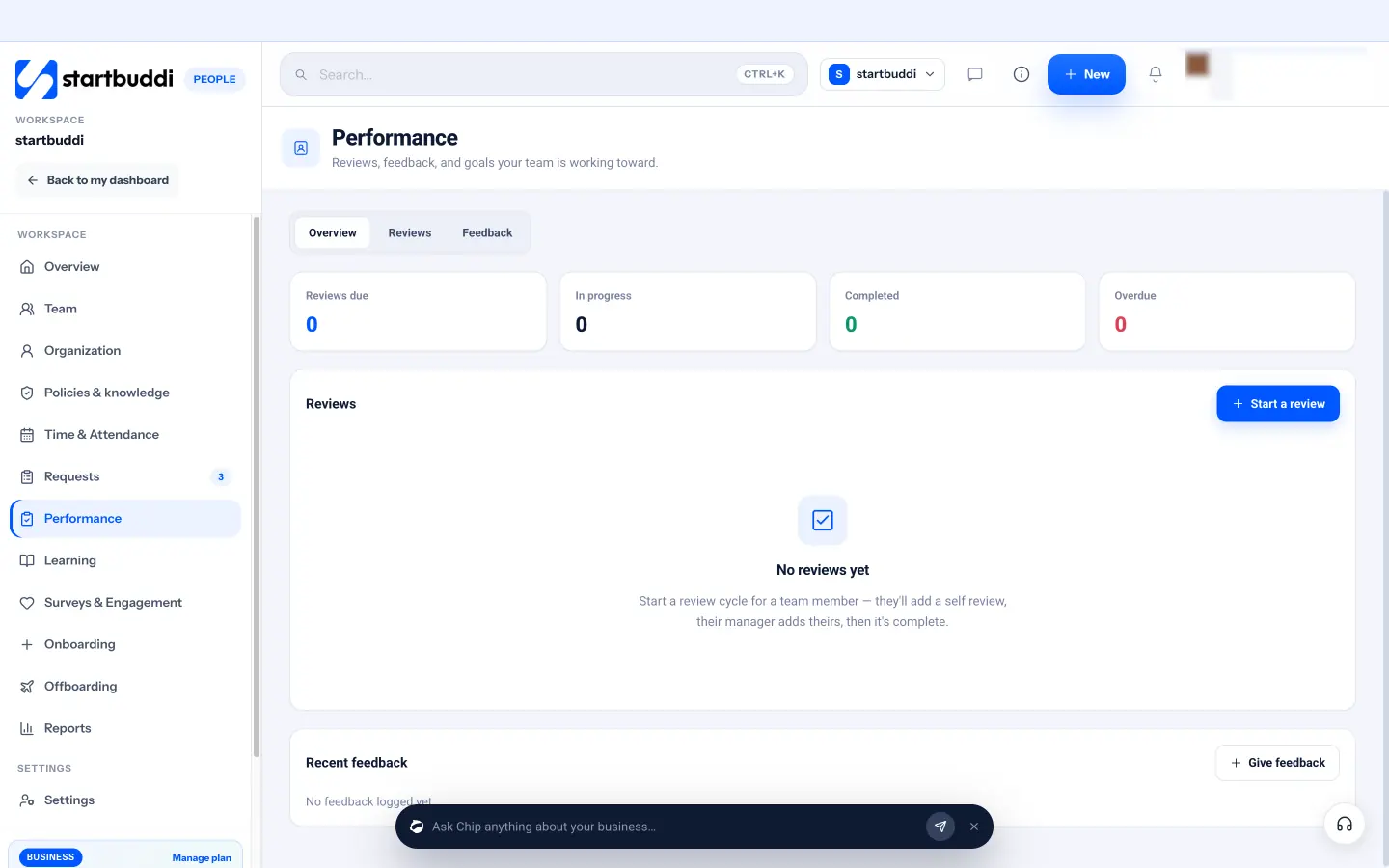
See performance reviews in People, or how startbuddi works for startups. For the bigger picture of building a team, read our guide on how to build your first team. A free plan is available; see pricing for what each plan includes.
Hire on evidence, then help them succeed
Write the scorecard, start the log and score your next round independently. Start free with startbuddi to collect applications with a form and run onboarding and reviews in People once your new hire starts.
Frequently asked questions
What is data driven talent acquisition?
Data driven talent acquisition is hiring based on recorded evidence rather than instinct. You define what good looks like in advance, score every candidate the same way, keep a log of each decision and check later whether your choices worked. For a small business it can run entirely from a spreadsheet.
Can a small business really use data in hiring?
Yes, but the value is consistency rather than statistics. With a few hires a year, a scorecard and a hiring log make each decision fairer and easier to explain. Patterns you can act on, such as your best source of candidates, usually need ten or more hires to show up.
What data should I collect when hiring?
Collect the source of each application, the screening result with a reason, scores against your scorecard, the decision and its reason, and key dates. After the hire, add the probation outcome and first review rating. Leave out anything the scorecard doesn't need.
How do I score candidates objectively?
Agree four to six weighted criteria before advertising, ask every candidate the same structured questions, and rate each answer from 1 to 5 against written examples. Have each interviewer score alone before discussing. Multiply each score by its weight and add them up for a total you can compare.
What is the four-fifths rule in hiring?
The four-fifths rule is a US guideline for spotting unfair selection. If one group is selected at less than 80% of the rate of the most-selected group, it may indicate adverse impact. The guidelines note that differences based on small numbers may not be meaningful, so small businesses should treat it as a prompt to review, not a verdict.
How long can I keep candidate data?
Only as long as you need it for the hiring decision and any related claims, then delete it or remove names. The exact period depends on your country's law and your reasons for keeping it. Tell candidates your retention period when they apply.
Olabimpe Salami is the email and outreach specialist at startbuddi. Olabimpe writes about the messages that bring customers in and back: email, WhatsApp and SMS campaigns, follow-ups, and turning enquiries into paying clients.
Runs email and outreach at startbuddi