Best CRM for Mortgage Brokers: 11 Options by Country for 2026
The best CRM for mortgage brokers depends on your country and your LOS. 11 options for the US, UK and Canada on follow-up and price, checked Oct 2026.


Photo: Michael Fousert / Unsplash
The best CRM for mortgage brokers in the US is a mortgage-built tool that syncs with your loan origination system: Bonzo for a solo loan officer who lives on texts and calls, Shape for a broker shop that wants CRM and marketing together. UK brokers should look at Mortgage Brain Hub, and Canadian brokers at Finmo. Prices were checked on 14 October 2026.
startbuddi is our product. It’s on this list for brokers outside the big mortgage markets, and we’re plain about what it can’t do.
Key takeaways
- Mortgage CRMs are regional. A US tool built around loan origination systems, NMLS licensing and US texting rules won’t fit a UK broker working with sourcing systems and the FCA, and the reverse is true too.
- The two features that pay for a mortgage CRM are LOS sync (so loan status updates the client record) and past-client follow-up (rate changes, product expiry, anniversaries). Without them you’re running a general CRM.
- Referral partners matter as much as borrowers. Track estate agents, realtors and builders as a pipeline of their own.
- Many mortgage vendors only quote on request, and several block automated checks of their sites. Ask for a written quote that includes texting, LOS connectors and setup.
Mortgage CRMs compared
| Tool | Best for | Starting price (checked 14 Oct 2026) | Free plan | Standout feature |
|---|---|---|---|---|
| Bonzo | US loan officers who text and call a lot | $150 per seat/month (Solo) | No | Full telephony and LOS sync |
| Shape | US broker shops wanting CRM and marketing in one | Per user; quote on request | No | Opt-in consent tracking and disclosures |
| Total Expert | Lenders, banks and credit unions | Pricing on request | No | Customer intelligence and journeys |
| Salesforce Financial Services Cloud | Large lenders with admin teams | $325 per user/month, billed annually | No | Industry data model on Salesforce |
| Mortgage Brain Hub | UK brokers | Pricing on request | No | Sourcing, criteria, CRM and submissions in one login |
| Finmo | Canadian brokers | Pricing on request | No | Borrower portal and lender network |
| HubSpot | Brokers focused on online lead generation | Free; Starter from $20 per seat/month | Yes | Free CRM with forms and email |
| Zoho CRM | Budget brokers willing to customise | $14 per user/month, billed yearly | Yes (3 users) | Custom modules and workflows |
| Nutshell | Small broker teams wanting a simple CRM | $13 per user/month, billed annually | No (14-day trial) | Unlimited contacts on every plan |
| Less Annoying CRM | Solo brokers on a budget | $15 per user/month | No (30-day trial) | One plan, everything included |
| startbuddi | Brokers in Nigeria and across Africa working on WhatsApp | See pricing | Yes | WhatsApp, email and website chat in one inbox |
Prices are in US dollars before tax, as each vendor shows them.
What a mortgage broker needs from a CRM
A general CRM will hold names and a sales pipeline. A mortgage CRM earns its price with these:
- LOS integration. In the US, a sync with your loan origination system so milestones (application, approval, closing) update the CRM and trigger client and realtor updates.
- Past-client follow-up. Most repeat business comes from people whose rate or product is changing. Look for automated reminders and campaigns tied to closing dates and loan terms.
- Referral partner tracking. Who sent each client, how many closed, and co-branded updates you can send to partners.
- Texting and calling built in, with opt-in and opt-out recorded per contact.
- Document collection, often through a separate point-of-sale portal, linked to the record.
- Compliance features: consent tracking, required disclosures in marketing emails, and records you can produce for an audit.
- Pre-approval and pricing tools, if you want quotes inside the CRM.
Document collection often lives in a separate point-of-sale portal. Floify, for example, says its Broker Edition “can serve as your main loan origination system (LOS) or enhance your current one” (Floify). If you already use one, check the CRM you pick can link to it, so a borrower’s documents and messages sit on the same record.
Why past-client follow-up pays for the CRM
Here’s an illustrative example. A UK broker has 400 past clients, most on five-year fixed rates, with completions spread evenly over five years. That means about 400 ÷ 5 = 80 products expiring each year, or between 6 and 7 a month.
| If the broker… | Clients contacted before expiry each year | Result |
|---|---|---|
| Relies on memory and a spreadsheet | Perhaps half, 40 | 40 clients may go straight to their lender or another broker |
| Uses a CRM that schedules contact six months before expiry | All 80 | Every client hears from the broker first |
The numbers are illustrative, but the point holds in every market: a broker’s best source of new cases is the book they already have, and a CRM that never forgets an expiry date is what protects it. That’s why date-triggered follow-up sits near the top of every mortgage CRM’s feature list, and why you should test it in any demo.
Your first 30 days in a new mortgage CRM
- Import past clients first, with completion date, lender, product type and expiry or rate-change date in their own fields.
- Tag referral partners and link each client to the partner who sent them.
- Set the follow-up rules for product expiry, rate changes and anniversaries, and check they fire on a test record.
- Connect your LOS or sourcing system, then check one live case updates end to end.
- Record consent for every contact before you send a single text or campaign.
Compliance by country
Rules depend on where you’re licensed. These are pointers, not legal advice; check with your compliance adviser or network.
- United States: loan officers are licensed through the NMLS, and calls and texts to consumers fall under federal telemarketing rules such as the Telephone Consumer Protection Act. That’s why US mortgage CRMs make consent tracking and opt-outs a headline feature.
- United Kingdom: mortgage advice is FCA-regulated, and the Consumer Duty “requires firms to put their customers’ needs first”, so your records need to show suitable advice and fair treatment at product expiry. For marketing calls, the ICO says you must not call numbers on the Telephone Preference Service unless the person has “specifically consented” (ICO telephone marketing guidance).
- Canada and Australia: brokers are licensed provincially in Canada and under credit licensing in Australia, and most brokers there work through an aggregator or brokerage that supplies the core system.
- Nigeria and other African markets: mortgage broking is a smaller, bank-led market. Most brokers need a clean client list, WhatsApp follow-up and document handling, alongside each lender’s own process.
How we chose
We looked at tools a broker or small brokerage could run without an in-house IT team, and judged them on:
- Mortgage fit: LOS or sourcing integration, past-client follow-up, referral partners.
- Country fit.
- Communication: texting, calling, email, consent records.
- Published pricing.
- Honest limits.
Every fact comes from the vendor’s own site, checked on 14 October 2026. Several well-known mortgage CRMs, including Jungo, BNTouch, Surefire and Salestrekker, blocked automated requests to their sites on the day we checked, so we couldn’t verify their current features or prices and left them out rather than quote second-hand figures. If you’re shortlisting, contact them directly. We didn’t run hands-on tests and don’t quote review scores.
1. Bonzo
Bonzo is a sales and communication platform for loan officers that positions itself as a CRM replacement.
Best for: US loan officers who work their database by text, call and video.
Key features
- “Full telephony, including sms, mms, video, email, voicemail drops, and calling.”
- Unlimited prospect uploads, lead capture and automatic follow-up.
- Post-close messages: “birthday messages, refinance reminders, and review requests”.
- “Sync with loan origination systems (LOS), email, lead sources, AI tools”, plus a Zapier connection.
Pricing: Bonzo’s pricing page lists Solo at $150 per seat a month, with Small team and Enterprise packages on request. A MonitorBase connection for credit and licence alerts is a paid add-on.
Pros
- Communication is the core, not an add-on.
- Built-in past-client nurture.
Cons
- More expensive per seat than general CRMs.
- US-focused.
Skip it if you rarely text clients or you’re outside the US.
2. Shape
Shape is an all-in-one CRM and marketing platform. Its site says mortgage, insurance, solar and education come with “pipelines, fields, and automations built for how that business works”.
Best for: US brokerages that want CRM, marketing and social posting together, with compliance controls.
Key features
- “Opt-in consent tracking” and “email footer & global disclosure control”.
- Document, flyer and PDF generation; UTM tracking.
- Add-ons such as Shape Social and custom layouts.
Pricing: Shape’s pricing page shows Core with “per-user pricing” and a “Get a Quote” button, Complete above it, and Enterprise with “custom pricing”. No figures are published.
Pros
- Compliance controls built into marketing.
- One platform for CRM and marketing.
Cons
- No public prices.
- Many features to set up.
Skip it if you only need a simple contact list.
3. Total Expert
Total Expert is a customer engagement platform for lenders, banks and credit unions.
Best for: mortgage lenders and financial institutions with marketing and compliance teams.
Key features
- Customer intelligence that flags opportunities in your existing customer base.
- Journeys: personalised, automated campaigns across the customer’s “financial journey”.
- A Trust + Compliance area and a reporting centre.
Pricing: the Total Expert site offers demos rather than prices. Pricing on request.
Pros
- Built for lenders’ marketing and retention at scale.
Cons
- Aimed at institutions rather than a solo broker.
Skip it if you’re a one or two person brokerage.
4. Salesforce Financial Services Cloud
Financial Services Cloud is Salesforce’s industry CRM for banks, wealth managers, insurers and lenders.
Best for: large lenders with an admin team or partner. Several mortgage CRMs are also built on Salesforce.
Key features
- Industry data models built on Sales Cloud.
- Segmentation, financial goals and plans.
Pricing: Salesforce’s Financial Services Cloud pricing lists Sales Core at $325 per user a month, billed annually, and Sales Advanced at $500.
Pros
- Highly customisable.
Cons
- Expensive, and needs specialist setup.
Skip it if you’re under about 20 people. See our Salesforce alternatives.
5. Mortgage Brain Hub
Mortgage Brain is a UK mortgage technology company backed by several large UK lenders.
Best for: UK brokers who want sourcing, criteria, affordability, CRM and submissions in one place.
Key features
- Mortgage Brain Hub “brings together sourcing, criteria, affordability, CRM and submissions into one place with a single login”.
- CRM Brain as the client record, alongside Sourcing Brain and Criteria Brain.
- Consumer Duty resources for brokers.
Pricing: free demos are offered; pricing on request.
Pros
- The CRM sits next to the tools UK brokers use for every case.
Cons
- UK only.
Skip it if you’re outside the UK.
6. Finmo
Finmo, from Lendesk, is a mortgage platform for Canadian brokers.
Best for: Canadian brokers who want application, documents and lender submission in one flow.
Key features
- A borrower portal, automated document collection and instant qualification, according to its product page.
- Deal filtering by goal, status, document progress, credit pull and closing date.
- A lender network, and integrations with “nearly any other system or CRMs”.
Pricing: Finmo offers demos; pricing on request.
Pros
- Built for the Canadian broker workflow.
Cons
- More an origination platform than a marketing CRM; many brokers pair it with a CRM.
Skip it if you’re outside Canada.
7. HubSpot
HubSpot is a general CRM platform with free tools.
Best for: brokers who win clients through their website, content and ads.
Key features
- Free CRM, forms, email and a meeting link.
- Sequences and automation on paid hubs, useful for lead nurturing.
Pricing: HubSpot’s product catalogue lists free tools for up to 1,000 contacts and Smart CRM Starter from $20 per seat a month.
Pros
- Strong marketing and a free start.
Cons
- No LOS sync or mortgage data model out of the box.
Skip it if you need loan milestones in the CRM. See startbuddi vs HubSpot.
8. Zoho CRM
Zoho CRM is a customisable general CRM with a free edition.
Best for: budget-conscious brokers who will build custom modules for loans and products.
Key features
- Custom modules, workflows and web forms.
- Telephony and email integrations.
Pricing: Zoho CRM’s pricing page lists a free edition for 3 users and Standard at $14 per user a month billed yearly ($20 monthly).
Pros
- Cheap and flexible.
Cons
- No mortgage features unless you build them.
Skip it if you want something mortgage-ready. See startbuddi vs Zoho.
9. Nutshell
Nutshell is a general sales CRM with email marketing included.
Best for: small broker teams that want a simple pipeline and marketing emails at a low price.
Key features
- Pipelines, email and calendar sync, forms and landing pages.
- Webchat and an AI chatbot on every plan.
Pricing: Nutshell’s pricing page starts at $13 per user a month billed annually, with “unlimited contacts & storage” and a 14-day trial.
Pros
- Low price, unlimited contacts.
Cons
- No LOS sync or texting compliance features.
Skip it if you need mortgage-specific automation.
10. Less Annoying CRM
Less Annoying CRM is a simple CRM with one plan.
Best for: a solo broker who wants contacts, follow-ups and a pipeline, and nothing more.
Key features
- Contacts, tasks, calendar and unlimited pipelines.
Pricing: Less Annoying CRM’s pricing page shows $15 per user a month plus tax, with a 30-day trial.
Pros
- Very easy to learn; predictable price.
Cons
- No texting, automation or mortgage features.
Skip it if you want automated past-client campaigns. See startbuddi vs Less Annoying CRM.
11. startbuddi
startbuddi is an all-in-one workspace for small service businesses: contacts and deals, a shared inbox with WhatsApp, bookings, documents with e-signatures, invoices and payments, with Chip, an AI assistant.
Best for: a broker or property finance adviser in Lagos, Nairobi or Accra whose clients and referrers message on WhatsApp, and who needs a tidy pipeline and documents alongside each lender’s own system.
Key features
- A deal pipeline for applications, plus a second pipeline for referral partners such as estate agents and developers.
- One inbox for email, website chat, WhatsApp and SMS (WhatsApp and SMS from Starter).
- Booking pages for first meetings, and documents sent for e-signature.
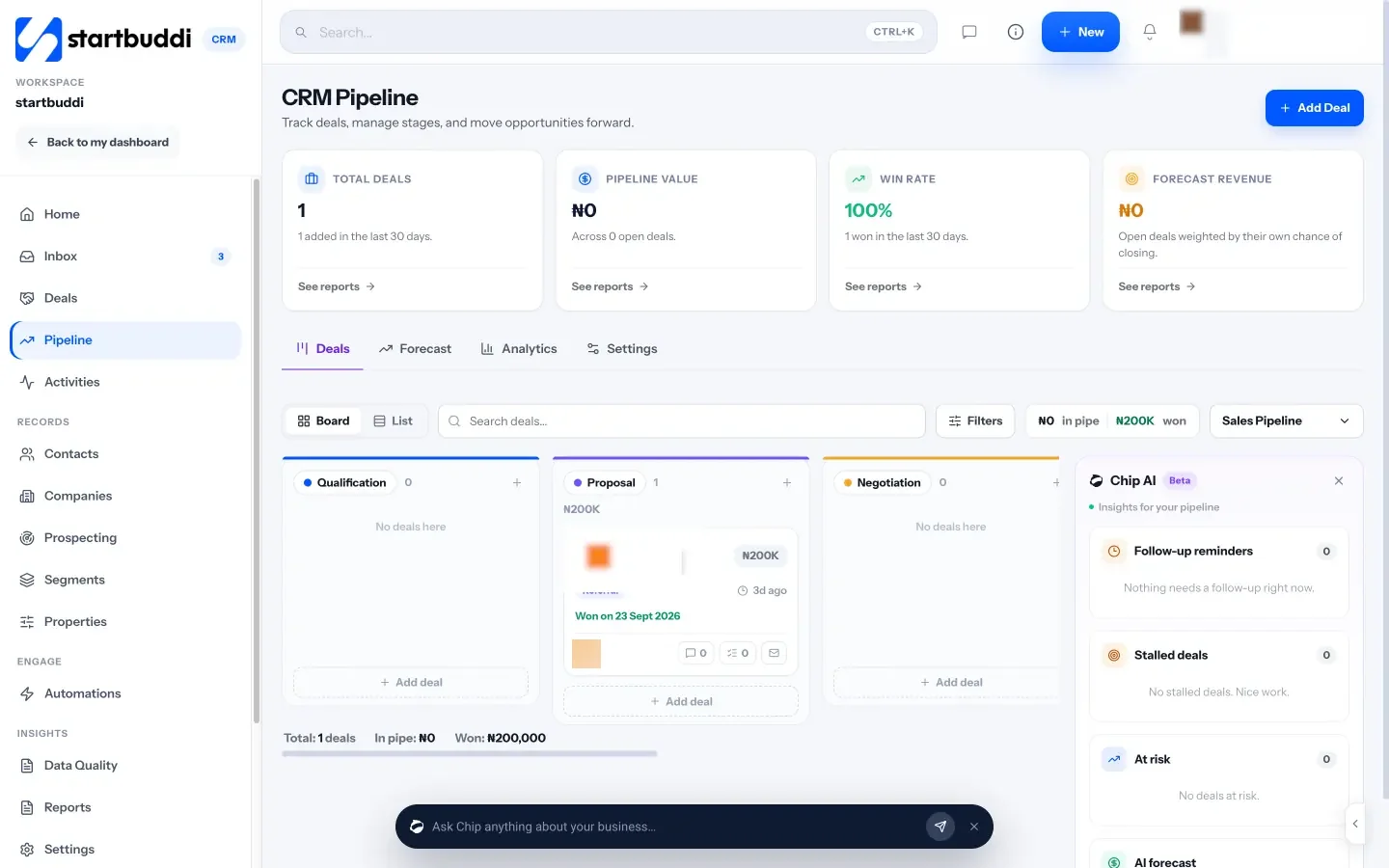
Pricing: free plan available; see pricing.
Pros
- Fits WhatsApp-first clients and referrers.
- CRM, bookings and documents in one place.
Cons
- No LOS integration, sourcing or pricing engine.
- Its automations can’t fire from a date field, so rate-change and product-expiry follow-ups have to be set as tasks by hand.
- No compliance archiving of calls and texts.
Skip it if you’re a US loan officer or a UK adviser; a mortgage-built tool from this list will do far more. Our WhatsApp CRM page shows the inbox in more detail.
How to choose the best CRM for mortgage brokers in your country
| Where you work | Start with |
|---|---|
| US, solo loan officer | Bonzo |
| US, small brokerage | Shape |
| US, lender or credit union | Total Expert or Salesforce Financial Services Cloud |
| UK | Mortgage Brain Hub, or your network’s recommended system |
| Canada | Finmo, paired with a CRM if you market heavily |
| Australia | Ask your aggregator which CRM it supports before you buy |
| Nigeria and other African markets | startbuddi, Zoho CRM or HubSpot alongside lenders’ processes |
Then ask every vendor these questions:
- Which LOS or sourcing systems do you integrate with, and what does the connector cost?
- How are texts and calls charged, and how is consent recorded?
- Can follow-ups trigger from closing date, rate or product expiry?
- Can referral partners get automatic updates?
- What does setup cost, and can I export everything if I leave?
For CRMs outside mortgage, see the best CRM software and the best free CRM. Brokers in Nigeria can compare local options in the best CRM software in Nigeria, and anyone new to CRMs should start with what a CRM does for a small business.
Try startbuddi
If you broker in a market where clients and estate agents live on WhatsApp, start free with no card, import your client list and set up a pipeline for applications and one for referrers. Our CRM for service businesses page shows the setup, and pricing shows what each plan includes.
Frequently asked questions
What is the best CRM for mortgage brokers?
In the US, a mortgage-built CRM that syncs with your loan origination system is best: Bonzo for a solo loan officer focused on texting and calls, Shape for a small brokerage. UK brokers should look at Mortgage Brain Hub, and Canadian brokers at Finmo. General CRMs only make sense if you don't need LOS or sourcing integration.
What is the best CRM for mortgage brokers in the UK?
Most UK brokers want a CRM that sits next to sourcing, criteria and submissions. Mortgage Brain Hub combines all of these with CRM in one login. Whatever you choose, check it records advice and product-expiry contact in a way that supports the FCA's Consumer Duty.
What is the best CRM for mortgage brokers in Canada?
Finmo is built for the Canadian broker workflow, with a borrower portal, document collection and a lender network. Many Canadian brokers pair an origination platform like Finmo with a marketing CRM. Ask your brokerage which systems it already supports.
What is the best CRM for mortgage brokers in Australia?
Australian brokers usually work through an aggregator, and the aggregator's supported CRM is often the practical choice because it connects to lodgement and commission systems. Ask your aggregator for its list before you buy. General CRMs work for marketing, but not for lodgement.
Do mortgage brokers need a mortgage-specific CRM?
Most do, once they have a few hundred past clients. Mortgage CRMs sync loan milestones, trigger follow-ups from closing dates and rates, and record texting consent. A new broker with a small book can start with a general CRM and move when past-client follow-up becomes the main source of business.
How much does a mortgage CRM cost?
Published prices on this list range from free (HubSpot and Zoho CRM free editions) to $150 per seat a month for Bonzo Solo and $325 per user a month for Salesforce Financial Services Cloud. Many mortgage vendors only quote on request. Ask for texting, LOS connectors and setup to be included in the quote.
Tiwalade Joanna Okedara-Kalu is the founder, CEO and CTO of startbuddi, the business system that brings clients, bookings, invoices, projects, marketing and the Chip AI assistant into one place. Tiwalade builds software around how service businesses really work day to day, and writes about client management, getting paid on time and why small businesses outgrow the tools they start with.
Founded startbuddi and leads its product and engineering