The best CRM software in Nigeria: how to choose one for your small business
How to choose the best CRM software in Nigeria: WhatsApp, Paystack and transfer payments, naira pricing, NDPA 2023 data protection and published plans.



Photo: Annie Spratt / Unsplash
- Pick a CRM that puts WhatsApp chats on each customer's record, takes payment by transfer, USSD and card, and is priced so the cost stays steady in naira. Check how it handles your customers' data under the NDPA 2023, then trial it for a week on your phone with real customers.
The best CRM software in Nigeria is the one that fits how Nigerian customers actually buy: they message you on WhatsApp, pay by bank transfer, USSD or card, and expect prices in naira. For most small businesses that means a CRM that brings WhatsApp chats onto each customer’s record, takes payment through a local gateway such as Paystack, lets you start free or cheaply, and works well on a phone. Big international names can do the job too, but check how they bill you, how they handle WhatsApp and where your customer data goes before you commit.
This guide explains what a CRM should do for a Nigerian small business, the checks that matter locally (WhatsApp, payments, naira pricing, the Nigeria Data Protection Act, power and data costs), and the published plans of a few well-known tools. We make startbuddi, so we are not neutral; we say so where it matters and link each tool’s own pricing page so you can check for yourself.
What a CRM does for a small business in Nigeria
A CRM (customer relationship management tool) is one shared place for everyone who has asked about, bought from or owes you money. If the term is new, our plain-words explainer on what a CRM is covers the basics.
In practice, a CRM for small business in Nigeria replaces three things most owners juggle today:
- A phone full of WhatsApp chats. Orders, quotes and complaints sit in one person’s phone. If that staff member leaves, or the phone gets stolen, the history goes with it.
- A notebook or spreadsheet of names. Useful until two people edit it at once, or nobody remembers who promised to call back.
- Bank alerts you match by hand. “Who sent this ₦45,000 transfer?” is a question a CRM with invoices can answer for you.
A good CRM gives each customer one page with their chats, deals, notes and payments, and tells you who to follow up with today. If you are still weighing whether you need one at all, our comparison of a CRM and a spreadsheet walks through the trade-offs.
Why WhatsApp should be at the centre of your CRM
For many Nigerian businesses, WhatsApp is the shop counter. People are online mainly on their phones: DataReportal counted 165 million cellular mobile connections and 109 million internet users in Nigeria in late 2025, which is 45.5% of the population (DataReportal). A CRM that ignores WhatsApp ignores most of your conversations.
What to check
- Official connection. The CRM should connect through the WhatsApp Business Platform (the official API), not a browser extension or an unofficial app that risks your number being blocked.
- A shared number. Several staff should be able to reply from the business number, with each chat assigned to one person so customers are not answered twice or not at all.
- Keeping your phone app. Many owners don’t want to give up the WhatsApp Business app on their phone. Ask whether the CRM supports using both at once.
- Templates and the 24-hour window. WhatsApp lets businesses reply freely within a 24-hour customer service window that opens when a customer messages you and resets with each new message. Outside that window you need an approved template. The CRM should make this obvious, not leave you guessing why a message failed.
What it costs
WhatsApp charges businesses on the platform per message delivered, based on the message category (marketing, utility, authentication or service) and the recipient’s country. Service replies inside the 24-hour window are free, as are utility messages sent in reply to a customer (WhatsApp Business Platform pricing). Marketing broadcasts cost money, so a CRM should show you who you can message before you send. Our guide to bulk WhatsApp marketing in Nigeria goes deeper on broadcasts and opt-in.
Local payments: transfer, USSD and card in one place
A CRM that stops at “deal won” leaves you chasing money in another app. For a Nigerian business, the useful version sends an invoice with a pay button and records the payment against the customer when it lands.
Paystack is one of the gateways most Nigerian small businesses use. Its checkout accepts card, bank transfer, USSD and other channels, and its published fee for local transactions is 1.5% + ₦100, with the ₦100 waived for transactions under ₦2,500 and fees capped at ₦2,000 per transaction. Paystack settles to your bank account the next working day (Paystack pricing).
When you compare CRMs, ask:
- Can I send an invoice from a customer’s record, in naira, with a pay button?
- Does it connect to Paystack (or my gateway) so paid invoices update automatically?
- Can I record a bank transfer that arrived outside the gateway, including part payments?
- Does a paid invoice move the deal to “won”, or do I have to update two places?
Naira pricing and how CRMs bill you
Most international CRMs bill in US dollars, per user (they call it a seat), by card. That creates two problems for a Nigerian business: the naira cost moves with the exchange rate, and some local cards struggle with recurring foreign payments. A CRM priced in naira gives you a steady monthly cost you can plan around.
Also watch how the price grows:
- Per seat: you pay for every staff member who logs in. Fine for one or two people, expensive when your sales team grows.
- Per organisation: one price covers a set number of users.
- By contacts: the price rises as your customer list grows.
- Add-ons: WhatsApp, SMS, email sending or AI may cost extra on top of the plan.
Work out what you would pay in 12 months with the team and customer list you expect, not just what you pay in month one.
Data protection: the NDPA 2023 and your customer list
A CRM holds personal data, so the Nigeria Data Protection Act 2023 applies to how you collect and use it. The Act is enforced by the Nigeria Data Protection Commission (NDPC). A few points matter directly when you choose and use a CRM:
- Consent for marketing. The NDPC’s General Application and Implementation Directive (GAID) 2025 says consent is required for any direct marketing activity (NDPC GAID 2025). Your CRM should record who opted in and let people opt out easily.
- Breaches. Section 40(2) of the Act, quoted in the GAID, requires a data controller to notify the Commission within 72 hours of becoming aware of a breach likely to put people’s rights at risk. Choose a CRM with sensible access controls so one lost login doesn’t expose everything.
- Where data goes. Transfers of personal data outside Nigeria have their own rules in the Act and the GAID. Ask any CRM vendor where your data is stored and what safeguards they use.
- Getting your data out. You should be able to export your full customer list at any time. It’s your business, not the vendor’s.
This is general information, not legal advice. For your own situation, read the NDPC’s guidance or speak to a data protection professional.
Power, data and working from your phone
Power cuts and the cost of mobile data are part of daily business in Nigeria, so a CRM should cope with both. We can’t give you a universal number for either, but these checks help:
- Test it on your phone. Open the CRM on the phone you actually use, on mobile data, during the trial. Can you find a customer, reply to a chat and send an invoice in under a minute?
- Cloud, not a local server. A cloud CRM keeps working when the office generator is off, because your team can pick up on a phone from anywhere.
- Scheduled sending. If you can schedule a message or invoice to go out later, it goes whether or not your laptop still has battery.
- Fewer apps. Every separate tool means another login, another subscription and more data used switching between them.
Well-known CRMs and their published plans
These are widely used CRMs, with details taken from their own pricing pages when we checked in September 2026. Prices change and some show introductory offers or local currencies depending on where you view them, so confirm on the linked page. We haven’t ranked them. For a fuller side-by-side view, see our list of CRM software for small business.
| Tool | Free plan | Paid plans | Worth knowing |
|---|---|---|---|
| HubSpot | Yes: free tools for up to 2 users and 1,000 contacts | Starter is priced per seat in US dollars; the page often shows offers | Free access has no time limit |
| Zoho CRM | Yes: free for 3 users | Standard and higher editions, per user | The pricing page lets you view prices in NGN, KES and ZAR among other currencies |
| Pipedrive | No free plan; 14-day free trial | Lite from US$14 per seat a month, billed annually | Built around a visual sales pipeline |
| Bitrix24 | Yes: free for 1 to 2 users | Basic US$49 a month billed annually (US$69 monthly) per organisation, including 5 users | Lists WhatsApp among its contact centre channels |
| startbuddi | Yes: Free plan, 1 seat and 250 contacts | Starter: 2 seats and 2,500 contacts (see pricing) | Charged in your local currency where available; Paystack on invoices |
Whichever you shortlist, run the same test on each: add ten real customers, connect WhatsApp, send one invoice and see how long it all takes.
How to choose the best CRM for your Nigerian business
- List where customers reach you. WhatsApp, Instagram DMs, calls, email, walk-ins. Rank them by volume. Your CRM must handle the top two well.
- List how customers pay. Transfer, USSD, card, cash, POS. Make sure the CRM (or the invoicing inside it) handles the main ones.
- Count your people. How many staff will reply to customers or chase payments in the next year? Price every option for that number.
- Check the billing currency. Naira pricing, or a dollar card that works reliably every month.
- Ask about data. Where is it stored, can you export it, and can you control who sees customer phone numbers?
- Trial with real work. One week, real customers, on your phone. The tool you still open on Friday is the right one.
The same needs across Africa
Much of this applies beyond Nigeria. Paystack publishes pricing for Ghana, Kenya and South Africa as well as Nigeria (Paystack pricing), so the same invoice-and-pay flow works there. Data protection laws apply too: Kenya’s is the Data Protection Act 2019, overseen by the Office of the Data Protection Commissioner, and South Africa’s is the Protection of Personal Information Act (POPIA), overseen by the Information Regulator. Check the rules where you trade.
How startbuddi helps
In startbuddi, the Customers module is a CRM built for small businesses, with contacts, a shared inbox, a sales pipeline and Chip, the AI assistant, in one place. It sits in the same workspace as invoices, bookings and marketing, so you don’t need a separate tool for each.
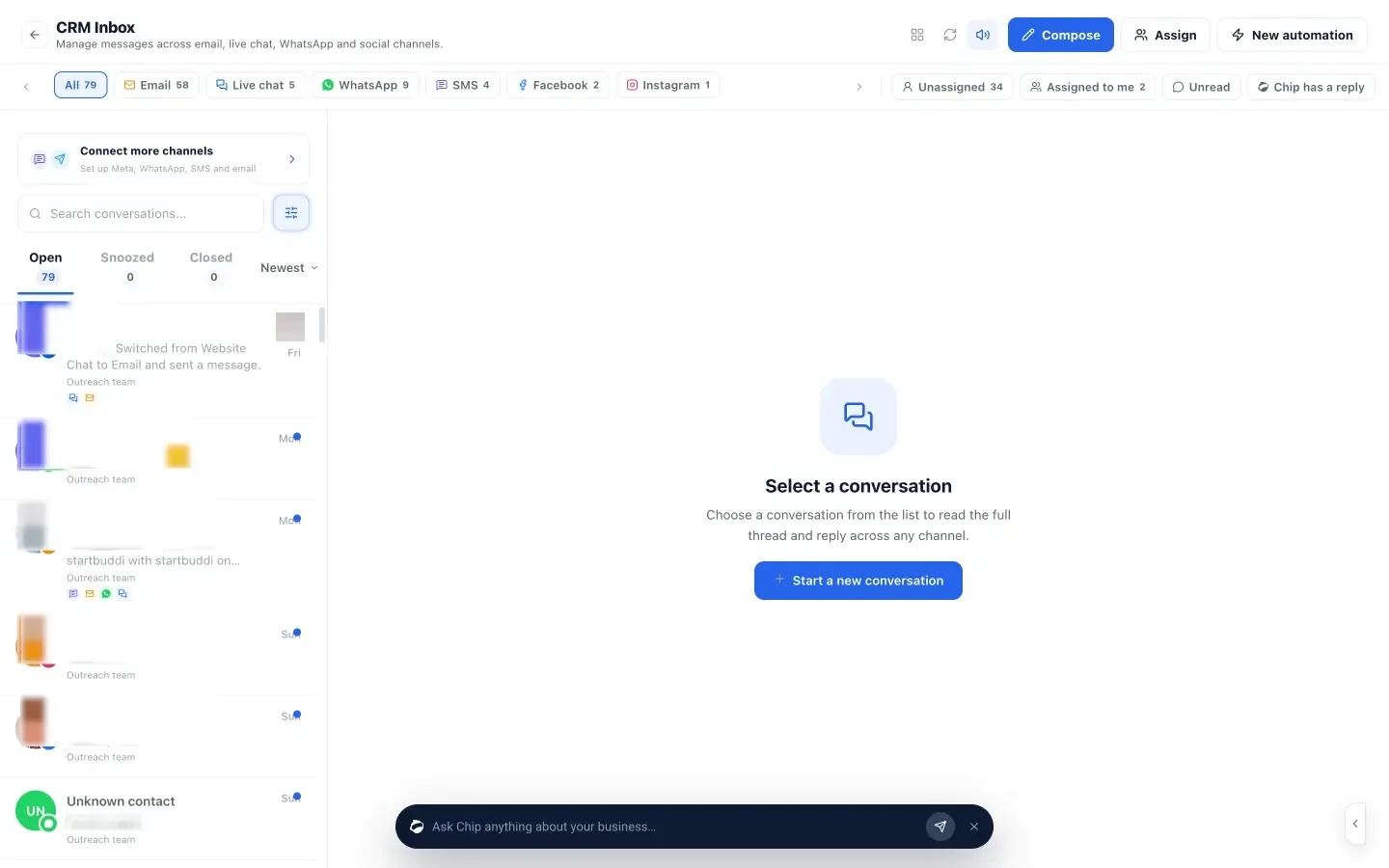
WhatsApp and every other chat in one inbox. The Inbox brings WhatsApp, email, SMS, website chat, Instagram and Facebook into one list. WhatsApp connects through Meta’s official sign-up, and if your number is already on the WhatsApp Business app you can keep using the app: contacts and chats are imported once, up to 180 days back, and replies show in both places. Outside the 24-hour window the composer switches to approved templates. You can assign chats to a teammate, share them fairly with round robin, leave internal notes, and schedule a message that sends even when you are offline. Our help article shows how to connect WhatsApp.
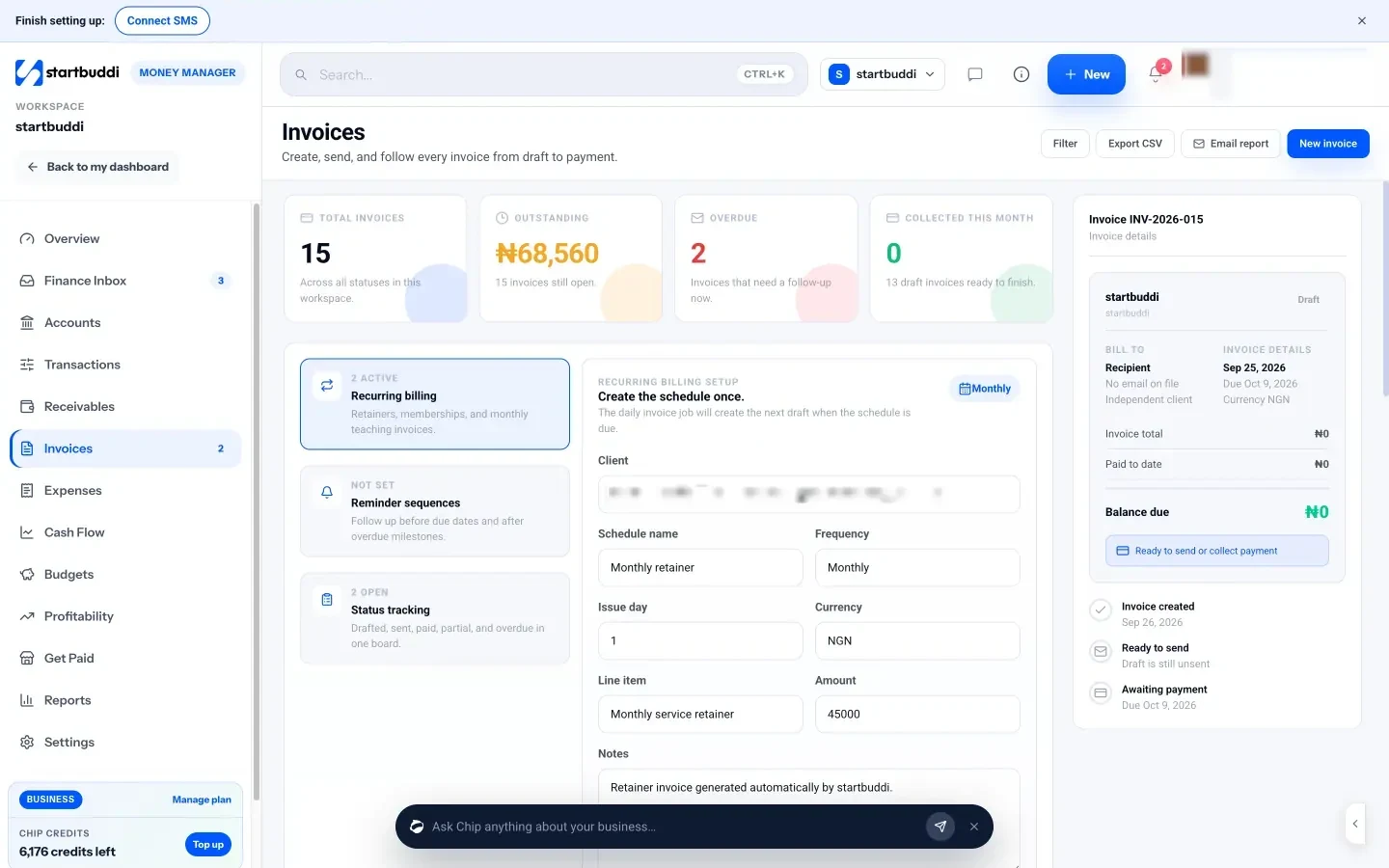
Naira invoices with Paystack. From a contact you can create an invoice in Money Manager, pre-addressed to that customer. Invoices default to the workspace currency (naira by default), and with Paystack connected your customer pays by card, bank transfer or USSD; the invoice is marked paid automatically. For transfers that arrive outside Paystack, use Record payment, which handles part payments too, and the Receivables view shows who owes you and what is overdue. See invoicing for the details.
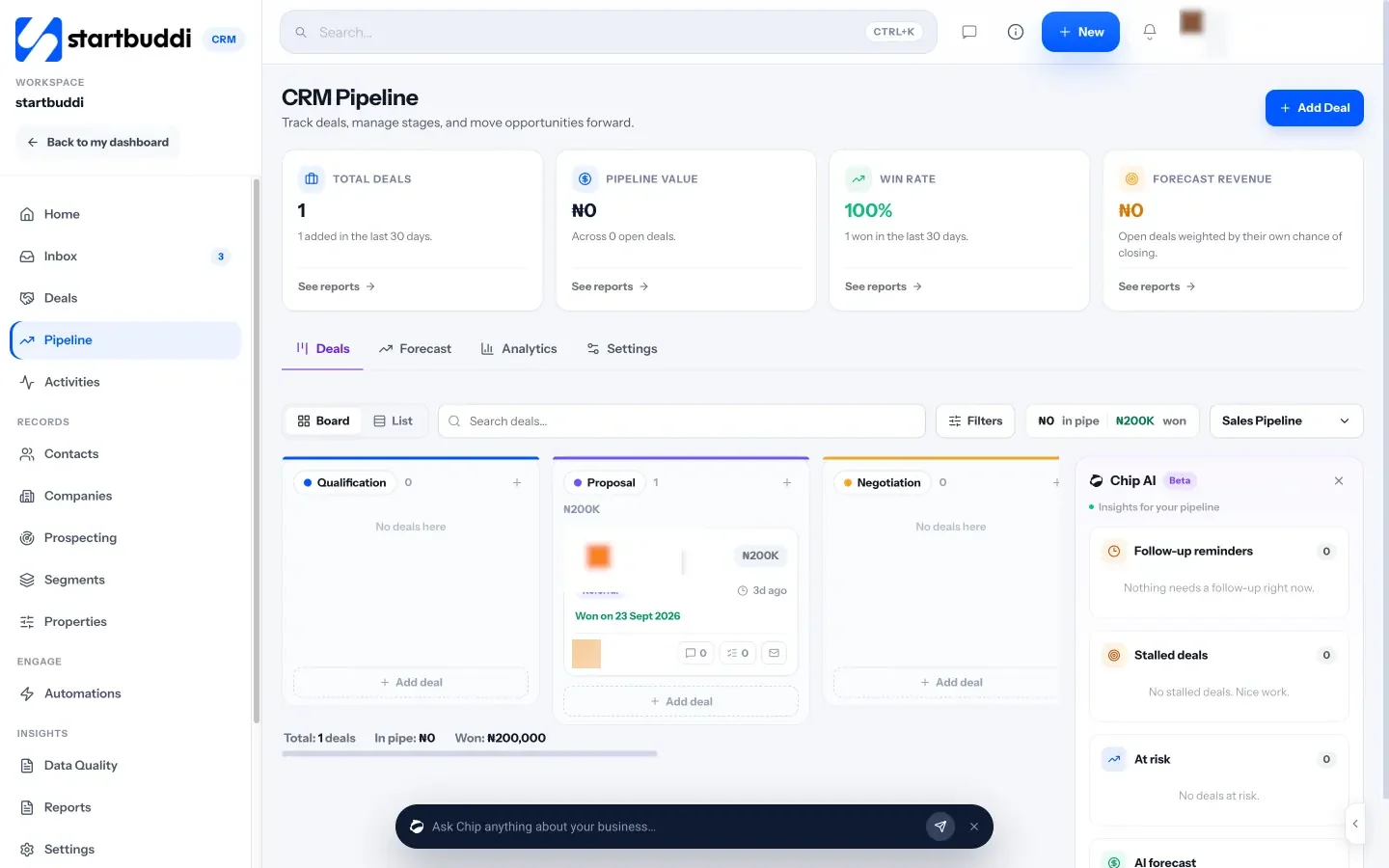
A pipeline that updates itself. Deals move across stages on a board. When a contact replies, their deal moves out of the first stage, and when an invoice on a deal is paid, the deal is marked won. Chip flags stalled and at-risk deals. More on the sales pipeline.
Local details. The add-contact form is ready for +234 numbers, CSV imports handle up to 10,000 contacts at a time, and you can export to CSV or Excel whenever you want. Admins can mask customer phone numbers for team members below manager level, which helps with the NDPA.
Plans. Free costs nothing and covers 1 seat and 250 contacts. Starter (2 seats, 2,500 contacts) adds WhatsApp, SMS and more automations. Growth (5 seats, 15,000 contacts) adds Chip replying on WhatsApp and the inbox by itself. Scale has 15 seats and 75,000 contacts. Prices are charged in your local currency where available (see the pricing page). Paid plans come with a 30-day trial, and paying yearly costs ten times the monthly price.
What it doesn’t do. startbuddi isn’t accounting software or a point of sale, and it can’t yet host your data in Africa. If you need a till for walk-in sales, use a POS alongside it.
Your next step
Write down where your last 20 customers first contacted you and how they paid. That list tells you which CRM features matter. Then try your top choice with real customers for a week. If WhatsApp and transfers top your list, start on startbuddi’s Free plan or compare plans on the pricing page.
Sources
- DataReportal: Digital 2026 Nigeria
- WhatsApp Business Platform pricing
- Paystack pricing
- Nigeria Data Protection Commission: Nigeria Data Protection Act 2023
- NDPC: General Application and Implementation Directive (GAID) 2025
- Kenya: Office of the Data Protection Commissioner
- South Africa: Information Regulator
- HubSpot pricing, Zoho CRM pricing, Pipedrive pricing, Bitrix24 pricing
Frequently asked questions
What is the best CRM for small business in Nigeria?
The one that handles how your customers reach you and pay you. If most come through WhatsApp and pay by transfer, shortlist CRMs with an official WhatsApp connection and naira invoices with Paystack, then trial two with real customers.
Is there a CRM priced in naira?
Yes. startbuddi's paid plans are charged in your local currency where available, with checkout through Paystack in Nigeria, and there is a Free plan. See current prices on the pricing page. Most international CRMs bill in US dollars by card.
Is there a free CRM in Nigeria?
Several CRMs have free plans, including HubSpot, Zoho CRM, Bitrix24 and startbuddi, each with limits on users or contacts. Check whether WhatsApp is included on the free plan before you rely on it.
Do I need customers' consent to message them from a CRM?
For marketing, yes: the NDPC's 2025 directive says direct marketing needs consent. Keep a record of who opted in and make it easy to opt out.
Which CRM works in Ghana, Kenya and South Africa too?
Any cloud CRM works there, but check local payments and data rules. Paystack publishes pricing for all three countries, and Kenya and South Africa have their own data protection laws.
Tiwalade Joanna Okedara-Kalu is the founder, CEO and CTO of startbuddi, the business system that brings clients, bookings, invoices, projects, marketing and the Chip AI assistant into one place. Tiwalade builds software around how service businesses really work day to day, and writes about client management, getting paid on time and why small businesses outgrow the tools they start with.
Founded startbuddi and leads its product and engineering