Best CRM for Nonprofits: 13 Donor Databases Compared for 2026
The best CRM for nonprofits, compared: 13 donor databases and free options for small charities, with Gift Aid, receipts and prices checked October 2026.


Photo: Centre for Ageing Better / Unsplash
The best CRM for nonprofits with a small team is Little Green Light, a low-cost donor database priced by the number of supporters. Bloomerang is the stronger pick for donor retention once you have a development role. Small UK charities should look at Beacon or Donorfy for Gift Aid, and Givebutter or Zeffy if the budget is zero. Prices were checked on 14 October 2026.
startbuddi is our product. It appears near the end because it isn’t a donor database, and we explain exactly where it falls short for charities.
Key takeaways
- A nonprofit needs a donor CRM, not a sales CRM. Gifts, recurring giving, appeals, acknowledgements and (in the UK) Gift Aid are the core, and general CRMs handle them badly.
- Pricing works differently: most donor CRMs charge by the number of supporters or by your revenue, not per user, so a small team with a big mailing list can pay more than you’d expect.
- “Free” usually means a fundraising platform paid for by optional donor tips or per-donation fees. That can be the right answer, but read how each one makes money.
- Salesforce gives eligible nonprofits 10 free licences, but you’ll still pay someone to set it up.
Nonprofit CRMs compared
| Tool | Best for | Starting price (checked 14 Oct 2026) | Free plan | Standout feature |
|---|---|---|---|---|
| Little Green Light | Small nonprofits on a budget | $45/month (up to 2,500 constituents) | No (free trial) | Low price, priced by supporters |
| Bloomerang | Retention-focused small and mid-size nonprofits | CRM from $125/month, billed annually | No | Donor retention insights, unlimited users |
| DonorPerfect | Growing fundraising teams | From $99/month | No | Customisable dashboards and forms |
| Neon CRM | Membership and events organisations | From $99/month | No | Priced by revenue, not records |
| Salesforce Nonprofit Cloud | Larger or complex organisations | 10 free licences for eligible nonprofits; Core $70 per user/month | Yes (Power of Us) | Almost unlimited customisation |
| Beacon | UK charities wanting a modern CRM | £33.50/month billed annually (Starter) | No (free trial) | Gift Aid and supporter portal |
| Donorfy | Small UK charities | Free Essentials; Starter priced by constituents | Yes (Essentials) | Automatic Gift Aid claiming on paid plans |
| Keela | Small teams wanting fundraising and CRM together | From $164/month (up to 1,000 contacts) | No | Unlimited forms, emails and donations |
| Givebutter | Zero-budget fundraising with a CRM | Free (optional donor tips) | Yes | Unlimited users and contacts |
| Zeffy | US and Canadian nonprofits wanting no fees | Free | Yes | Free forms, tickets and memberships |
| CiviCRM | Organisations with technical help | Open source; you pay for hosting | Yes (self-hosted) | Contributions, memberships and events |
| HubSpot | Marketing-led nonprofits | Free tools; 40% nonprofit discount on paid plans | Yes | Strong email and website tools |
| startbuddi | Community groups and social enterprises in Africa | See pricing | Yes | WhatsApp, bookings and payment links in one place |
Prices are as each vendor shows them, before tax.
What a nonprofit actually needs from a CRM
Before you look at any tool, check it can do the jobs that keep a charity funded and compliant.
- Gift records, separate from invoices. Each donation linked to a donor, a campaign or appeal, and a fund if money is restricted.
- Recurring giving. Monthly donors are the steadiest income most small charities have, so you need to see who lapsed.
- Acknowledgements and receipts. In the US, the IRS says the written acknowledgement for a gift of $250 or more must include the organisation’s name and the amount, among other details (IRS guidance).
- Gift Aid in the UK. HMRC lets a charity “claim back 25p every time an individual donates £1”, but only with a valid declaration, and you “must keep a record of declarations for 6 years after the most recent donation” you claimed on (GOV.UK on Gift Aid declarations). A UK charity CRM should store declarations and prepare claims.
- Retention reporting. Who gave last year but not this year. Customer retention is called donor retention here, and it’s the number most fundraisers watch.
- Volunteers, members and events, if you run them.
- Grants, at least deadlines and reports due, if trusts and foundations fund you.
- Consent and data protection. GDPR in the UK and EU, the Nigeria Data Protection Act in Nigeria. Store how and when each supporter agreed to hear from you.
How we chose
We focused on tools a nonprofit with one to about ten staff could run, and judged them on:
- Donor management: gifts, recurring giving, appeals, receipts.
- Country fit: Gift Aid for UK charities; US tax acknowledgements.
- True cost: subscription, how pricing scales (supporters, revenue or users), and fees on donations.
- Ease: whether a volunteer treasurer could keep it up to date.
- Honest limits.
Prices come from each vendor’s own pricing page, checked on 14 October 2026. We didn’t run hands-on tests and don’t quote review scores. Where a platform makes money from per-donation or platform fees, we tell you to read its pricing page rather than quote rates, because those change and depend on how donors pay.
1. Little Green Light
Little Green Light (LGL) is a cloud donor database built for small and mid-size nonprofits.
Best for: a small nonprofit moving off spreadsheets that wants proper donor records without a big bill.
Key features
- Gift and fundraising records, with acknowledgements and receipts produced inside the system.
- Mail-merge letters, labels and envelopes, with a record of who received them.
- Online donations collected and synced to donor records.
Pricing: LGL’s pricing page lists $45 a month for up to 2,500 constituents, $60 up to 5,000 and $75 up to 10,000, with 10% off for annual billing and a free trial.
Pros
- One of the lowest prices for a real donor database.
- Priced by supporters, not users, so the whole team can log in.
Cons
- Plainer interface than newer tools.
- Fewer built-in fundraising pages than all-in-one platforms.
Skip it if you want online fundraising, events and CRM from one vendor.
2. Bloomerang
Bloomerang is a donor management platform known for its focus on donor retention.
Best for: small and mid-size nonprofits with someone responsible for fundraising.
Key features
- Donor management with “predictive giving insights”.
- Major gifts, grant tracking and membership management in the CRM.
- Fundraising forms, events and text fundraising as an add-on.
Pricing: Bloomerang’s pricing page lists Bloomerang CRM from $125 a month billed annually, and Bloomerang Fundraising from $40 a month, which “must be purchased as part of bundle with Bloomerang CRM”. The full Giving Platform starts at $242 a month. It includes unlimited users.
Pros
- Retention reporting is central rather than an afterthought.
- Unlimited users.
Cons
- More than a very small charity needs.
- Annual billing only on the prices shown.
Skip it if you’re a volunteer-run group with a few hundred donors.
3. DonorPerfect
DonorPerfect is a long-standing fundraising CRM with online forms and email marketing.
Best for: nonprofits with a growing fundraising team that want customisable reports.
Key features
- Customisable dashboards, online forms and email marketing “included in every DonorPerfect plan”.
- Free data transfers from most CRMs, according to its pricing page.
Pricing: DonorPerfect’s pricing page shows fundraising suites “starting at $99/month”, with custom pricing on request.
Pros
- Mature and widely used.
- Free data transfer helps the move.
Cons
- Many features means a learning curve.
Skip it if you want the simplest possible tool.
4. Neon CRM
Neon CRM, from Neon One, is a donor, membership and events CRM.
Best for: membership organisations and nonprofits running events alongside fundraising.
Key features
- Donor management, supporter profiles and a donor portal.
- Websites and other Neon One products to add on.
Pricing: Neon One’s pricing page lists Neon CRM from $99 a month, and explains it charges “based on revenue instead of records”.
Pros
- Your bill doesn’t jump as your mailing list grows.
- Strong for memberships and events.
Cons
- Revenue-based pricing rises as you raise more.
Skip it if you have a large list but small income and want per-record pricing instead.
5. Salesforce Nonprofit Cloud
Nonprofit Cloud is Salesforce’s CRM for nonprofits.
Best for: larger nonprofits, or smaller ones with a skilled volunteer or partner to configure it.
Key features
- Fundraising, programmes and engagement on the Salesforce platform.
- A huge app marketplace.
Pricing: Salesforce’s nonprofit pricing says “any eligible nonprofit receives 10 Salesforce Nonprofit Cloud Core licenses, at no cost” through its Power of Us programme. Paid editions start at $70 per user a month for Sales and Service Core, billed annually.
Pros
- Ten free licences is generous.
- It can be shaped to almost any process.
Cons
- Free licences aren’t free setup. Most small charities need paid help.
- Complex for a team without an admin.
Skip it if nobody on your team will own the system. Our Salesforce alternatives list has simpler options.
6. Beacon
Beacon is a UK-built CRM for charities and nonprofits.
Best for: UK charities that want Gift Aid, a supporter portal and a modern interface.
Key features
- Supporter, donation and Gift Aid records.
- A portal so supporters, volunteers or beneficiaries can update their own records.
Pricing: Beacon’s pricing page lists Starter at £37 a month, or £33.50 a month on annual billing, for 500 to 2,000 contacts with 3 users and 10 read-only users. Growth starts at £127 a month (£114 annually).
Pros
- Built around UK charity needs.
- Clear published prices.
Cons
- Three full users on Starter.
Skip it if you’re outside the UK and don’t need Gift Aid.
7. Donorfy
Donorfy is a UK charity CRM with a free version for small charities.
Best for: small UK charities starting with their first CRM.
Key features
- Starter includes “Automatic Gift Aid claiming”, a GDPR preference centre and Enthuse and JustGiving integrations.
- Starter allows up to 1,000 constituents and unlimited users.
Pricing: Donorfy’s pricing page points small charities to Essentials, “the free charity CRM for small charities”. Paid plans are priced by the number of constituents, with a calculator on the page; prices are shown plus VAT.
Pros
- A free starting point built for UK charities.
- Gift Aid automation on paid plans.
Cons
- Check what Essentials leaves out before you rely on it.
Skip it if you’re outside the UK and Ireland.
8. Keela
Keela is a nonprofit CRM with fundraising forms, email and donor management.
Best for: small teams that want forms, email and donor records in one subscription.
Key features
- “All plans include unlimited forms, emails, donations, and support.”
- Contact records with donations, emails and event history.
Pricing: Keela’s pricing page lists plans starting from $164 a month for up to 1,000 contacts, and $243 for 1,001 to 2,500.
Pros
- Fewer separate tools to pay for.
Cons
- Higher entry price than LGL or Beacon.
Skip it if you already have email and forms you’re happy with.
9. Givebutter
Givebutter is a fundraising platform with a free donor CRM.
Best for: small US nonprofits with no software budget that raise money online.
Key features
- Donation pages, events and peer-to-peer fundraising.
- Givebutter’s page lists “unlimited users, contacts, email blasts” on the free platform.
Pricing: Givebutter’s pricing page explains it’s free “thanks to optional tips from donors”, and that a platform fee applies if you turn tips off. A paid Givebutter Plus tier is priced by contact count.
Pros
- Genuinely free to start.
- Fundraising and CRM together.
Cons
- Donors see a tip prompt, which some organisations dislike.
- Read the fee terms for when tips are off.
Skip it if you don’t want donors asked to tip the platform.
10. Zeffy
Zeffy is a free fundraising platform with a donor CRM for nonprofits.
Best for: nonprofits that want donation forms, tickets and memberships without paying fees.
Key features
- Donation forms, event tickets, raffles and memberships.
- Newsletters and emails to donors.
Pricing: Zeffy describes itself as “free, all-in-one fundraising software + CRM” with “zero fees”.
Pros
- Free for the nonprofit.
Cons
- Lighter CRM than a dedicated donor database.
- Check it supports your country before signing up.
Skip it if you need deep reporting or Gift Aid.
11. CiviCRM
CiviCRM is an open-source CRM used by thousands of nonprofits, run on your own website platform.
Best for: organisations with technical help or a hosting partner.
Key features
- Contributions, memberships and events.
- Contact management, email marketing, case management and reports.
Pricing: CiviCRM is open source, so there’s no licence to buy; you pay for hosting and any partner support. It also offers a hosted service, CiviCRM Spark.
Pros
- No licence fee, no lock-in.
- Very complete for nonprofits.
Cons
- Needs setup and maintenance.
Skip it if nobody can look after a server or pay a partner.
12. HubSpot
HubSpot is a marketing, sales and service platform with free tools and a nonprofit discount.
Best for: nonprofits that grow through content, campaigns and their website.
Key features
- Free CRM, forms, email and landing pages.
- “Donor cultivation pipelines” and donation forms through marketplace integrations, such as Donorbox.
Pricing: HubSpot for Nonprofits offers a 40% discount on list prices for eligible organisations. Free tools allow up to 1,000 contacts.
Pros
- Best-in-class marketing tools.
Cons
- Not a donor database: gifts, receipts and Gift Aid need integrations.
Skip it if you need donor records more than marketing. See startbuddi vs HubSpot.
13. startbuddi
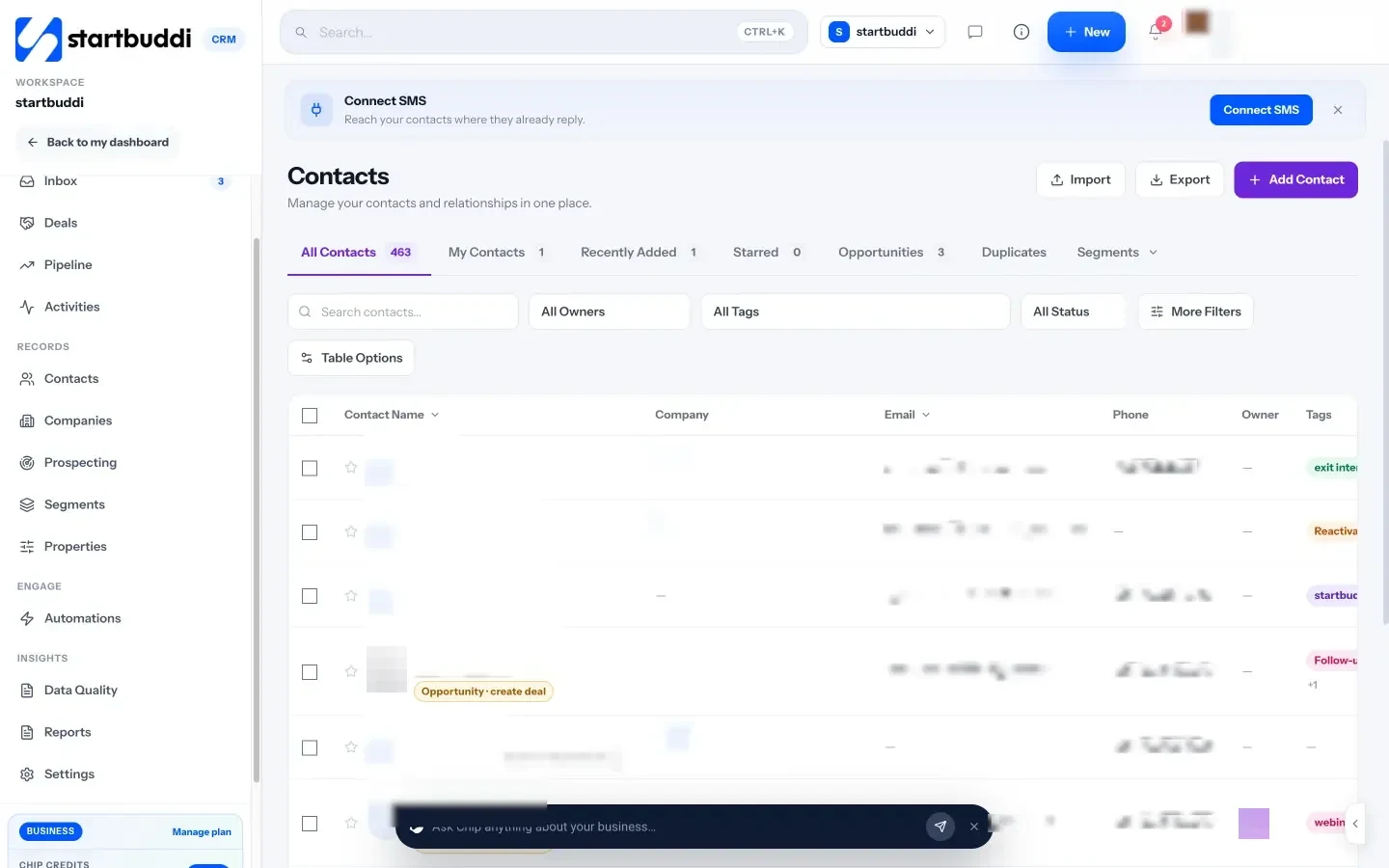
startbuddi is an all-in-one workspace for small service businesses: contacts, a shared inbox with WhatsApp, bookings, documents, invoices and payment links, with Chip, an AI assistant.
Best for: a community organisation, social enterprise or church group in Nigeria or elsewhere in Africa that mainly needs a supporter list, WhatsApp and email updates, bookings for sessions or appointments, and a way to take one-off payments.
Key features
- Contacts with tags, segments and notes; a pipeline you can use for partnerships or sponsors.
- One inbox for email, website chat, WhatsApp and SMS (WhatsApp and SMS from Starter).
- Payment links by card, bank transfer, USSD or mobile money through Paystack, or card through Stripe, with money going to your own account.
Pricing: free plan available; see pricing.
Pros
- Fits groups that run on WhatsApp and bank transfers.
- Contacts, bookings, documents and payments in one login.
Cons
- Not a donor management system. Payments are recorded as invoices or payment-link payments, not as gifts against appeals and funds.
- No Gift Aid declarations or HMRC claims, no tax receipt batches, no fund accounting, no grant tracking.
Skip it if you’re a registered charity that claims Gift Aid or issues tax receipts. Use a donor CRM from this list instead.
How to choose the best CRM for nonprofits of your size
| Your organisation | Start with |
|---|---|
| Volunteer-run, no budget | Givebutter, Zeffy or Donorfy Essentials (UK) |
| Small nonprofit, first donor database | Little Green Light |
| UK charity claiming Gift Aid | Beacon or Donorfy |
| Fundraising staff focused on retention | Bloomerang or DonorPerfect |
| Membership body or events-heavy | Neon CRM |
| Complex programmes, technical help available | Salesforce Nonprofit Cloud or CiviCRM |
| Campaign and content-led | HubSpot with a donation integration |
| Community group in Africa running on WhatsApp | startbuddi, with gift records kept in a donor tool when you grow |
Then work out your real cost for three years:
- Count supporters, not just staff. Most donor CRMs price by records or revenue.
- Add donation fees. For free platforms, read how they’re funded.
- Add setup. Salesforce and CiviCRM are cheap to license and costly to configure.
- Ask for a migration. Several vendors move your data for free; get it in writing.
Still on spreadsheets? Our page on CRM vs spreadsheet shows when it’s time to move. For general free options, see the best free CRM, and for business CRMs, the best CRM software. Groups in Nigeria can compare local options in the best CRM software in Nigeria.
Try startbuddi
If your organisation is closer to a small business than a registered charity, and you want supporters, WhatsApp, bookings and payments in one place, start free with no card. Our WhatsApp CRM page explains the inbox, and pricing shows what each plan adds. New to CRMs? Start with what a CRM does for a small organisation, or see how service-led groups use it on our CRM for service businesses page.
Frequently asked questions
What is the best CRM for small nonprofits?
Little Green Light is the best CRM for most small nonprofits, because it's a proper donor database from $45 a month and priced by supporters, not users. UK charities should compare Beacon and Donorfy for Gift Aid. If the budget is zero, Givebutter and Zeffy are free fundraising platforms with a CRM built in.
Is there a free CRM for nonprofits?
Yes. Givebutter and Zeffy are free fundraising platforms with donor CRMs, Donorfy offers a free Essentials version for small UK charities, and CiviCRM is open source. Salesforce gives eligible nonprofits 10 free Nonprofit Cloud licences. Each has a catch, such as donor tips, limited features or setup costs.
What is the best CRM for charities in the UK?
Beacon and Donorfy are built for UK charities and handle Gift Aid, which most US donor CRMs don't. Beacon's Starter plan is £33.50 a month on annual billing for up to 2,000 contacts. Donorfy has a free Essentials version and paid plans priced by constituents.
Do nonprofits need a special CRM or can they use a regular one?
Most need a nonprofit CRM, because donations, recurring gifts, acknowledgements and Gift Aid don't fit a sales pipeline. A regular CRM can work for a small community group that mainly sends updates and runs events. Once you issue tax receipts or claim Gift Aid, move to a donor database.
Is Salesforce free for nonprofits?
Partly. Through the Power of Us programme, eligible nonprofits get 10 Nonprofit Cloud Core licences at no cost, according to Salesforce's pricing page. Extra licences, apps and especially setup by a consultant cost money, so budget for implementation.
How much does a nonprofit CRM cost?
Entry prices on this list run from free (Givebutter, Zeffy, Donorfy Essentials) to $45 a month for Little Green Light and $125 a month for Bloomerang CRM. Most donor CRMs price by the number of supporters or by your revenue, so check where your list will be in two years.
Tiwalade Joanna Okedara-Kalu is the founder, CEO and CTO of startbuddi, the business system that brings clients, bookings, invoices, projects, marketing and the Chip AI assistant into one place. Tiwalade builds software around how service businesses really work day to day, and writes about client management, getting paid on time and why small businesses outgrow the tools they start with.
Founded startbuddi and leads its product and engineering