Customer retention: Definition, Examples and How It Works

Customer retention is a business's ability to keep its existing customers buying from it over time. It is usually measured as a customer retention rate: the percentage of customers you had at the start of a period who are still customers at the end of it.
Key takeaways
- What is customer retention in one line? Keeping the customers you already have. It is the flip side of churn rate: if you keep 85% of customers, you lost 15%.
- Retention rate = ((customers at the end minus new customers) ÷ customers at the start) × 100.
- Leave new customers out of the calculation, or growth hides the customers you lost.
- Keeping customers is usually cheaper than finding new ones, which is why small changes in retention move profit.
What is customer retention in a small business?
For a service business, customer retention is whether a client comes back or renews. An IT support firm retains a client when the monthly support contract carries on. A salon retains a customer when they book again. A web agency retains a client when the hosting and care plan renews, or when the client returns for the next project.
It is different from customer acquisition, which is winning a customer for the first time. Both matter, but retention is the one owners tend to stop watching once the calendar is full.
Why customer retention matters
Repeat customers cost less to serve and less to sell to. In Harvard Business Review, Amy Gallo wrote that acquiring a new customer is anywhere from five to 25 times more expensive than retaining an existing one (2014, checked on 1 October 2026). Bain & Company has long argued that increasing retention by as little as 5% can boost profits by as much as 95% (checked on 1 October 2026). Those figures come from larger companies, so treat them as direction, not a promise.
For a small business, the effect is easier to see. Every client you keep is income you don’t have to replace next month, and a referral source that is already happy.
How to calculate customer retention rate
Use three numbers for the same period, such as a quarter or a year:
- S: customers at the start of the period
- E: customers at the end of the period
- N: new customers won during the period
Customer retention rate = ((E minus N) ÷ S) × 100
Subtracting N matters. Without it, a month where you win lots of new customers can hide the fact that existing ones walked away.
For subscription or retainer businesses, count active contracts. For businesses without contracts, such as salons or repair shops, decide what “still a customer” means first, for example “bought at least once in the last 90 days”, and use the same rule every time.
Customer retention examples with numbers
These numbers are illustrative.
A managed IT support firm in Lagos
| Count | |
|---|---|
| Clients on monthly support at 1 July (S) | 40 |
| New clients signed in July to September (N) | 8 |
| Clients on monthly support at 30 September (E) | 42 |
Retention rate = ((42 minus 8) ÷ 40) × 100 = (34 ÷ 40) × 100 = 85%. The firm kept 34 of its 40 starting clients and lost 6, a churn rate of 15%. If each client pays ₦250,000 a month, those 6 lost clients were ₦1,500,000 of monthly income that the 8 new ones had to replace before the business grew at all.
A hair salon in Manchester
The salon counts a customer as “active” if they visited in the last 90 days. On 1 January it had 300 active customers. During the quarter it won 60 new ones, and on 31 March it had 315 active customers. Retention rate = ((315 minus 60) ÷ 300) × 100 = (255 ÷ 300) × 100 = 85%. The same rate as the IT firm, with a very different meaning: 45 regulars stopped coming, which at £45 a visit every six weeks is a real hole in the diary.
What affects customer retention
- The first weeks. Customers who get a clear start, a named contact and a quick early win are more likely to stay.
- Staying in touch. Check-ins, reminders and useful updates between jobs, not only when an invoice is due.
- Fixing problems fast. One slow response to a complaint can end a long relationship.
- Asking how you’re doing. A simple score such as the net promoter score spots unhappy customers before they leave.
Our customer retention strategies guide goes through each of these step by step, and how to retain clients covers the service-business angle.
Related terms
- Churn rate: the share of customers you lose in a period, the mirror image of retention.
- Customer lifetime value: how much a customer is worth over the whole relationship, which rises as retention improves.
- Net promoter score: a one-question survey of how likely customers are to recommend you.
How startbuddi handles customer retention
startbuddi keeps every client’s history in one record, so you can see who has gone quiet and act before they leave.
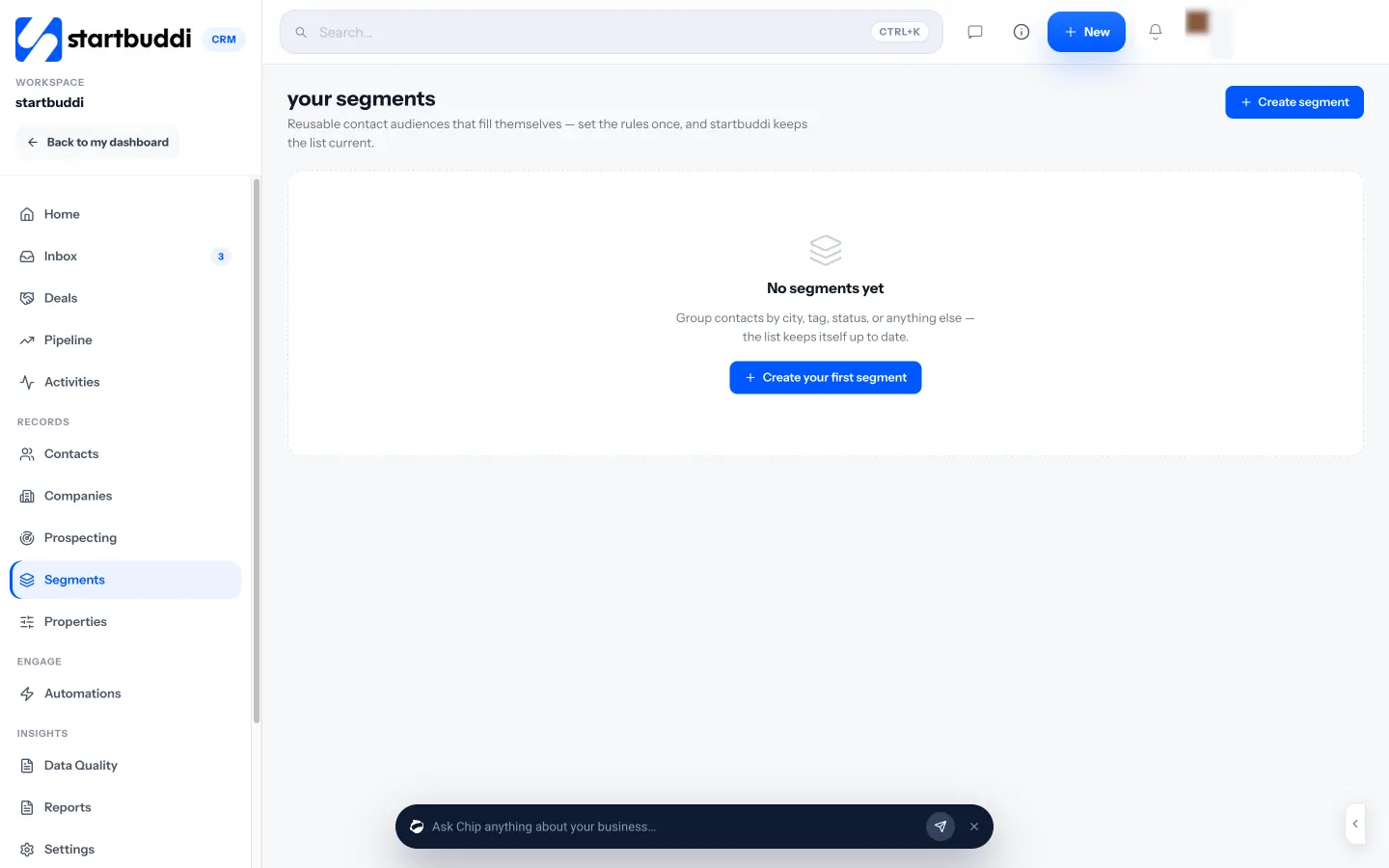
- Segments in Customers group contacts by status, tag or any property you track, and the list stays up to date as contacts change.
- Subscriptions in Money Manager handle retainers and maintenance plans, with renewals charged through your connected payment provider. See Subscriptions.
- Email campaigns to a segment, such as a check-in to clients you haven’t worked with recently, are available on paid plans.
- Bookings send reminder emails before appointments, which helps regulars keep coming back.
If you run an IT services business, see how startbuddi works for IT teams. A free plan is available; see pricing.
Customer retention is part of Customers in startbuddi.
See CustomersRelated terms
FAQ
What is a good customer retention rate?
A good customer retention rate depends on your industry and how you sell. Businesses with contracts or subscriptions, such as managed IT support, usually see higher rates than one-off services. The most useful benchmark is your own rate last quarter: track it the same way every time and aim to raise it.
What is the difference between customer retention and churn?
Customer retention measures the share of customers you keep in a period, and churn measures the share you lose. If you start with 100 customers and still have 90 of them at the end, retention is 90% and churn is 10%. The two always add up to 100% when measured over the same customers.
How do you improve customer retention?
You improve customer retention by giving new customers a good start, staying in touch between jobs, fixing problems quickly and asking for feedback. Making renewal easy, for example with a retainer or maintenance plan, also helps. Start with the customers who are most valuable to you.
Does customer retention matter for a business without subscriptions?
Yes. Salons, repair shops and agencies that sell one project at a time still depend on customers coming back and recommending them. Define what counts as an active customer, for example a purchase in the last 90 days, and measure retention against that.
Tiwalade Joanna Okedara-Kalu is the founder, CEO and CTO of startbuddi, the business system that brings clients, bookings, invoices, projects, marketing and the Chip AI assistant into one place. Tiwalade builds software around how service businesses really work day to day, and writes about client management, getting paid on time and why small businesses outgrow the tools they start with.
Founded startbuddi and leads its product and engineering