What is Net Promoter Score (NPS)?
Also called: NPS, Net Promoter, likelihood to recommend, customer loyalty score
Net Promoter Score (NPS) is a customer loyalty measure based on one question, "How likely are you to recommend us?", scored 0 to 10. It is the percentage of promoters minus the percentage of detractors.
Net Promoter Score (NPS) is a simple way to measure how loyal your customers are. You ask one question: “On a scale of 0 to 10, how likely are you to recommend us to a friend or colleague?” Then you subtract the share of unhappy customers from the share of enthusiastic ones. The result is a score between −100 and +100.
It is popular because it is quick for customers to answer and easy for you to track over time.
Why Net Promoter Score matters for a small business
- Word of mouth is your cheapest channel. NPS tells you how many customers are likely to send others your way.
- It spots problems early. A falling score often comes before cancellations and lost repeat business, so it is an early warning for churn.
- It finds your fans. Promoters are the people to ask for reviews, testimonials and referrals.
- It is easy to run. One question, one follow-up, no survey expertise needed.
How to calculate Net Promoter Score
Group every answer into one of three bands:
| Score | Group | What it usually means |
|---|---|---|
| 9 to 10 | Promoters | Loyal fans who are likely to recommend you |
| 7 to 8 | Passives | Satisfied but not excited, and open to competitors |
| 0 to 6 | Detractors | Unhappy customers who may warn others off |
NPS = % promoters − % detractors
Passives count towards the total number of responses but are not added or subtracted.
Worked example
A dental practice in Melbourne gets 50 replies after appointments: 30 promoters, 12 passives and 8 detractors.
- Promoters: 30 ÷ 50 = 60%
- Detractors: 8 ÷ 50 = 16%
- NPS = 60 − 16 = +44
NPS is written as a whole number, not a percentage, so this practice’s score is 44.
How to run an NPS survey
- Ask the main question on a 0 to 10 scale.
- Add one open follow-up: “What is the main reason for your score?” This is where the useful detail is.
- Pick the moment. Shortly after a service is delivered, or at a regular point such as every six months for ongoing clients.
- Keep it short. Two questions get far more answers than ten.
- Close the loop. Thank promoters and ask for a review. Contact detractors personally to fix the problem.
What to do with the results
- Promoters (9 to 10): thank them, ask for a public review, and ask if they know anyone who could use your help. Happy customers often just need to be asked.
- Passives (7 to 8): read their comments closely. They often point to one small annoyance, such as slow replies or confusing invoices, that stops them being fans.
- Detractors (0 to 6): reply personally within a day. Apologise where it is deserved, fix what you can, and note the reason. Patterns across several detractors show you what to change first.
What is a good NPS?
Any score above zero means you have more promoters than detractors. Scores vary a lot by industry and country, so the most useful comparison is with your own previous results. With a small customer base, a few answers can swing the number a long way, so look at the trend over several months rather than one survey.
Common mistakes
- Chasing the number. Asking customers to “give us a 10” makes the score meaningless.
- Surveying only happy customers. Send it to everyone in the group, not just the ones you like.
- Ignoring passives. A 7 or 8 is a customer who could easily leave. Ask what would make it a 9.
- Collecting and doing nothing. If customers see no change, they stop answering.
- Using it as the only measure. Pair NPS with repeat purchases and churn to see the full picture.
Related terms
NPS is a leading sign of churn rate and customer lifetime value: promoters tend to stay and buy more. It is also a useful check at the end of the customer journey. eNPS (employee Net Promoter Score) uses the same method to ask staff how likely they are to recommend you as an employer.
Net Promoter Score in startbuddi
startbuddi does not have a dedicated customer NPS dashboard, but you can run NPS surveys with the tools you have. Forms includes an “NPS and Feedback” template, and the builder has radio button, dropdown and rating fields plus long text for the “why” question. Answers can be saved to each contact, so you can see who your promoters and detractors are.
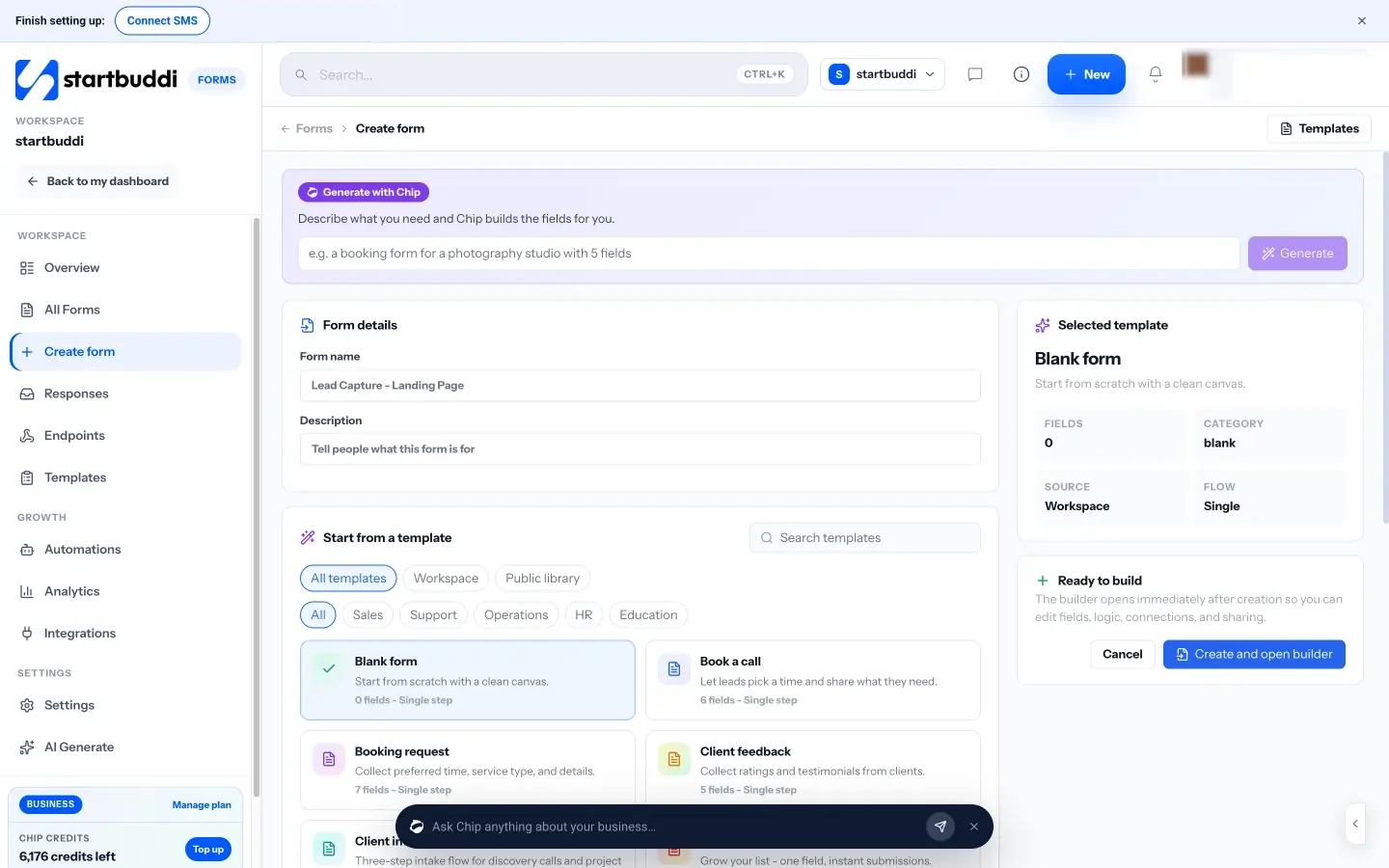
On paid plans, Automations can send the survey for you, for example when a booking is completed. For your own team, Surveys in People includes an eNPS template with a promoter, passive and detractor breakdown, anonymous by default.
Your next step: send the two NPS questions to your last 20 customers, and personally reply to every detractor within a day.
Related terms
FAQ
How do you calculate NPS?
Ask how likely customers are to recommend you on a 0 to 10 scale. Subtract the percentage who scored 0 to 6 from the percentage who scored 9 or 10.
What is a good Net Promoter Score?
Anything above zero means more promoters than detractors. Because scores vary by industry and country, compare mainly against your own past results.
How many responses do I need for NPS?
There is no strict minimum, but with fewer than about 30 answers treat the number as a rough signal and focus on the comments.
How often should I send an NPS survey?
After key moments, such as a finished project, or at regular intervals like every six months for ongoing customers. Avoid asking the same person too often.
Tiwalade Joanna Okedara-Kalu is the founder, CEO and CTO of startbuddi, the business system that brings clients, bookings, invoices, projects, marketing and the Chip AI assistant into one place. Tiwalade builds software around how service businesses really work day to day, and writes about client management, getting paid on time and why small businesses outgrow the tools they start with.
Founded startbuddi and leads its product and engineering