What is a customer journey?
Also called: Customer journey map, buyer journey, customer lifecycle, customer experience journey, decision journey
The customer journey is the full path a person takes with your business, from first hearing about you, through buying, to using what they bought, coming back and recommending you.
The customer journey is every step a person takes with your business: noticing you, checking you out, getting in touch, buying, using what they bought, and hopefully coming back and telling friends. Each place they meet you along the way, such as your Instagram, your website, a WhatsApp chat or an invoice, is called a touchpoint.
Thinking in journeys helps you see your business the way customers do, rather than as a set of separate tasks.
Why the customer journey matters for a small business
- It shows where you lose people. Maybe plenty of people message you but few book. The journey shows that gap.
- It links marketing, sales and service. A great ad is wasted if the enquiry sits unanswered for three days.
- It finds easy wins. Small fixes, like a confirmation message or a thank-you after the job, often have an outsized effect.
- It makes repeat business deliberate. The journey does not end at payment. The next purchase starts there.
The stages of the customer journey
| Stage | What the customer is doing | Typical touchpoints |
|---|---|---|
| Awareness | Realising they have a need and noticing you | Social posts, search, word of mouth, a sign on your shop |
| Consideration | Comparing options | Your website, reviews, prices, a quick question by chat |
| Decision | Choosing and buying | A quote, a booking page, a checkout, an invoice |
| Experience | Receiving the product or service | Onboarding, reminders, the work itself, updates |
| Retention | Deciding whether to come back | Follow-ups, rebooking prompts, newsletters |
| Advocacy | Recommending you | Review requests, referral offers, being easy to share |
A customer journey example
Wanjiru runs a catering business in Nairobi. Mapping one corporate client’s journey looks like this:
- Awareness: an office manager sees a friend’s LinkedIn post about Wanjiru’s lunch at a conference.
- Consideration: she visits the website, looks at the menu and sends a WhatsApp message asking about prices for 40 people.
- Decision: Wanjiru replies within the hour with a quote. The client pays a deposit through a payment link.
- Experience: a reminder the day before, lunch delivered on time, the final invoice the same afternoon.
- Retention: a thank-you message with a short feedback question, and a check-in a month later about the next event.
- Advocacy: the office manager leaves a review and recommends Wanjiru to another department.
When she mapped it, Wanjiru found her weakest step: before, she never followed up after an event, so repeat bookings depended on luck. She also noticed that enquiries arriving late in the evening often waited until the next afternoon for a reply, by which time some office managers had already booked someone else. Two small changes, a same-evening reply and a follow-up a month after each event, closed both gaps.
How to map your customer journey
- Pick one customer type. Use your buyer persona. Different customers take different paths.
- List every touchpoint, from the first post they see to the last message you send.
- Note what they think and feel at each step. Where are they confused, worried or waiting?
- Mark the gaps. Slow replies, missing information, no follow-up.
- Fix one gap at a time, starting with the one closest to money.
Common mistakes
- Stopping at the sale. Onboarding, retention and advocacy are where lifetime value is won.
- Mapping the journey you wish customers took. Use real enquiries and real conversations.
- Too many tools. When enquiries live in WhatsApp, quotes in email and invoices in a spreadsheet, nobody sees the whole journey.
- Ignoring the handovers. Problems often happen between steps, such as between a booking and the first reminder.
- Making it a one-off project. A journey map is only useful if you revisit it when you add a channel or change your offer.
Related terms
A sales funnel focuses on the steps up to the purchase, while the customer journey carries on after it. Lead nurturing covers the consideration stage, and Net Promoter Score measures how the whole journey felt. For the step after the sale, read how to onboard a new client.
The customer journey in startbuddi
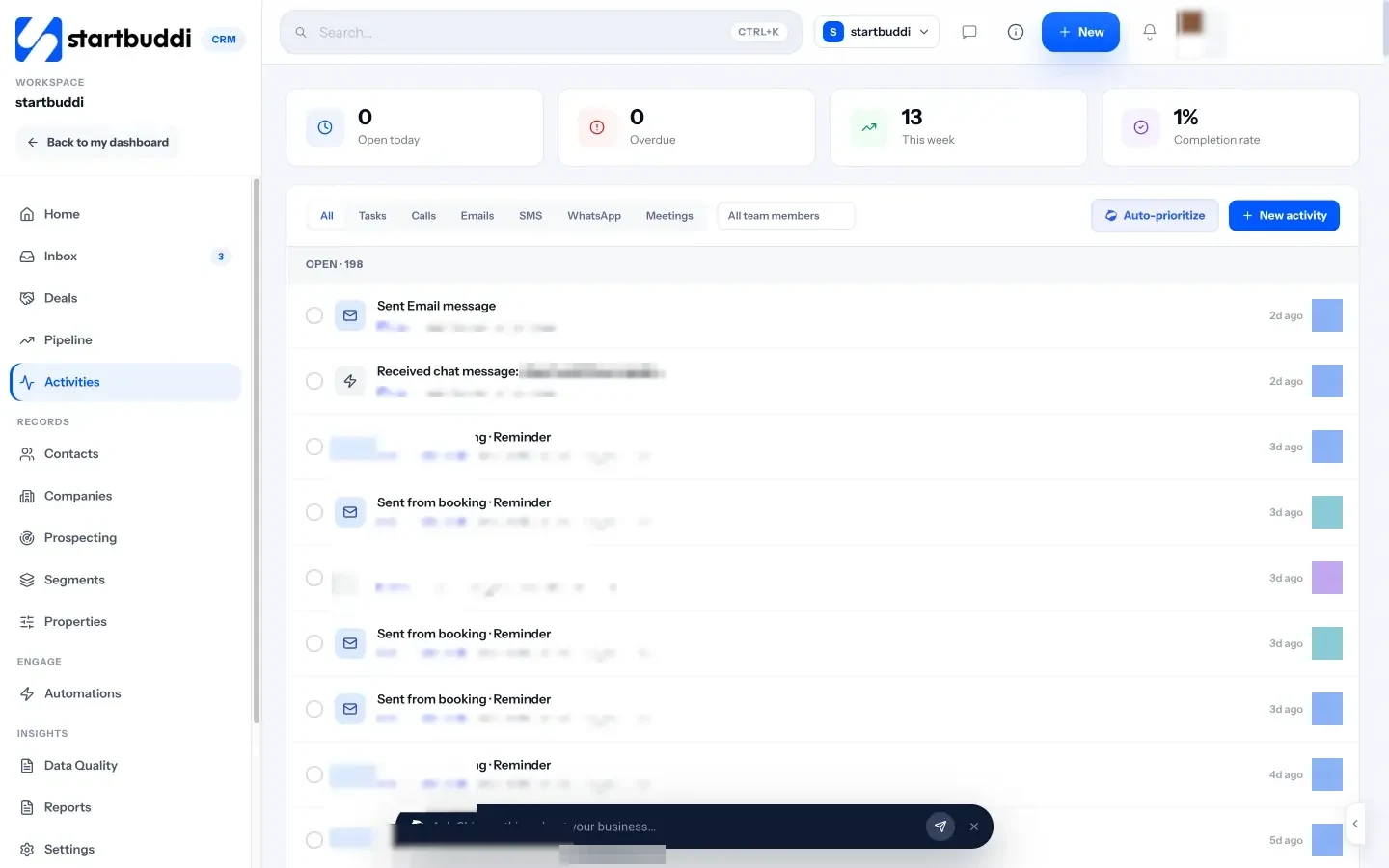
Because forms, bookings, inbox messages, deals, invoices and marketing all live in one place, each contact’s page in Customers shows their activity, conversations, deals and a money summary together. The Activities view lists emails, chats, calls, meetings and booking reminders across channels.
The Analytics Funnel tab follows contacts from becoming a contact, to filling in a form, booking a time, getting a deal and being won, with the time each step takes and where people came from. On paid plans, Automations can fill the gaps you find, with triggers such as form submitted, booking completed and invoice paid.
Your next step: write down the six stages for your main customer type, and fix the one step where people most often go quiet.
Related terms
FAQ
What are the stages of the customer journey?
A common version is awareness, consideration, decision, experience, retention and advocacy. Some models merge or rename stages, but the idea is the same.
What is the difference between a customer journey and a sales funnel?
A sales funnel usually ends at the purchase. The customer journey carries on through using the product, coming back and recommending you.
What is a customer journey map?
A simple document or diagram that lists each stage, the touchpoints, what the customer thinks and feels, and where the gaps are.
How often should I update my customer journey map?
Whenever you add a channel, change your offer or notice a drop at one stage. For most small businesses, a quick review every six months is enough.
Tiwalade Joanna Okedara-Kalu is the founder, CEO and CTO of startbuddi, the business system that brings clients, bookings, invoices, projects, marketing and the Chip AI assistant into one place. Tiwalade builds software around how service businesses really work day to day, and writes about client management, getting paid on time and why small businesses outgrow the tools they start with.
Founded startbuddi and leads its product and engineering