What is a sales funnel?
Also called: Marketing funnel, conversion funnel, purchase funnel, AIDA funnel, revenue funnel
A sales funnel is the set of steps people go through on the way to buying from you, from first noticing you to paying, drawn as a funnel because fewer people reach each step.
A sales funnel is the series of steps people take on the way to becoming customers. It is drawn as a funnel because it is wide at the top, where many people notice you, and narrow at the bottom, where a smaller number actually buy.
A simple funnel might be: 2,000 people see your post, 200 visit your page, 40 fill in the form, 10 book a call and 4 become customers. Seeing it laid out like that shows you exactly where people drop away.
Why a sales funnel matters for a small business
- It shows where the leaks are. If lots of people visit but few enquire, fix the page. If lots enquire but few buy, fix the follow-up.
- It helps you plan. Work backwards from how many customers you need to how many visitors that takes.
- It stops you over-spending on the top. More traffic will not help if the bottom of the funnel is broken.
The stages of a sales funnel
| Stage | What happens | Example |
|---|---|---|
| Awareness (top) | People discover you | A post, an ad, a search result, a referral |
| Interest | They look closer | Visiting your page, following you, reading reviews |
| Lead | They share contact details | A form, a lead magnet download, a WhatsApp message |
| Consideration | They talk to you or compare | A call, a quote, a proposal |
| Purchase (bottom) | They buy | Paying an invoice, a deposit or a checkout |
Many businesses add a stage after the purchase, such as repeat purchase or referral, which turns the funnel into a loop. Your stages do not have to match a textbook. Use the steps your customers really take: for a salon that might be see a post, check prices, book online, turn up and rebook.
A sales funnel example with numbers
A web designer in Accra tracks one month:
- 3,000 people see her posts and ads
- 300 visit her portfolio page (10%)
- 30 fill in the quote form (10% of visitors)
- 12 get on a call (40% of enquiries)
- 4 sign and pay a deposit (33% of calls)
Each step has its own conversion rate. If she needs 6 clients a month instead of 4, she has two options: find 50% more people at the top, or improve one step. Raising the call-to-client rate from 33% to 50% would get her there with no extra traffic.
Sales funnel vs sales pipeline
The two words are often mixed up. A sales funnel is about volume: how many people move from one stage to the next, mostly in marketing. A sales pipeline is about specific deals: which named opportunities are at which stage and what they are worth. The funnel tells you where people drop off; the pipeline tells you who to call today.
How to improve your sales funnel
- Top: post where your customers already are, and make it easy to reach your page from every profile.
- Interest: show prices or a starting price, real work and reviews.
- Lead: use a short form and a clear call to action.
- Consideration: reply fast, and follow up more than once. See how to follow up with leads.
- Purchase: make paying easy, with a payment link or online invoice.
- After: ask for a review and a referral, and invite them back.
Common mistakes
- Not measuring each step. Without numbers at each stage, you are guessing where the problem is.
- Building a complicated funnel too early. Five pages and ten emails before you have a single customer is wasted effort. Start simple.
- Treating every lead the same. A hot referral and a cold ad click need different follow-up.
- Forgetting existing customers. Past customers skip straight to the bottom of the funnel.
- Judging a stage on one bad week. Small numbers jump around. Compare a full month with the previous one before you change anything big.
Related terms
The customer journey covers the same path in more depth and continues after the sale. Pipeline management is how you work individual deals through the bottom of the funnel. Our post on lead capture automation covers the lead stage.
Sales funnels in startbuddi
On paid plans, Marketing analytics shows a funnel from people reached, to engaged, clicked, became customers and repeat buyers within 90 days, worked out from your campaigns and paid invoices.
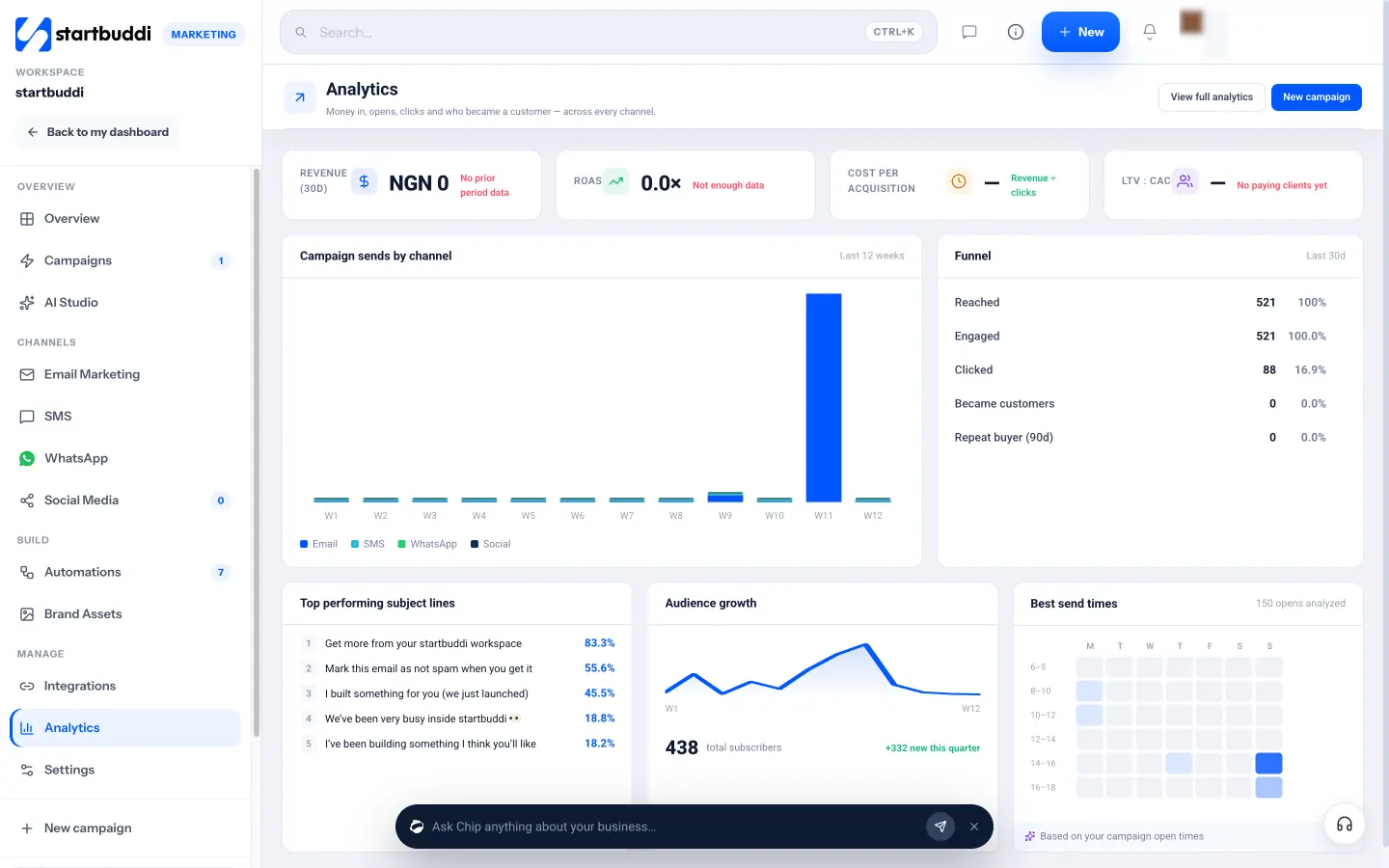
The workspace Analytics page has its own Funnel tab, from becoming a contact to filling in a form, booking a time, getting a deal and being won, split by where people came from. Once someone is a real opportunity, the Pipeline tracks the deal itself: when a contact replies their deal moves out of the first stage, and when an invoice on a deal is paid, the deal is marked won.
Your next step: write down last month’s numbers for each stage of your funnel, find the biggest drop, and fix that step first.
Related terms
FAQ
What are the stages of a sales funnel?
A simple version is awareness, interest, lead, consideration and purchase. Many businesses add repeat purchase or referral at the end.
What is the difference between a sales funnel and a sales pipeline?
A funnel measures how many people move between stages. A pipeline tracks individual deals, their stage and their value.
Do small businesses need a sales funnel?
You already have one, even if you have never drawn it. Writing it down with numbers shows you where you lose customers and what to fix first.
What is a funnel in marketing tools?
Often it means a set of linked pages, such as a signup page, a thank-you page and a checkout. That is one way to build the lead and purchase stages of a sales funnel.
Tiwalade Joanna Okedara-Kalu is the founder, CEO and CTO of startbuddi, the business system that brings clients, bookings, invoices, projects, marketing and the Chip AI assistant into one place. Tiwalade builds software around how service businesses really work day to day, and writes about client management, getting paid on time and why small businesses outgrow the tools they start with.
Founded startbuddi and leads its product and engineering