What is pipeline management?
Also called: Sales pipeline management, deal management, opportunity management, pipeline review

Pipeline management is the ongoing work of tracking, reviewing and moving deals through the stages of your sales pipeline, so you know what is likely to close, what has stalled and what to do next.
Pipeline management is the ongoing work of tracking, reviewing and moving deals through your sales pipeline. The pipeline itself is the picture: columns such as New lead, Proposal sent and Won, with a card for every potential sale. Pipeline management is what you do with that picture every week so it stays true and keeps turning into paid work.
A pipeline you set up once and never touch soon fills with deals that died months ago. Managing it means asking three questions regularly: what is likely to close, what is stuck, and what is the next action on each deal?
Why pipeline management matters for a small business
When you are the founder, the salesperson and the person doing the work, sales often happen in bursts. You are busy delivering, so nobody follows up, and a month later there is nothing new coming in. Regular pipeline management smooths that out.
- Fewer lost deals. You spot the proposal nobody answered before the buyer goes elsewhere.
- More honest forecasts. You can see roughly how much work is coming next month and plan hiring, spending or marketing around it.
- Better use of your time. You focus on the deals most likely to close instead of whoever messaged last.
- Clear lessons. Tracking why deals are lost shows whether the problem is price, timing or the wrong kind of lead.
How pipeline management works: an example
Tunde runs a three-person web design studio in Lagos. His pipeline has five stages: New enquiry, Call booked, Proposal sent, Negotiation, and Won or Lost. Every Monday he spends 20 minutes on it:
- He filters for deals whose expected close date has passed. Two have. He emails one client and marks the other as lost, with the reason “went with a cheaper freelancer”.
- He looks at Proposal sent. One proposal is ten days old with no reply, so he books a short follow-up call.
- He checks each deal has a next step and an owner. One new enquiry has no owner, so he assigns it to his colleague.
- He glances at the total value in Proposal sent and Negotiation to judge whether the studio needs to do more marketing this month.
The review is short because it happens every week. Leave it for three months and it becomes a clean-up project nobody wants to start.
Key parts of good pipeline management
Clear stages with entry rules
Each stage should mean one thing. “Proposal sent” means a written proposal with a price has gone to the buyer, not “we had a nice chat”. Four to six stages is plenty for most small businesses. Our sales pipeline entry covers typical stages in more detail.
A next step on every deal
A deal without a next action is already drifting. Every card should have an owner and a dated next step, even if it is “check in on the 15th”.
Realistic values and close dates
Forecasts are only as good as the numbers on each deal. Use the price you actually quoted and a close date the buyer gave you, not a hopeful guess.
Honest win and loss tracking
Close lost deals quickly and record the reason. A pipeline full of zombie deals makes your forecast look healthy when it isn’t.
Simple numbers to watch
You don’t need a dashboard wall. Watch four things: the value of open deals, how many new deals you add each month, your win rate, and how long deals take from first contact to close.
Best practices and common mistakes
- Review weekly, briefly. Twenty minutes every Monday beats a two-hour session once a quarter.
- Don’t let deals sit forever. Decide on a limit, such as 30 days without contact, after which a deal is either revived with a real follow-up or marked lost.
- Keep sales and delivery separate. Once a deal is won, the work belongs in your projects, not as a card stuck in the last column.
- Don’t add too many stages. If you can’t explain the difference between two stages in one sentence, merge them.
- Let the system do the updating where it can. Automatic moves, such as marking a deal won when the invoice is paid, keep the board accurate without extra admin.
Related terms
A sales pipeline is the set of stages; pipeline management is the practice of running it. A CRM is where the pipeline usually lives, next to your contacts and conversations. A lead management system handles people before they become deals, and CRM reporting turns your pipeline history into win rates and forecasts. For a practical walkthrough, read how to manage a client pipeline.
Pipeline management in startbuddi
The Pipeline in startbuddi Customers shows your deals as a board. You drag a card to move it, and use Mark as won or Mark as lost with an optional reason. Filters let you pull up deals closing in the next 7, 30 or 90 days, or deals past their close date, and you can run separate pipelines for new business, renewals or partners.
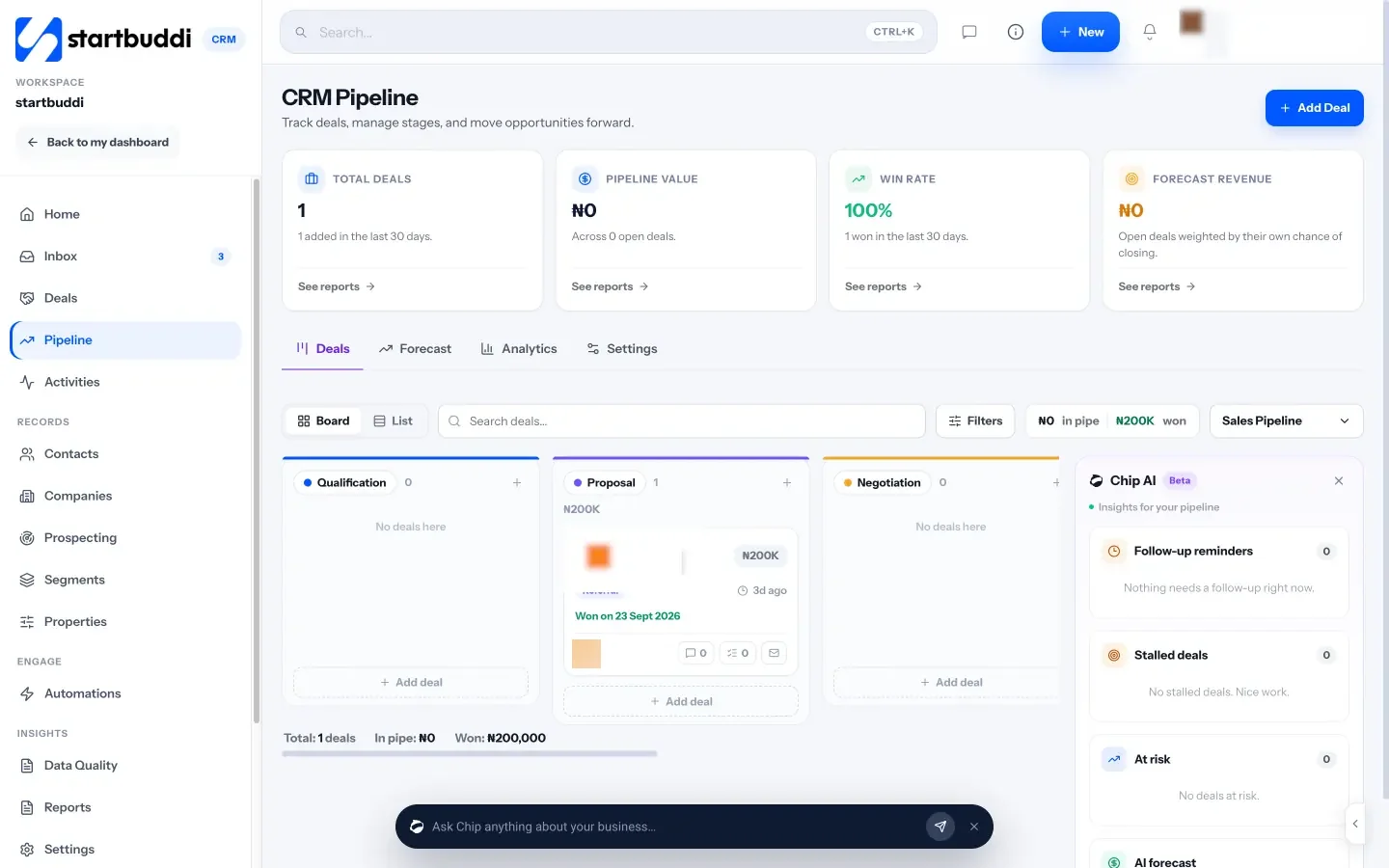
With Keep it current automatically switched on for a pipeline in Manage Pipelines, a deal moves out of the first stage when the contact replies, and is marked won when an invoice on the deal is paid. Each move is written to the deal’s history with the reason. An insights drawer lists stalled deals, deals at risk and follow-up reminders, and Chip can suggest moving a deal to the next stage, which you accept or put aside. The Forecast tab shows open deals, win rate and deals likely to close soon.
Your next step: book 20 minutes next Monday, open your pipeline and close or follow up every deal past its close date. The pipeline is part of Customers, and you can compare plans on the pricing page.
Related terms
FAQ
What is the difference between a sales pipeline and pipeline management?
The sales pipeline is the set of stages and the deals in them. Pipeline management is the regular work of reviewing, updating and moving those deals so the picture stays accurate.
How often should I review my pipeline?
Once a week works for most small businesses. A short, regular review stops stalled deals piling up and keeps your forecast honest.
When should I mark a deal as lost?
When the buyer says no, goes quiet after several genuine follow-ups, or misses the close date with no new date agreed. Record the reason so you can learn from it.
How many pipeline stages should I have?
Four to six is enough for most small businesses. Each stage should describe something that has clearly happened, such as a call booked or a proposal sent.
Omolola Akiyode is the operations and project manager at startbuddi, leading cross-functional projects and the content that helps founders get set up. Omolola writes about projects, websites and getting found online, and turns complex ideas into clear, practical steps.
Runs operations and projects at startbuddi