Best CRM for Insurance Agents: 11 Options Compared for 2026
The best CRM for insurance agents depends on whether you also need an AMS. 11 options compared on renewals, carriers, texting and price, checked Oct 2026.


Photo: Zarak Khan / Unsplash
The best CRM for insurance agents in a US independent agency is AgencyZoom, because it sits on top of your agency management system and automates renewals. AgencyBloc suits health, life and benefits agencies that want CRM and AMS in one. Nutshell is the best general CRM for a small agency on a budget. Prices were checked on 14 October 2026.
startbuddi is our product. It’s on this list, but it isn’t an insurance system, and we say plainly below where it falls short.
Key takeaways
- Decide first whether you need a CRM, an agency management system (AMS), or both. A CRM wins and keeps clients; an AMS holds policies, carriers, commissions and documents. Most P&C agencies need both, connected.
- Insurance-built tools understand policies, renewals, cross-sell by line and carrier downloads. General CRMs are cheaper and easier, but you’ll build those pieces yourself or do without.
- Compliance is part of the choice: who you can call or text, what you must record, and how long you keep it. The software helps; it doesn’t make you compliant.
- Outside the US, most insurance-built CRMs don’t fit local carriers or rules, so a general CRM plus your carrier’s own portals is often the practical answer.
Insurance CRMs compared
| Tool | Best for | Starting price (checked 14 Oct 2026) | Free plan | Standout feature |
|---|---|---|---|---|
| AgencyZoom | US independent P&C agencies with an AMS | $149/month (Essential, 7 seats) | No (14-day trial) | Renewal automation and AMS integration |
| AgencyBloc AMS+ | Health, life, senior and benefits agencies | Pricing on request | No | CRM, policies and commissions in one system |
| Momentum AMS | Small P&C agencies wanting a priced AMS | $119/month (Essentials, 1 user) | No (free trial) | Published prices with extra seats at $54 |
| EZLynx | Independent agencies wanting rating and AMS together | Pricing on request | No | Comparative rater for multiple carriers |
| HawkSoft | Independent P&C agencies wanting a long-standing AMS | Pricing on request | No | Independently owned AMS |
| Salesforce Financial Services Cloud | Large agencies and carriers | $325 per user/month, billed annually | No | Industry data model on Salesforce |
| Nutshell | Small agencies wanting a simple general CRM | $13 per user/month, billed annually | No (14-day trial) | Unlimited contacts on every plan |
| Zoho CRM | Budget agencies willing to customise | $14 per user/month, billed yearly | Yes (3 users) | Custom modules for policy records |
| HubSpot | Agencies focused on marketing and lead generation | Free; Starter from $20 per seat/month | Yes | Free CRM with forms and email |
| Less Annoying CRM | Solo agents who want simple and cheap | $15 per user/month | No (30-day trial) | One plan with every feature |
| startbuddi | Small agencies outside the US running on WhatsApp | See pricing | Yes | WhatsApp, email and website chat in one inbox |
Prices are in US dollars before tax, as each vendor shows them.
CRM or agency management system: which do you need?
This is the question most “best CRM” lists skip, and it decides everything else.
| Job | Insurance CRM | Agency management system |
|---|---|---|
| Capture and follow up leads | Yes, its main job | Sometimes, basic |
| Quote pipeline and sales tracking | Yes | Limited |
| Policy records, coverage and endorsements | Light, or synced from the AMS | Yes, the system of record |
| Carrier downloads and rating | Through integrations | Yes, or through a rater |
| Commissions | Some (AgencyBloc) | Yes |
| Renewal and cross-sell campaigns | Yes | Reminders, less marketing |
| Certificates and ID cards | No | Yes |
- A captive agent (selling for one carrier) usually gets policy and quoting tools from the carrier, so a CRM for leads, follow-ups and referrals is often enough. Check your carrier’s rules on outside software first.
- An independent P&C agency almost always needs an AMS, then a CRM that integrates with it.
- A health, life or benefits agency often does best with a combined system built for those lines.
- A small broker outside the US (for example in Lagos, Nairobi or Accra) rarely finds a local AMS that fits, and runs on carrier portals plus a general CRM.
What an insurance agent needs from a CRM
Beyond contacts and a pipeline, look for:
- Policy and renewal tracking: renewal dates per policy, with tasks or campaigns triggered ahead of them.
- Household and line-of-business view: who has auto but not home, so you can cross-sell.
- Quote-to-bind pipeline: where every quote stands, by producer.
- Carrier and AMS integration: so policy data isn’t typed twice.
- Two-way texting and call logging: most clients answer a text before an email.
- Referral tracking: many agencies live on referrals from clients, realtors and dealers.
- Commission tracking: if you pay producers, you need to reconcile what carriers paid.
Compliance to keep in mind
Rules depend on where you’re licensed and what you sell, so check with your regulator or compliance adviser. A few examples of what the software has to support:
- United Kingdom: the FCA’s Consumer Duty “requires firms to put their customers’ needs first”, which means records that show how advice and renewals were handled. For marketing calls, the ICO’s telephone marketing guidance says you must not call numbers on the Telephone Preference Service “unless that person has specifically consented to your calls”.
- United States: calls and texts fall under federal telemarketing and Do Not Call rules, plus your state’s licensing and record-keeping requirements. Your CRM should record consent and opt-outs per contact.
- Nigeria: insurance agents and brokers are licensed by NAICOM, and customer data falls under the Nigeria Data Protection Act. Record consent before you add clients to WhatsApp or SMS broadcasts.
How we chose
We looked at tools an agency of one to about 20 people could run, and judged them on:
- Insurance fit: policies, renewals, cross-sell, carriers and commissions.
- Integration: with the major agency management systems and raters.
- Communication: texting, email sync and call logging.
- True cost: published price, seats included, setup.
- Honesty about limits.
Every price comes from the vendor’s own site, checked on 14 October 2026. Where a vendor only gives prices on request, we say so. We didn’t run hands-on tests and don’t quote review scores. We left out Radius (radiusbob), which older lists still name: its own site says it “is no longer sold as a standalone product” and its tools now live inside AgencyBloc’s AMS+.
1. AgencyZoom
AgencyZoom is a sales and retention CRM for independent insurance agencies, owned by Vertafore.
Best for: US independent P&C agencies that already have an AMS and want automation for new business, renewals and service.
Key features
- Lead management, quote pipeline, producer goals and referral tracking.
- AMS integration; its pricing page says this “includes most major agency management systems” and some “may require additional costs”.
- Renewal automation, two-way email and two-way texting from the Growth plan.
Pricing: AgencyZoom’s pricing page lists Essential at $149 a month, Growth at $199 and Pro at $349, each with a 14-day trial, and “Each plan comes with 7 seats”. Annual billing takes 20% off. Its FAQ says it doesn’t replace your AMS: it “acts as an extension to your AMS”.
Pros
- Built for how P&C agencies sell and retain.
- Seven seats included makes it reasonable for a small team.
Cons
- Renewal automation and texting aren’t on Essential.
- You still need, and pay for, an AMS.
Skip it if you’re outside the US or a captive agent with carrier-supplied tools.
2. AgencyBloc AMS+
AgencyBloc makes an agency management system for health, life, senior and benefits insurance, now including the tools from Radius.
Best for: agencies selling health, life, Medicare or group benefits that want CRM, policies and commissions in one place.
Key features
- Client and policy management, with sales tools carried over from Radius.
- Commissions+ to link “agents, policies, and commissions data together”.
- Quote+ for small group quoting and enrolment.
Pricing: AgencyBloc’s pricing page asks you to “Request Customized Pricing Info” and book a demo. Pricing on request.
Pros
- Commission tracking is built in, which general CRMs lack.
- Designed for the lines it serves.
Cons
- No public prices.
- Less suited to P&C agencies.
Skip it if you mainly sell auto and home.
3. Momentum AMS
Momentum AMS is an agency management system for independent agencies, with published prices.
Best for: small P&C agencies that want a priced AMS with client management, rather than a quote-only sales process.
Key features
- Policy and client management in one system.
- Add-on products for marketing, rating and voice.
Pricing: Momentum’s pricing page lists Essentials at $119 a month for 1 user, Professional at $199 for 2 users and Business at $419 for 5 users, with extra seats at $54 each. Enterprise is on request. A free trial is offered.
Pros
- Rare in this market: prices you can see before a demo.
- Starts small, at one user.
Cons
- It’s an AMS first; sales automation is lighter than a dedicated CRM.
- Add-ons are priced separately.
Skip it if you already have an AMS and only need a sales CRM.
4. EZLynx
EZLynx, part of Applied Systems, combines an agency management system, a comparative rater and agency websites.
Best for: independent agencies that want rating and management from one supplier.
Key features
- Management of quotes, policies, documents and service requests.
- A comparative rater: “Quote multiple carriers in real time with just one entry.”
- Agency websites.
Pricing: the EZLynx site offers “special pricing” through a form. Pricing on request.
Pros
- Rating built in saves rekeying.
- Backed by a large insurance software company.
Cons
- No published prices.
- More system than a two-person agency may need.
Skip it if you only want a sales CRM.
5. HawkSoft
HawkSoft is an agency management system for independent agencies, independently owned.
Best for: independent P&C agencies looking for an AMS with a long track record.
Key features
- Client and policy management for independent agencies.
- A product tour and partner integrations listed on its site.
Pricing: the HawkSoft site asks you to contact sales. Pricing on request.
Pros
- Focused on independent agents only.
- Often paired with a sales CRM for the best of both.
Cons
- No public prices.
- You’ll want a separate CRM for marketing and pipeline.
Skip it if you’re a captive agent.
6. Salesforce Financial Services Cloud
Financial Services Cloud is Salesforce’s industry CRM for banks, wealth managers and insurers.
Best for: large agencies, MGAs and carriers with an admin or partner to configure it.
Key features
- Industry-specific data models built on Sales Cloud.
- Segmentation, financial goals and plans.
- AI and automation on higher editions.
Pricing: Salesforce’s Financial Services Cloud pricing lists Sales Core at $325 per user a month, billed annually, and Sales Advanced at $500.
Pros
- Almost unlimited customisation.
- Large partner ecosystem.
Cons
- Expensive per user, before implementation.
- Needs specialist help to set up well.
Skip it if you’re under about 20 people. Our Salesforce alternatives list covers lighter options.
7. Nutshell
Nutshell is a general sales CRM with email marketing and forms included.
Best for: small agencies that want an affordable CRM and will track renewals as tasks and pipelines.
Key features
- Pipelines, email and calendar sync, forms and landing pages.
- Webchat and an AI chatbot on every plan.
Pricing: Nutshell’s pricing page starts at $13 per user a month billed annually (“Save $6/month with annual billing”), with “unlimited contacts & storage” and a 14-day trial.
Pros
- Low price with unlimited contacts.
- Marketing tools included.
Cons
- No policy, carrier or commission features.
- You build the insurance process yourself.
Skip it if you need AMS integration.
8. Zoho CRM
Zoho CRM is a customisable general CRM with a free edition.
Best for: budget-conscious agencies happy to set up custom modules for policies and renewals.
Key features
- Custom modules and workflow rules on paid plans.
- Telephony and email integrations.
Pricing: Zoho CRM’s pricing page lists a free edition for 3 users, and Standard at $14 per user a month billed yearly ($20 monthly). Custom modules start on Standard.
Pros
- Cheap and very flexible.
- Free plan to test with.
Cons
- No insurance features out of the box.
- Setup takes real time.
Skip it if you want something insurance-ready. See startbuddi vs Zoho.
9. HubSpot
HubSpot is a CRM platform with free tools and paid marketing, sales and service hubs.
Best for: agencies that win business through content, ads and online forms.
Key features
- Free CRM, forms, landing pages and email.
- Sequences and automation on paid hubs.
Pricing: HubSpot’s product catalogue lists free tools for up to 1,000 contacts and Smart CRM Starter from $20 per seat a month.
Pros
- Strong for lead nurturing and marketing.
- Free to start.
Cons
- No insurance data model or AMS connections out of the box.
- Gets expensive at Professional.
Skip it if most of your business is renewals and service. More in startbuddi vs HubSpot.
10. Less Annoying CRM
Less Annoying CRM is a simple CRM with one plan and every feature included.
Best for: a solo agent who wants contacts, follow-ups and a pipeline without complexity.
Key features
- Contacts, tasks, calendar, unlimited pipelines.
- 25 GB file storage per user.
Pricing: Less Annoying CRM’s pricing page shows $15 per user a month plus tax, with a 30-day trial.
Pros
- Very easy to learn.
- Predictable price.
Cons
- No texting, automation or insurance features.
Skip it if you want automated renewal campaigns. See startbuddi vs Less Annoying CRM.
11. startbuddi
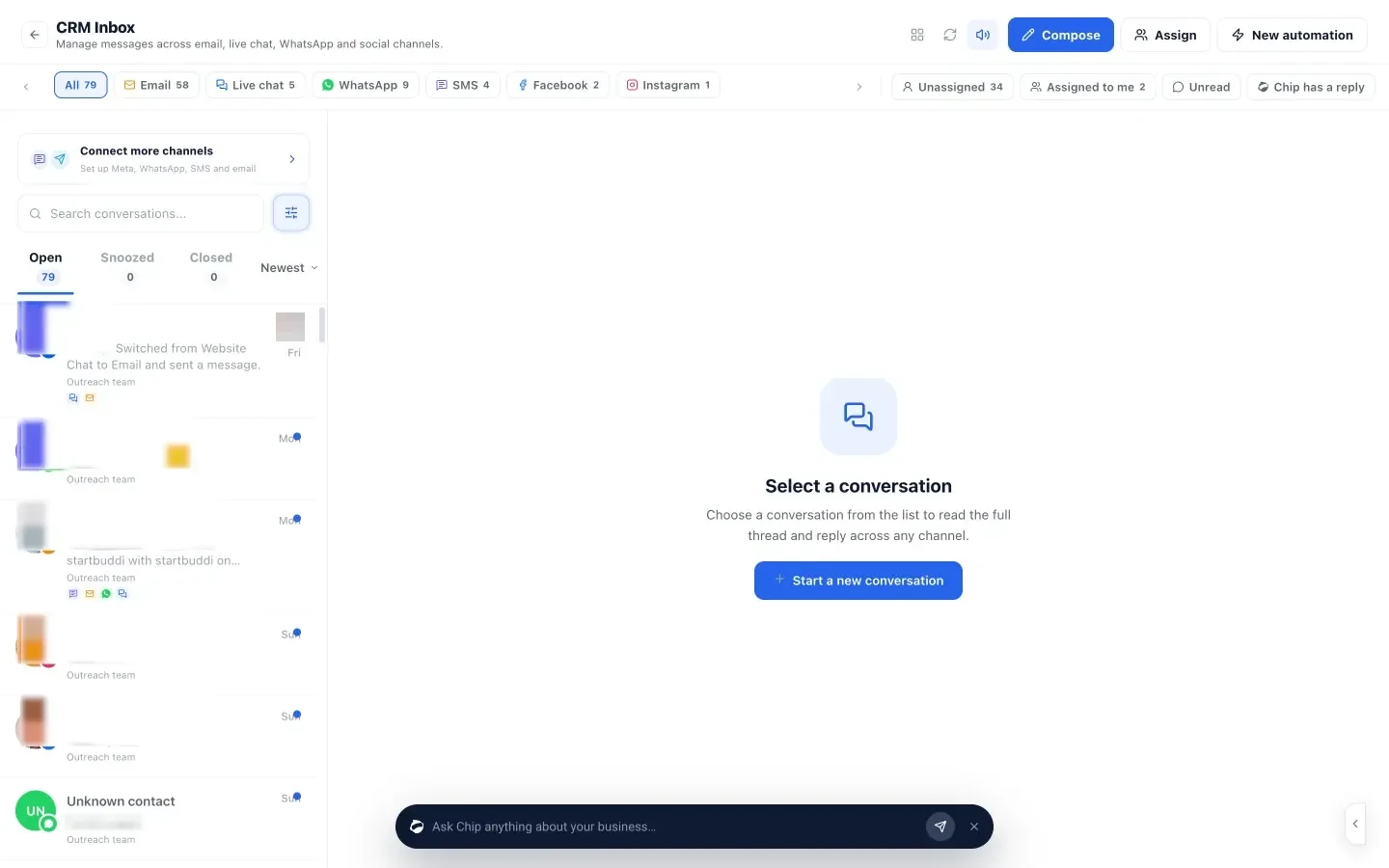
startbuddi is an all-in-one workspace for small service businesses: contacts and deals, a shared inbox, bookings, documents with e-signatures, invoices and payments, with Chip, an AI assistant, on every screen.
Best for: a small agency or broker outside the US, for example in Lagos or Nairobi, whose clients message on WhatsApp and who needs a tidy contact list and follow-ups alongside the carriers’ own portals.
Key features
- One inbox for email, website chat, WhatsApp and SMS (WhatsApp and SMS from Starter), with notes shared on the contact.
- A deal pipeline for quotes, custom fields for policy type and insurer, tasks and activities.
- Documents with e-signatures for proposals and client forms; payment links by card, transfer, USSD or mobile money through Paystack.
Pricing: free plan available; see pricing.
Pros
- WhatsApp-first communication, which is how many clients in Africa prefer to talk.
- CRM, documents and payments in one place.
Cons
- Not an insurance system: no policy records, carrier downloads, rating or commission tracking.
- Its automations can’t fire from a date field, so renewal reminders have to be set as tasks by hand.
- No compliance archiving of calls and texts, and no AMS integration.
Skip it if you’re a US P&C agency; AgencyZoom with an AMS will serve you far better. For the wider picture, see our WhatsApp CRM page.
How to choose the best CRM for insurance agents and agencies
| Your situation | Start with |
|---|---|
| US independent P&C agency with an AMS | AgencyZoom |
| US independent agency without an AMS | Momentum AMS, EZLynx or HawkSoft, then add a CRM if needed |
| Health, life, senior or benefits | AgencyBloc AMS+ |
| Captive agent | Your carrier’s tools, plus Less Annoying CRM or Nutshell for follow-ups |
| Large agency or carrier | Salesforce Financial Services Cloud |
| Small broker outside the US | Zoho CRM, HubSpot or startbuddi alongside carrier portals |
Before you sign, ask each vendor:
- Does it integrate with my AMS and rater, and at what extra cost?
- Can it trigger renewal campaigns from policy dates?
- How does it record consent and opt-outs for calls and texts?
- What does onboarding cost, and how long does it take?
- Can I export everything if I leave?
Free options to test with are in our best free CRM guide, and the general best CRM software list covers tools beyond insurance. Agencies in Nigeria should also read the best CRM software in Nigeria.
Try startbuddi
If you’re a small broker who runs on WhatsApp and wants clients, follow-ups, documents and payments in one place, start free with no card and import your client list from a CSV. Keep your carrier portals for policies. Our CRM for service businesses page shows the setup, and pricing shows what each plan includes. If you’re new to CRMs, start with what a CRM does for a small business.
Frequently asked questions
What is the best CRM for insurance agents?
For US independent P&C agencies, AgencyZoom is the strongest pick because it integrates with most agency management systems and automates renewals. Health, life and benefits agencies usually do better with AgencyBloc. Small agencies on a budget can start with Nutshell or Zoho CRM.
What is the difference between an insurance CRM and an AMS?
A CRM manages leads, quotes, follow-ups and marketing. An agency management system is the system of record for policies, carriers, documents and commissions. Most independent agencies need both, connected so that policy data flows into the CRM.
What CRM do insurance agents recommend on Reddit?
Forum threads are a useful shortlist, but they date quickly. Radius, for example, is no longer sold on its own, according to its website, and its tools are now part of AgencyBloc's AMS+. Check every recommendation against the vendor's current site before you book a demo.
Can I use a general CRM for an insurance agency?
Yes, if you're a captive agent or a small broker without complex policy data. General CRMs like Zoho CRM, HubSpot and Nutshell handle leads and follow-ups well. You'll have to track renewals, lines of business and commissions yourself, or keep them in an AMS.
How much does an insurance CRM cost?
Published prices on this list range from free (HubSpot and Zoho CRM free editions) to $325 per user a month for Salesforce Financial Services Cloud. AgencyZoom starts at $149 a month with 7 seats included, and Momentum AMS at $119 a month for 1 user. Several insurance vendors only quote on request.
What is the best CRM for an insurance broker outside the US?
Most insurance-built CRMs are designed around US carriers and agency systems. Brokers in the UK, Nigeria or Kenya often use a general CRM such as Zoho CRM, HubSpot or startbuddi alongside insurers' own portals. Check that the CRM supports your consent and data protection rules.
Tiwalade Joanna Okedara-Kalu is the founder, CEO and CTO of startbuddi, the business system that brings clients, bookings, invoices, projects, marketing and the Chip AI assistant into one place. Tiwalade builds software around how service businesses really work day to day, and writes about client management, getting paid on time and why small businesses outgrow the tools they start with.
Founded startbuddi and leads its product and engineering