Online Payment Methods: A Practical Guide for Small Businesses
Online payment methods explained for small businesses: cards, bank transfer, USSD, mobile money, wallets and direct debit, what each suits and how to pick.


Online payment methods are the ways a customer can pay you over the internet: debit and credit cards, bank transfers, USSD, mobile money, digital wallets such as PayPal or Apple Pay, direct debit and buy now, pay later. Most small businesses need two or three, chosen to match how their customers already like to pay.
Key takeaways
- Offer the methods your customers already use. In Lagos that’s often transfer and card; in Nairobi, mobile money; in London, card and wallets.
- Fees vary a lot by method. A local bank transfer through a payment provider can cost a fraction of an international card.
- Payment links, QR codes and invoices are ways to deliver a payment request. The method is what the customer pays with on the other side.
- Bank transfers to your account number cost little but need checking by hand. Provider-backed transfers confirm themselves.
- Every method you add should land in one record, or your books will drift.
Why online payment methods matter
The easier it is to pay you, the faster you get paid. A client who wants to pay by transfer at 10pm shouldn’t have to wait for you to send account details in the morning. A customer abroad shouldn’t be told “card only” if their card is declined for international use.
Method choice also changes what you keep, because providers charge different rates for cards, transfers and international payments. Across a year of jobs that adds up, so check your provider’s pricing page for each method you offer.
There’s a trust side too. A clear checkout page with your business name, a receipt by email and a familiar method reassure a first-time client far more than a bank account number pasted into a chat. For a new business without many reviews, that reassurance helps close the sale.
The main online payment methods
Debit and credit cards
The default almost everywhere. The customer enters card details on a secure checkout page, often with a one-time code from their bank. Cards work across borders, which makes them the safest choice for international clients, but international cards usually cost more. Card data is covered by the PCI Data Security Standard (checked on 1 October 2026), which applies to everyone involved in card processing. Using a provider’s hosted checkout keeps most of that burden off your business.
Bank transfer
Very common in Nigeria and for business clients everywhere. There are two kinds:
- Direct to your account number. Cheap or free, but you have to check your bank to confirm it arrived, and fake “transfer screenshots” are a known trick.
- Through a payment provider. The provider gives the customer an account number for that payment and confirms it automatically when the money lands.
USSD
Customers dial a short code on any phone, with no internet or smartphone needed, and approve the payment through their bank. Useful in Nigeria for customers without cards or reliable data.
Mobile money
Wallets on a phone number, such as M-Pesa in Kenya or MTN MoMo in Ghana. In much of East and West Africa this is how most people pay, so a business there that can’t take mobile money is turning customers away.
Digital wallets
PayPal, Apple Pay and Google Pay store a customer’s card or balance so they can pay in a tap. They’re popular with customers in the US, UK and Europe, and with freelancers billing clients abroad.
Direct debit and ACH
The customer authorises you to pull payments from their bank account, which suits retainers and memberships. In the US this runs over ACH. Bank debits usually cost less than card payments; check your provider’s pricing page for current rates.
Buy now, pay later
The customer pays in instalments and you’re paid upfront, minus the provider’s fee. Some providers offer it at checkout, such as Afterpay through Square; check the rate on your provider’s pricing page. It can help with larger one-off purchases, but most services don’t need it.
How online payments work
Behind most methods sits a payment gateway such as Paystack or Stripe. The flow is the same:
- You create a payment request: an invoice, a payment link, a checkout on your site or a QR code.
- The customer picks a method on the provider’s checkout page and pays.
- The provider confirms the payment to you and to the customer.
- The money settles to your bank, minus fees. Paystack (checked on 1 October 2026) settles to your bank the next working day.
- You record it against the invoice or sale, so your bookkeeping matches the bank.
Payment links and QR codes are just quicker ways to start step 1, handy for sending in a WhatsApp chat or showing on a counter. If a customer disputes a card payment with their bank, you may face a chargeback, which is one reason to keep clear records of what was paid for.
What each method costs
Providers price each method differently, and rates change, so check the current figures on your provider’s own page. Paystack’s pricing page lists its rates for Nigeria and its other countries, and Stripe’s pricing page lists its rates by country.
A few patterns hold in most countries:
- Bank-based methods, such as transfers and direct debit, usually cost less than cards.
- International cards and currency conversion usually cost the most.
- Some providers cap the fee on large local payments, which matters if you send big invoices.
- A fixed amount per payment weighs more on a small sale than on a large one.
Our comparison of the best online payment solutions covers the providers themselves.
How to choose online payment methods for your business
- List how your last 20 customers paid, or asked to pay. That’s your starting point.
- Cover local and international. A Lagos agency with UK clients needs Nigerian methods (transfer, card, USSD) and an international card option.
- Match the method to the sale. Small, frequent payments suit wallets, USSD and mobile money. Big invoices suit transfers. Retainers suit direct debit or subscriptions.
- Check settlement times and when money reaches your bank, not just the fee.
- Keep it to two or three methods you can reconcile easily, then add more if customers ask.
| Business | Good starting mix |
|---|---|
| Salon in Lagos | Card, transfer and USSD through one provider |
| Consultant in Nairobi | Mobile money and card |
| Freelance designer in London with US clients | Card and a digital wallet |
| Agency in Accra on monthly retainers | Mobile money, transfer and a recurring subscription |
If you’re in Nigeria, how to create a payment link shows the quickest way to start.
Common mistakes with online payments
- Trusting a screenshot. Confirm transfers in your bank or provider dashboard before you deliver.
- Offering only one method. One declined card or one bank outage and the sale stalls.
- Ignoring international fees. Price overseas work to absorb them, or invoice in the client’s currency through a provider that supports it.
- Not recording payments against invoices. You end up chasing clients who’ve already paid.
- Mixing business and personal accounts. It makes reconciling and tax far harder.
How to take online payments in startbuddi
startbuddi isn’t a payment provider and never holds your money. You connect your own Paystack or Stripe account in Money Manager, and payments go straight to you.
- Connect a provider. In Money Manager, open Settings and connect Paystack (card, bank transfer, USSD and mobile money) or Stripe (card), or both.
- Send an invoice with a pay button. Invoices can also show your bank details for a direct transfer; record the payment when it arrives.
- Use Get Paid for quick sales. Create a payment link for a WhatsApp chat, a pay me page for your bio, or print a QR code from Scan to pay.
- Take deposits on bookings. In Bookings, switch on “Require payment to book” for the full amount or a deposit.
- Sell subscriptions for retainers and memberships; renewals are charged by your provider.
Payments land in Transactions and match themselves to what they were for. Apple Pay and Google Pay aren’t offered in startbuddi.
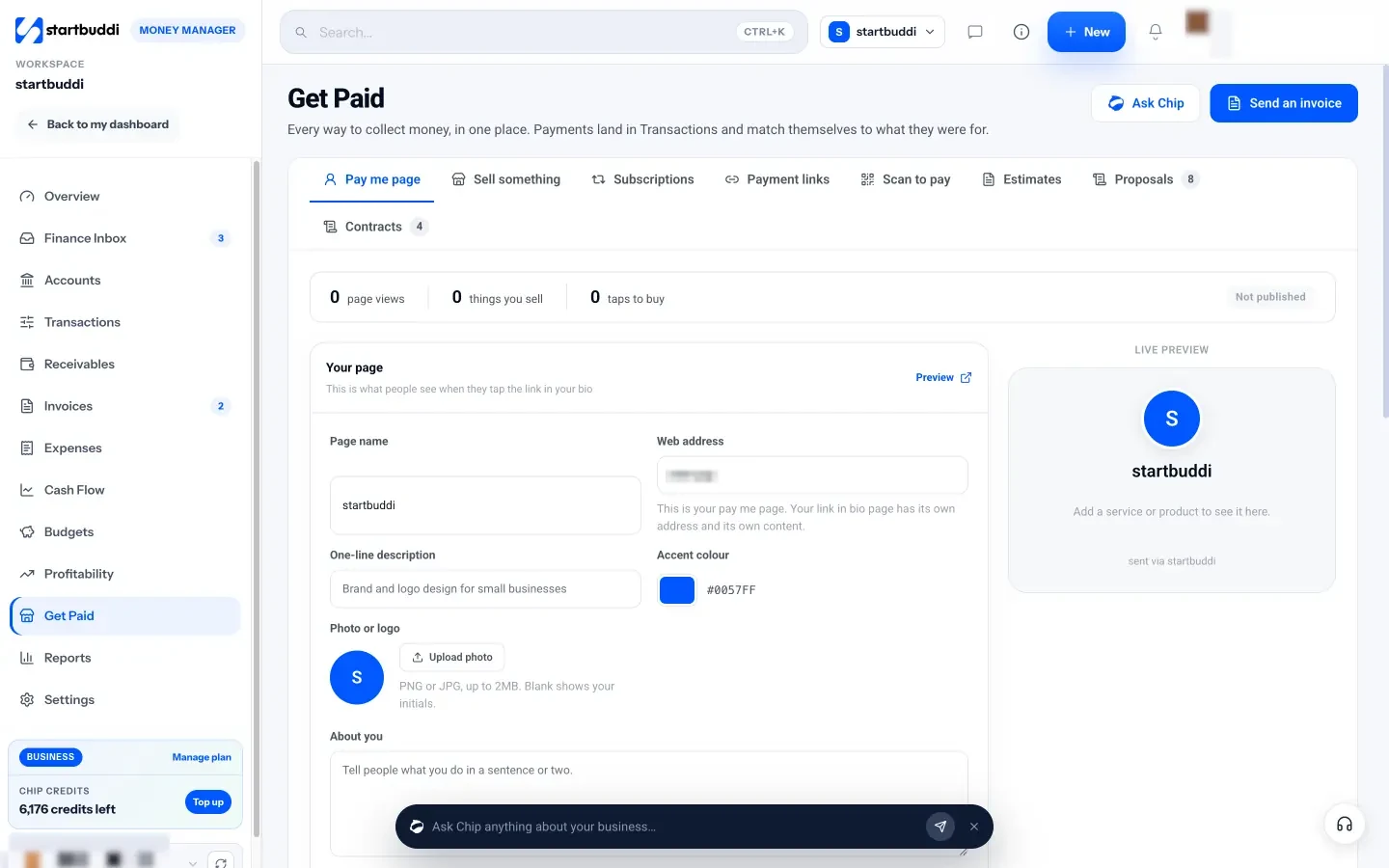
See Get Paid, how payment links for freelancers work, or start with our guide to sending your first invoice. For in-person tap payments, see our explanation of contactless payment.
Get paid the way your customers want to pay
Connect Paystack or Stripe, then send invoices, payment links and QR codes from one place. Start free with startbuddi, no card needed.
Frequently asked questions
What are the most common online payment methods?
The most common are debit and credit cards, bank transfers, digital wallets like PayPal and Apple Pay, mobile money and direct debit. Which ones matter depends on your country: cards and wallets lead in the US and UK, transfers and cards in Nigeria, and mobile money in Kenya and Ghana.
What is the cheapest way to accept payments online?
Bank-based methods are usually cheapest. A direct transfer to your account number costs little, and transfers through a payment provider usually cost less than cards. International cards are usually the most expensive. Check your provider's own pricing page for current rates.
Are online payments safe for small businesses?
Yes, when you use an established provider's hosted checkout. The provider handles card security and fraud checks. Your main risks are fake transfer confirmations and chargebacks, so confirm payments in your dashboard and keep records of what each payment was for.
Do I need a website to accept online payments?
No. You can send an invoice with a pay button, share a payment link in WhatsApp or email, or show a QR code. A payment provider such as Paystack or Stripe processes the payment, and the money settles to your bank.
How many payment methods should a small business offer?
Two or three is enough for most. Cover the methods most of your customers use locally, plus one that works for international clients if you have them. Add more only when customers ask, because each method is another thing to reconcile.
What is the difference between a payment method and a payment gateway?
A payment method is how the customer pays, such as a card or mobile money. A payment gateway is the service that processes it, such as Paystack or Stripe. One gateway usually supports several methods.
Omolola Akiyode is the operations and project manager at startbuddi, leading cross-functional projects and the content that helps founders get set up. Omolola writes about projects, websites and getting found online, and turns complex ideas into clear, practical steps.
Runs operations and projects at startbuddi