Bookkeeping: Definition, Examples and How It Works

Bookkeeping is the day-to-day recording of a business's financial transactions: every sale, payment, expense and transfer, with its date, amount, category and supporting document. Accurate books are what accounts, tax returns and financial decisions are built from.
So what is bookkeeping in practice? It’s the routine of entering what happened, keeping the proof and checking your records against the bank, usually weekly or monthly, so the numbers can be trusted when someone needs them.
Key takeaways
- Bookkeeping records transactions. Accounting interprets them, prepares statements and handles tax.
- Every entry needs proof: an invoice, a receipt, a bank statement line.
- Single-entry bookkeeping suits very small businesses; double-entry is the standard for companies and anyone who needs a balance sheet.
- Reconciling your books with the bank is the step that catches mistakes.
- Tax authorities require you to keep records for years: six in Nigeria, five after the filing deadline for UK sole traders.
Why bookkeeping matters for a small business
Without books, you’re guessing. You can’t tell which clients are profitable, how much tax to set aside, or whether a quiet month is a blip or a trend. Banks and investors will ask for records before lending, and tax authorities can ask for them years later.
It’s also a legal requirement in most countries. Section 31 of Nigeria’s Tax Administration Act 2025 (checked on 1 October 2026) says every person must keep books or records of accounts, in English, whether or not they are liable to pay tax, and keep them for at least six years after the year of assessment the income relates to.
For bookkeepers and accountants, clean books from a client are the difference between a two-hour month-end and a two-day one.
How bookkeeping works
The routine is the same whatever software you use:
- Capture every transaction: sales invoices, payments received, bills, receipts and bank charges.
- Record each one with its date, amount, who it was with and a category.
- Keep the proof. The US tax authority’s Publication 583 (checked on 1 October 2026) lists supporting documents such as sales slips, paid bills, invoices, receipts, deposit slips and cancelled cheques.
- Track what’s owed both ways: accounts receivable from clients and bills you haven’t paid yet.
- Reconcile your records against bank and payment statements, and fix anything that doesn’t match.
- Close the period and hand over reports: profit and loss, cash flow and, for double entry, a balance sheet.
Single-entry vs double-entry bookkeeping
| Single entry | Double entry | |
|---|---|---|
| How it works | One line per transaction, like a cash book | Every transaction recorded twice, as a debit and a credit |
| What it produces | Income, expenses, profit | Profit and loss and a balance sheet |
| Error checking | Weak: mistakes are easy to miss | Built in: debits must equal credits |
| Best for | Sole traders and very small businesses | Companies, businesses with stock, loans or staff |
IRS Publication 583 describes a single-entry system as one based on the income statement, and a double-entry system as one that uses journals and ledgers, with transactions entered in a journal and then posted to ledger accounts.
What is bookkeeping compared with accounting?
Bookkeeping is recording and organising. Accounting uses those records to prepare financial statements, advise on tax and plan. A bookkeeper makes sure the books are complete and correct; an accountant signs off the accounts and the tax return. In small businesses the owner often does the bookkeeping and pays an accountant at year end.
An example with numbers
These figures are illustrative.
Ama runs a small bookkeeping practice in Accra. A new client, a photography studio, hands her a month of records. Here’s part of the cash book after she enters and categorises them:
| Date | Description | Category | Money in (GHS) | Money out (GHS) | Proof |
|---|---|---|---|---|---|
| 2 Nov | Wedding shoot, balance | Client payment | 6,500 | Invoice 041, bank line | |
| 4 Nov | Studio rent | Rent | 2,800 | Lease, bank line | |
| 9 Nov | Lens hire | Equipment hire | 450 | Receipt | |
| 15 Nov | Product shoot, deposit | Client payment | 1,500 | Invoice 043, mobile money | |
| 20 Nov | Editing software | Software | 220 | Card statement | |
| Totals | 8,000 | 3,470 |
Net for these entries: 8,000 − 3,470 = GHS 4,530. When Ama reconciles, the bank shows GHS 30 less: a bank charge the studio never recorded. She adds it under Bank fees and the books match. That one check is why reconciliation matters.
How long to keep bookkeeping records
The period depends on where you pay tax:
- Nigeria: at least six years after the year of assessment (Tax Administration Act 2025, section 31).
- United Kingdom: sole traders keep records for at least five years after the 31 January submission deadline of the tax year (checked on 1 October 2026).
- United States: the IRS’s general rule is three years (checked on 1 October 2026), longer in some cases, such as six years if income was under-reported by more than 25%.
Keep digital copies, backed up somewhere other than one phone. Our bookkeeping client onboarding checklist is for bookkeepers taking on new clients.
Related terms
- Cash flow: the money moving in and out, which your books record.
- Accounts receivable: money clients owe, tracked as part of bookkeeping.
- Expense tracking: recording what the business spends, with receipts.
How startbuddi handles bookkeeping
startbuddi isn’t accounting software: it has no general ledger, no double-entry accounts and no tax filing. What it does is keep the records a bookkeeper needs in one place. Invoices and payments are recorded in Money Manager, payments through Paystack and Stripe appear in Transactions and match themselves to their invoices, and expenses carry a category and an attached receipt. Reports shows a cash-basis profit and loss and a running total of tax added to invoices, and Export CSV gives your bookkeeper or accountant the raw data.
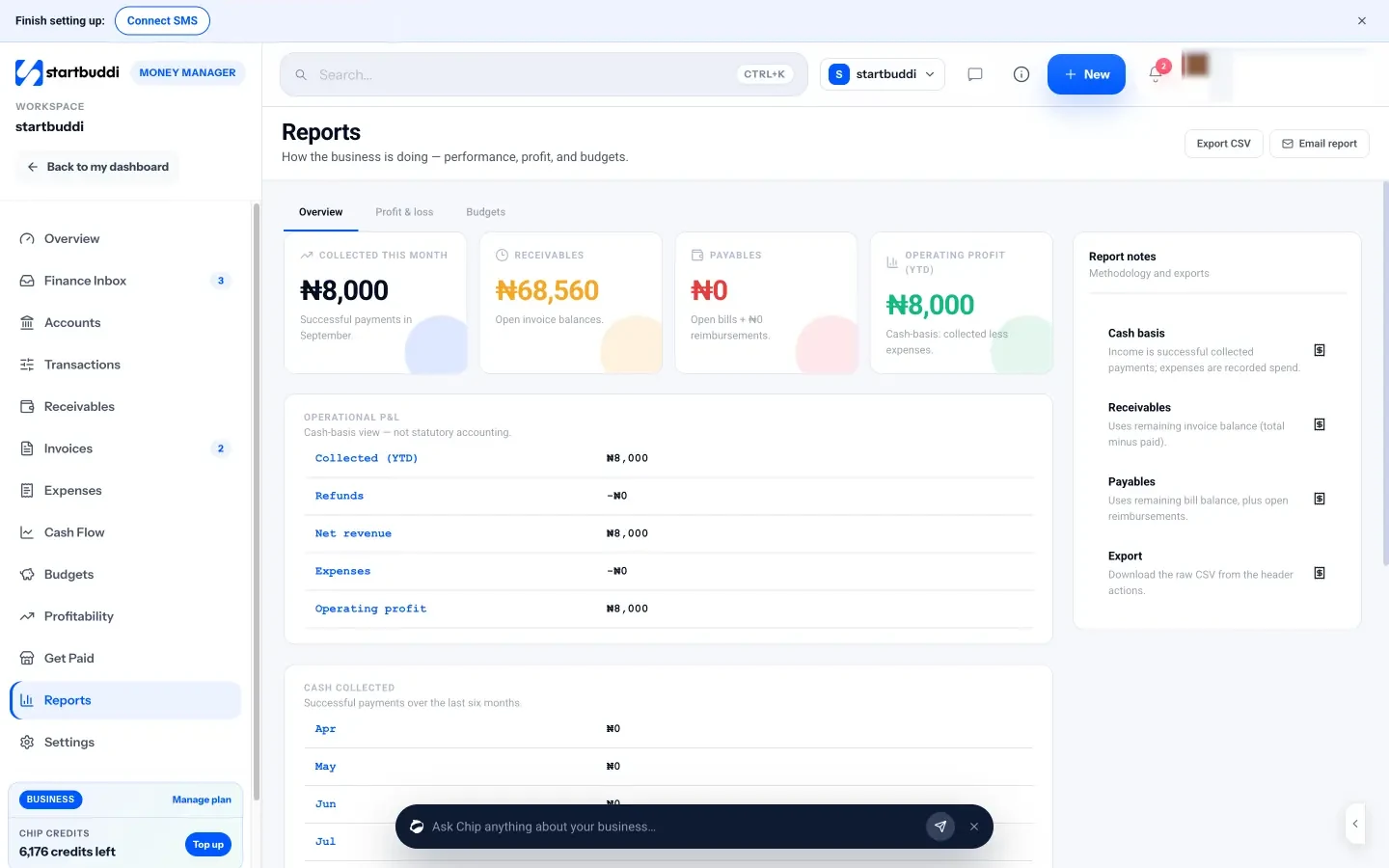
See Money Manager reports, or read about the reports built from your books in our guide to financial statements for small business.
Keep clean records without the extra admin
Send invoices, take payments, log expenses with receipts and export everything for your accountant. Start free with startbuddi, no card needed.
Bookkeeping is part of Money Manager in startbuddi.
See Money ManagerRelated terms
FAQ
What is bookkeeping in simple terms?
Bookkeeping is keeping an accurate record of all the money that comes into and goes out of a business. Each transaction is written down with its date, amount and category, and backed by a receipt or invoice. Those records are then used for accounts, tax and decisions.
What is the difference between bookkeeping and accounting?
Bookkeeping records and organises transactions. Accounting uses those records to prepare financial statements, work out tax and give advice. A bookkeeper keeps the books correct; an accountant interprets them and usually prepares the tax return.
Can I do my own bookkeeping?
Yes. Many small business owners do their own bookkeeping with a spreadsheet or an app, especially in the first years. Set aside time every week, keep every receipt and reconcile with your bank monthly. Bring in a bookkeeper or accountant when it takes too long or the business gets more complex.
What is double-entry bookkeeping?
Double-entry bookkeeping records every transaction twice, as a debit in one account and a credit in another. Because the two sides must balance, it catches mistakes and produces a balance sheet as well as a profit and loss. Most companies use it.
How often should bookkeeping be done?
Weekly is best for most small businesses: enter transactions and file receipts while they're fresh. Reconcile with your bank at least monthly. Leaving it until year end makes mistakes harder to find and costs more if you pay someone to fix it.
Chinedu Kalu is the co-founder and chief operating officer of startbuddi, responsible for how the company runs day to day. Chinedu writes about the operational side of a small business: registering and running the company, money, hiring and the routines that keep a team on track.
Co-founded startbuddi and runs its operations