Bookkeeping Client Onboarding Checklist: Step-by-Step List + Free Template
A bookkeeping client onboarding checklist from first call to first month-end: engagement letter, ID checks, bank access, opening balances and documents.


A bookkeeping client onboarding checklist is the list of steps you work through between “yes, let’s work together” and the first clean month-end: agree the scope in a signed engagement letter, run identity and money laundering checks, get professional clearance, collect bank and software access, gather records, set opening balances and fix a monthly rhythm for documents.
Key takeaways
- Nothing starts until the engagement letter is signed and the identity checks are done. Those two steps protect you more than any other.
- Ask for read-only access wherever you can. You need to see the money, not move it.
- Agree a cut-off date and opening balances before you post a single transaction.
- Set the monthly document deadline in week one, or month-end will always be late.
- Copy the checklist below as your template and run every new client through it the same way.
Why bookkeepers need their own onboarding checklist
A generic onboarding list covers the contract, the kick-off call and a welcome email. Bookkeeping needs more, because you are about to handle someone’s bank data, payroll and tax position. Get it wrong and the cost shows up months later: a missing loan account, opening balances that never reconcile, or receipts arriving in a carrier bag on the 28th.
There is also a compliance side that most service businesses don’t have. In the UK, professional bookkeeping is one of the accountancy services covered by the money laundering rules, and you must be supervised either by HMRC or by a professional body, as GOV.UK’s guidance for accountancy service providers explains (checked on 1 October 2026). In Nigeria, the EFCC’s Special Control Unit against Money Laundering lists “Accountants and Accounting Firms” among the businesses under its mandate (checked on 1 October 2026). Wherever you work, check which rules apply to you before you take on your first client.
If you want the general version for any service business, our chapter on the client onboarding process covers the first 48 hours. The list below is the bookkeeping-specific one.
The bookkeeping client onboarding checklist
Copy this list into your own template. Each phase ends with something you can check off before moving on.
1. Before you say yes
2. Proposal and engagement letter
3. Identity and money laundering checks
4. Professional clearance from the previous bookkeeper
5. Access and authorisations
6. Records to gather
7. Set up the books
8. Kick-off and monthly rhythm
9. First month-end
Worked example: a 30-day onboarding plan
The dates and client below are illustrative. Ifeoma runs a two-person bookkeeping practice in Lagos and signs a new client, a small interior design studio with two bank accounts, a Paystack account and four staff on payroll. She takes over from 1 October.
| Day | What happens | Who does it |
|---|---|---|
| 1 | Discovery call; proposal sent the same afternoon | Ifeoma |
| 3 | Engagement letter signed; first monthly invoice sent | Client, Ifeoma |
| 4 | ID documents and CAC registration checked; risk note filed | Ifeoma |
| 5 | Clearance letter sent to the previous accountant | Ifeoma |
| 7 | Read-only bank access, accounting software login and Paystack view access set up | Client |
| 10 | Handover file and September trial balance received | Previous accountant |
| 12 | Chart of accounts agreed; opening balances entered at 30 September | Ifeoma |
| 14 | Kick-off call; documents due by the 5th working day each month | Both |
| 30 | First month reconciled; one list of queries sent | Ifeoma’s assistant |
Each step depends on the one before: opening balances wait for the handover, and the handover waits for clearance. Ifeoma tells the client this on day one, so a slow previous accountant doesn’t look like her delay.
A document request message you can copy
Send this after the engagement letter is signed. Edit the list to fit the client.
Hi Chidi, thanks for signing. To get your books set up from 1 October, please send these by Friday:
- Your last full year’s accounts or tax return
- Bank and card statements from 1 October for every business account
- A list of customers who owe you money and suppliers you owe, as at 30 September
- Your TIN and, if you’re registered, your latest VAT return
- Read-only access to your bank accounts and a login for me on your accounting software
From November, please send receipts and statements by the 5th working day of each month. Any questions, reply here.
Common mistakes when onboarding bookkeeping clients
- Starting before the letter is signed. If the scope is unwritten, every extra job becomes an argument about fees.
- Skipping identity checks for “small” clients. The rules don’t have a size exception, and the risk isn’t related to the fee.
- Using the client’s own logins. If anything goes wrong, you can’t show who did what. Ask for your own user.
- No cut-off date. Without one, you end up fixing last year’s mistakes for free.
- No monthly deadline. Documents arrive on the 28th and month-end slips by weeks.
- Asking questions one at a time. Batch them into one message.
Copy the bookkeeping client onboarding checklist
The full checklist is above, ready to copy into a document, a spreadsheet or your practice software as a template. For the details you collect before the first call, our free client intake form template gives you a starting set of questions to adapt for bookkeeping.
How to run this checklist in startbuddi
startbuddi isn’t accounting software: there is no ledger, bank reconciliation or tax filing in it, so the books stay in the accounting software you already use. What it handles is the client side of onboarding: the proposal, the signed letter, the document chase and the monthly rhythm.
- Capture the client. Add the business and its contacts in Customers. Use a form in Forms for the intake questions, so answers land on the client’s record.
- Send the proposal and engagement letter. In Documents, start from the Letter of Engagement or Service Agreement template, add your scope and fee, and send it for signature with startbuddi eSign.
- Collect documents and logins in a client portal. In Work, create a client portal and run a checklist from the new client onboarding template. The client uploads files and shares logins there; logins go into the portal’s access vault, encrypted, with every view logged.
- Set up the monthly close as tasks. In Work, add a task such as “Monthly close: interior studio” with subtasks for each step, set it to repeat monthly, and assign it to whoever does the work.
- Bill the monthly fee. In Money Manager, set up recurring invoicing for the fee, so a draft invoice is created for you each month to check and send.
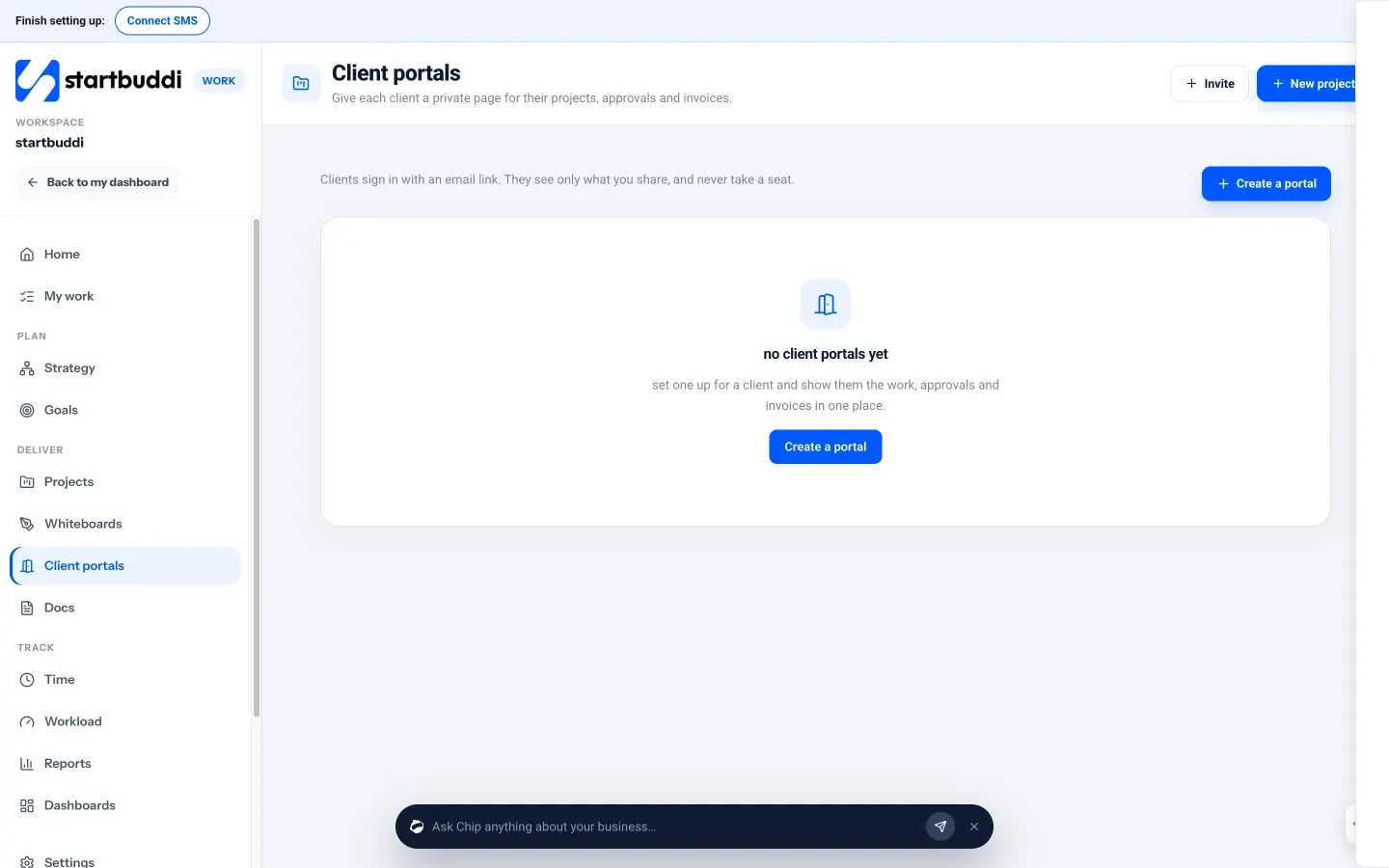
You can build and preview a portal on the free plan; inviting clients needs a paid plan. See client portals for what each portal includes, pricing for plans, and how startbuddi works for professional services firms. Our client management guide covers keeping clients once they are onboarded.
Frequently asked questions
What should be included in a bookkeeping client onboarding checklist?
It should cover the engagement letter, identity and money laundering checks, professional clearance from the previous bookkeeper, access to banks and software, the records to collect, opening balances, and a monthly document deadline. It ends with the first month-end and a review of what to improve.
How long does it take to onboard a new bookkeeping client?
For a small business with a clean handover, two to four weeks is common. The slow steps are usually clearance from the previous bookkeeper and getting bank access. Catch-up work on messy records adds time and should be quoted separately.
Do bookkeepers need an engagement letter?
Yes, you should always have one. It sets out what you will and won't do, what the client must provide, your fees and how the arrangement ends. It is also your best protection in a dispute.
What is professional clearance in bookkeeping?
Professional clearance is a letter you send, with the client's permission, to their previous bookkeeper or accountant. It asks whether there is any professional reason not to take on the client and requests the handover information. Wait for the reply before you start the work.
Should I ask clients for their bank login?
No. Ask for read-only access in your own name, or a bank feed into the accounting software, or monthly statement exports. Logging in as the client can breach their bank's terms and leaves no record of who did what.
Omolola Akiyode is the operations and project manager at startbuddi, leading cross-functional projects and the content that helps founders get set up. Omolola writes about projects, websites and getting found online, and turns complex ideas into clear, practical steps.
Runs operations and projects at startbuddi