Cash Flow: Definition, Examples and How It Works

Cash flow is the movement of money into and out of a business over a period. Money in comes from customers paying, loans and investment; money out goes on salaries, suppliers, rent, tax and equipment. Positive cash flow means more came in than went out.
So what is cash flow telling you that profit doesn’t? It tells you whether you’ll have money in the account on the day a bill is due. A business can be profitable on paper and still miss payroll because clients haven’t paid yet.
Key takeaways
- Cash flow measures timing: when money actually arrives and leaves, not when you earned or owed it.
- Profit and cash flow are different. Unpaid invoices count as revenue but put nothing in the bank.
- Cash flows are usually grouped into three types: operating, investing and financing.
- Late-paying clients are the most common cause of cash shortfalls in service businesses.
- A simple weekly forecast of the next four to thirteen weeks catches most problems early.
Why cash flow matters for a small business
For an IT services firm, the gap between doing the work and getting paid can be long. You buy a client’s laptops and licences up front, pay engineers every month, then wait 30 or 60 days for the client’s finance team to pay your invoice. Each new project can make the cash position worse before it makes it better.
Running out of cash is what stops most small businesses, not a lack of work. If you know your cash flow, you can see a gap coming weeks ahead, chase a payment, delay a purchase or ask for a deposit before it becomes a crisis.
How cash flow works
Every movement of money falls into one of three groups. The international accounting standard for cash flow statements, IAS 7 (checked on 1 October 2026), uses the same split:
| Type | What it covers | IT services example |
|---|---|---|
| Operating | Money from your main work and the costs of doing it | Client payments, engineer salaries, software subscriptions, rent |
| Investing | Buying or selling long-term assets | A new server, company laptops, selling old equipment |
| Financing | Loans, owner money and repayments | A bank loan, the owner putting money in, loan repayments, dividends |
Operating cash flow is the one to watch most closely. If it’s negative month after month, the business is relying on loans or savings to keep going.
What is cash flow compared with profit?
Profit is income minus expenses for a period, counted when you earn and incur them. Cash flow counts money only when it moves. The difference is mostly timing: accounts receivable (invoices clients haven’t paid) and accounts payable (bills you haven’t paid yet). See gross vs net profit for how profit itself is measured.
The US Small Business Administration notes (checked on 1 October 2026) that the cash method of accounting “shows cash flow clearly”, which is one reason many small businesses start with it.
An example with numbers
These figures are illustrative.
Chidi runs a five-person IT support firm in Lagos. In October he invoices ₦6,000,000 of work, and his costs for the month are ₦4,200,000. On paper, he made ₦1,800,000 profit.
| October | Amount |
|---|---|
| Cash at the start of the month | ₦1,500,000 |
| Client payments received (from August and September invoices) | +₦3,900,000 |
| Salaries | −₦2,800,000 |
| Rent, internet and software | −₦600,000 |
| Laptops bought for a new client project | −₦800,000 |
| Cash at the end of the month | ₦1,200,000 |
| Net cash flow for October | −₦300,000 |
Profit was ₦1,800,000, but cash fell by ₦300,000. Most of October’s ₦6,000,000 of invoices won’t be paid until November or December, and the laptops were paid for before the client paid for them. Without forecasting, Chidi would see a profitable month and a shrinking bank balance and not know why.
Two changes fix most of it: asking for 50% up front on equipment-heavy projects, and moving the slowest clients from 60-day to 30-day payment terms.
How to improve cash flow
- Invoice the day the work is done, not at the end of the month.
- Take deposits on projects where you buy hardware or licences first.
- Shorten payment terms and send polite reminders before and on the due date.
- Line up big costs with the dates clients usually pay.
- Keep a buffer of at least one month of fixed costs.
Our guide on how to track cash flow walks through a 13-week forecast you can keep in 15 minutes a week.
Related terms
- Accounts receivable: money customers owe you.
- Accounts payable: money you owe suppliers.
- Payment terms: when a customer has to pay, which shapes your cash flow more than almost anything else.
How startbuddi handles cash flow
startbuddi isn’t accounting software and doesn’t replace your accountant or bank. Its Money Manager gives you a working view of cash. The Cash Flow page shows your current known balance, expected money in and expected money out, and a balance forecast built from open invoices by due date, subscription renewals, recurring expenses and bills. Every input is listed, so you can see where the number comes from. “Run a scenario” lets you test changes, such as overdue invoices being paid this week, without touching your records.
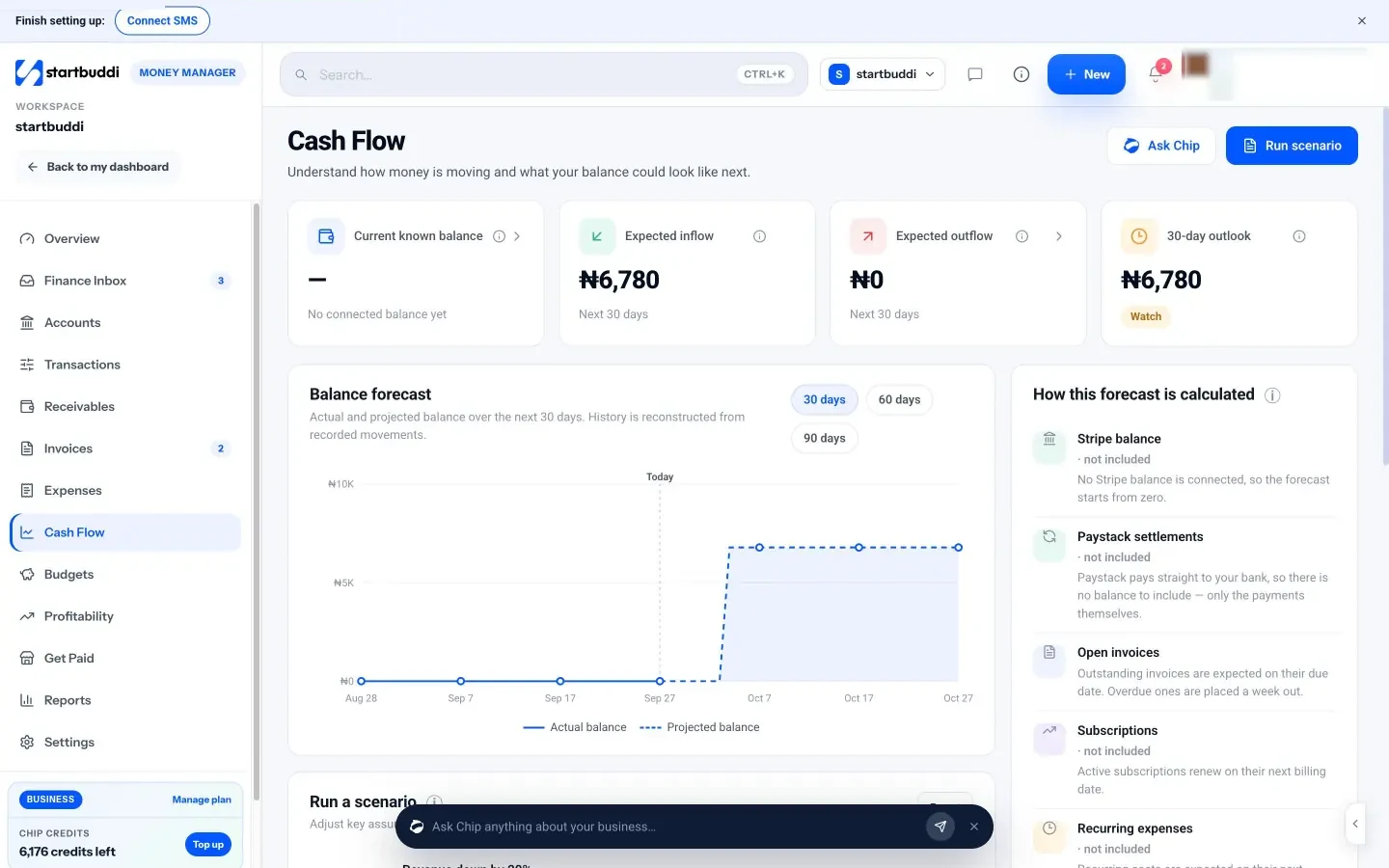
Bank accounts aren’t connected, so the forecast uses your Stripe balance and your startbuddi records. Paystack payments settle straight to your bank. See cash flow in Money Manager or how startbuddi works for IT teams.
See next month’s cash before it happens
Send invoices, take payments by card, transfer or USSD, and watch a cash forecast built from your real invoices and bills. Start free with startbuddi, no card needed.
Cash Flow is part of Money Manager in startbuddi.
See Money ManagerRelated terms
FAQ
What is cash flow in simple terms?
Cash flow is the money coming into and going out of a business over a period, such as a week or a month. If more comes in than goes out, cash flow is positive. If more goes out, it's negative and the bank balance falls.
What is the difference between cash flow and profit?
Profit counts income and costs when they're earned or incurred, while cash flow counts money only when it actually moves. A business with lots of unpaid invoices can show a profit and still run short of cash. That's why you need to watch both.
What are the three types of cash flow?
The three types are operating, investing and financing cash flow. Operating covers your day-to-day work, investing covers buying or selling long-term assets like equipment, and financing covers loans, owner money and repayments.
Is negative cash flow always bad?
No. A month of negative cash flow can be fine if you paid for equipment or a big order that will bring money in later. It becomes a problem when operating cash flow is negative month after month, because the business is then living on savings or loans.
How often should a small business check cash flow?
Weekly is a good habit for most small businesses. A short check of what's in the bank, what's due in and what's due out over the next few weeks catches most shortfalls early. Review it monthly in more detail.
Chinedu Kalu is the co-founder and chief operating officer of startbuddi, responsible for how the company runs day to day. Chinedu writes about the operational side of a small business: registering and running the company, money, hiring and the routines that keep a team on track.
Co-founded startbuddi and runs its operations