How to fill your salon’s chair: marketing that works for beauty businesses
Beauty salon marketing that fills chairs: get found on Google, win reviews, make booking one tap, post your work, bring regulars back and fill quiet slots.


- Fill your salon's chairs by getting found on Google, collecting recent reviews, putting one booking link everywhere, showing your work on social media and bringing regulars back with permission-based messages. Target quiet slots with small offers instead of blanket discounts.
Beauty salon marketing that fills chairs rests on five things: be easy to find on Google and social media, make booking take one tap, show your work often, keep the clients you already have coming back, and ask happy clients for reviews and referrals. You do not need a big budget. You need a simple routine, a booking link that works everywhere and the discipline to do a little every week.
This guide gives you practical beauty salon marketing ideas for hair, nail, lash, brow and skin businesses, a 30-day plan you can start on Monday, the rules to respect when you message clients, and the marketing tools a small salon actually needs.
Start with the numbers: where do empty chairs come from?
Before you post anything, look at your diary for the last month. Empty chairs usually come from one of three places, and each needs a different fix.
| Where the gap is | What it looks like | Marketing that fixes it |
|---|---|---|
| Quiet days and times | Busy Saturdays, empty Tuesday afternoons | Off-peak offers and a last-minute list |
| Lapsed clients | Regulars who have not been back in three months | Rebooking and win-back messages |
| Too few new clients | The same faces every week, slow growth | Google, reviews, social media and referrals |
Most salons jump straight to chasing new clients. Often the cheaper win is filling the quiet slots and bringing back the regulars who drifted. Your booking reports should show your busiest and quietest hours and how many clients came back; if they do not, count by hand for one month.
Get found locally: Google and reviews
When someone searches “nail salon near me” or “braids in Nairobi”, Google’s local results decide who they call. Two things matter most there: a complete Google Business Profile and a steady flow of recent reviews.
Set up your Google Business Profile properly
Add your correct category, hours, prices, photos of real work and your booking link. Google lets you add your own booking link to your profile. Our guide to setting up a Google Business Profile walks through each step, and local SEO covers the rest of getting found.
Make reviews part of the routine
Reviews carry a lot of weight. BrightLocal’s 2026 Local Consumer Review Survey of 1,002 US adults found that 97% of consumers read reviews for local businesses, 68% will only use a business with four stars or more, and 74% look for reviews written in the last three months. Recency matters, so ask every week, not once a year.
- Ask in person at the end of a great appointment, then send the link the same day.
- Reply to every review, briefly and personally.
- Never buy reviews or reward only positive ones. In the US, the FTC’s 2024 rule bans fake reviews and incentives conditioned on a particular sentiment, and other countries have similar consumer rules.
Make booking effortless
Every piece of marketing should end in the same place: a booking. If a client has to message you, wait for a reply and go back and forth about times, many will give up. A salon booking app with one shareable link solves this.
- Put the link in your Instagram and TikTok bio, your WhatsApp Business profile, your Google profile and your email signature.
- Add it to every post caption that shows a service: “Book this look: link in bio.”
- Print a QR code for the mirror stations and front desk. Our free booking link QR code tool makes one in a minute.
If you are still choosing one, our guide to choosing a salon booking app has a checklist.
Social media that shows your work
Beauty is visual, so social media is where most salons win or lose attention. You do not need to post daily. You need to post consistently and show real results.
Content ideas that work for salons
- Before and after, with the client’s permission. The single most useful post type for any salon.
- Process clips: 15 seconds of a colour melt, a nail art detail or a lash fill.
- Meet the team: who does what, and what they love doing.
- Aftercare tips: how to make a blow-dry last, how to protect gel nails.
- Price transparency: “What a full set costs here, and why.”
- Availability posts: “Two slots left Thursday, link in bio.”
Make photo permission a habit
Ask before you take a photo, and ask again before you post a face. A simple line at booking or at the chair works: “We love sharing our work. Is it OK to post a photo of your nails, without your name?” Note the answer on the client’s record so the whole team knows. Clients who say yes often share the post themselves, which is free reach from exactly the right audience.
Batch it
Film a few clips during quieter hours, then plan and schedule a week or a month at once. Our guide on planning a month of social media content in an afternoon shows how to batch a whole month.
Marketing to the clients you already have
Your existing clients are your best audience. They already trust you, and good salon client management turns that trust into repeat bookings.
Rebook, remind and win back
Rebook before clients leave the chair, send reminders before visits, and follow up when a regular has not been back for a while. Our guide to salon client management covers records, rebooking and follow-up templates in detail.
Email, WhatsApp and text: respect consent
Short, useful messages to people who asked for them work well: a new service, a seasonal treatment, open slots next week. Stay on the right side of the rules:
- In the US, the FTC’s CAN-SPAM guide requires marketing emails to include your physical postal address and a working opt-out that you honour within 10 business days.
- In the UK, the ICO says you need consent, or an existing customer relationship with a clear opt-out, before sending marketing emails or texts to individuals.
- WhatsApp’s Business Messaging Policy only allows you to message people who gave you their number and opted in.
Rules differ by country, so check yours. This is general information, not legal advice.
Fill quiet slots without discounting your whole menu
Blanket discounts train clients to wait for a sale. Targeted offers fill the gaps without cheapening your brand.
- Off-peak pricing: a small saving or a free add-on on your quietest weekday afternoons only.
- A last-minute list: clients who opt in to hear about cancellations. Message them when a slot opens.
- Short services for new clients: a brow tidy or a gloss treatment is an easy first visit that leads to bigger bookings.
- Seasonal packages: wedding season, festive party nails, back-to-school cuts.
Referrals and local partnerships
Word of mouth is still the strongest beauty salon marketing there is. Make it easy for happy clients to send friends: a card with your booking link, or a simple “bring a friend” offer for both of you. Then look for businesses that serve the same people: wedding planners and photographers for bridal hair and makeup, gyms and yoga studios for brows and lashes, clothing boutiques for nails. A shared promotion or a stack of each other’s cards costs almost nothing.
Paid ads: when they are worth trying
Paid ads on Instagram, Facebook, TikTok or Google can bring new clients quickly, but they also burn money quickly if the basics are missing. Get these right first: a complete Google profile, at least a handful of recent reviews, a booking link that works on a phone and a few strong before-and-after photos. Ads send people to those things; they do not replace them.
When you are ready, start small and specific:
- One service, one audience, one area. “Knotless braids for women within 5 km” beats “our salon” for everyone in the city.
- A small daily budget for two weeks, set in advance, so a test cannot run away with your rent.
- A clear action: book now, or message us on WhatsApp. Send people straight to the booking page for that service, not your home page.
- Track the result in bookings, not likes. Ask new clients how they found you, and note it on their record.
If an ad brings bookings that cost less than the profit from a first visit, and some of those clients rebook, keep going. If not, stop and put the money back into reviews and regulars.
Measure what works
You cannot tell which beauty salon marketing is working unless you count something. Keep it to four numbers, checked once a month:
- New clients, and where they said they found you.
- Returning clients as a share of all bookings.
- Empty hours in your quietest days.
- New reviews and your average rating.
Write them in a notebook or a spreadsheet each month. After three months you will see which habits move the numbers and which just feel busy. Drop the ones that do not help and do more of the ones that do. That is the whole secret of marketing a small salon: a few simple things, done consistently, measured honestly.
Beauty salon marketing ideas: a 30-day plan
| Week | Focus | Tasks |
|---|---|---|
| 1 | Foundations | Complete your Google Business Profile, add your booking link everywhere, print a QR code for the front desk. |
| 2 | Reviews and regulars | Ask every client for a review, reply to all reviews, message clients who have not visited in three months. |
| 3 | Content | Film ten short clips, schedule two to three posts a week for the next month. |
| 4 | Quiet slots and referrals | Launch one off-peak offer, start a last-minute list, approach one local partner. |
At the end of the month, compare bookings, new clients and reviews with the month before. Keep what worked and drop what did not.
Marketing tools for small business salons: what you actually need
You can do all of the above with a handful of tools. For a salon, the essentials are:
- A booking system with a shareable link.
- A client list with notes and marketing permissions.
- A way to send email, WhatsApp or text to groups of clients.
- A social media scheduler, so posting does not depend on a free evening.
- A link in bio page that puts booking, prices and contact details in one place.
Many salons stitch these together from four or five separate apps. That works, but every extra login is another place for a client’s details to go missing.
How startbuddi helps
With startbuddi, bookings, clients and marketing sit in one place, so the person who books is the same person you can message later.
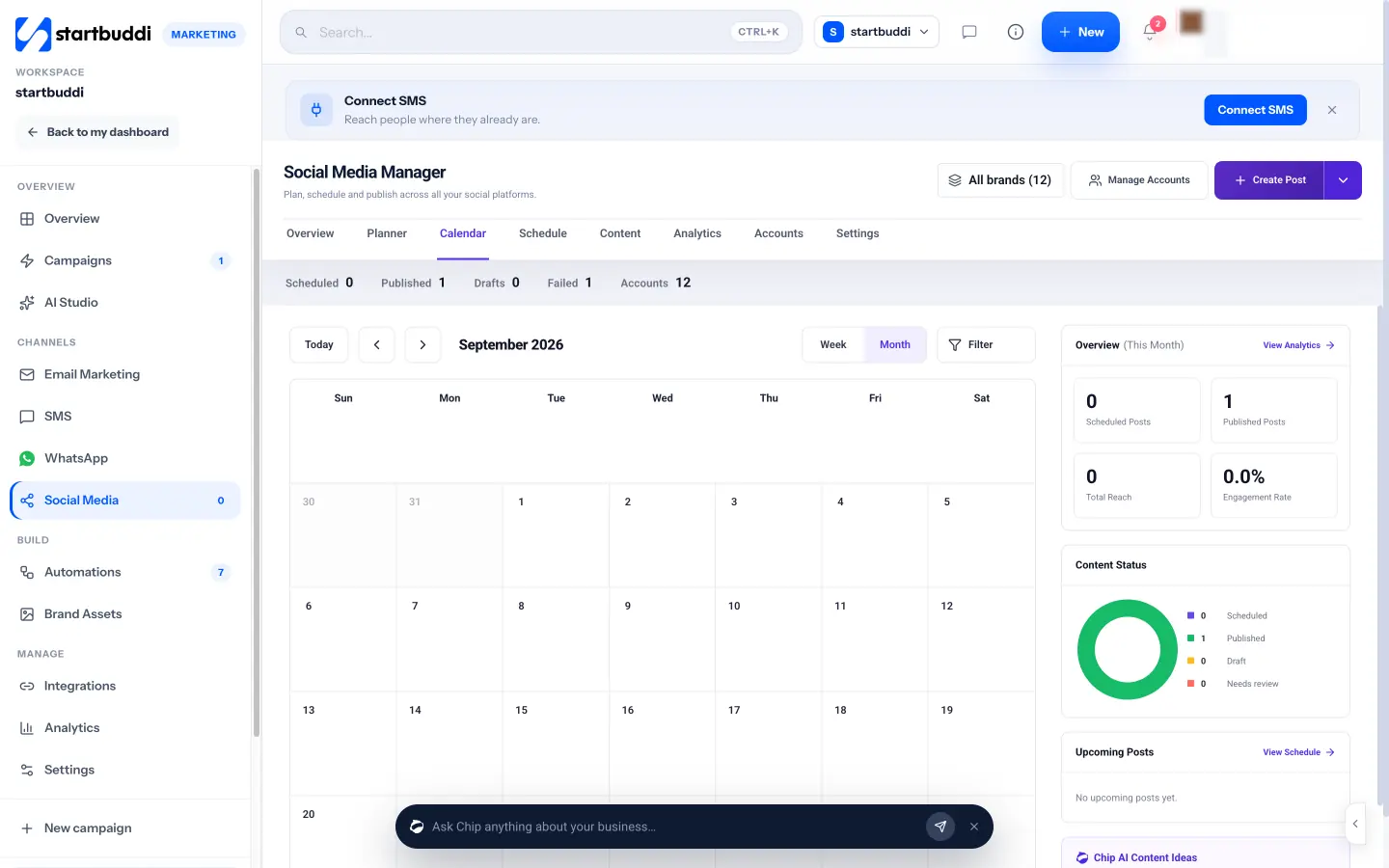
Plan and schedule social posts. The Social Media Manager schedules posts to Facebook, Instagram, LinkedIn, X, YouTube and Pinterest from one calendar. Plan with Chip drafts a week of post ideas for you to edit and approve.
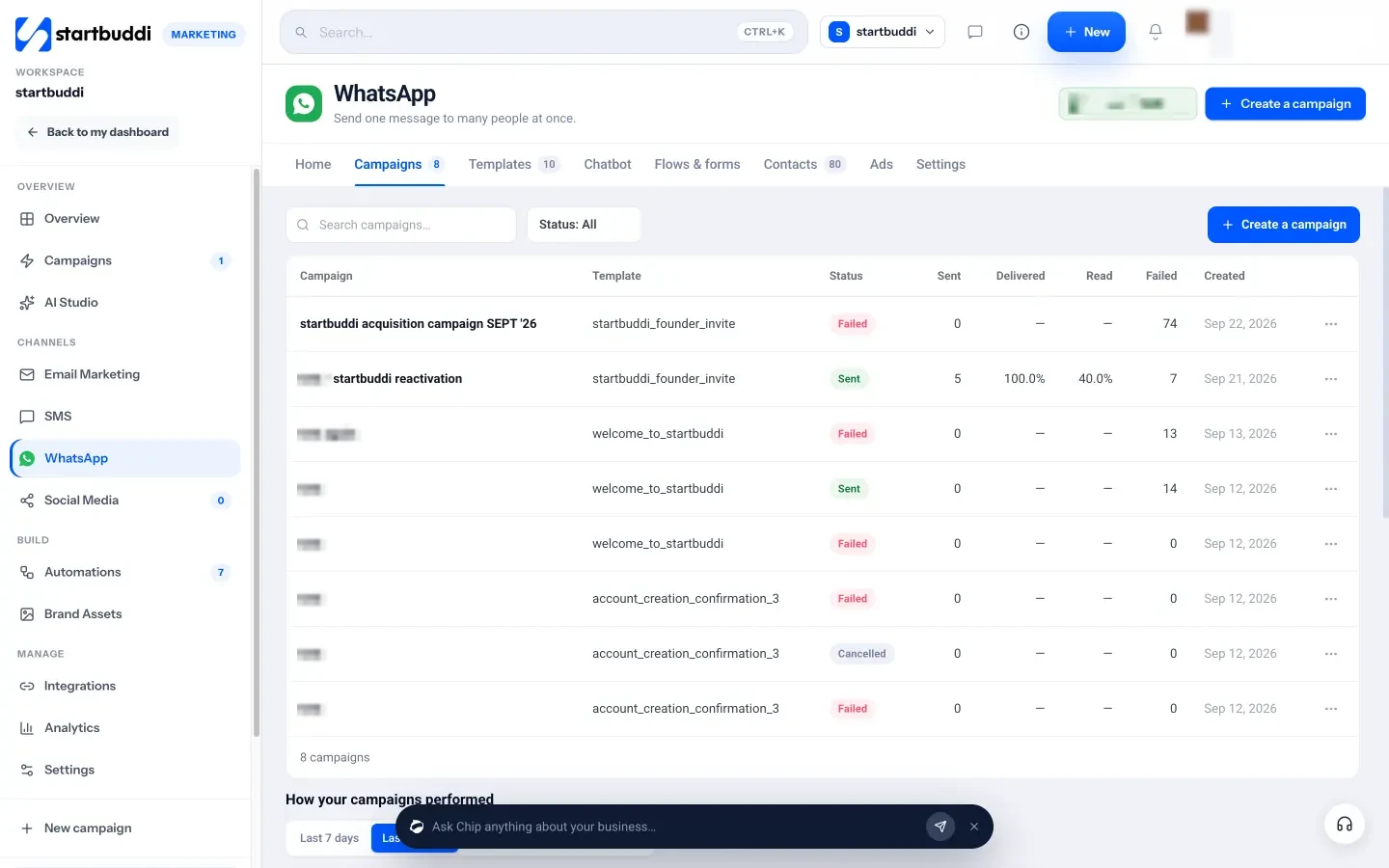
Message the clients you already have. Send email campaigns, SMS and WhatsApp broadcasts using Meta-approved templates, to segments such as “colour clients” or “not visited in 90 days”. Every booking adds or updates the client in your contacts, so your lists grow on their own.
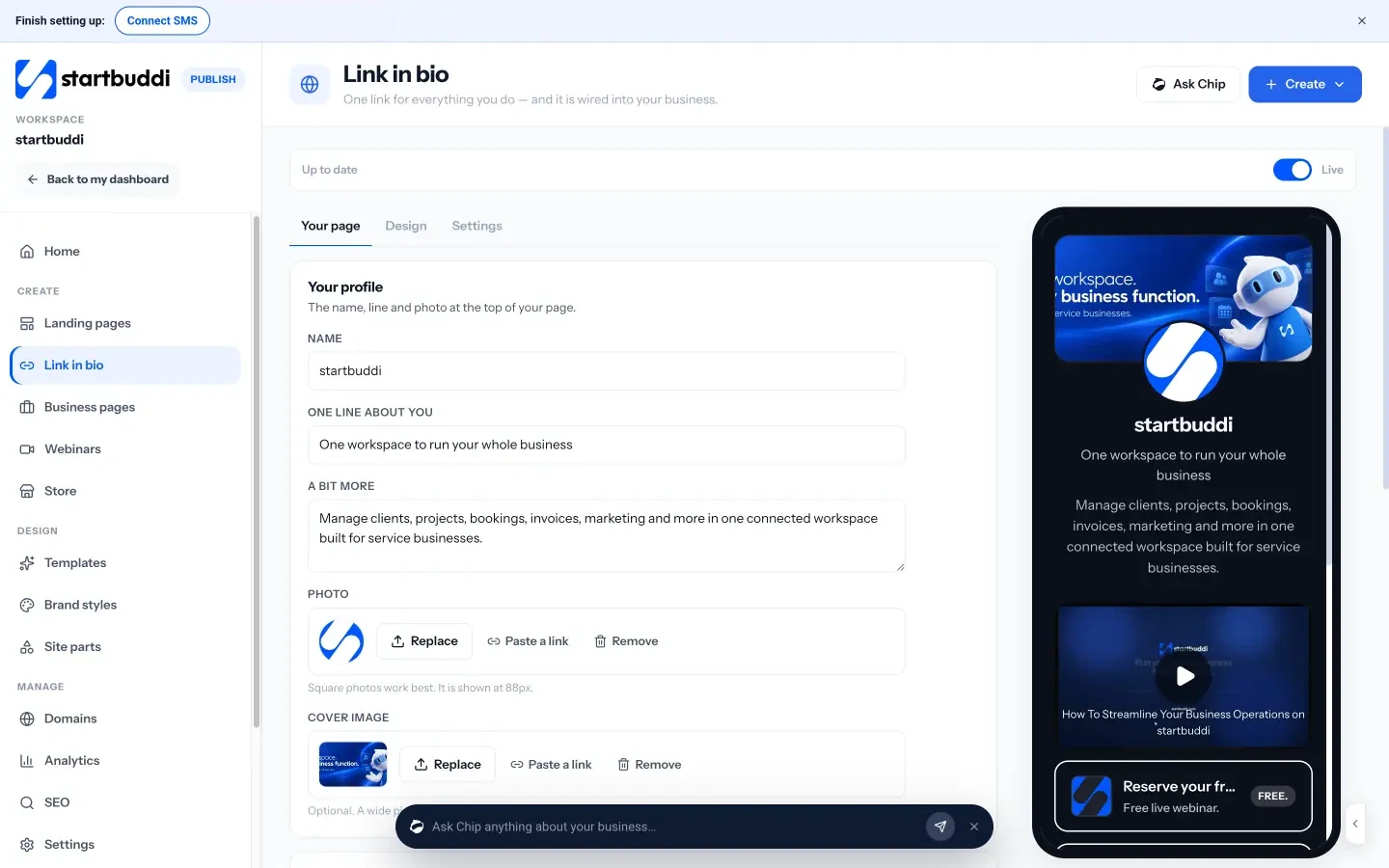
One page for your bio. A link in bio page can hold a Booking block, a WhatsApp chat button, your price list, products and a sign-up form for your last-minute list.
Bookings that feed the marketing. Bookings gives you a shareable link, a QR code and reports on peak hours and repeat customers, so you know which slots need filling.
What it does not do. The Marketing module, including social scheduling, email campaigns, WhatsApp and SMS, is not included on the Free plan; it starts on Starter (see pricing), and WhatsApp needs a connected WhatsApp Business number. Social posting does not cover TikTok, Threads or Google Business Profile posts yet. There is no built-in review request tool or loyalty scheme, and the online store has no discount codes, so run offers with a special price or a separate payment link. The link in bio page and bookings work on Free. See pricing for full plan details.
Your next step
Open your diary and find your three quietest hours of the week. Pick one idea from this guide to fill them, start it this week, and check the result in a month. For the full salon setup, from bookings to clients to payments, read our guide on how to run a salon business.
Sources
- Google Business Profile Help: bookings and booking links
- BrightLocal: Local Consumer Review Survey 2026
- FTC: final rule banning fake reviews and testimonials (2024)
- FTC: CAN-SPAM Act compliance guide for business
- ICO: electronic mail marketing
- WhatsApp Business Messaging Policy
Frequently asked questions
What is the cheapest way to market a beauty salon?
Look after your Google Business Profile, ask every happy client for a review and message past clients who agreed to hear from you. All three are free and usually fill more chairs than paid ads.
How often should a salon post on social media?
Two to three good posts a week is plenty for most salons, as long as you keep it up. Consistency and real before-and-after work matter more than posting every day.
Should I offer discounts to fill my salon?
Target them. A small off-peak offer or a free add-on on quiet afternoons fills gaps without teaching clients to wait for a sale. Avoid discounting your whole menu.
Which marketing tools does a small salon need?
A booking link, a client list with marketing permissions, a way to send email or WhatsApp messages, a social media scheduler and a link in bio page. Fewer, connected tools are easier to keep up with.
Olabimpe Salami is the email and outreach specialist at startbuddi. Olabimpe writes about the messages that bring customers in and back: email, WhatsApp and SMS campaigns, follow-ups, and turning enquiries into paying clients.
Runs email and outreach at startbuddi