Sales Qualified Lead (SQL): Definition, Examples and How It Works

A sales qualified lead (SQL) is a lead you have checked, usually on a short call or in writing, and confirmed has a real need you can meet, a budget, the authority to decide and a timeframe. So what is sales qualified lead status in practice?
A sales qualified lead (SQL) is a lead you have checked, usually on a short call or in writing, and confirmed has a real need you can meet, a budget, the authority to decide and a timeframe. So what is sales qualified lead status in practice? It means the next step is a quote or proposal, not more nurturing.
Key takeaways
- An SQL has been checked by a person, not just scored. Someone has asked about need, budget, decision and timing.
- The usual route is lead, then marketing qualified lead, then SQL, then customer. A lead who asks for a price can skip straight to SQL.
- When a lead becomes an SQL, open a deal so it appears in your sales pipeline with a value and a next step.
- Speed matters most at this stage. An SQL who waits a week for a quote may sign with someone else.
Why SQLs matter for a small business
For a small IT services firm, the most expensive part of selling is quotes, site visits and proposals. A network audit for a 40-person office can take a day before any money changes hands, and doing that for people who were never going to buy is how small firms end up busy and broke.
An SQL rule protects that time: you only write a proposal or visit a site once the lead has passed a few simple questions.
How a sales qualified lead works
In larger companies marketing warms up leads and sales qualifies them. HubSpot’s lifecycle stages define an SQL as a contact that “your sales team has qualified as a potential customer” (checked on 1 October 2026). Salesforce’s article on sales-qualified leads describes a prospect that has shown an intention to buy and met set qualification criteria, and names BANT (budget, authority, need and timeline) as a common test (checked on 1 October 2026).
In a small business one person often does both jobs, but the stages still tell you what to do next:
| Stage | What you know | Your next step |
|---|---|---|
| Lead | They left contact details | Reply and learn more |
| Marketing qualified lead | They fit your profile and have engaged | Personal follow-up and a short call |
| Sales qualified lead | Need, budget, decision-maker and timing confirmed | Quote, proposal or site visit |
| Opportunity or deal | You have sent a price | Follow up until yes or no |
| Customer | They have paid | Deliver and onboard |
The MQL vs SQL page compares those two stages side by side.
The questions that turn a lead into an SQL
BANT is the best-known checklist. For a service business, these five questions cover it in a five-minute call:
- Need: “What’s happening that made you get in touch now?”
- Fit: “How many people and devices are we talking about, and where?”
- Budget: “Do you have a budget in mind, or a figure you’re currently paying?”
- Authority: “Who else will be involved in the decision?”
- Timing: “When would you want this in place?”
A lead becomes an SQL when you have clear answers on need, fit and timing, and at least a budget range. If they can’t decide alone, invite whoever can to the next call.
What is sales qualified lead conversion? An example with numbers
SQL conversion is the share of sales qualified leads that become paying customers. Here is an illustrative example.
A managed IT provider in Lagos spends a quarter tracking its pipeline:
- 120 leads come in from its website form, referrals and WhatsApp.
- 48 meet its MQL rule (right size, inside Lagos, engaged).
- After a five-minute call, 20 of the 48 are confirmed as SQLs (20 ÷ 48 = 41.7%).
- It sends 20 proposals and wins 7 (7 ÷ 20 = 35%) at an average of ₦450,000 a month.
That is 7 × ₦450,000 = ₦3,150,000 a month in new contracts. Without the qualifying call, the team would have written 48 proposals instead of 20. If each proposal takes three hours, that’s 84 hours saved (28 × 3) in one quarter.
When a lead is not an SQL
Disqualify, or send back to nurturing, when:
- the need is real but more than six months away;
- there is no budget and no plan to find one;
- they are outside your service area or too small or large for you;
- they want something you don’t do.
Related terms
- Marketing qualified lead: the stage before SQL, based on fit and engagement.
- Warm lead: a lead who knows you and has shown interest.
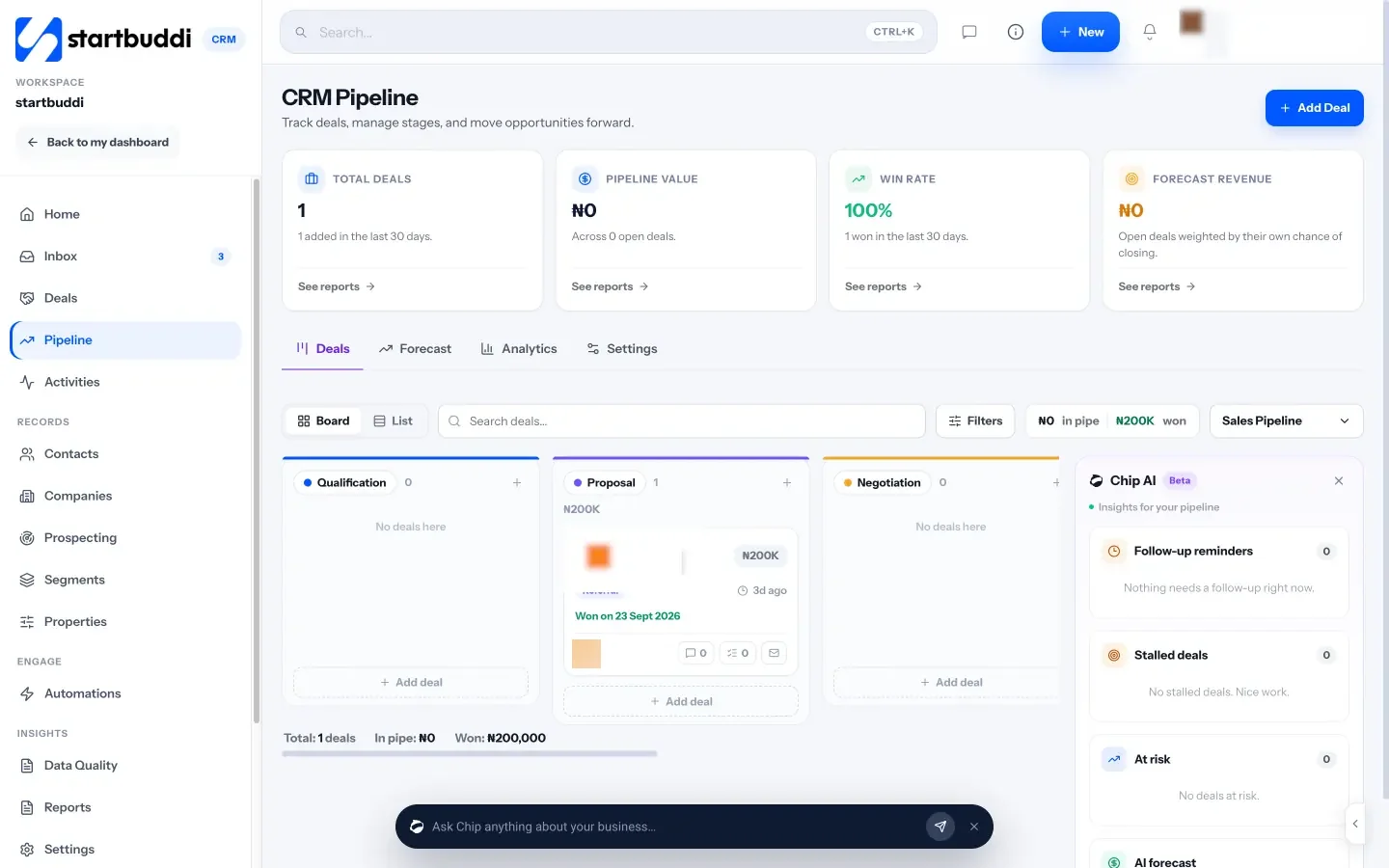
- Sales pipeline: the stages an SQL moves through as a deal, from quote to won or lost. Each column is a deal stage.
For the qualifying conversation itself, read how to pre-qualify leads, and for the full process from enquiry to signed client, our guide to the sales process for small business.
How startbuddi handles sales qualified leads
In startbuddi, leads are contacts in Customers, and SQLs become deals in your pipeline.
- Mark the lead. Set the contact’s lead status to Qualified (the options are New, Qualified and Disqualified), or drag it on the board view of Contacts.
- Open a deal. Create a deal with the contact, a value and a stage. New pipelines start with stages such as New Leads, Qualified, Proposal Sent, Negotiation, Won and Lost, and you can rename or add your own.
- Keep it moving. When the contact replies, their deal moves out of the first stage, and when an invoice on the deal is paid, the deal is marked won. Chip flags stalled deals and suggests next stages; those suggestions are in beta.
- Book the qualifying call from the contact page; it checks clashes with your bookings and adds a meeting link.
See also our CRM for IT teams and the sales pipeline feature. A free plan is available; see pricing.
Sales Qualified Lead (SQL) is part of Customers in startbuddi.
See CustomersRelated terms
FAQ
What makes a lead sales qualified?
A lead is sales qualified when a person has confirmed they have a need you can meet, a budget or budget range, the authority to decide (or access to whoever does) and a timeframe. Frameworks such as BANT are a common checklist. Asking for a price or proposal is often a strong sign.
What is the difference between an MQL and an SQL?
An MQL fits your customer profile and has engaged with your marketing, but nobody has checked whether they are ready to buy. An SQL has been checked, usually on a call, and is ready for a quote or proposal. MQLs get nurturing; SQLs get a price.
Can a lead skip the MQL stage and become an SQL straight away?
Yes. A referral who calls to ask for a quote this month, with a budget, is ready for sales now. There is no reason to send them through marketing first.
How quickly should you follow up with an SQL?
As soon as you can, ideally within one working day. At this stage the buyer is usually comparing options, and a prompt, specific quote often wins.
Tiwalade Joanna Okedara-Kalu is the founder, CEO and CTO of startbuddi, the business system that brings clients, bookings, invoices, projects, marketing and the Chip AI assistant into one place. Tiwalade builds software around how service businesses really work day to day, and writes about client management, getting paid on time and why small businesses outgrow the tools they start with.
Founded startbuddi and leads its product and engineering