MQL vs SQL: what is the difference?
Also called: Marketing qualified lead vs sales qualified lead, MQL and SQL, lead stages, lead lifecycle stages
A marketing qualified lead (MQL) has shown interest, for example by downloading a guide, but is not ready to buy. A sales qualified lead (SQL) has been checked and is ready for a direct sales conversation.
MQL vs SQL is about how ready a lead is to buy. A marketing qualified lead (MQL) has shown interest in what you do, for example by downloading a checklist or opening several emails, but has not asked to buy. A sales qualified lead (SQL) has been checked and is ready for a direct sales conversation: a call, a quote or a proposal.
In short: an MQL is warm, an SQL is ready. The difference tells you who to nurture and who to call today.
Why the difference matters for a small business
You may not have a marketing team and a sales team. You might be both. The distinction still helps, because it stops two common mistakes:
- Pitching too early. Calling everyone who downloads a guide feels pushy and wastes your time.
- Following up too late. Leaving someone who asked for a quote in the same newsletter list as everyone else loses the sale.
Sorting leads into MQLs and SQLs means each person gets the right next step.
MQL vs SQL at a glance
| Marketing qualified lead (MQL) | Sales qualified lead (SQL) | |
|---|---|---|
| What they did | Downloaded a guide, joined a list, attended a webinar, clicked several emails | Asked for a quote, booked a call, replied “how much?”, requested a demo |
| What they want | To learn | To solve a problem, soon |
| Checked for fit? | Roughly: right type of customer | Yes: need, budget and timing discussed |
| Right next step | Helpful emails, content, invitations | A conversation, a proposal, a clear price |
| Who handles it | Marketing (or you, in marketing mode) | Sales (or you, in sales mode) |
How leads move from MQL to SQL: an example
A solar installer in Pretoria runs a page offering a free “How much could solar save you?” guide.
- Lead: a homeowner downloads the guide. They are a contact, nothing more yet.
- MQL: over two weeks they open three follow-up emails and click the pricing article. They fit the ideal customer (homeowner, in the service area). Marketing qualified.
- SQL: they reply asking whether a site visit is free and say they want panels before winter. The installer checks need, budget range and timing in a short call. Sales qualified.
- Opportunity: a site visit is booked and a deal is created with an estimated value.
How to decide when a lead is an MQL or an SQL
- Fit: are they the kind of customer you serve? Location, business type, size.
- Engagement: what have they done? Many businesses use a simple lead score, adding points for opens, clicks, visits and replies.
- Intent: have they done something that signals buying, like asking about price or availability? Intent usually matters more than engagement.
- Qualification: for SQLs, a quick check of budget, authority, need and timeline. See our BANT definition.
Some teams add a middle stage, a sales accepted lead (SAL), when sales has reviewed an MQL and agreed to follow it up. Most small businesses do not need that extra step.
Common mistakes
- Counting any download as an MQL. Fit matters. A student researching an assignment is not a lead.
- No handover rule. If nobody decides when a lead is sales ready, hot leads wait in the newsletter.
- Slow follow-up on SQLs. Someone who asks for a price today may ask a competitor tomorrow. See how to follow up with leads.
- Never sending leads back. An SQL who turns out not to be ready should go back to nurturing, not into the bin.
Related terms
Lead nurturing is what you do with MQLs. BANT is one way to confirm an SQL. Once qualified, a lead becomes a deal in your sales pipeline. Our post on lead scoring for small business covers the points systems many teams use to spot MQLs.
MQLs and SQLs in startbuddi
startbuddi does not label contacts “MQL” or “SQL”, but it has what you need to run the same process. In Contacts, each person has a lead status (New, Qualified or Disqualified) and a lead score from 0 to 100, worked out from their activity, spend, how recently they engaged and whether they have a deal. You can filter by “Lead score is at least” and by status, and an Opportunities view shows contacts worth turning into deals.
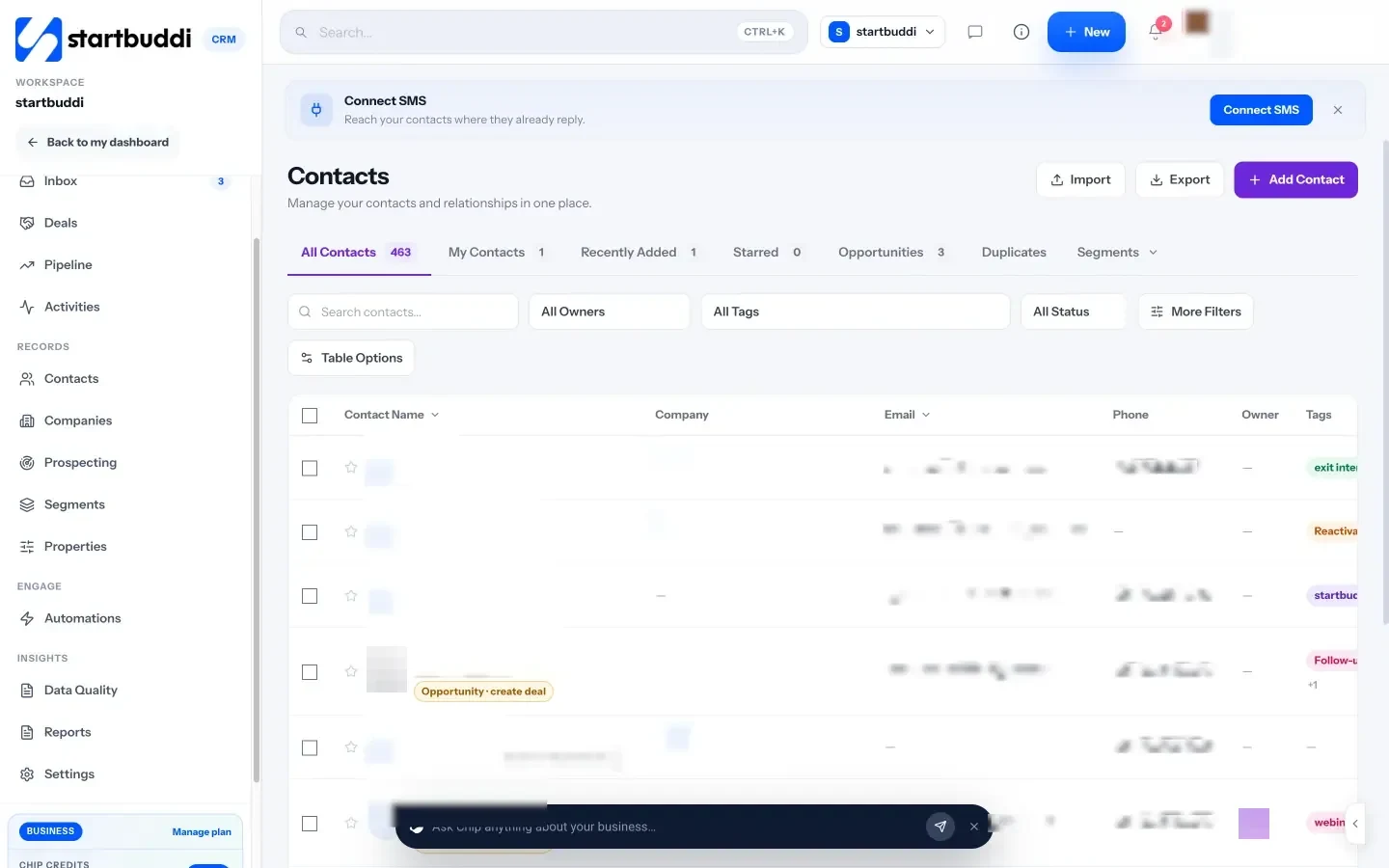
When a lead is ready, create a deal in the Pipeline, whose default stages start with New Leads and Qualified. In the inbox, Chip can suggest when a conversation looks like it should become a deal. On paid plans, Automations can keep nurturing everyone else, with triggers such as a tag being added or a contact joining a segment.
Your next step: write one sentence defining an MQL and one defining an SQL for your business, and check this week’s leads against them.
Related terms
FAQ
What does MQL and SQL stand for?
MQL stands for marketing qualified lead and SQL for sales qualified lead. In this sense SQL has nothing to do with the database language.
What turns an MQL into an SQL?
Usually a clear buying signal, such as asking for a price or booking a call, plus a quick check that they fit and have the need, budget and timing.
Do small businesses need MQLs and SQLs?
Not the labels, but the idea helps. Knowing who is just interested and who is ready to buy tells you where to spend your selling time.
What comes after an SQL?
An opportunity or deal: a qualified lead you are actively selling to, tracked in your pipeline until it is won or lost.
Tiwalade Joanna Okedara-Kalu is the founder, CEO and CTO of startbuddi, the business system that brings clients, bookings, invoices, projects, marketing and the Chip AI assistant into one place. Tiwalade builds software around how service businesses really work day to day, and writes about client management, getting paid on time and why small businesses outgrow the tools they start with.
Founded startbuddi and leads its product and engineering