Deal stage: Definition, Examples and How It Works

What is deal stage in sales? A deal stage is one step in your sales process, such as Qualified or Proposal sent, that shows how close a sale is to being won or lost. Each open deal sits in one stage and moves on when the buyer acts, for example by accepting a proposal.
Key takeaways
- Deal stages are the columns of your sales pipeline. The pipeline is the whole board; a stage is one column on it.
- A good stage is defined by what the buyer has done, not by what you hope will happen.
- Most small businesses need five or six stages, ending in Won and Lost.
- Giving each stage a probability lets you turn a pile of deals into a realistic sales forecast.
Why deal stages matter for a small business
Past about ten open deals, you start forgetting who needs a follow-up and which proposal has gone quiet. Deal stages fix that. They tell you the next action for every deal: a deal in “Proposal sent” needs a follow-up call, not another discovery meeting. They show where deals get stuck, because if half your deals die between “Proposal sent” and “Negotiation”, the problem is probably the proposal or the price. And they let you forecast, which matters when you’re deciding whether you can afford to hire or take on a bigger contract.
How a deal stage works
A deal stage only works if everyone on the team agrees what it means. The simplest way is to write an exit rule for each stage: the thing that must be true before a deal moves on.
| Stage | What it means | Exit rule (move on when…) |
|---|---|---|
| New lead | Someone has shown interest | You’ve had a first conversation |
| Qualified | They have a real need, a budget and a timeline | They’ve agreed to receive a proposal |
| Proposal sent | They have your price and scope in writing | They come back with questions or changes |
| Negotiation | You’re agreeing terms, scope or price | They sign or pay a deposit |
| Won | They’ve said yes and committed | Deal closed |
| Lost | They’ve said no or gone silent past your cut-off | Deal closed, reason recorded |
The Qualified stage is where a framework such as BANT (budget, authority, need, timing) earns its keep. If you can’t answer those four questions, the deal isn’t qualified yet, however keen the person sounds.
Deal stage probability
Most sales tools let you give each stage a probability: the share of deals in that stage you expect to win. HubSpot’s help centre explains that its default sales pipeline gives every stage a probability and multiplies the total amount in each stage by it to show a weighted amount (checked on 1 October 2026). Pipedrive works the same way and lets a probability set on a single deal override the stage’s probability (checked on 1 October 2026).
Start with rough guesses, then replace them with your own numbers once you’ve closed 20 or 30 deals. If 4 of the last 10 deals that reached “Proposal sent” were won, that stage’s probability is about 40%.
Example: a weighted forecast from deal stages
A three-person IT support firm in Nairobi sells monthly support contracts and one-off network installs. Here is its pipeline at the start of the month. The figures are illustrative.
| Stage | Deals | Total value | Stage probability | Weighted value |
|---|---|---|---|---|
| Qualified | 4 | KES 1,200,000 | 20% | KES 240,000 |
| Proposal sent | 3 | KES 900,000 | 40% | KES 360,000 |
| Negotiation | 2 | KES 800,000 | 70% | KES 560,000 |
| Total | 9 | KES 2,900,000 | KES 1,160,000 |
The raw pipeline says KES 2.9 million. The weighted forecast says about KES 1.16 million is likely, which is the more honest number to plan around. If the owner needs KES 1.5 million of new work this quarter to hire a fourth technician, the gap is clear: about KES 340,000 of weighted value, or roughly one more deal reaching Negotiation.
Common mistakes with deal stages
- Too many stages. Ten stages means deals sit between columns and nobody updates them. Merge stages that don’t change your next action.
- Stages based on your activity. “Called twice” says what you did, not where the buyer is. Use buyer actions as exit rules.
- No Lost stage, or no cut-off. A deal with no reply for 60 days is lost until the buyer says otherwise. Keeping it open inflates the forecast.
Keeping stages honest week to week is the job of pipeline management. For how stages fit into the whole sales process, from first enquiry to signed contract, see our guide to the sales process for small business.
How startbuddi handles deal stages
In startbuddi, deal stages live in the sales pipeline inside Customers. New pipelines start with New Leads, Qualified, Proposal Sent, Negotiation, Won and Lost, and you can rename, add or remove stages in the Stage Builder. Deleting a stage never deletes its deals.
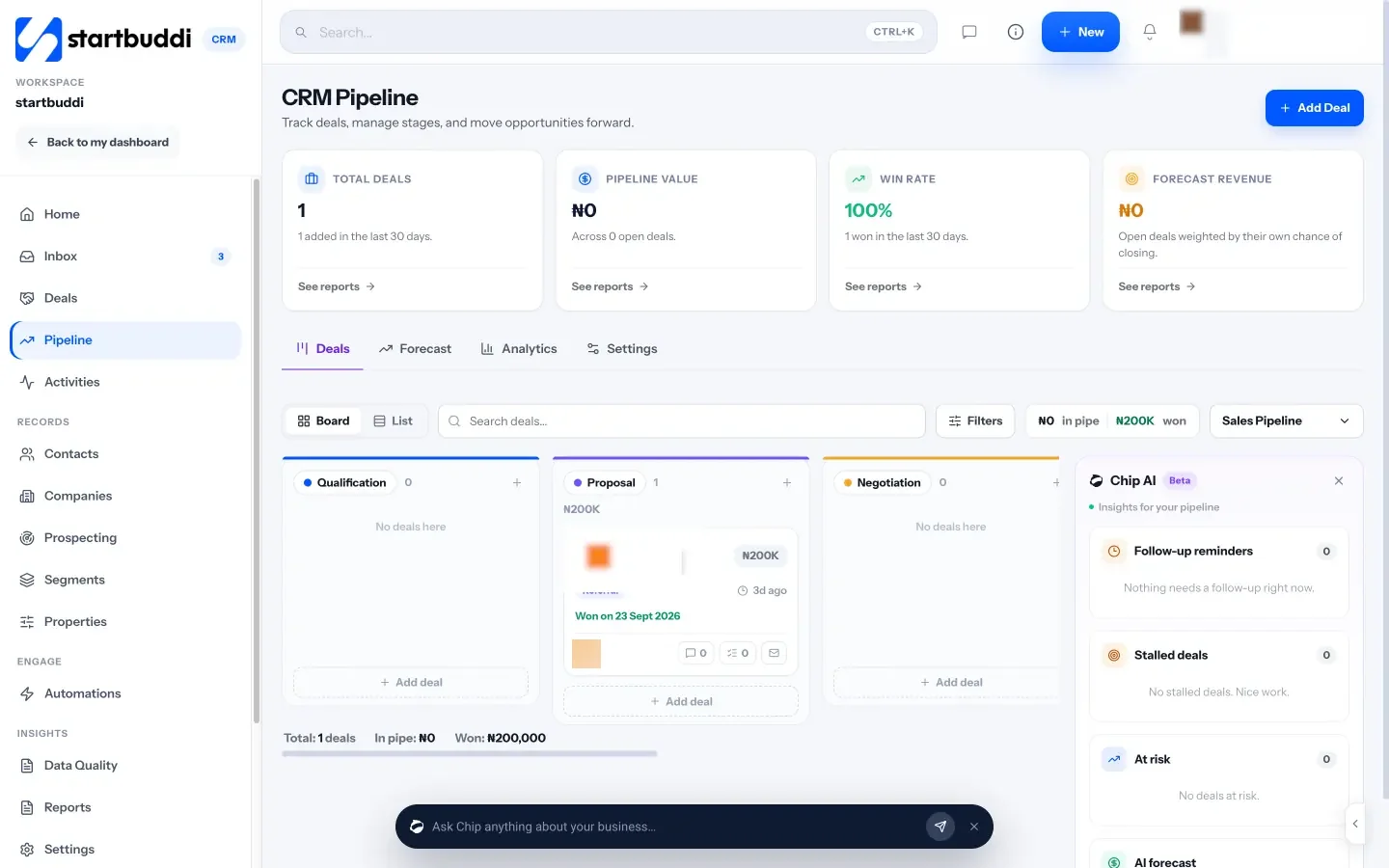
- Drag a deal card to its next stage, or mark it won or lost with a reason.
- Each deal can carry its own probability, and the Forecast tab shows a weighted pipeline by stage.
- Some stage moves happen on their own: when a contact replies, their deal leaves the first stage, and when an invoice on a deal is paid, the deal is marked won. Every move is written to the deal’s history.
- Chip, startbuddi’s AI assistant, flags stalled deals and suggests a next stage you can accept with one click.
A free plan is available; see pricing for what each plan includes.
Put your deal stages to work
Write an exit rule for each of your stages this week, then set them up in a pipeline you’ll actually update. Start startbuddi free and move your first deals across the board today.
Related terms
FAQ
What is a deal stage in sales?
A deal stage is a named step in your sales process that shows how far a potential sale has progressed, such as Qualified, Proposal sent or Negotiation. Every open deal sits in one stage at a time and moves forward when the buyer takes a specific action.
How many deal stages should a small business have?
Five or six is enough for most small businesses: something like New lead, Qualified, Proposal sent, Negotiation, Won and Lost. Add a stage only if it changes what you do next with a deal.
What is deal stage probability?
Deal stage probability is the share of deals in a stage that you expect to win, such as 40% for Proposal sent. Multiplying each stage's total value by its probability gives a weighted forecast that is more realistic than the raw pipeline total.
When should a deal be moved to Lost?
Move a deal to Lost when the buyer says no or when it passes a silence cut-off you've set, such as 60 days with no reply. Record the reason, so you can spot patterns, and reopen the deal if the buyer comes back.
Tiwalade Joanna Okedara-Kalu is the founder, CEO and CTO of startbuddi, the business system that brings clients, bookings, invoices, projects, marketing and the Chip AI assistant into one place. Tiwalade builds software around how service businesses really work day to day, and writes about client management, getting paid on time and why small businesses outgrow the tools they start with.
Founded startbuddi and leads its product and engineering