How to write a one page business plan (with template and example)
Write a one page business plan in an afternoon: nine sections, a worked example, common mistakes and a simple rhythm to keep the plan useful all year.


Photo: SUSHMITA NAG / Unsplash
- A one page business plan answers nine questions: the problem, the customer, your offer, why you, channels, revenue, costs, 12-month targets and the next 90 days. Keep each section short, use real numbers, and review it every month so it guides what you do.
A one page business plan is a single sheet that answers the questions that matter: what problem you solve, for whom, how you reach them, how you make money, what it costs, and what you will achieve in the next 12 months. It takes an afternoon to write, it fits on your fridge, and unlike a 40-page plan, you will actually read it again. The simplest version has nine short sections, and you will find a template and a worked example below.
You don’t need a long plan to be taken seriously. You need a clear one. This guide explains why a short plan works, what to put in each section, how to fill it in using a worked example, and how to turn it into weekly action.
Why a one page business plan is worth writing
Long business plans have a reputation for being written once, for a bank or an investor, and then forgotten. But planning itself helps. Research by Francis Greene and Christian Hopp, reported in Harvard Business Review, found that entrepreneurs who wrote formal plans were 16% more likely to reach viability than otherwise similar founders who didn’t plan.
The US Small Business Administration describes two styles of plan in its guide to writing a business plan: a traditional plan that is detailed and comprehensive, and a lean plan that focuses on the key elements, is fast to write and is typically one page. It suggests the lean format when you want to start quickly or expect to change the plan often, which describes almost every small business in its first few years.
A one-page plan gives you three things:
- Clarity. If you can’t explain your business on one page, you probably haven’t decided some important things yet.
- Focus. It makes you choose one customer, one main offer and a handful of numbers, instead of chasing everything.
- A tool you use. Because it is short, you can check it every month and update it as you learn.
If you later need a full plan for a loan or investor, your one-pager becomes its outline. Nothing is wasted.
The 9 sections of a one-page plan
There are several well-known one-page formats. The Business Model Canvas from Strategyzer maps a business in nine blocks, and the Lean Canvas from LEANSTACK adapts it for startups by focusing on problems and early customers. The version below borrows from both and is written for small service and product businesses.
| Section | The question it answers | Keep it to |
|---|---|---|
| 1. The problem | What pain or need does your customer have? | 2 or 3 lines |
| 2. Your customer | Who exactly has that problem and will pay to fix it? | 1 sentence |
| 3. Your offer | What do you sell, and what result does it give? | 1 or 2 products or packages |
| 4. Why you | Why would they choose you over the alternatives? | 1 sentence |
| 5. How customers find you | Which two or three channels bring in buyers? | 3 bullets |
| 6. How you make money | Prices, how people pay, and how often | A short price list |
| 7. What it costs | Your main monthly costs | 5 to 8 lines |
| 8. Targets | What will be true in 12 months, in numbers? | 3 numbers |
| 9. Next 90 days | The milestones that get you started | 3 to 5 actions |
How to write each section
1. The problem
Describe the problem in your customer’s words, not yours. “Small restaurant owners lose bookings because they can’t answer the phone during service” is stronger than “restaurants need digital transformation”. If you can, name how customers solve it today, even badly. That is your real competition.
2. Your customer
Be specific enough that you could find ten of them this week. “Women” is not a customer. “Working mothers in Abuja who want healthy meals delivered twice a week” is. You can serve other people too, but the plan should name who you are building for first.
3. Your offer
Write what you sell and the result it delivers. Start with one or two offers. A long menu at the start usually means none of it is marketed well. If you are unsure what to charge, our guide on how to price your services walks through it.
4. Why you
This is your reason to be chosen. It might be speed, a specialism, a guarantee, where you are, or the way you work. Avoid “quality” and “great service”, because everyone claims those. Ask yourself what a happy customer would say about you to a friend.
5. How customers find you
List the two or three channels you will actually use, for example Instagram, referrals from past clients and a Google Business Profile. Fewer channels done well beat seven done badly. Our guide on getting your first 100 customers has ideas for each.
6. How you make money
Write your prices and how customers pay: once, monthly, per project or per booking. Note whether you take a deposit. Recurring income, such as monthly retainers or subscriptions, makes planning much easier.
7. What it costs
List your main monthly costs: tools, rent, stock, transport, marketing, your own pay. Add them up. That total is the minimum you need to bring in each month to break even.
8. Targets
Pick three numbers that describe success in 12 months. Good choices are monthly revenue, number of active customers and one number that shows the business is healthy, such as profit margin or repeat customers. If you want help choosing, read our guide to the 7 numbers every small business should track.
9. Next 90 days
Turn the plan into the first steps. What must happen in the next three months for the targets to be possible? Keep it to a handful of actions with dates. Our guide to a 90-day business plan goes further.
A one page business plan template you can copy
Copy these prompts into a document and fill in the gaps. Write in short sentences, and leave a line blank rather than guess if you don’t know an answer yet. Blanks show you what to find out next.
Business name: ______ Date: ______
The problem: My customers struggle with ______ and today they deal with it by ______.
Customer: I help ______ (who) in ______ (where) who want ______.
Offer: I sell ______ so that they get ______.
Why me: Customers choose me because ______.
Channels: People will find me through 1. ______ 2. ______ 3. ______.
Revenue: I charge ______ per ______, paid ______.
Costs: My monthly costs are ______, a total of ______.
12-month targets: By ______ I will have ______ customers, ______ monthly revenue and ______.
Next 90 days: 1. ______ by ______ 2. ______ by ______ 3. ______ by ______.
If you prefer a ready-made file, download our free business plan template and use the summary page as your one-pager.
A worked example: a one-page plan for a meal-prep business
Here is how a fictional small business might fill it in. Use it as a model, not a script.
| Section | Example |
|---|---|
| The problem | Busy professionals want to eat healthily but don’t have time to cook on weekdays, and takeaway is expensive and heavy. |
| Customer | Working professionals aged 25 to 45 in Lekki and Victoria Island who already spend on fitness. |
| Offer | Weekly plan: 10 healthy lunches delivered on Monday and Thursday. Add-on: breakfast packs. |
| Why us | A nutritionist designs every menu, and meals arrive chilled in reusable containers. |
| Channels | Instagram, partnerships with two local gyms, and referrals with a free week for each friend who joins. |
| Revenue | ₦45,000 a week per customer, paid weekly or monthly in advance. |
| Costs | Ingredients, packaging, kitchen rent, delivery rider, gas, marketing, founder’s pay. |
| 12-month targets | 60 active weekly customers; 35% gross margin; 50% of customers stay three months or more. |
| Next 90 days | Test the menu with 10 paying customers; sign one gym partnership; set up online ordering and payment; hit 20 active customers. |
Now check the numbers. Sixty customers at ₦45,000 a week is ₦2,700,000 a week, or roughly ₦11.6 million in a typical month of about 4.3 weeks. At a 35% gross margin, about ₦4.1 million a month is left after ingredients and packaging to pay for kitchen rent, the rider, marketing and the founder. If those costs come to more than that, the founder knows early that prices, portions or the target need to change. That five-minute sum is the most useful thing on the page.
Notice what is missing: long market research, five-year projections and a mission statement. Those can come later if you need them. The one-pager tells you what to do on Monday.
Test your plan with five questions
Before you call it done, read the page and answer these honestly:
- Could a stranger explain my business after reading it? If not, the offer or customer section is too vague.
- Do the numbers add up? Multiply your price by your target customers. Does it cover your monthly costs, including your pay?
- Have I spoken to real customers? At least five conversations with people who match your customer line will tell you if the problem is real.
- Is every target a number with a date?
- Do I know what to do on Monday? If the 90-day list doesn’t tell you, make it more specific.
Share the page with someone you trust, such as a mentor, a partner or an experienced friend, and ask them where it is weakest. A one-pager is quick to read, so people are far more likely to give useful feedback than on a long document.
Common mistakes to avoid
- Describing everyone as your customer. A plan for everybody is a plan for nobody. Narrow it down, then expand once it works.
- Targets without numbers. “Grow the business” can’t be checked. “20 active customers by March” can.
- Forgetting to pay yourself. If your own pay isn’t in the costs, the plan hides whether the business really works.
- Writing it and filing it. The plan is only useful if you look at it. Put a monthly review in your calendar.
- Treating it as fixed. Your first plan will be partly wrong. That is normal. Update it when you learn something, and keep old versions so you can see how your thinking changed.
How to keep your plan alive
A plan earns its place when it shapes your week. Here is a simple rhythm:
- Weekly (10 minutes): check your 90-day actions. What moved? What is stuck?
- Monthly (30 minutes): compare your real numbers with your targets and costs. Adjust prices, channels or spending if the numbers are off.
- Quarterly (1 hour): rewrite sections that have changed and set the next 90 days.
- Yearly (half a day): step back and ask whether you are still solving the right problem for the right customer.
If you work with a partner or a small team, share the plan with them and review it together. A plan everyone has read keeps everyone pulling in the same direction.
How startbuddi helps you write and use your plan
startbuddi won’t write your strategy for you, but it gives the plan a home and connects it to the work that makes it happen.
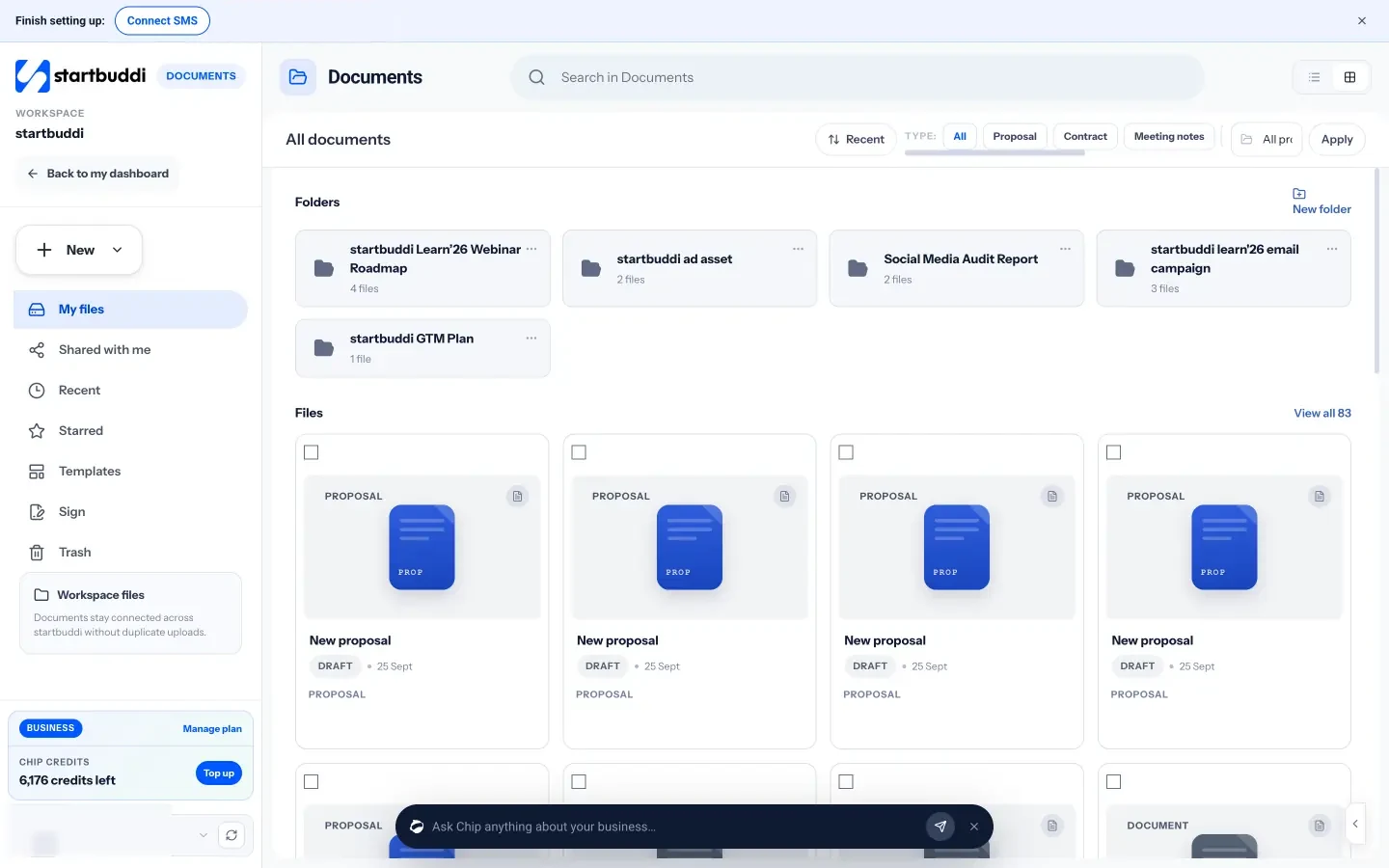
Write and share it in Documents
Start with our free business plan template, or open Documents and create a new startbuddi Doc. The editor has headings, tables and checklists, and you can ask Chip to help you tighten a section or list what is missing. Share a link with a partner or mentor so they can comment, and every time you save, a version is kept so you can look back at earlier drafts.
Turn targets into goals
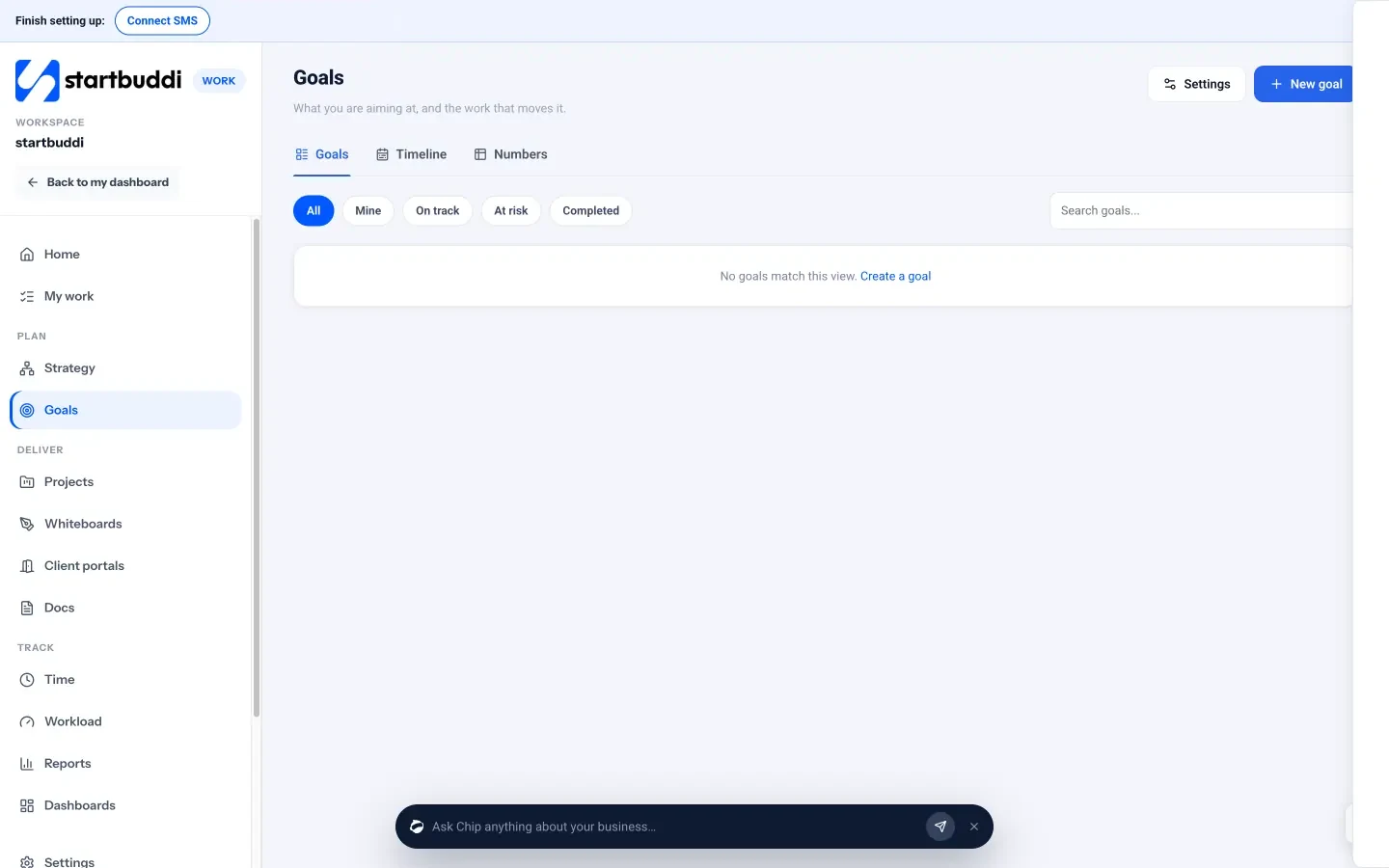
In Goals, add each 12-month target as a goal with an owner, a period and key results, such as “20 active customers” or “35% gross margin”. Link the projects and tasks that move each goal, and check in weekly on whether it is on track, at risk or off track. Chip can draft a check-in from what changed since the last one.
See how it all connects
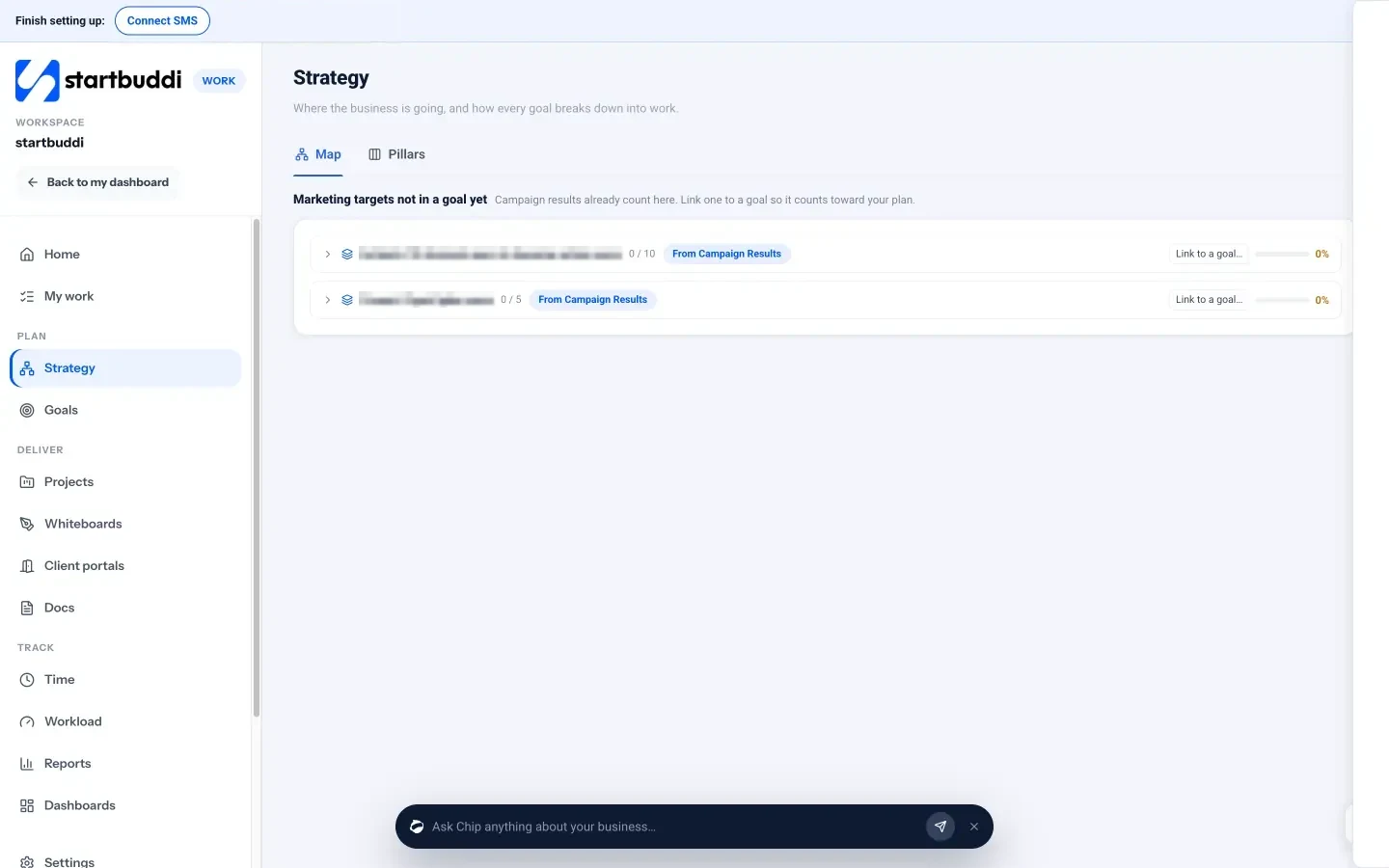
The Strategy map shows how each goal breaks down into initiatives, projects, milestones and tasks, grouped under the few big themes (pillars) your plan is built on. If you are new to goals and key results, our glossary entry on what OKRs are explains the idea in plain words.
Your next step
Block two hours this week, open a blank page and answer the nine questions above in as few words as you can. Don’t aim for perfect. Aim for finished. Then choose the three actions for the next 90 days and put them in your calendar. When you are ready to give your plan a home, you can set your first goals in startbuddi, or compare plans on the pricing page.
Sources
- Harvard Business Review: Research, writing a business plan makes your startup more likely to succeed (2017)
- US Small Business Administration: write your business plan
- Strategyzer: the Business Model Canvas
- LEANSTACK: Lean Canvas
Frequently asked questions
Is a one page business plan enough for a bank loan?
Usually not on its own. Lenders often want financial statements and more detail, but your one-pager makes a strong outline for the longer version.
How long does it take to write?
Most founders can draft one in two to three hours. Expect to revise it a few times in the first months.
How often should I update my plan?
Check your actions weekly, your numbers monthly and rewrite changed sections every quarter.
What is the difference between a business plan and a business model canvas?
A canvas maps how the business works. A one-page plan adds targets and the next steps you will take, so it also works as a to-do list.
Chinedu Kalu is the co-founder and chief operating officer of startbuddi, responsible for how the company runs day to day. Chinedu writes about the operational side of a small business: registering and running the company, money, hiring and the routines that keep a team on track.
Co-founded startbuddi and runs its operations